
In This Article
- The Big Idea: The Ground Is a Giant Battery
- How It Actually Works (Without the Engineering Jargon)
- Types of Ground Loop Systems
- Why Geothermal Is So Ridiculously Efficient
- How Long These Systems Actually Last
- The Cost Question (Let's Be Honest About It)
- Is Geothermal Right for Your Home?
- The Bottom Line
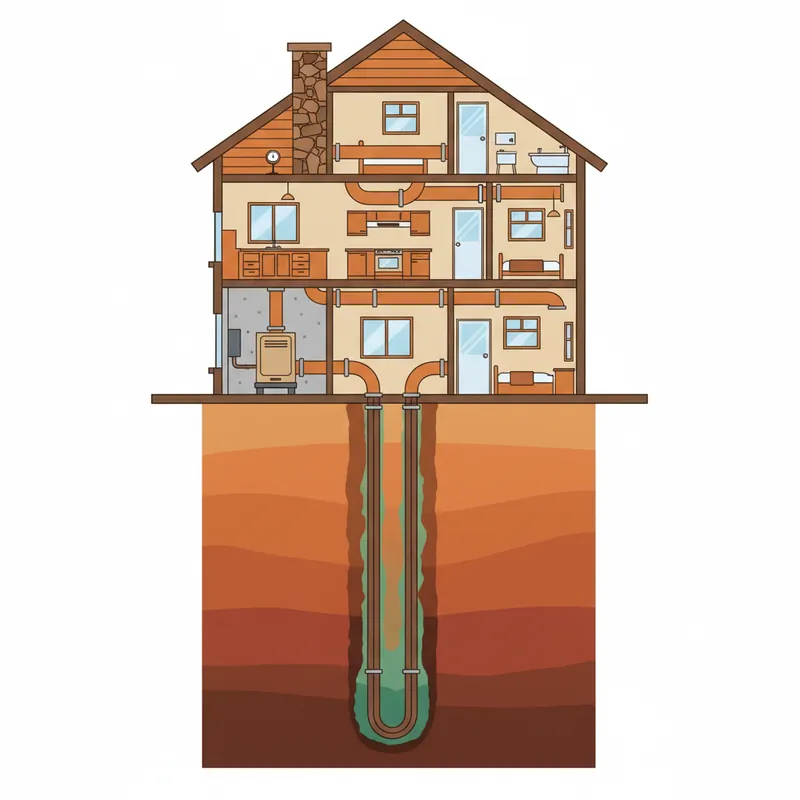
The short answer: a geothermal heat pump works by moving heat between your house and the ground instead of making heat by burning fuel. A loop of buried pipe carries water (or a water–antifreeze mix) that picks up warmth from the earth in winter and dumps your home's heat back into the earth in summer. A heat pump unit indoors uses a refrigerant cycle — the same one in your refrigerator, run in reverse — to concentrate that borrowed warmth and blow it through your ducts. The refrigerant never leaves the indoor unit; the buried loop just shuttles heat to and from the ground. Because it's moving heat rather than generating it, it delivers three to five units of heat for every unit of electricity it draws. The rest of this guide walks through each of those steps in plain English.
If you've spent any time looking into ways to cut your heating and cooling bills, you've probably stumbled across geothermal heat pumps. And if you're like most people, your first reaction was something along the lines of: "Wait, you can heat your house with the ground?"
Yep. And it's not some experimental thing, either. People have been doing this for decades. The core principle is simple: while outdoor air temperatures swing from -10°F to 100°F+ depending on the season, the ground just 6 feet below the surface stays remarkably stable — averaging 55.3°F across the U.S. (NOAA Climate Normals), ranging from about 35°F in Alaska to 72°F in Florida. The technology is mature, well-understood, and endorsed by both the U.S. Department of Energy and the EPA as one of the most efficient heating and cooling options out there.
But here's the problem with most explanations of geothermal: they either oversimplify it to the point of being useless, or they throw so much technical language at you that your eyes glaze over by paragraph three. So let's try something different. Let's actually explain how this works in a way that makes sense. (For the big-picture homeowner overview of how one system does both jobs, start with our guide to geothermal heating and cooling; if you're curious about the Earth's heat as an energy source more broadly, see what geothermal energy is.)
The Big Idea: The Ground Is a Giant Battery
Here's the thing most people don't realize about the ground beneath their feet: it doesn't care what the weather's doing.
Seriously. While the air temperature outside might swing from 95°F in July to -10°F in January, the ground about 30 feet down stays somewhere between 50°F and 59°F all year long. That's not our estimate — the U.S. Department of Energy puts the temperature at about 30 feet below the surface at between roughly 50°F (10°C) and 59°F (15°C) for most of the country. Shallower ground swings a bit more with the seasons, but the deeper you go the more constant it gets — and the point is the same: the earth holds a remarkably stable temperature.
Think of it like a massive thermal battery. In winter, the ground is warmer than the air. In summer, it's cooler. A geothermal heat pump just takes advantage of that difference.
Why Is The Ground Temperature So Stable?
The earth absorbs about 47% of the sun's energy that hits it. Below the frost line (usually 4-6 feet down in most of the U.S.), that solar energy accumulates and stabilizes. The deeper you go, the more consistent it gets. By 30 feet down, seasonal temperature swings basically disappear. It's this stored solar energy that geothermal systems tap into — not volcanic heat or anything like that.
How It Actually Works (Without the Engineering Jargon)
At its core, a geothermal heat pump does the same thing your refrigerator does. Your fridge pulls heat out of the inside (making it cold) and dumps that heat out the back. That's why the back of your fridge feels warm.
A geothermal heat pump works on the exact same principle — it just uses the ground instead of your kitchen air. The system has three main parts:
1. The Ground Loop
This is a network of pipes buried in your yard. Most systems use high-density polyethylene (HDPE) plastic pipe — tough stuff with a 50-year warranty — filled with water or a water-antifreeze mix. The fluid circulates through these pipes, picking up or shedding heat to the surrounding soil.
2. The Heat Pump Unit
This sits inside your house, usually in a basement or utility closet. It's about the same size as a traditional furnace. Inside it, there's a compressor and a heat exchanger that concentrate the low-grade heat from the ground into usable warmth — or, in summer, do the reverse.
3. The Distribution System
In most homes, this is just your existing ductwork. Heated or cooled air gets pushed through your ducts the same way it would with any HVAC system. If you've got ductwork already, you can usually keep it.
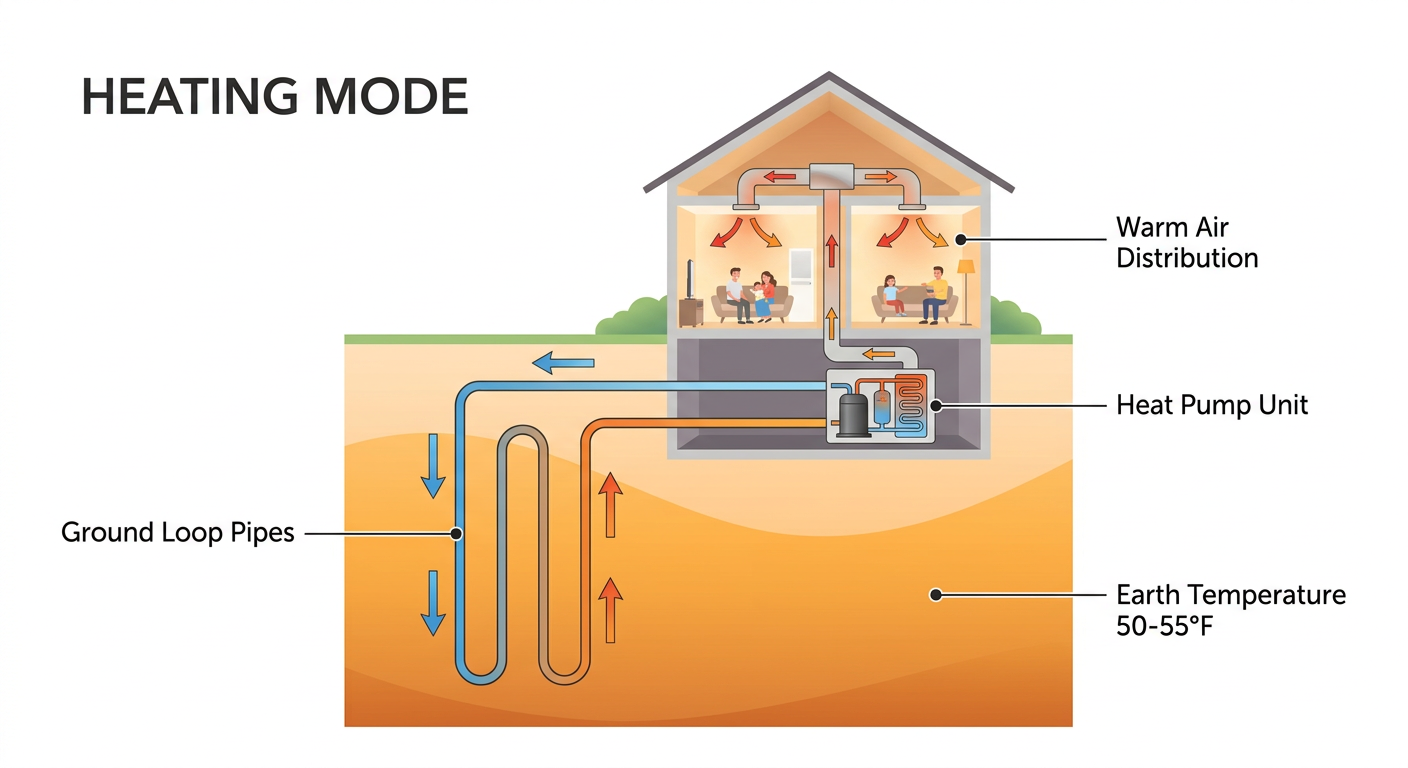
Heating Mode (Winter)
The fluid in the ground loop absorbs heat from the soil (remember, the ground is warmer than the air in winter). It carries that warmth to the heat pump. The heat pump concentrates it — think of it like a magnifying glass for heat — and delivers it to your home through the ductwork. The now-cooled fluid cycles back underground to pick up more heat.
Cooling Mode (Summer)
The process reverses. The heat pump pulls heat from your indoor air and transfers it to the fluid in the ground loop. The fluid carries that heat underground and dumps it into the cooler soil. Your house gets cooler, the ground absorbs the excess heat, and the cycle continues. For the full picture of how geothermal air conditioning works — including why it stays efficient on the hottest days — see our geothermal cooling guide.
Bonus: Free-ish Hot Water
Here's a nice perk most people don't know about. Many geothermal systems include something called a "desuperheater" — it captures excess heat during the cooling process and uses it to heat your domestic hot water. According to IGSHPA, this can save up to 50% on your water-heating bill. In summer, you're basically getting hot water for free as a byproduct of cooling your house.
Types of Ground Loop Systems
Not all ground loops are created equal. The type you need depends on your property — how much land you have, what the soil's like, and whether there's a body of water nearby. Here are the four main options:
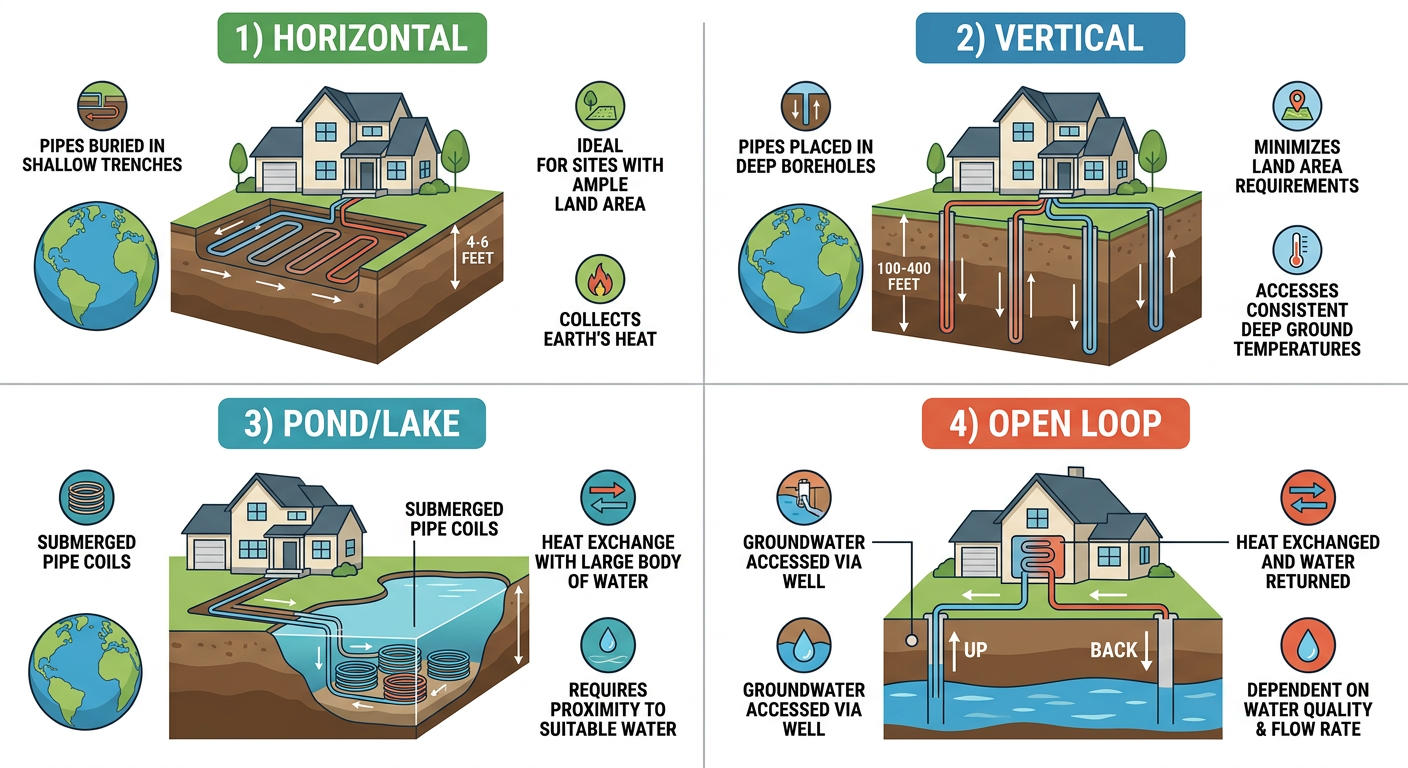
Horizontal Closed-Loop
This is the most common setup for residential installations. Pipes get buried in trenches about 4-6 feet deep. You typically need a decent amount of yard space — we're talking trenches that can run a couple hundred feet. It's the cheapest option to install, which is why most homeowners with enough land go this route. Works particularly well for new construction when the yard's already torn up.
Vertical Closed-Loop
When yard space is limited — say you're in a subdivision or your lot is just too small for horizontal trenches — vertical is the way to go. Installers drill holes about 4 inches in diameter, 100 to 400 feet deep, and spaced about 20 feet apart. Two pipes go down each hole and connect at the bottom with a U-bend. It costs more (drilling always does), but it uses way less land. This is also the standard approach for large commercial buildings and schools.
Pond/Lake Loop
Got a pond or lake on your property that's deep enough? You might be in luck. Instead of burying pipes in the ground, the loop gets coiled and submerged in the water at least 8 feet deep (to avoid freezing in cold climates). The water provides even better heat transfer than soil. It's the cheapest loop option to install when a suitable body of water is available, but obviously, not everyone has a pond out back.
Open-Loop
Instead of circulating the same fluid in a closed loop, an open-loop system pumps groundwater or lake water directly through the heat pump and then discharges it — either back into the ground through a reinjection well or into a surface drainage. These can be very efficient, but they depend on having clean, abundant groundwater and local regulations that allow discharge. Some areas restrict or don't permit open-loop systems at all, so check local rules first. For a deeper comparison, see our full guide: Open Loop vs. Closed Loop: Which Is Right for You?
Why Geothermal Is So Ridiculously Efficient
Here's where geothermal really pulls ahead of pretty much everything else.
A conventional furnace burns fuel to create heat. Even a high-efficiency gas furnace tops out around 95-98% efficiency — meaning for every dollar of gas you burn, you get 95-98 cents worth of heat. Not bad.
But a geothermal heat pump doesn't create heat at all. It moves heat that already exists in the ground. And here's the kicker: for every unit of electricity it uses to run, it delivers 3 to 5 units of heating energy. In engineering terms, that's a coefficient of performance (COP) of 3 to 5 — three to five times as much heat delivered as electricity consumed. You will see that written as "300–500% efficiency," which is a way of saying the same ratio; the figure is only coherent because the extra energy is heat drawn from the ground, not created by the machine. What that means on an actual utility bill — annual kWh, and what pushes it up or down — is covered in how much electricity a geothermal heat pump uses.
"Ground source heat pumps offer 50 to 70% savings versus other heating systems and 30 to 40% savings in cooling compared to air conditioners and air-source heat pumps."
— International Ground Source Heat Pump Association (IGSHPA)
Compare that to an air-source heat pump, which pulls heat from the outside air. Those work great in mild weather, but when it's 15°F outside, there's not a lot of heat to extract from the air. Efficiency drops off a cliff. Geothermal doesn't have that problem because the ground temperature doesn't change much regardless of what's happening above the surface.
The DOE puts overall energy consumption reduction at 25-50% compared to conventional systems. IGSHPA's numbers are even more optimistic at 20-50%. Either way, we're talking about cutting your heating and cooling energy use roughly in half.
How Long These Systems Actually Last
This is one of geothermal's strongest selling points, and it's not talked about enough.
The Department of Energy notes that geothermal systems last longer and need less maintenance than conventional equipment. The indoor heat pump components typically run about 20–24 years — already comparable to a high-end furnace or air conditioner. But the ground loop — those pipes buried in your yard? Fifty years or more. IGSHPA notes that most ground loop pipe carries a 50-year warranty.
Think about that for a second. A traditional air conditioner lasts maybe 15-20 years. A furnace, 15-25 years. With geothermal, the most expensive part of the system (the ground loop) lasts half a century. When the indoor unit eventually wears out, you just replace that — the ground loop keeps going. Your second heat pump unit will cost a fraction of the original installation.
The Cost Question (Let's Be Honest About It)
Alright, let's not dance around it. Geothermal heat pumps are expensive upfront. The DOE describes the installation cost as "several times that of an air-source system of the same heating and cooling capacity." For a typical residential installation, you're looking at somewhere in the range of $15,000 to $35,000, sometimes more depending on your property and the type of loop system needed.
That's a lot of money. No getting around it.
But here's what the math actually looks like when you factor in the full picture:
- Federal tax credit — expired: The 30% federal credit under IRC §25D applied to systems placed in service through December 31, 2025. It is not available for property placed in service after that date (One Big Beautiful Bill Act, P.L. 119-21). On a $25,000 installation that credit was worth $7,500; as of 2026 you pay the full $25,000.
- State and utility incentives: State and utility incentives are unaffected by the federal repeal and now carry more of the load. Many states offer their own rebates and credits, and some utility companies do too. These vary by state and change often — see our state guides and verify current amounts with your state energy office or utility.
- Energy savings: If you're saving $1,500-$2,500 per year on heating and cooling (which is in the typical range), a $15,000-$35,000 system pays for itself in roughly 6 to 23 years depending on where your cost and savings actually land. The widely cited 5-10 year payback assumed the 30% federal credit that has now expired.
- Lifespan advantage: Over the life of the system, you'll replace a traditional HVAC setup 2-3 times while the geothermal ground loop is still going strong.
IGSHPA puts it bluntly: "Positive cash flow; energy savings usually exceed the cost of the system." That doesn't mean it's cheap. It means you're making an investment that pays you back — and then some.
Is Geothermal Right for Your Home?
Geothermal is a great fit for a lot of homes, but it's not for everyone. Here's a quick gut-check:
Geothermal probably makes sense if:
- You're building a new home (easiest and cheapest time to install)
- You have enough yard space for horizontal loops, or you're willing to drill vertical
- You're replacing an aging furnace or AC and want a long-term solution
- You live in an area with significant heating AND cooling needs (the system does both)
- Energy costs in your area are high — the savings math gets better fast
- You plan to stay in the home long enough to recoup the investment (6-23 years, per the payback range above)
It might not be the best fit if:
- You're in a very mild climate where heating/cooling costs are already low
- Your property has significant site constraints (solid rock close to the surface, very small lot with no drilling access)
- You're planning to move in the next few years
- Your budget can't handle the upfront cost even with incentives
A qualified geothermal installer can evaluate your specific site — soil conditions, lot size, existing ductwork, local regulations — and give you a realistic estimate. The International Ground Source Heat Pump Association maintains a directory of accredited installers.
The Bottom Line
Geothermal heat pumps aren't magic, and they're not free. But they are arguably the most efficient way to heat and cool a building that exists today. The technology is proven, the components are durable (we're talking 50+ years for the ground loop), and the operating costs are dramatically lower than conventional HVAC.
The catch is the upfront cost, and that catch got bigger. The 30% federal §25D credit ended for systems placed in service after December 31, 2025, so the whole installed price is now yours to fund. What's left is potential state and utility incentives plus the energy savings themselves — which still work out for a lot of homeowners, especially if you're already facing a major HVAC replacement, but the payback is longer than it was and you should run the numbers on the full price.
The ground beneath your house is sitting at a comfortable 50-something degrees right now, winter or summer, just waiting to be tapped. That's not going to change. The only question is whether you want to take advantage of it.
Key Takeaway
Geothermal heat pumps use the earth's constant underground temperature (50–60°F) to heat and cool your home at a COP of 3 to 5 — three to five units of heat delivered per unit of electricity drawn. The heat pump unit lasts 25+ years and the ground loop lasts 50+. The 30% federal §25D credit that used to shorten payback expired for systems placed in service after December 31, 2025, so budget the full installed cost and check state and utility programs.
Sources
- U.S. Department of Energy, Geothermal Technologies Office — "Geothermal Heat Pumps"
- U.S. Department of Energy, Office of Geothermal — "Geothermal Heat Pumps"
- International Ground Source Heat Pump Association — "About Geothermal"
- U.S. Department of Energy, Office of Geothermal — "Grid Impacts from Mass Deployment of Geothermal Heat Pumps" (2024)