
In This Guide
- Why Louisiana's Cooling Climate Changes the Equation
- Quick Verdict: Should You Go Geothermal?
- The Ground-Source Cooling Advantage
- Climate & Geology: Water Is Everything
- Geology & Drilling Conditions by Region
- Regional Costs & ROI
- Case Study: Natchitoches Parish Propane Home
- Case Study: Livingston Parish New Construction
- Case Study: Beauregard Parish Cattle Farm + REAP
- Month-by-Month Energy Profile
- Open-Loop System Assessment by Region
- Loop Type Cost Comparison
- Incentive Stacking: Federal ITC & USDA REAP
- Hurricane Resilience: The Underground Insurance Policy
- The Dehumidification Advantage
- Solar + Geothermal Stacking
- The Honest Gas Assessment
- Permits & Licensing Requirements
- Finding & Vetting a Qualified Installer
- Maintenance & System Longevity
- Vacation Rental & Seasonal Property Economics
- How to Claim the Federal Tax Credit
- Louisiana vs. Neighboring States
- Frequently Asked Questions
- Bottom Line
- Sources
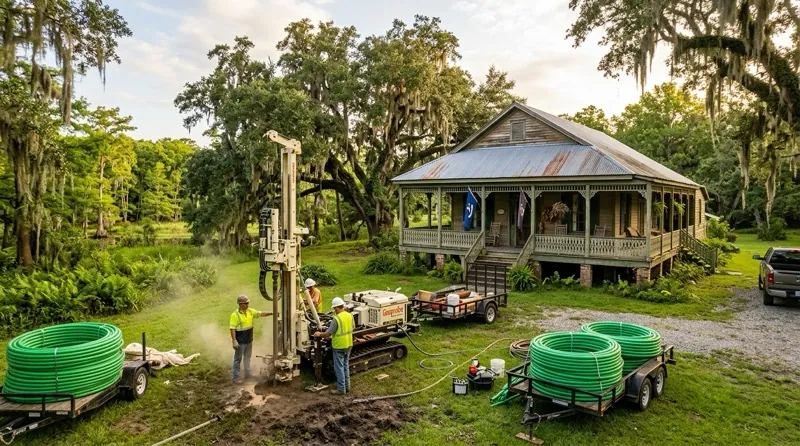
Why Louisiana's Cooling Climate Changes the Equation
Louisiana has the cheapest electricity in America. At 8.80¢/kWh — dead last, rank 50 — your power bill is already lower than almost anywhere else you could live. So why would you spend $20,000+ on a geothermal heat pump?
Because cheap electricity isn't the whole story. Louisiana's climate is brutally cooling-dominant. New Orleans averages 2,700 cooling degree days — more than Phoenix. Baton Rouge, Shreveport, Lake Charles — they all run AC eight to nine months a year. When your air conditioner is working that hard, the efficiency difference between a conventional 16 SEER unit rejecting heat into 95°F, 90% humidity outdoor air and a geothermal system dumping heat into 67°F ground is enormous.
Three things make Louisiana's geothermal market distinctive:
- The ground temperature advantage. Louisiana's soil sits at 64–68°F year-round at 50 feet depth — the warmest of any southern state. That's a 28–30°F advantage over outdoor air when cooling in July. Conventional AC fighting 95°F air runs at significantly reduced efficiency. Geothermal doesn't.
- Hurricane resilience. Louisiana averages a hurricane or tropical storm landfall every 2.8 years. Every outdoor AC condenser is one Cat 3 storm away from a $6,000–$12,000 insurance claim. Your geothermal ground loop, buried underground? Doesn't care about hurricanes. At all.
- 27,000 farms and 2.5 million agricultural acres. Sugar cane in the delta, rice in Cajun country, cattle and timber in north Louisiana. USDA REAP grants cover up to 50% of a geothermal system for these properties. Stack with the 30% ITC and you're looking at 47–75% cost reduction for qualifying agricultural producers.
Quick Verdict: Should You Go Geothermal in Louisiana?
| Your Situation | Verdict | Estimated Payback |
|---|---|---|
| Rural propane home | 🟢 Strong yes | 7–11 years |
| Electric resistance heating | 🟢 Yes | 6–9 years |
| All-electric home (high AC bills) | 🟢 Good for cooling savings | 8–13 years |
| New construction | 🟢 Best opportunity | 5–8 years (incremental) |
| Farm/ranch (USDA REAP eligible) | 🟢 Excellent | 4–7 years |
| Coastal property (hurricane zone) | 🟢 Resilience + savings | 7–12 years |
| Aging AC replacement | 🟢 Good upgrade path | 6–10 years |
| Natural gas (metro areas) | 🔴 Probably not | 30–60+ years |
The honest assessment: Louisiana is one of the hardest states to make a financial case for geothermal when you're replacing natural gas. The state sits atop the Haynesville Shale. LNG export terminals line the coast. Gas is cheap, electricity is cheap, and the gap is tiny. But for propane homes in rural parishes, for new construction, and for anyone tired of replacing storm-damaged AC equipment — geothermal earns its keep.
The Ground-Source Cooling Advantage
Most geothermal content focuses on heating efficiency. In Louisiana, cooling efficiency is where the story lives. Here's the physics:
A conventional air conditioner's efficiency degrades dramatically in heat and humidity. A unit rated 16 SEER at 95°F outdoor air in moderate humidity might deliver effective performance of 11–12 SEER in real Louisiana summer conditions — 95°F air at 85% relative humidity with outdoor condensing pressures in the 400+ PSI range. The equipment is fighting the environment to do its job.
Geothermal changes the exchange medium. The refrigerant cycle rejects heat not into 95°F air but into a closed water loop circulating through ground maintained at 67°F year-round. That's a 28°F advantage — and heat transfer efficiency scales with temperature differential. The result: a geothermal system's effective cooling performance (EER 20–24) consistently exceeds what conventional AC achieves on real Louisiana summer days.
Over an 8–9 month cooling season, this efficiency gap accumulates. The annual electricity savings from cooling alone — not even counting heating — can justify a significant share of the system's payback.
Climate & Geology: Water Is Everything
Louisiana's geology is dominated by one fact: water. The Mississippi River, its floodplain, and the Gulf of Mexico have deposited thousands of feet of unconsolidated sediment across most of the state. This creates both opportunities and challenges for geothermal.
Southern Louisiana (South of I-10)
Holocene and Pleistocene alluvial deposits — soft clay, silt, sand, and organic muck, hundreds of feet deep. The water table is 2–8 feet below surface. This eliminates horizontal loops for most properties. Vertical closed-loop is the standard. The silver lining: drilling through unconsolidated sediment is fast (no rock), and wet, clay-rich soil has excellent thermal conductivity (1.2–1.6 BTU/hr·ft·°F). You drill faster and get better loop performance than most of the country. Ground temperatures: 66–68°F.
Acadiana / Cajun Prairie (Lafayette to Lake Charles)
Pleistocene prairie terrace deposits. Slightly higher and drier than the delta, but the water table is still shallow (6–15 feet). Vertical loops are preferred. The Chicot Aquifer underlies much of this region — a major drinking water source that restricts open-loop options. Ground temperatures: 65–67°F.
Central Louisiana (Alexandria/Natchitoches)
Transition zone. Red River valley has alluvial deposits; upland areas (Kisatchie terrain) have deeper water tables (15–25 ft) and more varied soil. Horizontal loops are feasible on elevated properties. Tertiary-age sandstone and clay formations make up the uplands. Ground temperatures: 63–65°F.
North Louisiana (Shreveport/Monroe/Ruston)
Upland Tertiary formations. Higher elevation, deeper water tables (20–40+ ft), firmer soil. The most horizontal-loop-friendly region of Louisiana. The Haynesville Shale sits thousands of feet below — no impact on shallow geothermal installation. Ground temperatures: 62–64°F.
| City | Ground Temp (50 ft) | Heating Degree Days | Cooling Degree Days |
|---|---|---|---|
| New Orleans | 68°F | 1,400 | 2,700 |
| Baton Rouge | 67°F | 1,600 | 2,600 |
| Lafayette | 67°F | 1,400 | 2,700 |
| Lake Charles | 67°F | 1,700 | 2,500 |
| Alexandria | 65°F | 1,800 | 2,400 |
| Shreveport | 64°F | 2,200 | 2,400 |
| Monroe | 63°F | 2,400 | 2,200 |
Geology & Drilling Conditions by Region
Louisiana's drilling conditions are uniquely favorable in many ways — unconsolidated sediment means fast drilling and low per-foot costs. But the shallow water table in the south creates significant design constraints. Here's what your installer will encounter by region:
| Region | Dominant Geology | Thermal Conductivity (BTU/hr·ft·°F) | Typical Bore/Trench Depth | Drilling Cost/ft | Key Challenges |
|---|---|---|---|---|---|
| New Orleans / Southeast (Mississipi Delta, below I-10) | Holocene alluvial clay, silt, organic muck (Mississippi River deposits, 0–500+ ft deep) | 1.2–1.6 (excellent — saturated clay) | Vertical only: 150–200 ft; Water table: 2–6 ft | $9–$13/ft (fast unconsolidated drilling) | No horizontal loops. Subsidence 0.5–2 in/yr — use flexible loop-to-building connections. Saltwater intrusion risk near coast — use HDPE pipe, not metal fittings. Urban lot constraints. |
| Baton Rouge Metro (EBR/WBR Parishes) | Mixed: Southern Hills Aquifer upland (Pleistocene terrace gravels/sands) and valley alluvium | 1.0–1.4 (upland) / 1.2–1.5 (valley) | Vertical: 150–200 ft; Horizontal on upland: 6–7 ft | Vertical: $10–$14/ft; Horizontal: $2.50–$4/ft | Horizontal loops feasible in elevated EBR upland areas. Valley floors (near Mississippi) revert to high-WT vertical. City permit required. Southern Hills Aquifer limits open-loop in most of parish. |
| Acadiana / Cajun Prairie (Lafayette, Lake Charles, Opelousas) | Pleistocene Prairie Terrace (clay/sand/gravel) over Chicot Aquifer | 1.0–1.3 | Vertical: 150–200 ft; Water table: 6–15 ft | $10–$14/ft | Water table variable — must probe before designing horizontal. Chicot Aquifer is primary drinking water source — open-loop generally not advisable. Lake Charles industrial areas: soil contamination check warranted. |
| Coastal Plain (Houma, Morgan City, Terrebonne, Lafourche) | Holocene marsh/swamp deposits — highest organic content in state | 1.3–1.7 (very high — organic saturated peat/clay) | Vertical only: 150–200 ft; Water table: 1–4 ft | $9–$12/ft | Highest thermal conductivity in the state. Shallowest water table — some sites may have artesian pressure. Saltwater interface nearby — specify marine-grade connections. Land subsidence acute: 1–2 in/yr in some areas. |
| Florida Parishes / North Shore (St. Tammany, Livingston, Washington) | Pleistocene upland sands/clays (higher elevation), Pontchartrain Basin alluvium in valleys | 0.9–1.3 | Vertical: 150–200 ft; Horizontal possible on elevated sites: 6–8 ft | $10–$14/ft; Horizontal: $2.50–$4/ft | Best geology near New Orleans for horizontal loops. St. Tammany uplands (Madisonville, Covington) have adequate depth. Growing suburban market. Water table: 8–20 ft on high ground. |
| Central LA / Kisatchie Uplands (Natchitoches, Alexandria, Leesville) | Tertiary Catahoula/Coushatta sands and clays — upland formation, firmer than delta | 0.9–1.2 (lower conductivity — drier soil in uplands) | Vertical: 175–225 ft; Horizontal: 6–7 ft (where WT allows) | Vertical: $11–$15/ft; Horizontal: $3–$5/ft | Deeper water tables (15–25 ft on uplands). Horizontal loops viable in piney hill areas. Softer tertiary sands drill well. Best territory for rural horizontal installs outside of North LA. |
| NW Louisiana / Piney Hills (Shreveport, Bossier City, Minden) | Wilcox Group sands and Tertiary clays; Haynesville Shale at depth (3,000+ ft — irrelevant for geo) | 0.9–1.2 | Vertical: 175–225 ft; Horizontal: 6–7 ft | Vertical: $11–$15/ft; Horizontal: $2.50–$4/ft | Deepest water tables in state (20–40+ ft). Best horizontal loop territory in Louisiana. Most installer options (oil/gas drilling infrastructure benefits). Haynesville gas keeps conventional fuel cheap — honest payback for gas homes is long. |
| NE Louisiana / Macon Ridge / Delta (Monroe, Ruston, Bastrop) | Mississippi Embayment alluvium and loess bluffs (Macon Ridge); deep alluvial deposits in lowlands | 1.0–1.4 | Vertical: 150–200 ft; Horizontal on Macon Ridge: 6–7 ft | $10–$14/ft; Horizontal: $2.50–$4/ft | Macon Ridge loess bluffs have good horizontal conditions. Delta lowlands are high-WT vertical territory. Sparta Aquifer in this region has conservation orders — open-loop restricted. |
Key Pre-Drill Resource: USGS Groundwater Data
Before designing your loop system, check water table depth for your specific location using the USGS groundwater data portal at waterdata.usgs.gov. Louisiana USGS has extensive monitoring well data across parishes. This is especially critical in the gray zones — properties that might be high enough for horizontal but near low-lying areas. Your installer should pull this data or commission a soil probe before finalizing loop design. A $500 soil probe can save $6,000–$10,000 in unnecessary vertical loop costs if your property is suitable for horizontal.
The Louisiana Office of Conservation (part of DNR) also maintains well records at dnr.louisiana.gov. Search by parish to understand drilling conditions in your area — neighboring water well logs reveal formation depths and groundwater levels your installer needs to plan effectively.
Regional Costs & ROI
| Region | Avg. System Cost (3–4 ton) | Best Loop Type | Typical Annual Savings | Payback (Before Incentives) | Payback (After 30% ITC) |
|---|---|---|---|---|---|
| New Orleans Metro (ENTERGY) | $24,000–$46,000 | Vertical (mandatory) | $800–$1,400 (vs. high AC bills); $1,800–$2,400 (vs. propane) | 12–30 yr (AC); 8–13 yr (propane) | 8–21 yr (AC); 6–9 yr (propane) |
| Baton Rouge Metro (ENTERGY) | $22,000–$42,000 | Vertical or horizontal (upland) | $900–$1,500 (vs. AC bills); $1,600–$2,200 (vs. propane) | 11–27 yr (AC); 8–13 yr (propane) | 8–19 yr (AC); 6–9 yr (propane) |
| Acadiana (Lafayette/Lake Charles, ENTERGY/CLECO) | $20,000–$38,000 | Vertical | $800–$1,300 (vs. AC); $1,500–$2,100 (vs. propane) | 11–27 yr (AC); 7–13 yr (propane) | 8–19 yr (AC); 5–9 yr (propane) |
| North Shore / Florida Parishes (ENTERGY) | $19,000–$36,000 | Horizontal (elevated) or vertical | $900–$1,400 (vs. AC); $1,500–$2,000 (vs. propane) | 10–24 yr (AC); 7–12 yr (propane) | 7–17 yr (AC); 5–8 yr (propane) |
| Central LA / Kisatchie (CLECO/co-ops) | $19,000–$35,000 | Horizontal or vertical | $1,500–$2,200 (vs. propane) | 7–13 yr (propane) | 5–9 yr (propane) |
| NW Louisiana / Shreveport (SWEPCO) | $18,000–$34,000 | Horizontal (best opportunity) | $1,400–$2,100 (vs. propane) | 7–13 yr (propane) | 5–9 yr (propane) |
| NE Louisiana (ENTERGY/co-ops) | $18,000–$34,000 | Horizontal or vertical | $1,400–$2,000 (vs. propane) | 7–14 yr (propane) | 5–10 yr (propane) |
Case Study: Natchitoches Parish Propane Home
The Setup
A 2,200 sq ft ranch on 2 acres in rural Natchitoches Parish. Built 1988. Heating with a 500-gallon propane tank, aging 10 SEER central AC that runs March through November.
Old System Costs
- Annual propane: 650 gallons × $2.90/gallon = $1,885/year (mild winters)
- Annual cooling: $1,280/year (10 SEER AC, 8–9 months)
- Total HVAC: $3,165/year
The Geothermal System
- Equipment: 3.5-ton WaterFurnace 7 Series, desuperheater for hot water
- Loop: Horizontal slinky — piney hill soil with adequate depth (2-acre rural lot, WT at 18 ft)
- Installed cost: $25,000
- Federal ITC (30%): −$7,500
- Net cost: $17,500
The Math
- Annual geothermal electricity: ~$1,040/year (8.80¢/kWh, COP 3.5 heating / EER 22 cooling)
- Desuperheater savings: $250/year
- Annual savings: $3,165 − $1,040 + $250 = $2,375/year
- Simple payback (after ITC): $17,500 ÷ $2,375 = 7.4 years
- At $3.30/gallon propane: payback drops to 6.8 years
- 20-year net savings: ($2,375 × 20) − $17,500 = $30,000
Verdict: Strong propane conversion case. The 2-acre piney hill lot provided the water table depth needed for horizontal loops — $7,000–$10,000 cheaper than vertical. The cooling savings alone (replacing a worn 10 SEER unit with EER-22 geothermal in an 8-month cooling climate) nearly justify the system on their own. The desuperheater pays for roughly $250/year in water heating essentially for free.
Case Study: Livingston Parish New Construction
The Setup
A 2,600 sq ft home in a new Denham Springs subdivision east of Baton Rouge. Builder spec'd 15 SEER heat pump (all-electric — no gas line to subdivision). Water table at 8 ft — horizontal loops out.
Conventional HVAC Quote
- All-electric heat pump + air handler + ductwork: $13,500 installed
- Estimated annual operating cost: $2,450/year (cooling-dominant — AC runs 9 months)
The Geothermal System
- Equipment: 4-ton ClimateMaster Tranquility 30, two-stage + desuperheater
- Loop: Vertical — 3 bores × 200 ft (water table at 8 ft eliminates horizontal)
- Installed cost: $32,000
- Incremental over conventional: $32,000 − $13,500 = $18,500
- Federal ITC (30% of $32,000): −$9,600
- Net incremental cost: $18,500 − $9,600 = $8,900
The Math
- Annual geothermal electricity: ~$1,280/year
- Annual savings vs. conventional: $2,450 − $1,280 = $1,170/year
- Desuperheater adds $200–$350/year in water heating savings
- Incremental payback (with desuperheater): $8,900 ÷ $1,445 = 6.2 years
- 20-year net savings on incremental: ($1,445 × 20) − $8,900 = $20,000
Verdict: All-electric new construction is Louisiana's sweet spot for geothermal. The incremental investment after ITC is under $9,000. Skip the gas line connection (saves $2,500–$4,000 in some subdivisions) and payback compresses to 4–5 years. The builder noted geothermal homes in the subdivision commanded $15,000–$25,000 higher appraisals — essentially paying back the system in resale value.
Case Study: Beauregard Parish Cattle Farm + REAP
The Setup
A 2,000 sq ft farmhouse on a 320-acre beef cattle operation outside DeRidder in Beauregard Parish, west-central Louisiana. The property is 12 miles from the nearest natural gas line — 100% propane. Heating and cooling run year-round, with August–September the brutal months ($220–$240/month electric just for the old window units that supplement the failing central unit). No CLECO incentive programs identified. The operator qualifies for USDA REAP — more than 50% of gross income from cattle sales.
Old System Costs
- Annual propane (heating + some DHW): 720 gallons × $3.10/gallon = $2,232/year
- Annual cooling (aging 12 SEER + supplemental window units): $1,560/year
- Total HVAC: $3,792/year
The Geothermal System
- Equipment: 3.5-ton WaterFurnace 5 Series, two-stage + desuperheater
- Loop: Horizontal slinky — Beauregard Parish upland (Catahoula sands, WT at 22 ft). 320 acres = no lot constraints.
- Installed cost: $24,000
REAP + ITC Stack
| Line Item | Amount |
|---|---|
| Total geothermal system cost | $24,000 |
| USDA REAP grant (25% competitive round) | −$6,000 |
| Remaining eligible for ITC | $18,000 |
| Federal ITC (30%) | −$5,400 |
| CLECO efficiency rebate (estimated) | −$600 |
| Net out-of-pocket | $12,000 |
| Annual savings (vs. propane + old cooling) | $2,742 |
| Simple payback | 4.4 years |
The Math
- Annual geothermal electricity: ~$1,050/year (8.80¢/kWh at COP 3.5/EER 22)
- Desuperheater savings: ~$240/year
- Annual savings: $3,792 − $1,050 + $240 = $2,982/year
- At 40% REAP (strong application): net drops to $8,400 → payback 2.8 years
- 20-year net savings (25% REAP): ($2,982 × 20) − $12,000 = $47,640
Verdict: Classic rural Louisiana cattle operation. The Beauregard Parish upland geology gave the family horizontal loop access — saving roughly $8,000 versus the vertical bores that would be required on lower-lying ground. The REAP grant rewarded an established agricultural operation. They eliminated propane delivery to a rural property 12 miles from the nearest gas line (delivery surcharges on remote propane: $0.25–$0.50/gallon over base price). Year-round comfort improved dramatically — the old system couldn't keep up with August humidity. And with beef cattle prices strong in 2026, the tax credit came in handy in a higher-income year.
REAP application tip: the Beauregard Parish operation used the LSU AgCenter for technical assistance with the energy audit component of the REAP application — available free of charge through the Louisiana Cooperative Extension Service. The USDA Louisiana State Office in Alexandria processed the application. Timeline: 6 months from submission to award. Start before you break ground.
Month-by-Month Energy Profile
This profile models the Natchitoches Parish propane farmhouse (2,200 sq ft, 3.5-ton) after geothermal conversion.
| Month | Old Propane Cost | Old Electric (AC) | Geo Electric Cost | Monthly Savings |
|---|---|---|---|---|
| January | $380 | $0 | $85 | $295 |
| February | $290 | $0 | $70 | $220 |
| March | $120 | $60 | $55 | $125 |
| April | $0 | $110 | $70 | $40 |
| May | $0 | $160 | $100 | $60 |
| June | $0 | $200 | $130 | $70 |
| July | $0 | $220 | $140 | $80 |
| August | $0 | $215 | $135 | $80 |
| September | $0 | $175 | $110 | $65 |
| October | $0 | $100 | $65 | $35 |
| November | $175 | $40 | $50 | $165 |
| December | $340 | $0 | $75 | $265 |
| Annual Total | $1,305 | $1,280 | $985 | $1,600 |
Propane at $2.90/gallon. Electric at 8.80¢/kWh (EIA 2024). Louisiana's cooling season runs March–November in most of the state. Desuperheater hot water savings not included in table. Savings are meaningful even in moderate months — geothermal's EER 22 cooling vs. 10 SEER conventional produces significant AC cost reduction.
Open-Loop System Assessment by Region
| Region | Open-Loop Viability | Water Temp | Key Considerations |
|---|---|---|---|
| New Orleans / Southeast LA | 🔴 Not recommended | 68°F | Subsidence risk; saltwater intrusion near coast; contaminated groundwater in industrial areas; municipal well restrictions. |
| Baton Rouge Metro | 🔴 Not recommended | 67°F | Southern Hills Aquifer is primary drinking water source; DOTD/DNR restrictions on new wells; city water supply protection. |
| Acadiana (Lafayette/Lake Charles) | 🔴 Not recommended | 67°F | Chicot Aquifer — primary regional water supply; DOTD wellhead protection zones across most of the region. |
| Coastal Plain (Houma/Terrebonne) | 🔴 Not recommended | 68°F | Saltwater interface. Freshwater lens thin. Subsidence acute. Not suitable for any groundwater withdrawal. |
| North Shore (St. Tammany/Livingston) | 🟡 Site-specific | 65°F | Some upland areas have viable shallow aquifers. LA DNR registration required. Water quality testing essential. |
| Central LA (Alexandria/Natchitoches) | 🟡 Possible, complex | 64°F | Tertiary aquifers may support in upland areas. LA DOTD water well registration required; water quality variable. |
| NW Louisiana (Shreveport) | 🟡 Site-specific | 63°F | Red River alluvium may support in some areas. Oil/gas drilling activity nearby — water quality testing important. DOTD registration required. |
| NE Louisiana (Monroe) | 🔴 Restricted | 63°F | Sparta Aquifer has conservation orders in place due to over-withdrawal. New non-agricultural wells likely restricted. |
Bottom line: Louisiana is overwhelmingly a closed-loop state. The combination of shallow water tables, critical drinking water aquifers, industrial contamination in some areas, Sparta Aquifer conservation orders in the northeast, and saltwater intrusion along the coast makes open-loop systems inadvisable for most of the state. Any open-loop consideration requires LA DNR/DOTD registration, water quality testing, and careful NRD consultation — and most parishes will say no.
Loop Type Cost Comparison
| Loop Type | Typical Cost (3-ton) | Best For | Louisiana Notes |
|---|---|---|---|
| Vertical closed-loop | $20,000–$32,000 | Most of southern Louisiana | Default for below I-10. Fast drilling in unconsolidated sediment — cost is lower than vertical loops in rocky states. |
| Horizontal slinky | $12,000–$18,000 | North Louisiana uplands (WT > 10 ft) | Kisatchie area, piney hills, Shreveport/Monroe region. Needs site assessment first. |
| Horizontal straight | $14,000–$20,000 | Large rural properties in north LA | Farms with deep water tables and acreage. Less common but feasible in the right areas. |
| Pond/lake loop | $8,000–$14,000 | Properties with qualifying ponds | Farm ponds in north/central LA. Must be ½ acre minimum, 8+ feet deep. Crawfish ponds (12–18 inches) do NOT qualify. |
| Open-loop | Not advisable | Very limited | See open-loop assessment above. DNR registration + aquifer protection concerns statewide. |
Crawfish pond clarification: Louisiana has an estimated 175,000 acres of crawfish ponds, and the question comes up constantly — can you use one as a heat exchange pond? No. Commercial crawfish ponds are 12–18 inches deep — far too shallow for heat exchange (ponds need minimum 8 feet depth and ½ acre surface area). If you have a deeper recreational or stock pond on the property, that's a different story.
Incentive Stacking: Federal ITC & USDA REAP
Federal Investment Tax Credit (ITC) — 30%
The federal residential clean energy credit under IRC Section 25D provides 30% back on total installed cost — equipment, loops, drilling, ductwork, desuperheater, all labor. No cap. Through 2032. Carries forward to future tax years if unused.
USDA REAP — Critical for Louisiana Agriculture
Louisiana has approximately 27,000 farms covering 8.1 million acres — sugar cane in the delta, rice and crawfish in Acadiana, cattle and timber in north Louisiana, soybean operations statewide. REAP grants cover up to 50%; loan guarantees up to 75%.
Best-Case REAP + ITC Stack
| Line Item | Amount |
|---|---|
| 3.5-ton horizontal system (installed) | $24,000 |
| USDA REAP grant (25%) | −$6,000 |
| Federal ITC (30% of remaining) | −$5,400 |
| Utility rebate (estimated) | −$600 |
| Net cost | $12,000 |
| Annual savings (vs. propane) | $2,742 |
| Payback | 4.4 years |
At 50% REAP (competitive round, strong application): net drops to $6,000 → payback 2.2 years.
Louisiana Utility Incentive Programs
| Utility | Service Territory | Geothermal Incentive | Status |
|---|---|---|---|
| Entergy Louisiana | New Orleans, Baton Rouge, Acadiana, north LA | Efficiency programs — no dedicated GSHP rebate identified | [NEEDS VERIFICATION] — contact (800) 368-3749 |
| Entergy New Orleans | Orleans Parish | Energy efficiency programs | [NEEDS VERIFICATION] — contact (800) 368-3749 |
| SWEPCO | Shreveport/Bossier City area | Varies — has offered HVAC efficiency rebates | [NEEDS VERIFICATION] — contact (888) 216-3523 |
| CLECO | Central Louisiana | Has offered HVAC efficiency rebates ($200–$500/ton) | [NEEDS VERIFICATION] — contact (800) 622-6537 |
| Louisiana electric cooperatives (11) | Rural parishes statewide | Varies by co-op | [NEEDS VERIFICATION] — contact your specific co-op |
Note: Louisiana lacks the investor-owned utility rate structures that drive aggressive rebate programs in states like Michigan or Colorado. Rebates are modest when they exist. The federal ITC and USDA REAP carry much more financial weight here.
Hurricane Resilience: The Underground Insurance Policy
Louisiana averages a hurricane or tropical storm landfall every 2.8 years. Since 2005 alone: Katrina, Rita, Gustav, Isaac, Barry, Laura, Delta, Zeta, Ida. Every one of them destroyed thousands of outdoor AC condensers.
What a hurricane does to conventional HVAC:
- Outdoor condenser demolished by wind, debris, or flooding: $4,000–$8,000 to replace
- Compressor contaminated by storm surge saltwater: total loss
- Refrigerant lines breached: environmental hazard + replacement cost
- Power restoration delays mean weeks without cooling in Louisiana's heat
What a hurricane does to geothermal:
- Ground loop (6–200 ft underground): completely unaffected
- Indoor heat pump unit: protected like any indoor appliance — if the house survives, the unit survives
- No outdoor condenser to be destroyed or flooded
- After power restoration, system runs immediately with no repairs
The insurance math: If you replace an outdoor AC condenser once per decade due to storm damage ($5,000–$8,000 each time), that's $500–$800/year in expected storm replacement costs that geothermal eliminates entirely. Factor that into the payback calculation and coastal Louisiana properties see paybacks 2–3 years shorter.
For a home in Cameron, Terrebonne, or Plaquemines Parish — where major hurricane exposure is a near-certainty over a 25-year system lifespan — the resilience argument alone may justify the investment.
The Dehumidification Advantage
Louisiana's humidity is legendary. Relative humidity routinely exceeds 90% in summer, making indoor comfort about moisture removal as much as temperature. Geothermal systems have a natural advantage:
Longer run cycles = better dehumidification. Conventional AC systems in Louisiana are often oversized for the cooling load (contractors size for peak August afternoons), which means they short-cycle — turning on, quickly cooling the air temperature, then shutting off before adequately removing moisture. The result: cold, clammy air and continued mold risk.
Geothermal systems are properly sized for the ground-loop capacity and tend to run in longer, steadier cycles. This extended contact time between return air and the evaporator coil removes significantly more moisture. Many Louisiana geothermal homeowners report drier, more comfortable air quality — and lower supplemental dehumidifier costs — as an unexpected benefit.
Desuperheater bonus: The desuperheater captures waste heat from the cooling process to pre-heat domestic hot water. In Louisiana's 8–9 month cooling season, this provides 60–80% of your water heating needs essentially free. At Louisiana's 8.80¢/kWh, that's $200–$400/year in water heating savings.
Solar + Geothermal Stacking
Louisiana gets 4.5–5.3 peak sun hours per day. Net metering policy has been contentious — Entergy has pushed for reduced compensation rates for solar exports. Check current net metering rules before sizing an array.
| Component | Cost | After 30% ITC |
|---|---|---|
| 3.5-ton geothermal (vertical) | $28,000 | $19,600 |
| 8 kW solar array | $21,000 | $14,700 |
| Total | $49,000 | $34,300 |
| Annual energy savings (vs. propane + grid) | ~$2,400/year | |
| Combined payback | ~14.3 years | |
Louisiana-specific note: If export credits are reduced, size the solar array to match your geothermal consumption rather than over-generating. A well-matched system offsets roughly 80% of geothermal electricity, compressing the geothermal payback dramatically. Propane homes in north Louisiana with favorable solar (5.0–5.3 hours/day) and horizontal loop access can see combined paybacks in the 8–10 year range.
The Honest Gas Assessment
Louisiana produces natural gas. The Haynesville Shale is one of the most productive shale gas plays in the country. LNG export terminals at Sabine Pass, Cameron, and Calcasieu Pass mean gas infrastructure will remain robust for decades. Gas is cheap and it's going to stay cheap.
The math for a Baton Rouge gas home:
- Average Louisiana gas heating cost: ~$400–$700/year (mild winters)
- Conventional AC cooling cost: ~$800–$1,200/year
- Total conventional HVAC: ~$1,200–$1,900/year
- Geothermal total (heating + cooling): ~$800–$1,200/year
- Annual savings: $400–$700
- Net system cost after ITC: $15,400–$22,400
- Payback: 22–56 years
Not compelling. If you have a working gas furnace and a recent AC unit, keep them.
When gas homes should still consider geothermal:
- New construction with no gas to subdivision — all-electric subdivisions are growing in Louisiana; geothermal vs. conventional heat pump is a much better comparison with payback under 8 years
- AC is dying and you live in a hurricane zone — if you're replacing the outdoor condenser anyway, use that moment to evaluate geothermal
- Storm damage replacement — if a hurricane takes out your condenser, use the insurance payout toward geothermal and eliminate future storm exposure
- Extreme cooling bills on large homes — homes over 3,000 sq ft with high cooling loads see larger absolute savings where the payback can become reasonable
- You expect gas prices to rise — possible, but Louisiana's LNG export infrastructure suggests gas supply will remain robust in-state
Permits & Licensing Requirements
Louisiana's permitting for geothermal is relatively straightforward, with the main regulatory touchpoints being contractor licensing through the LSLCB and DNR registration for any groundwater interaction.
Contractor Licensing — Louisiana State Licensing Board for Contractors (LSLCB)
Louisiana requires state contractor licensing through the LSLCB for any project over $50,000 in most circumstances, and city/parish mechanical permits for HVAC work. Key licenses:
- Specialty Subcontractor: Mechanical (HVAC) — required for any mechanical contractor performing HVAC work in Louisiana. Verify at lslbc.louisiana.gov before hiring. Contractors can be searched by name or license number.
- Well drilling license — Louisiana DNR Office of Conservation regulates water well drillers. Any drilling for geothermal bores (open or closed loop) must be performed by a licensed water well contractor. Verify at dnr.louisiana.gov.
- Electrical license — electrical connections to geothermal heat pump require a licensed Louisiana electrician. State Electrical Board governs licensing.
Building Permits by Jurisdiction
| Jurisdiction | Permit Type | Approximate Cost | Processing Time | Contact |
|---|---|---|---|---|
| New Orleans (Orleans Parish) | Mechanical permit; may require excavation permit for trenching | $150–$400 | 2–4 weeks (online: potentially faster) | NOLA Bureau of Building permit portal |
| Baton Rouge (EBR Parish) | Mechanical permit via Dept. of Public Works | $100–$300 | 1–3 weeks | EBR Parish DPWS |
| Jefferson Parish | Mechanical permit | $100–$300 | 1–3 weeks | Jefferson Parish Inspection and Code Enforcement |
| Lafayette/Lafayette Parish | Mechanical permit; excavation for trenching | $100–$250 | 1–2 weeks | Lafayette Consolidated Government |
| Shreveport | Mechanical permit; City of Shreveport Permits Division | $100–$250 | 1–2 weeks | Shreveport Permits Division |
| Rural parishes | Varies. Many rural LA parishes have minimal HVAC permit requirements | $0–$100 | Immediate to 1 week | Parish police jury or sheriff's office |
DNR / DOTD Water Well Registration (Open-Loop)
Open-loop systems require registration with the Louisiana Department of Natural Resources (DNR), Office of Conservation, Water Resources Division. This is a lengthy process (2–4+ months) and is often declined in protected aquifer zones. Closed-loop vertical bores in unconsolidated sediment technically involve drilling but typically require only the mechanical permit and a licensed well driller — they don't constitute a water well since no groundwater is withdrawn.
For coastal parishes, the Louisiana Department of Transportation and Development (DOTD) may have additional jurisdiction over certain groundwater activities. Your installer should confirm permitting requirements for your specific parish before starting work.
Typical Project Timeline
| Step | Timeframe | Notes |
|---|---|---|
| Site assessment (soil probe, WT depth) | 1–2 days | Critical first step, especially to confirm horizontal viability |
| Mechanical permit (metro) | 1–4 weeks | Orleans/EBR: 2–4 weeks. Shreveport/Lafayette: 1–2 weeks. Rural: faster. |
| Closed-loop drilling (vertical) | 1–2 days | Unconsolidated sediment drills fast — 200 ft bore in a day is common |
| Horizontal trenching (where applicable) | 1 day | North Louisiana sandy soil: fast, often under 1 day for a 3-ton system |
| Equipment installation | 2–4 days | Includes piping, ductwork (if needed), controls, commissioning |
| Final inspection | 1–3 business days | Schedule proactively; municipal backlogs vary |
| Total (closed-loop) | 2–5 weeks | Faster than most states due to soft drilling conditions |
Finding & Vetting a Qualified Installer
Louisiana has a limited geothermal installer base — lower adoption historically means fewer specialists. Baton Rouge and Shreveport have the most options. New Orleans has some. Rural parishes often require contractors to travel, adding $1,500–$3,000 in mobilization costs. Texas-based installers from the Beaumont/Houston area also serve western Louisiana.
Where to Find Installers
- IGSHPA Accredited Installer Directory: igshpa.org/accredited-installer — search Louisiana AND neighboring states (TX, AR, MS)
- WaterFurnace Dealer Locator: waterfurnace.com/dealer-locator
- ClimateMaster Dealer Network: climatemaster.com/residential/find-a-dealer
- Bosch Geothermal: bosch-thermotechnology.us
- GeoExchange Directory: geoexchange.org
- LSLCB Contractor Search: lslbc.louisiana.gov — verify any contractor's state license
- Louisiana electric cooperatives: Some co-ops maintain referral lists for energy-efficient HVAC
- LSU AgCenter: For agricultural operations, the extension service may have contractor referrals for REAP-eligible energy projects
Regional Installer Availability
| Region | Est. Qualified Installers | Wait Time | Notes |
|---|---|---|---|
| Baton Rouge Metro | 4–7 | 4–8 weeks | Best availability. Some have specific experience with subsidence-area connections. |
| New Orleans Metro (NOLA/Jefferson) | 3–6 | 4–8 weeks | Good options. Vertical-loop only — make sure installer knows southern LA geology. |
| Shreveport / NW Louisiana | 3–6 | 4–8 weeks | Oil/gas drilling culture benefits — many experienced drillers. Best horizontal loop expertise. |
| Lafayette / Acadiana | 2–4 | 6–10 weeks | Moderate availability. TX-based contractors sometimes serve this area. |
| North Shore (St. Tammany) | 2–4 | 6–10 weeks | Growing market. Baton Rouge firms travel here regularly. |
| Central LA / Alexandria | 1–3 | 8–12 weeks | Limited. May need Baton Rouge or Shreveport contractor. |
| Rural / Coastal Parishes | 1–2 | 10–16 weeks | Very limited. Expect mobilization surcharges ($1,500–$3,000). Houston-area firms may serve SW Louisiana. |
8-Point Vetting Checklist
- IGSHPA accreditation or manufacturer certification — proves geothermal-specific training beyond general HVAC
- LSLCB specialty mechanical license (verified) — required by state; check lslbc.louisiana.gov before hiring
- Louisiana DNR licensed well driller on staff or under contract — required for any drilling
- Louisiana-specific water table knowledge — ask specifically: "What is the typical water table depth in this parish, and how does that affect loop design?" Wrong answer or hesitation is a red flag
- References in Louisiana — at least 3 completed Louisiana installations. Soil conditions here are unique (soft, saturated); out-of-state experience alone isn't sufficient
- Manual J load calculation in the proposal — Louisiana's 2,400–2,700 CDD with high latent loads requires accurate sizing. Ask whether they account for latent (humidity) load separately from sensible (temperature) load
- Written warranty: equipment (10 yr), labor (1–2 yr), loop (25–50 yr) — verify loop warranty from pipe manufacturer
- Subsidence/flexible connections (coastal/delta areas) — ask whether they use flexible connections at the building penetration to accommodate ground movement. Required for any installation south of I-10
Maintenance & System Longevity
Louisiana's warm, saturated soils are excellent for ground loop longevity. The indoor equipment is protected from Louisiana's severe weather. But the climate creates specific maintenance needs — primarily around humidity, condensate drainage, and the long annual cooling season.
Maintenance Schedule
| Task | Frequency | DIY or Pro? | Louisiana-Specific Notes |
|---|---|---|---|
| Check/replace air filter | Every 1–2 months | DIY | Louisiana's pollen season (Feb–May) + high humidity mean filters clog faster. Monthly during peak season. A clogged filter in Louisiana's humidity stresses the unit AND reduces dehumidification. |
| Inspect condensate drain | Monthly during cooling season | DIY | With AC running 8–9 months and relative humidity above 80%, the condensate line handles significant water volume. Algae growth in drain pans is common. Flush with dilute bleach quarterly. A clogged drain causes water damage fast in this climate. |
| Clean evaporator coil | Annually (spring) | Pro | Louisiana's pollen, mold spores, and organic particulates accumulate on the coil. Annual cleaning maintains dehumidification efficiency — the performance you're paying for. |
| Check loop pressure/antifreeze | Annually (fall) | Pro | Louisiana design temps: 18–25°F (rarely, but Winter Storm Uri 2021 showed extreme events happen). Propylene glycol at 15–20% is standard. Mild climate means lower glycol stress, but verify annually. |
| Desuperheater inspection | Annually | Pro | Louisiana water varies by region: Baton Rouge/Shreveport have moderate hardness (100–250 ppm); some coastal areas have issues with dissolved minerals. Scale in heat exchanger reduces efficiency. Annual inspection; descale if needed. |
| Subsidence connection check (south LA) | Annually | Pro | At 0.5–2 inches/year subsidence, connections between ground loop and building should be inspected for stress or movement. Flexible connections reduce risk but don't eliminate it. |
| Ductwork moisture inspection | Every 2–3 years | Pro | Louisiana's humidity can cause condensation in ductwork, especially in unconditioned attics and crawl spaces. Inspect for moisture intrusion, mold, and duct seal integrity. Crawl space ducts in older homes are particularly vulnerable. |
| Compressor and electrical check | Every 2–3 years | Pro | Long cooling seasons mean high annual compressor hours. Check refrigerant, electrical connections, thermostat calibration. Verify the ground-to-water heat exchanger isn't scaling. |
System Lifespan
| Component | Expected Lifespan | Replacement Cost | Notes |
|---|---|---|---|
| Heat pump unit (indoor) | 20–25 years | $5,000–$9,000 | Protected indoors from Louisiana's hurricanes, hail, and extreme humidity. No outdoor exposure means no corrosion from salt air, no wind damage. Indoor equipment in Louisiana lasts longer than outdoor condensers. |
| Ground loop (HDPE pipe) | 50–75+ years | $0 (doesn't need replacing) | Louisiana's warm, saturated soil is actually ideal for HDPE longevity — no freeze-thaw cycles, no UV exposure, no chemical degradation. Loop installations from the 1990s in Louisiana are still operating perfectly. |
| Circulating pump | 10–15 years | $500–$1,200 | Higher annual hours than heating-dominant states. Variable-speed pumps last longer. Stock a spare for rural coastal properties — if the pump fails during a hurricane-season heat event, you want immediate replacement capacity. |
| Compressor | 15–20 years | $2,000–$4,000 | Louisiana's long cooling season means higher annual runtime hours. Properly sized systems handle this within design parameters. |
| Condensate pump | 5–8 years | $150–$400 | Higher duty cycle in Louisiana than most states. Inspect annually; replace proactively in high-moisture areas. |
| Antifreeze solution | 10–15 years | $200–$400 | Lower stress in mild Louisiana climate — glycol doesn't degrade as quickly as in northern states. Test every 3 years. |
| Thermostat/controls | 10–15 years | $200–$500 | Smart thermostats with remote monitoring recommended for vacation properties and camps. |
Louisiana Longevity Advantages
- No outdoor unit in hurricane country. Louisiana averages a significant hurricane every 2.8 years. Every outdoor condenser faces that risk. The geothermal heat pump sits inside your home — protected from Category 5 winds and storm surge.
- Warm, stable ground loop conditions. No freeze-thaw cycling stresses your ground loop connections. Louisiana's soil temperature variation (seasonal) is minimal at depth — far less thermal stress than northern states.
- Humidity protects loop HDPE. Wet soil conditions maintain HDPE flexibility and prevent the micro-cracking that can occur in arid environments. Southern Louisiana's saturated clay is actually ideal HDPE territory.
Vacation Rental & Seasonal Property Economics
Cajun Country (Breaux Bridge/Henderson/Grand Isle)
Fishing camps and vacation rentals in Acadiana are expanding. Many are propane-heated and in hurricane zones. Geothermal provides fuel savings AND storm resilience — a genuine marketing differentiator. "Hurricane-proof HVAC" resonates with guests who've experienced losing power and AC for weeks after a storm.
River Road Plantation Properties
Historic properties between New Orleans and Baton Rouge. High-end vacation rentals with enormous HVAC costs due to large floor plans and poor historic insulation. A 4,000+ sq ft plantation home can spend $8,000–$15,000/year on HVAC. Geothermal transforms operating economics. The "cooled and heated by the Mississippi alluvium since 1850" marketing angle practically writes itself.
North Shore Rentals (Covington/Mandeville/Madisonville)
Growing weekend rental market on the Tchefuncte River and Lake Pontchartrain. Properties here have better geology (higher elevation, deeper water table than New Orleans) — horizontal loops possible. Lower long-term operating costs attractive for investment properties.
Kisatchie / Central Louisiana Hunting Lodges
Propane-heated, rural, REAP-eligible. Good horizontal loop territory in the piney hills. Hunting season (October–January) aligns with moderate energy use; summer heat drives AC costs for off-season rentals. REAP stacking with ITC can cut costs by 47–75%.
Vacation Rental Tax Treatment
For business-use properties, geothermal qualifies for the Section 48 commercial ITC (same 30%) and MACRS 5-year depreciation. Rental property owners can recover 60–70% of system cost through credits and depreciation in the first 5 years. For coastal properties with hurricane exposure, the avoided replacement cost of storm-damaged condensers adds further value. Consult a tax professional.
How to Claim the Federal Tax Credit (IRS Form 5695)
- Confirm eligibility. ENERGY STAR certified geothermal heat pump at your primary or secondary residence.
- Gather documentation. Itemized invoice, ENERGY STAR certification, proof of payment, REAP award letter if applicable.
- Calculate eligible costs. Subtract any REAP grant first. ITC applies to the remaining net amount.
- Form 5695, Part I. Line 4 for geothermal costs; 30% credit on Line 6b.
- Transfer to Form 1040. Schedule 3, Line 5. Dollar-for-dollar tax reduction.
- Carryover. Unused credit carries forward indefinitely.
- File and retain records for 7 years.
Louisiana vs. Neighboring States
| Factor | Louisiana | Texas | Arkansas | Mississippi | Florida |
|---|---|---|---|---|---|
| Avg. Electricity Rate | 8.80¢ | 11.37¢ | 9.59¢ | 10.54¢ | 12.56¢ |
| Grid CO2 (lbs/MWh) | 927 | 880 | 960 | ~780 | 784 |
| State Incentive | None | None | None | None | None |
| Cooling Degree Days | 2,400–2,700 | 1,500–3,000 | 1,200–2,100 | 1,800–2,500 | 3,000–4,000+ |
| Ground Temp (50 ft) | 64–68°F | 62–70°F | 58–64°F | 63–67°F | 70–74°F |
| Propane Payback | 7–11 yr | 7–12 yr | 6–10 yr | 7–12 yr | N/A (no heating) |
| Gas Payback | 30–60 yr | 25–50 yr | 25–45 yr | 25–50 yr | N/A (no heating) |
| Hurricane Exposure | Very high | High (coast) | Low | High (coast) | Very high |
| Water Table Complexity | High (south of I-10) | Moderate | Low (Ozarks) | Moderate | Very high |
| Installer Density | Low-moderate | Moderate | Low-moderate | Low | Moderate |
| REAP Eligibility | Statewide (agriculture) | Rural areas | Nearly statewide | Rural areas | Rural areas |
| Unique Advantage | Cheapest electricity + hurricane resilience + 27K farms | Large market, moderate electricity | Ozark propane + poultry REAP + karst geology | Rural propane + lower costs | Cooling-only + very high ground temp |
Louisiana has the cheapest operating costs in the Gulf Coast region by far — 8.80¢ electricity at geothermal's COP 4 beats any other energy source in the state. Texas's higher electricity rates (11.37¢) actually make geothermal payback faster there in some scenarios. Louisiana's unique combination is the hurricane resilience angle — no neighboring state has the same storm exposure combined with a cooling-dominant climate where geothermal's ground temperature advantage compounds over 8–9 months of AC use annually.
Frequently Asked Questions
How much does geothermal cost in Louisiana?
$18,000–$46,000 before incentives; $12,600–$32,200 after 30% ITC. Southern Louisiana (vertical loops, high water table): $24K–$46K. North Louisiana (horizontal possible): $18K–$34K. Fast drilling in unconsolidated sediment keeps vertical loop costs lower than rocky states.
Can I install horizontal loops in southern Louisiana?
Generally no. Below I-10, the water table is 2–8 feet down — too shallow for horizontal burial (needs 6–10 ft). North Louisiana uplands (Shreveport, Monroe, Kisatchie) have deeper water tables where horizontal works.
Will geothermal survive a hurricane?
Yes. Ground loop is buried underground — completely storm-proof. Indoor unit is protected like any indoor appliance. No outdoor condenser to be destroyed. System runs immediately after power restoration with no repairs.
Does cheap electricity help or hurt the case?
Both. 8.80¢/kWh means rock-bottom operating costs ($60–$100/month). But cheap electricity = cheap gas, which compresses savings for gas homes to 30+ year payback. Strongest cases: propane homes, new construction, high-cooling-load properties.
How does geothermal handle Louisiana humidity?
Better than conventional AC. Longer steady cycles remove more moisture versus short-cycling conventional units. Drier indoor air, less mold risk. Desuperheater provides 60–80% of hot water for free during the 8–9 month cooling season ($200–$400/year savings).
Can I use my crawfish pond?
No — crawfish ponds are 12–18 inches deep, far below the 8-foot minimum. A deeper stock or recreational pond (8+ ft, ½+ acre) could work. Assessment required before using any water body.
Is it worth it for Louisiana farms?
Yes — especially with USDA REAP. Sugar cane, rice, cattle, poultry, crawfish operations all qualify. 25% REAP + 30% ITC = $12,000 net on a $24,000 system, 4–5 year payback. At 50% REAP: $6,000 net, 2+ year payback.
What about land subsidence?
Ground loop settles with surrounding soil — not damaged by subsidence. Use flexible connections at the building penetration (standard practice for experienced LA installers). Inspect annually. No show-stopper for geothermal in subsidence-prone areas.
How do I find a Louisiana installer?
IGSHPA directory + manufacturer locators. Baton Rouge: 4–7 firms. Shreveport: 3–6. New Orleans: 3–6. Rural: may need metro or Texas-based installer ($1,500–$3,000 mobilization). Verify LSLCB license at lslbc.louisiana.gov. Get 3+ quotes.
How long does it last?
Indoor unit: 20–25 years. Ground loop: 50–75+ years. Louisiana's warm, saturated soil is ideal for HDPE longevity — no freeze-thaw stress, no UV degradation. Original loops from 1990s installations still working.
What permits are needed?
Mechanical permit from city/parish. Contractor needs LSLCB specialty mechanical license (verify at lslbc.louisiana.gov). Driller needs Louisiana DNR well driller license. Closed-loop bores don't require water well registration. Open-loop requires DNR registration (rarely approved statewide).
Is open-loop viable in Louisiana?
Rarely. Most aquifers are drinking water supplies, under conservation orders, or facing saltwater intrusion. A few north/central Louisiana upland areas may work with DNR registration. Louisiana is a closed-loop state.
Bottom Line
Louisiana presents a divided geothermal market — and the division falls roughly along geographic and fuel-type lines.
If you heat with natural gas in Baton Rouge, New Orleans, or Shreveport, geothermal doesn't pencil out. Keep your gas furnace. When it dies, evaluate geothermal as a replacement — especially if you're replacing the AC unit at the same time or if you're in a hurricane-exposed coastal area.
If you heat with propane, use electric resistance, or are building new:
- 8.80¢/kWh electricity from the nation's cheapest grid means operating costs of $60–$100/month year-round. That's your heating, your 8–9 months of AC, and partial water heating.
- 64–68°F ground temperatures give you a 28–30°F advantage over Louisiana's brutal summer air — the biggest cooling efficiency margin of any state. In a climate where AC runs from March through November, that efficiency advantage compounds for nearly 270 days per year.
- No outdoor condenser means no hurricane damage. In a state that averages a significant storm every 2.8 years, eliminating that exposure has real financial value — $500–$800/year in expected avoided replacement costs.
- 27,000 farms and ranches with REAP eligibility. Stack the 25–50% REAP grant with the 30% ITC and a $24,000 system costs you $6,000–$12,000 net with a 2–5 year payback.
The desuperheater provides an unexpected bonus: 60–80% of your water heating essentially free during Louisiana's long cooling season. The longer run cycles dehumidify better than oversized conventional AC. And when the next hurricane comes through, your HVAC system keeps running the moment the lights come back on — no condenser replacement, no insurance claim, no weeks of waiting for parts.
Sources
- U.S. Energy Information Administration — Louisiana Electricity Profile 2024. Average residential rate: 8.80¢/kWh, rank 50 (cheapest in the nation).
- U.S. Energy Information Administration — Louisiana Natural Gas Prices.
- Internal Revenue Service — Form 5695: Residential Energy Credits. 30% credit through 2032 under IRC §25D.
- USDA Rural Development — Rural Energy for America Program (REAP).
- USDA National Agricultural Statistics Service — Louisiana Agricultural Statistics. ~27,000 farms, 8.1 million acres.
- USGS National Groundwater Information System — Groundwater Data for Louisiana. Water table depth monitoring by parish.
- Louisiana Department of Natural Resources — Office of Conservation, Water Resources Division. Well driller licensing and groundwater regulation.
- Louisiana State Licensing Board for Contractors — LSLCB Contractor License Verification.
- Entergy Louisiana — Residential Energy Efficiency Programs.
- CLECO Power — Energy Efficiency Programs, Central Louisiana.
- SWEPCO (AEP) — Efficiency Rebate Programs, NW Louisiana.
- Database of State Incentives for Renewables & Efficiency (DSIRE) — Louisiana Incentives.
- NOAA National Hurricane Center — Historical Hurricane Tracks. Louisiana average landfalls ~2.8 years per event.
- International Ground Source Heat Pump Association (IGSHPA) — Accredited Installer Directory.
- WaterFurnace International — Louisiana Dealer Locator.
- ClimateMaster — Louisiana Dealer Network.
- GeoExchange — Geothermal Heat Pump Industry Directory.
- EPA eGRID — Emissions & Generation Resource Integrated Database. Louisiana grid: ~927 lbs CO2/MWh.
- U.S. Department of Energy — Geothermal Heat Pumps Overview.
- LSU AgCenter — Louisiana Cooperative Extension Service. REAP application technical assistance, energy audits.