
In This Guide
- Why Texas Is a Geothermal Paradox
- Quick Verdict: Should You Go Geothermal?
- Does Geothermal Work in Texas?
- Texas's Deregulated Energy Market
- Regional Costs & ROI
- Real-World Case Studies
- Month-by-Month Energy Profile
- Open-Loop System Assessment
- Loop Type Cost Comparison
- Incentives: Federal ITC and the Honest Picture
- Incentive Stacking Table
- Solar + Geothermal Stacking
- Grid Resilience: The Winter Storm Uri Lesson
- Vacation Rental & Ranch Analysis
- How to Claim the Federal Tax Credit
- Permits & Licensing
- Finding & Vetting a Texas Installer
- Maintenance & System Longevity
- Texas vs. Neighboring States
- Frequently Asked Questions
- Bottom Line
- Sources
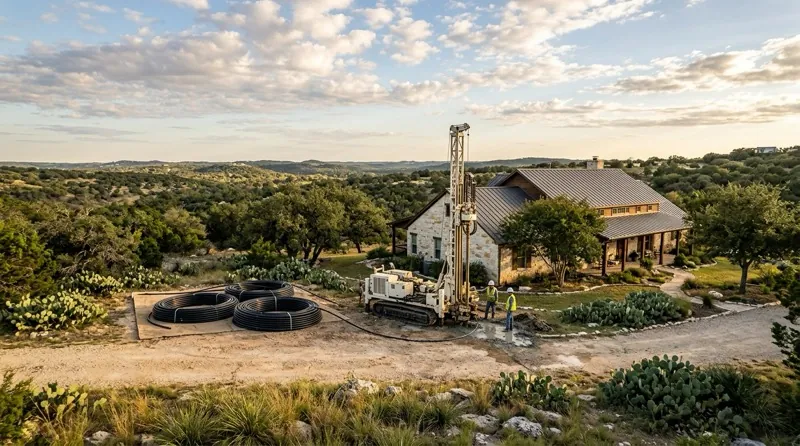
Why Texas Is a Geothermal Paradox
Texas is the nation's largest energy producer and consumer. It has cheap natural gas, abundant wind and solar, a deregulated electricity market, and enough land for horizontal ground loops from the Panhandle to the Gulf. On paper, that should make Texas either the best or worst state for residential geothermal — and it's somehow both.
The paradox: Texas electricity is cheap at 9.79¢/kWh (EIA 2024, rank 42 nationally), which sounds like it would kill the geothermal case. But that average masks enormous volatility. In the deregulated ERCOT market, Texans choose their own retail electricity provider — and rates can swing from 8¢ to 20¢ per kWh depending on contract timing, plan type, and market conditions. During Winter Storm Uri in February 2021, wholesale prices hit $9,000/MWh, and variable-rate customers received electric bills exceeding $10,000 for a single month.
That price volatility — not just the average rate — is what makes geothermal interesting in Texas. A ground-source heat pump doesn't care what electricity costs per kWh; it just needs less of it. When your cooling system runs at COP 4.5–5.0 instead of the conventional AC's 2.5–3.5, you're consuming 30–40% fewer kilowatt-hours. In a state where summer AC drives 40–60% of annual electricity use, that's substantial.
Three things define the Texas geothermal conversation:
- Cooling dominance. Most of Texas runs AC 7–10 months per year. Geothermal's cooling COP advantage (rejecting heat into 65–72°F earth vs. 100–110°F outdoor air) delivers savings every single summer day. Heating matters mainly in the Panhandle, North Texas, and Hill Country winter nights.
- Grid independence. After Winter Storm Uri, Texans understand that the ERCOT grid can fail. Geothermal doesn't eliminate your grid connection, but it dramatically reduces your peak demand — and pairs beautifully with solar + battery for true resilience.
- No state incentives. Texas has no state tax credit, no utility rebate program, and no energy efficiency mandate that drives GSHP adoption. The federal 30% ITC (IRC §25D) is your only incentive. That makes the economics harder — but also means the math is transparent.
Let's be direct: if you heat with cheap natural gas in Dallas or Houston, geothermal payback will likely exceed 20 years. But if you're in rural Texas on propane or electric resistance, building new, or operating a ranch where USDA REAP applies — the numbers change dramatically.
Quick Verdict: Should You Go Geothermal in Texas?
| Your Situation | Verdict | Typical Payback |
|---|---|---|
| Rural Texas — propane or electric resistance heating | ✅ Best TX scenario | 7–10 years |
| New construction — anywhere in Texas | ✅ Incremental cost is low | 6–10 years |
| Ranch/ag property — USDA REAP eligible | ✅ 55% coverage possible | 4–7 years |
| Large home (4,000+ sqft) — high cooling load | ✅ Economies of scale | 8–12 years |
| Pool owner — desuperheater value-add | ✅ Major bonus savings | 7–11 years (with pool credit) |
| Hill Country / Austin — replacing aging HVAC | ⚠️ Moderate — depends on current system | 12–16 years |
| DFW / Houston suburbs — natural gas heating | ❌ Hard to justify financially | 18–28 years |
| South Texas — mild winters, gas heating | ❌ Cooling savings alone are insufficient | 20–30+ years |
Does Geothermal Work in Texas?
Geothermal heat pumps work everywhere in Texas — but the type of system and the economics vary enormously across the state's 268,596 square miles.
Ground Temperatures by Region
| Region | Ground Temp (50ft) | HDD | CDD | Dominant Mode |
|---|---|---|---|---|
| Panhandle (Amarillo) | 57–60°F | 4,200 | 1,600 | Balanced heating/cooling |
| North Texas (DFW) | 63–66°F | 2,400 | 2,700 | Cooling-dominant |
| Hill Country (Austin/SA) | 67–70°F | 1,700 | 2,900 | Cooling-dominant |
| Gulf Coast (Houston) | 70–73°F | 1,400 | 3,000 | Strongly cooling-dominant |
| South Texas (McAllen) | 73–76°F | 600 | 3,800 | Almost exclusively cooling |
| West Texas (Midland) | 62–65°F | 2,900 | 2,400 | Balanced |
| East Texas (Tyler) | 65–68°F | 2,200 | 2,500 | Slight cooling-dominant |
The Panhandle and West Texas are the most favorable for geothermal because they have significant heating loads and cooling loads — both modes generate savings. South Texas and the Lower Rio Grande Valley are the weakest because ground temperatures approach 75°F, narrowing the gap between ground-source and air-source cooling efficiency.
Texas Geology: A Mixed Bag
Texas encompasses at least four major geological provinces, each with different implications for ground loop installation:
- Gulf Coastal Plain (Houston, Beaumont, Corpus Christi): Deep alluvial sediments — clay, sand, silt. Excellent for horizontal loops where land permits. Moderate thermal conductivity (0.8–1.2 BTU/hr·ft·°F). Vertical wells drill easily but may require casing through soft formations.
- Blackland Prairie / Cross Timbers (DFW, Waco, Temple): Expansive clay soils (Austin Chalk, Eagle Ford). Good thermal contact for loops but seasonal clay expansion/contraction requires careful backfill design. Vertical wells are standard and cost-effective.
- Edwards Plateau / Hill Country (Austin, San Antonio, Fredericksburg): Limestone bedrock at or near surface. Vertical drilling is the primary option — horizontal loops impractical in many locations due to shallow rock. Drilling costs run $15–$25/ft depending on formation hardness. The Edwards Aquifer is a major open-loop opportunity but strictly regulated by the EAA (Edwards Aquifer Authority).
- High Plains / Panhandle (Amarillo, Lubbock): Ogallala Aquifer overlying Permian formations. Sandy soils excellent for both horizontal and vertical loops. Open-loop potential from the Ogallala, but water rights and aquifer depletion are serious concerns.
Geology & Drilling Conditions by Region
| Region | Dominant Soil/Rock | Thermal Conductivity (BTU/hr·ft·°F) | Drilling Method | Drilling Cost ($/ft) | Notes |
|---|---|---|---|---|---|
| Gulf Coastal Plain (Houston, Beaumont) | Alluvial clay, sand, silt | 0.8–1.2 | Mud-rotary | $10–$15 | Casing may be needed through soft formations; excellent horizontal loop terrain |
| Blackland Prairie (DFW, Waco) | Austin Chalk, Eagle Ford clay | 1.0–1.4 | Mud-rotary / air-rotary | $12–$18 | Expansive clays require engineered backfill; seasonal soil movement affects horizontal loops |
| Edwards Plateau / Hill Country | Edwards Limestone, Glen Rose | 1.2–1.8 | Air-hammer / rotary | $15–$25 | Shallow bedrock limits horizontal; excellent conductivity reduces total bore footage needed |
| High Plains / Panhandle | Ogallala sand/gravel over Permian | 0.9–1.3 | Mud-rotary | $10–$16 | Sandy soils excellent for both loop types; wind erosion may expose shallow horizontal loops |
| Cross Timbers (Ft Worth, Denton) | Limestone, shale, clay interbeds | 1.0–1.5 | Air-rotary | $12–$20 | Alternating hard/soft layers; expect variable drilling speed and bit wear |
| East Texas Piney Woods | Sandy loam, red clay, lignite | 0.8–1.1 | Mud-rotary | $9–$14 | Easiest and cheapest drilling in TX; abundant land for horizontal loops |
| South Texas / Rio Grande Valley | Caliche, sandy clay, alluvium | 0.7–1.0 | Mud-rotary | $10–$15 | High ground temp (73–76°F) narrows cooling advantage; hard caliche layer at surface may need air-hammer |
Texas's Deregulated Energy Market
Texas is unique: approximately 85% of the state operates under a deregulated electricity market managed by ERCOT (Electric Reliability Council of Texas). This means homeowners choose their retail electricity provider — but also shoulder the risk of price volatility.
What Deregulation Means for Geothermal
| Factor | Impact on Geothermal Case |
|---|---|
| Average rate: 9.79¢/kWh | Lower savings per kWh than high-rate states (NE, CA) |
| Variable-rate plans: 8–20¢ swing | Geothermal hedges against rate spikes — uses fewer kWh regardless |
| Summer demand charges: 12–18¢ effective | COP 4.5+ cooling reduces peak demand significantly |
| No utility rebate programs | No rebates — federal ITC is the only incentive |
| No net metering mandate | Solar buyback varies by REP — research before combining with geo |
| Free nights/weekends plans | Pre-cooling with geothermal during free hours = near-zero cooling cost |
The free nights/weekends angle is uniquely Texan. Several retail electricity providers (REPs) offer plans with free electricity during off-peak hours. A geothermal system paired with good insulation and thermal mass can pre-cool the home during free hours, then coast through peak-rate periods. This strategy alone can cut effective cooling costs by 40–60% beyond what COP improvements deliver.
As of March 2026, the average residential rate across Texas is 9.79¢/kWh (EIA 2024). However, the grid's CO2 intensity sits at 823 lbs/MWh (EIA 2024, rank 22) — higher than the national average of ~860 lbs/MWh — due to the state's heavy natural gas (and some remaining coal) generation mix. Texas's rapid wind buildout is bringing this number down, which improves geothermal's environmental case over time.
Regional Costs & ROI
Installed System Cost by Region
| Region | Typical Home Size | System Size | Installed Cost | After 30% ITC | Primary Loop Type |
|---|---|---|---|---|---|
| Panhandle / West TX | 2,000–2,800 sqft | 3–4 ton | $20,000–$32,000 | $14,000–$22,400 | Horizontal or vertical |
| DFW Metroplex | 2,200–3,500 sqft | 3.5–5 ton | $24,000–$40,000 | $16,800–$28,000 | Vertical (lot size limits) |
| Austin / Hill Country | 2,000–3,200 sqft | 3–5 ton | $26,000–$42,000 | $18,200–$29,400 | Vertical (limestone) |
| Houston / Gulf Coast | 2,400–3,800 sqft | 4–5 ton | $25,000–$42,000 | $17,500–$29,400 | Vertical or horizontal |
| San Antonio / South TX | 2,000–3,000 sqft | 3–5 ton | $24,000–$38,000 | $16,800–$26,600 | Vertical |
| East Texas (Rural) | 1,800–2,600 sqft | 2.5–4 ton | $19,000–$30,000 | $13,300–$21,000 | Horizontal (land available) |
Why Hill Country costs more: Limestone bedrock requires rotary or air-hammer drilling instead of standard mud-rotary. Drilling costs in the Edwards Plateau run $15–$25/ft vs. $10–$15/ft in Gulf Coast sediments. However, limestone's excellent thermal conductivity (1.2–1.8 BTU/hr·ft·°F) means you need fewer total bore feet.
Annual Savings by Fuel Replaced
| Current Fuel | Annual Cost (Typical) | Geo Annual Cost | Annual Savings |
|---|---|---|---|
| Propane ($2.50–$3.50/gal) + old AC | $4,200–$6,500 | $1,800–$2,600 | $2,400–$3,900 |
| Electric resistance + old AC | $3,800–$5,800 | $1,600–$2,400 | $2,200–$3,400 |
| High-efficiency gas + new AC (SEER 16+) | $2,200–$3,400 | $1,400–$2,200 | $800–$1,200 |
| Standard gas furnace + aging AC (SEER 10–13) | $2,800–$4,200 | $1,400–$2,200 | $1,400–$2,000 |
Real-World Case Studies
Case Study 1: Dripping Springs Hill Country — Propane Home
- Home: 2,800 sqft ranch on 5 acres, Dripping Springs (west of Austin)
- Previous system: Propane furnace + SEER 12 AC (15 years old)
- Propane cost: $3.00/gallon, ~900 gallons/year ($2,700 heating)
- AC cost: ~$2,100/year (7 months of heavy cooling)
- Total previous energy cost: $4,800/year
- New system: 4-ton WaterFurnace 7 Series, 3x250ft vertical bores in limestone
- Installed cost: $34,500 (includes limestone drilling premium)
- After 30% ITC: $24,150 net cost
- Geothermal annual cost: $1,950 (electricity only)
- Annual savings: $2,850
- Simple payback: 8.5 years
- 25-year savings: $47,100 (after system cost, before maintenance savings)
Key insight: The limestone drilling premium added ~$4,000 vs. sedimentary soil, but the excellent thermal conductivity of Edwards limestone meant 3 bores sufficed where 4 would be needed in clay. Net cost difference: minimal.
Case Study 2: Suburban Houston — Natural Gas (Honest Assessment)
- Home: 3,200 sqft in Katy, TX (west Houston suburb)
- Previous system: 96% AFUE gas furnace + SEER 16 AC (8 years old, still functional)
- Gas heating cost: $650/year (mild winters, 1,400 HDD)
- AC cost: $1,800/year (8 months of cooling)
- Total previous energy cost: $2,450/year
- Proposed system: 5-ton closed-loop vertical, 4x250ft bores in Gulf Coast clay/sand
- Installed cost: $38,000
- After 30% ITC: $26,600 net cost
- Geothermal annual cost: $1,550 (electricity only)
- Annual savings: $900
- Simple payback: 29.6 years
Our honest take: This is a bad financial decision. The existing system is efficient, gas is cheap, and the AC still has useful life. The only scenario where this makes sense: if the current HVAC dies and you're replacing anyway (incremental payback: ~12 years), or if grid independence is worth a premium after your family experienced Winter Storm Uri.
Case Study 3: Frisco DFW — New Construction with Solar Stacking
- Home: 3,400 sqft new build in Frisco, TX (north DFW)
- Builder decision: Geothermal + 8kW solar vs. standard 96% AFUE gas + SEER 16 AC + no solar
- Conventional HVAC quote: $14,500 (gas furnace + AC, included in base price)
- Geothermal system: 5-ton ClimateMaster Tranquility 30 Digital, 4×250ft vertical bores in Blackland Prairie clay
- Geothermal installed cost: $36,000 (incremental: $21,500 over conventional)
- Solar (8kW): $20,800 gross (30% ITC = $14,560 net)
- Combined geo+solar gross cost: $56,800
- After 30% ITC on both: $39,760 net combined ($25,200 geo + $14,560 solar)
- Incremental over conventional: $25,260
- Conventional annual energy cost: $3,800 (gas heat $650 + SEER 16 AC $1,800 + other electric $1,350)
- Geo+solar annual energy cost: $480 (grid electricity only — solar covers ~85% of geo's electrical demand)
- Annual savings: $3,320
- Incremental payback: 7.6 years
- 25-year savings: $57,740 (net of incremental investment)
Key insight: New construction eliminates the biggest geothermal cost barrier — you're not paying for a standalone retrofit, you're paying the difference between geo and conventional HVAC. Adding solar makes the combined system essentially a net-zero energy home by Year 8. The Frisco buyer chose an ERCOT free-nights plan for the remaining 15% grid usage, bringing effective energy cost to near zero during off-peak hours.
Month-by-Month Energy Profile
Based on a 2,800 sqft home in Austin, TX replacing propane heat + SEER 12 AC with a 4-ton geothermal system:
| Month | Old System Cost | Geo Cost | Monthly Savings | Notes |
|---|---|---|---|---|
| January | $520 | $185 | $335 | Peak heating month, propane vs. COP 4.0 |
| February | $410 | $155 | $255 | Heating dominant, occasional mild days |
| March | $260 | $125 | $135 | Transition — some heating, some cooling |
| April | $310 | $140 | $170 | AC starts, geo COP advantage begins |
| May | $420 | $165 | $255 | Full AC season — 85°F air vs. 68°F ground |
| June | $540 | $195 | $345 | Heavy cooling — COP 5.0 vs. SEER 12 AC |
| July | $620 | $215 | $405 | Peak cooling — 100°F+ days, ground stays 68°F |
| August | $610 | $210 | $400 | Peak continues — sustained triple digits |
| September | $480 | $175 | $305 | Still heavy AC — 90°F average highs |
| October | $290 | $130 | $160 | Cooling tails off, pleasant shoulder season |
| November | $260 | $120 | $140 | First heating demand, propane vs. geo |
| December | $430 | $170 | $260 | Heating picks up — 5–7 cold nights |
Annual total: Old system $5,150 → Geothermal $1,985 = $3,165 savings
Note: July and August deliver the largest savings because the temperature differential between outdoor air (100°F+) and ground temperature (68°F) is greatest. This is the opposite of Northeast states, where winter heating generates the biggest savings.
Open-Loop System Assessment
Texas has several major aquifer systems that could support open-loop geothermal installations. However, water rights, aquifer regulations, and regional water politics make open-loop more complicated in Texas than in most states.
| Aquifer / Region | Open-Loop Viability | Key Considerations |
|---|---|---|
| Ogallala Aquifer (Panhandle) | ⚠️ Site-specific | Abundant water but aquifer depletion is severe. Groundwater Conservation Districts (GCDs) may restrict new well permits. Check local GCD rules before planning. |
| Edwards Aquifer (Hill Country / SA) | ⚠️ Heavily regulated | Excellent water quality and temperature (68–72°F year-round). Edwards Aquifer Authority (EAA) requires permits for all wells. Return flow must not contaminate the aquifer. Feasible but requires EAA approval process. |
| Trinity Aquifer (DFW / Central TX) | ⚠️ Site-specific | Declining water levels in some areas. Viable in rural areas with adequate production. Municipal competition for Trinity water may limit new well approvals. |
| Gulf Coast Aquifer (Houston / Coastal) | ⚠️ Subsidence risk | Harris-Galveston Subsidence District regulates groundwater pumping to prevent land subsidence (Houston has sunk up to 10 feet in some areas). Open-loop permits extremely difficult to obtain in Houston metro. |
| Carrizo-Wilcox (East TX) | ✅ Generally viable | Good water quality, adequate yields, fewer regulatory barriers. Best open-loop opportunity in Texas for most homeowners. |
| South TX / Brush Country | ❌ Not recommended | Brackish or saline water in many areas. Mineral content accelerates heat exchanger scaling. Closed-loop preferred. |
Critical Texas water law note: Texas follows the "Rule of Capture" for groundwater — you can pump what's under your land. However, Groundwater Conservation Districts (GCDs) have authority to regulate pumping rates and well spacing. As of 2026, there are 98 confirmed GCDs covering most of the state. Always check your local GCD before planning an open-loop system.
Loop Type Cost Comparison
| Loop Type | Cost Range (3-ton) | Land Needed | Best Texas Application |
|---|---|---|---|
| Horizontal (trenched) | $12,000–$18,000 | 1,500–2,500 sqft | Rural East TX, Panhandle — flat land, deep soil |
| Slinky (coiled horizontal) | $13,000–$19,000 | 800–1,500 sqft | Moderate lots — 30% less trench length than straight horizontal |
| Vertical (bored) | $18,000–$28,000 | Minimal (drill pads) | DFW/Houston/Austin suburbs — limited yard space |
| Open-loop (well-based) | $14,000–$22,000 | Well pad + discharge | Carrizo-Wilcox, Edwards (where permitted) |
| Pond/lake loop | $11,000–$16,000 | ½ acre+ pond/tank | Ranch stock tanks — Texas's hidden advantage |
Texas ranch advantage: Many Texas ranches have stock tanks (ponds) that are ideal for pond-loop geothermal. A ½-acre stock tank at 6+ feet deep can support a 3–4 ton system at the lowest installation cost of any loop type. If you have a ranch with a stock tank near your house, get a quote for pond loop first.
Incentives: Federal ITC and the Honest Picture
Texas has no state tax credits, no utility rebates, and no energy efficiency programs that specifically target ground-source heat pumps. The Lone Star State's free-market philosophy extends to energy efficiency — you're on your own.
Your sole incentive is the federal Residential Clean Energy Credit (IRC §25D):
- Credit amount: 30% of total installed cost (equipment + labor + drilling)
- No cap on credit amount
- Applies through 2032 (steps down to 26% in 2033, 22% in 2034)
- System requirements: Must meet ENERGY STAR criteria at time of installation
- Carryforward: If your tax liability is less than the credit, unused portion carries forward to future tax years
For a typical Texas installation of $28,000, that's an $8,400 credit — reducing net cost to $19,600.
Incentive Stacking Table
| Incentive | Amount | Status | Notes |
|---|---|---|---|
| Federal ITC (IRC §25D) | 30% of cost | ✅ Confirmed | Through 2032. No income limit. |
| Texas state credit | — | ❌ None | No state-level geothermal incentive |
| Utility rebates (ERCOT area) | — | ❌ None | Deregulated utilities don't offer efficiency rebates |
| Municipal utility rebates | Varies | [NEEDS VERIFICATION] | Austin Energy, CPS Energy (SA), and other munis may offer HVAC rebates. Check directly. |
| USDA REAP (rural/ag) | Up to 25% grant + 25% loan | ✅ Available | Rural properties and ag operations — can stack with ITC |
| Property tax exemption | — | ❌ None | TX has no property tax exemption for GSHP |
USDA REAP: Texas Ranchers' Secret Weapon
The USDA Rural Energy for America Program (REAP) is the most significant additional incentive available in Texas. If your property qualifies (rural location, agricultural operation, or small business), you can receive:
- Grant: Up to 25% of project cost
- Guaranteed loan: Up to 75% of project cost
- Combined with 30% ITC: Up to 55% of total cost covered
Example — Mason County ranch:
- 4-ton system for ranch house: $28,000 installed
- USDA REAP grant (25%): −$7,000
- Federal ITC (30% of $21,000 remaining): −$6,300
- Net cost: $14,700 (48% reduction)
- Annual savings (replacing propane): $2,800
- Payback: 5.3 years
Contact the USDA Texas State Office for current application cycles and deadlines.
Solar + Geothermal Stacking
Texas averages 230–300 sunny days per year — among the highest in the nation. Combining rooftop solar with geothermal creates a powerful synergy, especially given the state's deregulated electricity market.
How It Works in Texas
- Geothermal reduces your total electricity consumption by 30–40% (primarily through efficient cooling)
- Solar generates electricity during peak cooling hours (noon–5 PM) when the geo system runs hardest
- Net result: Your grid electricity purchase approaches zero during summer — the months that normally drive your highest bills
Texas Solar Buyback Caveat
Unlike states with mandatory net metering, Texas has no statewide net metering requirement. Solar buyback rates vary dramatically by REP:
- Green Mountain Energy: Offers solar buyback plans
- TXU Energy: Various solar plans with different buyback rates
- Most REPs: Offer wholesale or avoided-cost buyback (2–4¢/kWh) — far below retail
This means self-consumption is king in Texas. A geothermal system that runs on your own solar power during the day is the optimal configuration — you avoid exporting cheap and importing expensive.
Combined System Economics
- Geothermal only: $28,000 gross → $19,600 net → $2,800/yr savings → 7.0yr payback
- Solar (8kW) only: $20,000 gross → $14,000 net → $1,600/yr savings → 8.8yr payback
- Combined: $48,000 gross → $33,600 net → $4,100/yr savings → 8.2yr payback with near-zero grid dependence
Grid Resilience: The Winter Storm Uri Lesson
In February 2021, Winter Storm Uri caused the largest grid failure in Texas history. Temperatures plunged below 0°F in parts of the state. Natural gas supply froze. Power plants went offline. 4.5 million homes lost electricity for days. At least 246 people died.
Geothermal doesn't make you grid-independent — you still need electricity to run the heat pump and circulating pumps. But it changes the resilience calculus in three critical ways:
- Reduced peak demand. A geothermal system uses 30–50% less electricity than conventional heating/cooling. During a grid stress event, your home draws less — meaning available power goes further.
- No gas supply vulnerability. During Uri, natural gas wellheads froze, processing plants shut down, and gas pressure dropped across residential distribution networks. Geothermal has no gas supply chain. Your heat source is the ground beneath your property.
- Battery pairing. Geothermal's lower electrical demand means a smaller (cheaper) battery backup can keep your home heated or cooled during a short grid outage. A 10kWh battery that might last 4 hours with electric resistance heating could last 12+ hours with a geothermal system.
What geothermal doesn't solve: If the grid is down for 4+ days (as happened during Uri), no battery-backed system will sustain heating indefinitely. The real Uri lesson is that Texas homes need better insulation, dual-fuel capability, and grid modernization. Geothermal helps — it doesn't eliminate the risk.
Vacation Rental & Ranch Analysis
Texas's rural property and vacation rental market creates some interesting geothermal scenarios:
Hill Country Vacation Rentals
Fredericksburg, Wimberley, and the Highland Lakes area support a thriving short-term rental market. These properties run AC 8+ months per year, often for guests who keep thermostats at 68°F. A geothermal system cuts cooling costs by 35–45% while marketing as an "eco-friendly luxury retreat" — a premium that can add $25–$50/night in the eco-conscious Hill Country market.
Coastal Rentals (Galveston / Port Aransas)
Coastal properties face cooling-only demand. The warm Gulf Coast ground temperatures (70–73°F) narrow the efficiency advantage. Combined with salt air corrosion concerns for outdoor equipment, geothermal's underground installation is an advantage — but payback is longer than Hill Country properties.
Ranch Operations
Texas ranches often have the perfect setup for geothermal: large acreage (horizontal loop space), stock tanks (pond loop opportunity), propane as primary fuel (high savings potential), and USDA REAP eligibility. A ranch house on propane with a stock tank pond loop is the single best geothermal scenario in Texas.
How to Claim the Federal Tax Credit
- Confirm system qualifies. Must be an ENERGY STAR-certified ground-source heat pump installed in a U.S. home you own. Both primary and secondary residences qualify. Rental-only properties do not.
- Keep all documentation. Save the installer contract, itemized invoice (equipment, labor, drilling separate), ENERGY STAR certification, and manufacturer spec sheets.
- Calculate your credit. Total installed cost × 30% = your credit amount. Include everything: equipment, ground loop materials, drilling, trenching, piping, manifolds, antifreeze, labor, permits, and commissioning.
- File IRS Form 5695. Complete Part I (Residential Clean Energy Credit). Enter total costs on Line 1. The 30% credit calculates on Line 6a.
- Transfer to Form 1040. The credit from Form 5695 carries to Schedule 3, Line 5, then to Form 1040, Line 20.
- If credit exceeds tax liability: Unused credit carries forward to the next tax year. You don't lose it — it just applies when you have sufficient liability. This is especially relevant for Texans who may have lower federal tax liability due to no state income tax.
- Consider REAP stacking: If you received a USDA REAP grant, subtract the grant amount from your total cost before calculating the 30% ITC. The ITC applies to your out-of-pocket cost, not the full system price.
Permits & Licensing
Texas geothermal installations involve multiple licensing and permitting requirements across state agencies, groundwater districts, and local jurisdictions. This section walks through each layer.
TDLR Air Conditioning & Refrigeration (ACR) License
Any contractor who installs, repairs, or maintains a geothermal heat pump in Texas must hold a TDLR Air Conditioning and Refrigeration Contractor license. The ACR program has two classes relevant to geothermal:
- Class A License: Unlimited tonnage — required for most residential and all commercial geothermal installations. The installer must have completed an approved training program and passed the TDLR exam.
- Class B License: Limited to systems under 25 tons — sufficient for most residential work (typical homes are 3–5 tons).
- Verify any contractor's license: TDLR License Search — enter the contractor's name or license number to confirm active status, complaint history, and enforcement actions.
TDLR Water Well Driller License
All geothermal vertical bore drilling in Texas requires a TDLR-licensed Water Well Driller. This is separate from the HVAC license — most geothermal contractors subcontract the drilling to a licensed driller.
- Closed-loop wells: Must be registered with TDLR but do not require water rights since no groundwater is consumed. Well completion reports must be filed within 60 days.
- Open-loop wells: Require full well permits plus compliance with local Groundwater Conservation District (GCD) rules. Subject to water quality testing and return-water standards.
- Abandonment standards: If an existing well is decommissioned during geothermal installation, TDLR requires proper plugging per Chapter 76 rules to prevent groundwater contamination.
Edwards Aquifer Authority (EAA) Permits
Properties within the Edwards Aquifer Recharge Zone or Contributing Zone (primarily Bexar, Comal, Hays, Travis, Medina, Uvalde, and Kinney counties) face additional requirements:
- Open-loop systems: Require EAA authorization. You must demonstrate water will be returned at equal or better quality, and pumping stays within your permitted allocation. Timeline: 60–90 days for residential permits.
- Closed-loop systems: Face fewer EAA restrictions but still require TDLR well registration and may need a Water Pollution Abatement Plan (WPAP) if within the recharge zone.
- Contact EAA early: edwardsaquifer.org — permit timelines can delay your project by 2–3 months if not started during planning.
Groundwater Conservation Districts (GCDs)
Texas has over 100 GCDs, each with their own rules for well drilling. Open-loop geothermal systems require a well permit from your local GCD. Rules vary significantly:
- Barton Springs/Edwards Aquifer Conservation District (BSEACD): Strict rules in Travis and Hays counties — may require aquifer testing and monitoring wells.
- North Plains GCD / Panhandle GCD: Ogallala Aquifer districts concerned about depletion — open-loop may face water allocation caps.
- Gulf Coast GCDs: Generally more permissive for closed-loop; subsidence concerns may affect open-loop approval in Houston-area GCDs.
- Find your GCD: Texas Water Development Board GCD map
Local Building Permits
- Mechanical permit: Required in most cities and counties for the heat pump installation itself.
- Well/boring permit: Some counties require a separate drilling permit beyond the TDLR registration.
- Trenching/excavation permit: Required in most municipalities for horizontal loop installation.
- HOA architectural review: Many Texas subdivisions require review for any exterior work. The indoor heat pump unit typically doesn't trigger HOA rules, but drilling equipment access, landscape disturbance, and loop manifold locations may need approval. Get HOA approval before signing a contract.
Typical Permitting Timeline
| Permit Type | Agency | Typical Timeline | Approximate Cost |
|---|---|---|---|
| Mechanical (HVAC) | City/County | 3–10 business days | $75–$250 |
| Well registration (closed-loop) | TDLR | Filed post-completion | $50 per well |
| Well permit (open-loop) | Local GCD | 14–60 days | $100–$500 |
| Edwards Aquifer (EAA zone) | EAA | 60–90 days | $200–$1,000+ |
| Trenching/excavation | City/County | 3–7 business days | $50–$150 |
| HOA review | HOA Board | 30–60 days | $0–$100 |
Pro tip: A well-organized geothermal installer handles all permitting as part of the project. If a contractor asks you to pull the permits, that's a red flag — they may not be experienced with geothermal-specific requirements.
Finding & Vetting a Texas Installer
Texas's geothermal installer network is growing but still thin compared to the Midwest or Northeast. The state's sheer size means an installer 200 miles away might as well be in another state — always prioritize regional experience.
Where to Find Installers
- IGSHPA Member Directory: igshpa.org/member-directory — search by state for IGSHPA-certified professionals
- WaterFurnace Dealer Locator: waterfurnace.com/find-a-dealer — WF is the most common brand in TX
- ClimateMaster Dealer Locator: climatemaster.com/find-a-dealer
- Bosch/Geo Dealer Locator: bosch-thermotechnology.us/dealer-locator
- TDLR License Search: tdlr.texas.gov/LicenseSearch — verify ACR and Water Well Driller licenses
8-Point Installer Vetting Checklist
- IGSHPA certification (current) — Ask for certificate number and verify it's not expired. IGSHPA requires continuing education for renewal.
- TDLR ACR license (Class A or B) — Verify at tdlr.texas.gov/LicenseSearch. Check for complaints or enforcement actions.
- Licensed driller on team — TDLR Water Well Driller license required. Ask if they employ a driller or subcontract (both are fine — just verify the sub is licensed).
- Minimum 10 residential systems installed in YOUR region — Texas geology varies enormously. Dallas clay experience doesn't translate to Hill Country limestone or Gulf Coast sand. Ask for addresses of completed jobs near your property.
- Loop design software — Should use LoopLink RLC, GLD (Ground Loop Design), or GLHEPro — not rules of thumb or per-ton shortcuts. Ask to see the design report.
- Manual J load calculation — Must perform a room-by-room heating/cooling load calculation before sizing the system. A contractor who sizes by square footage alone will over- or under-size the system.
- Written warranty — Equipment manufacturer warranty (typically 5–10 years parts, some offer extended to lifetime compressor) PLUS contractor labor/workmanship warranty (minimum 1 year, better contractors offer 2–5).
- References from last 12 months — Call at least 2 recent customers. Ask about the installation process, cleanup, commissioning, and whether the system performs as promised.
Red flags:
- No IGSHPA certification ("we've been doing HVAC for 20 years" doesn't mean they know geothermal loop design)
- Quote without a site visit (impossible to quote accurately without seeing the property, soil, and access)
- Dramatically lower price than other quotes (cutting corners on loop length, bore depth, or equipment quality)
- Won't provide a loop design report (they may be guessing at bore depth and spacing)
- Pressure to sign immediately ("this price is only good today")
Regional Installer Availability
| Region | IGSHPA-Certified Installer Density | Notes |
|---|---|---|
| DFW Metroplex | Moderate (5–10 companies) | Growing market; several WaterFurnace dealers active |
| Austin / San Antonio | Moderate (5–8 companies) | Hill Country limestone experience is critical — ask specifically |
| Houston / Gulf Coast | Low-Moderate (3–6 companies) | Growing but still limited; some travel from Austin/DFW |
| Panhandle / West Texas | Low (1–3 companies) | May need to bring in OK or NM installers; IGSHPA HQ in OK helps |
| East Texas | Low (2–4 companies) | DFW-based installers often serve this region |
| South Texas / RGV | Very Low (1–2 companies) | Limited market; cooling-only economics make it a tough sell |
Maintenance & System Longevity
Geothermal systems have fewer maintenance needs than conventional HVAC — no outdoor condenser to clean, no refrigerant exposure to weather, no gas combustion to inspect. But Texas's unique climate and soil conditions create a few specific considerations.
Recommended Maintenance Schedule
| Task | Frequency | Who | Est. Cost | Texas-Specific Notes |
|---|---|---|---|---|
| Air filter replacement | Every 1–3 months | Homeowner | $10–$30 | Monthly in summer — TX dust and pollen loads are heavy; 7–10 month cooling season means more filter changes than northern states |
| Thermostat & settings check | Twice yearly | Homeowner | $0 | Verify changeover from cooling-dominant to heating mode (November) and back (March) |
| Condensate drain inspection | Monthly (cooling season) | Homeowner | $0 | Critical in TX — 7–10 months of dehumidification means heavy condensate flow; algae/biofilm buildup common in humid East TX and Gulf Coast |
| Professional tune-up | Annually | HVAC technician | $150–$300 | Check refrigerant charge, loop pressure, EWT/LWT delta, blower performance, electrical connections |
| Loop pressure check | Annually | Geothermal tech | Included in tune-up | Expansive clay soils in DFW/Central TX can stress loop connections — verify no pressure loss |
| Antifreeze concentration test | Every 3–5 years | Geothermal tech | $50–$100 | Less critical in TX (ground doesn't freeze) but pH should be checked to prevent loop corrosion |
| Desuperheater check (if equipped) | Annually | Geothermal tech | Included in tune-up | TX pool owners: verify desuperheater is contributing to pool heating during shoulder months |
| Ductwork inspection | Every 3–5 years | HVAC technician | $150–$400 | TX attic ductwork operates in 140°F+ summer attics — seals degrade faster than in temperate climates |
Component Lifespan
| Component | Expected Lifespan | Texas-Specific Factors |
|---|---|---|
| Ground loop (HDPE pipe) | 50–100+ years | No freeze-thaw cycling; expansive clay is the main risk — engineered grout protects connections |
| Heat pump compressor | 20–25 years | Indoor installation = no weather exposure. TX's warm climate means less thermal stress from extreme cold starts. High cooling hours increase total runtime but at moderate compressor load. |
| Circulating pump | 15–20 years | Variable-speed pumps last longer than fixed-speed; TX's longer cooling season means more annual pump hours |
| Blower motor | 15–20 years | ECM (variable-speed) motors recommended for TX — they handle the long cooling season more efficiently than PSC motors |
| Thermostat / controls | 10–15 years | Smart thermostats recommended for ERCOT time-of-use optimization |
| Ductwork | 20–30 years | Attic ductwork degrades faster in TX heat — consider duct replacement when installing geothermal if ducts are 15+ years old |
| Desuperheater | 15–20 years | Scale buildup from hard TX water can reduce efficiency — annual flushing recommended in hard-water areas (Hill Country, DFW) |
Texas advantage: Geothermal systems in Texas typically last longer than identical systems in northern states because the compressor never faces extreme cold-start conditions. The trade-off: higher total cooling hours mean the blower and circulating pump accumulate more runtime. Choose variable-speed components to maximize longevity.
Texas vs. Neighboring States
| Factor | TX | OK | LA | AR | NM |
|---|---|---|---|---|---|
| Avg. electricity rate | 9.79¢ | 9.09¢ | 8.80¢ | 10.92¢ | 13.45¢ |
| CO₂ (lbs/MWh) | 823 | 785 | 798 | 975 | 742 |
| State incentive | None | None | None | None | None |
| Typical payback (propane) | 7–10yr | 6–10yr | 8–12yr | 8–11yr | 8–12yr |
| Open-loop potential | Regional (EAA/GCD regulated) | Good (OWRB) | Limited (subsidence) | Good (Ozarks caution) | Limited (water scarcity) |
| Cooling load | Very high (2,400–3,800 CDD) | High (2,000–2,800 CDD) | Very high (2,700 CDD) | Moderate (1,600–2,200 CDD) | Moderate (1,200–2,400 CDD) |
| Deregulated market | Yes (ERCOT) | No | No | No | No |
| Permitting complexity | High (TDLR + GCD + EAA + local) | Moderate (OWRB) | Moderate (DOTD) | Low-Moderate (ANRC) | Moderate (OSE water rights) |
| Installer availability | Moderate (growing) | Good (IGSHPA HQ) | Low | Low-Moderate | Low |
Texas and its neighbors share a common theme: no state incentives. The Southern/Southwest region is the weakest for geothermal policy support in the entire country. The federal ITC is the sole driver across all five states. Texas's advantages: the largest cooling load in the region (more cooling hours = more COP savings), a growing installer network driven by commercial/data center demand, and ERCOT's free-nights/weekends plans that multiply geothermal's value. Oklahoma's proximity to IGSHPA headquarters gives it a surprising installer density advantage.
Frequently Asked Questions
Yes, but not as hot as the air. At 50 feet deep, Texas ground temperatures stay between 57°F (Panhandle) and 76°F (South Texas) year-round. Even in Houston at 72°F ground temperature, you're rejecting heat into 72°F earth instead of 100°F+ outdoor air. That's a significant efficiency gain — roughly 30–40% less electricity for the same cooling output. The advantage is smaller than in northern states but still meaningful over 7–8 months of heavy cooling.
Partially. Geothermal still needs electricity, so when the grid was completely down, it wouldn't have helped without battery backup. However, geothermal uses 50–70% less electricity for heating than electric resistance and eliminates reliance on the natural gas supply chain that froze during Uri. If you had geothermal + solar + battery, you would have been in the best possible position — your heating source (the ground) doesn't freeze, and your electrical demand is low enough for a reasonably sized battery to sustain.
For a typical 3–4 ton residential system: $20,000–$42,000 installed, depending on region and loop type. After the 30% federal tax credit, net costs range from $14,000–$29,400. Hill Country limestone drilling is the most expensive ($26,000–$42,000); East Texas horizontal loops in sandy soil are the cheapest ($19,000–$30,000). Always get at least 3 quotes — regional cost variation in Texas is among the highest in the nation.
No. Texas has no state income tax and therefore no state tax credit for geothermal. There are also no statewide utility rebate programs for ground-source heat pumps. The federal 30% ITC (IRC §25D) is your only tax incentive. Some municipal utilities (Austin Energy, CPS Energy in San Antonio) may offer HVAC efficiency rebates — check directly with your utility. Rural properties may qualify for USDA REAP grants (up to 25%).
Yes — and it's often the best option for Texas ranch properties. A stock tank (pond) of at least ½ acre and 6+ feet deep can support a pond-loop geothermal system. Coiled HDPE pipe is placed at the bottom of the pond, and the water provides excellent heat exchange. This is the cheapest loop type to install ($11,000–$16,000 for 3-ton) and works well in Texas because even stock tanks stay 55–65°F at depth through summer. Your installer should verify pond volume, depth, and whether it dries up in drought.
Open-loop geothermal wells in the Edwards Aquifer require EAA authorization. The process involves demonstrating that the water will be returned to the aquifer at the same quality (or better) and that your pumping rate is within your permitted allocation. Closed-loop systems in the Edwards zone don't consume groundwater and face fewer restrictions — but still require TDLR well registration. Contact the EAA early in your planning process; permit timelines can be 60–90 days.
Usually no, purely on financial terms. Natural gas in the DFW and Houston metro areas costs roughly $0.80–$1.20/therm, making gas furnace heating extremely cheap. The geothermal savings come almost entirely from cooling efficiency. For a home with a modern 96% AFUE gas furnace and SEER 16+ AC, annual savings are often only $800–$1,200 — yielding a 20–30 year payback. The exceptions: new construction (lower incremental cost), very large homes (4,000+ sqft with high cooling loads), or if grid resilience is a priority worth paying for.
The ground loop (HDPE pipe) lasts 50+ years in any Texas soil type — Gulf Coast clay, Edwards limestone, or Panhandle sand. The heat pump unit indoors lasts 20–25 years (no outdoor weather exposure like a conventional condenser). Texas's warm climate actually extends indoor equipment life since there's less thermal cycling stress from extreme cold starts. The main Texas-specific concern is expansive clay soils (common in DFW and Central TX) — the loop trench backfill must be engineered to accommodate seasonal soil movement.
Absolutely — it's one of the best combinations available. Texas averages 230–300 sunny days per year. Solar panels generate peak output during the same hours your geothermal system runs hardest (afternoon cooling). The pairing can virtually eliminate your grid electricity purchase during summer months. The key Texas caveat: solar buyback rates in the deregulated market are often only 2–4¢/kWh (wholesale), so you want to maximize self-consumption rather than export. Both systems qualify for the 30% ITC.
Data center cooling is increasingly using ground-source and direct geothermal technology in Texas. The state's data center corridor (Dallas–Fort Worth, Austin, San Antonio) is growing rapidly, and operators are exploring geothermal cooling to reduce PUE (Power Usage Effectiveness). For residential homeowners, this is relevant because the commercial geothermal buildout is expanding the installer workforce, driving down equipment costs, and normalizing the technology. See our article on geothermal and data centers for more on this trend.
Your installer needs a TDLR Air Conditioning & Refrigeration (ACR) license — Class A (unlimited tonnage) or Class B (under 25 tons). The well driller needs a separate TDLR Water Well Driller license. Both can be verified at tdlr.texas.gov/LicenseSearch. Beyond state licenses, look for IGSHPA certification — the industry standard for geothermal-specific design and installation competency. A contractor with an HVAC license but no IGSHPA cert may not understand loop design, which is the most critical part of a geothermal installation.
Less than conventional HVAC. Change the air filter every 1–3 months (monthly during the long TX cooling season), check the condensate drain regularly (heavy dehumidification produces lots of condensate in humid areas), and schedule one annual professional tune-up ($150–$300). The ground loop itself is maintenance-free — the HDPE pipe lasts 50+ years with no intervention. Texas's warm climate is actually easier on geothermal equipment than cold climates because the compressor never faces extreme cold-start stress. The main TX-specific concern is expansive clay soils in DFW and Central Texas — your annual check should verify loop pressure hasn't changed.
Bottom Line
Texas is not the easiest state for residential geothermal — cheap gas and no state incentives create a tough financial case for suburban gas-heated homes. But Texas has genuine geothermal sweet spots:
- Rural propane homes: 7–10 year payback, with USDA REAP potentially cutting that to 4–7 years
- New construction: Incremental cost is 40–60% less than retrofit, making 6–10 year payback realistic
- Ranch properties with stock tanks: Lowest-cost loop installation + REAP eligibility = best Texas scenario
- Grid-conscious homeowners: If Winter Storm Uri taught your family anything, the resilience premium may be worth the longer payback
- Hill Country and Panhandle: Highest heating loads in the state, combined with cooling savings, deliver balanced year-round value
Get three quotes minimum. Verify IGSHPA certification. Ask about loop type options specific to your geology. And run the numbers honestly — if your gas furnace is efficient and your AC is modern, the math may not work today. But when that equipment needs replacing in 10–15 years, remember that geothermal should be on your bid list.
Last verified: March 25, 2026. EIA rate data: 2024 annual average. Federal tax credit status: confirmed through 2032 per IRC §25D.
Sources
- U.S. Energy Information Administration — Texas Electricity Profile 2024
- U.S. Energy Information Administration — Texas State Electricity Data Tables
- ENERGY STAR — Geothermal Heat Pumps Tax Credit
- IRS — Form 5695: Residential Energy Credits
- USDA Rural Development — Rural Energy for America Program (REAP)
- Edwards Aquifer Authority — Permitting and Regulation Information
- Texas Department of Licensing and Regulation — Water Well Drillers Program
- IGSHPA — International Ground Source Heat Pump Association Standards
- Texas Commission on Environmental Quality — Groundwater Resources
- NOAA — Climate Data: Texas Regional Offices
- Public Utility Commission of Texas — Retail Electric Provider Information
- U.S. DOE — Geothermal Heat Pumps Technical Reference
- Texas Department of Licensing and Regulation — Air Conditioning & Refrigeration Contractors Program
- Texas Water Development Board — Groundwater Conservation Districts Map
- Barton Springs/Edwards Aquifer Conservation District — Permitting Information
- WaterFurnace — Texas Dealer Locator
- ClimateMaster — Dealer Network
- GeoExchange — Industry Data and Standards
- Texas Real Estate Research Center — Property Market Data