
In This Guide
📊 The Heat Pump Decision
You've decided you want a heat pump. Smart move. With 52 million American homes already on electric heating (Census, 2023) and electricity averaging 17.92¢/kWh nationwide (EIA, 2025), heat pumps are the most efficient way to heat and cool a home — and they're the direction the entire HVAC industry is heading.
But now you've got a decision to make: ground-source (geothermal) or air-source?
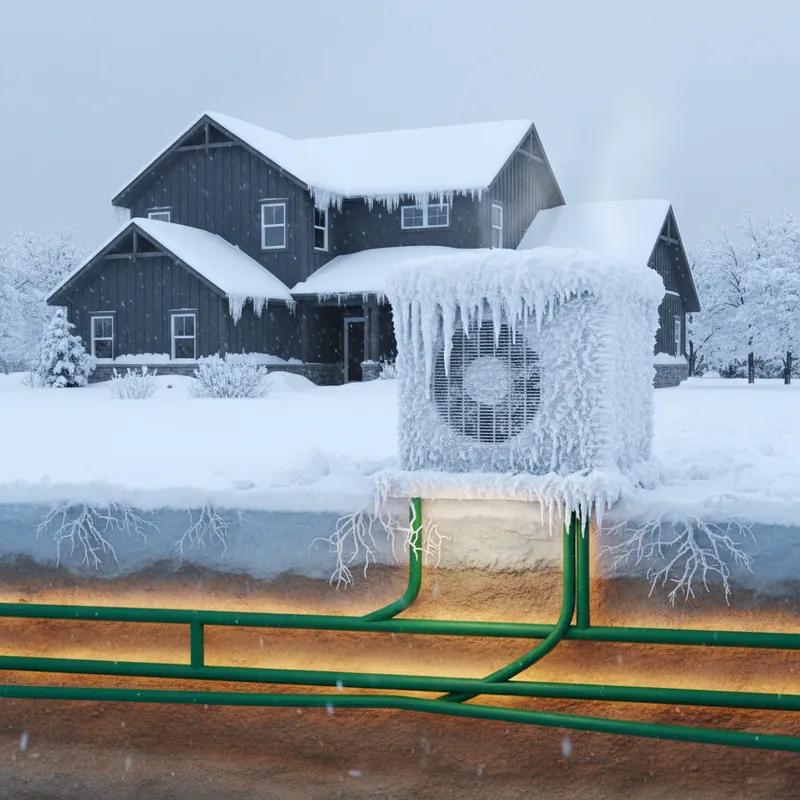
Both use the same basic principle — moving heat rather than generating it. Both can heat and cool your home. Both qualify for federal incentives. But they're fundamentally different machines. A ground-source system exchanges heat with soil that sits at a stable 55°F year-round (NOAA national average). An air-source system exchanges heat with outdoor air that swings from -10°F to 100°F depending on the season. That difference in source temperature drives everything — efficiency, performance, cost, and lifespan.
This guide breaks down the comparison honestly. We're a geothermal-focused site, so you know our bias — but we'll tell you when air-source is the smarter choice, too. Because the right answer depends on your house, your climate, your budget, and how long you plan to stay.
Quick Comparison Table
| Factor | Geothermal (Ground-Source) | Air-Source |
|---|---|---|
| Installed Cost | $20,000–$50,000 | $4,000–$15,000 |
| Heating Efficiency (COP) | 3.5–5.0 | 2.0–4.0 (drops in cold) |
| Cooling Efficiency (EER) | 16–25 | 12–18 |
| Performance at 0°F | No degradation | Significant loss (varies) |
| Indoor Unit Lifespan | 20–25 years | 15–20 years |
| Ground Loop Lifespan | 50+ years | N/A |
| Outdoor Equipment | Underground (invisible) | Outdoor condenser unit |
| Noise Level | Very quiet | Moderate (outdoor fan) |
| Federal Tax Credit (25D) | 30% | Not eligible under 25D* |
| Best Climate | All climates | Moderate to cold |
*Air-source heat pumps may qualify for the 25C Energy Efficient Home Improvement Credit (up to $2,000), which is a different — and smaller — credit than the 30% 25D credit available for geothermal. See our tax credit guide for details.
How They Actually Differ
Both geothermal and air-source heat pumps move heat using a refrigerant cycle. The fundamental difference is where they get their heat.
Air-source heat pumps exchange heat with outdoor air. In winter, they extract heat from cold outdoor air and move it inside. In summer, they reverse the process. Modern cold-climate air-source heat pumps (often called "ccASHP") have gotten remarkably good at this — some models can extract useful heat from air as cold as -15°F or below.
Geothermal heat pumps exchange heat with the ground. Because the ground below the frost line stays at a near-constant temperature year-round (typically 45–60°F depending on your region), a geothermal system always has a stable, moderate heat source to work with. It doesn't matter if it's 100°F outside or -20°F — the ground temperature barely budges.
That's the core trade-off: air-source is cheaper to install because you don't need to drill or dig. Geothermal is more efficient because it has a better heat source. Everything else flows from there.
For a deeper technical comparison, see our ground-source vs. air-source explainer.
Upfront Cost Comparison
Let's be honest about this, because it's the biggest factor in most buying decisions.
Air-Source: $4,000–$15,000 Installed
A standard ducted air-source heat pump for a typical home runs $4,000–$8,000 installed. A high-end cold-climate model with variable-speed compressor might run $8,000–$15,000. Ductless mini-split systems are generally at the lower end of that range for a single zone.
The installation is relatively straightforward — an outdoor unit, refrigerant lines to an indoor air handler, and ductwork connections (if ducted). Most HVAC companies can do this in a day or two.
Geothermal: $20,000–$50,000 Installed
Geothermal costs more because you're paying for the ground loop — either drilling vertical boreholes (typically 150–400 feet deep) or trenching horizontal loops (4–6 feet deep across your yard). The drilling or trenching is the majority of the cost premium over air-source.
A typical residential geothermal installation breaks down roughly like this:
- Heat pump unit: $3,000–$7,000 (comparable to a high-end air-source unit)
- Ground loop (drilling/trenching + piping): $10,000–$30,000 (this is where the cost lives)
- Interior work (ductwork, connections, controls): $3,000–$8,000
For detailed cost breakdowns, see our geothermal installation cost guide.
The Incentive Equalizer
Here's where the math shifts. Geothermal qualifies for a 30% federal tax credit under Section 25D. Air-source heat pumps qualify for a different, smaller credit (25C — up to $2,000).
On a $35,000 geothermal installation, the 30% credit gives you $10,500 back. That brings your net cost down to $24,500. Suddenly, the gap between geothermal and a $12,000 air-source system isn't $23,000 — it's more like $12,500. Still significant, but not the dramatic gulf it appears at sticker price.
Operating Cost and Efficiency
This is where geothermal earns back its premium — slowly, steadily, year after year.
Efficiency Numbers
According to the U.S. Department of Energy, geothermal heat pumps use up to 61% less energy than standard models and can reduce electricity use for heating by a significant margin compared to other electric heating systems.
In practical terms:
- Geothermal COP (heating): Typically 3.5–5.0 — meaning you get 3.5 to 5 units of heat for every unit of electricity consumed. This stays consistent regardless of outdoor temperature.
- Air-source COP (heating): Typically 2.5–4.0 at moderate temperatures (40–50°F outdoor). Drops to 1.5–2.5 at 0°F. The best cold-climate models maintain higher COPs in cold weather, but none match a geothermal system's consistency.
What That Means for Your Bills
For a 2,000 sq ft home with typical heating demand in a cold climate (6,000 HDD):
- Geothermal annual heating cost: Roughly $500–$800 (at $0.12/kWh)
- Air-source annual heating cost: Roughly $700–$1,200 (same rate, same home — higher because of reduced efficiency in cold weather)
- Annual savings with geothermal: $200–$500 per year
Add cooling season savings (geothermal is more efficient there too, though the gap is smaller), and the annual savings are typically $300–$700. In extreme climates — mountain communities, northern states — the gap widens further.
The Cold Climate Question
This is the single biggest performance differentiator, and it's the reason geothermal exists as a product category at all.
What Happens to Air-Source in Deep Cold?
Air-source heat pumps extract heat from outdoor air. As the air gets colder, there's less heat energy available to extract, and the system works harder to get it. At some point, most air-source systems need supplemental electric resistance heating to keep up — and electric resistance heating is expensive to run.
Modern cold-climate air-source heat pumps have gotten dramatically better at this. Models rated for operation down to -15°F or -22°F do exist, and they perform well in most of the continental U.S. But "performs well" and "performs at full efficiency" aren't the same thing. Even the best ccASHP models lose meaningful COP at single-digit and below-zero temperatures.
What Happens to Geothermal?
Nothing. The ground temperature at depth doesn't change with the weather. A geothermal system on the coldest night of the year operates at the same efficiency as a mild fall day. It simply doesn't care what's happening above ground.
This is why geothermal has its strongest value proposition in cold climates. The colder your winters, the wider the efficiency gap between geothermal and air-source, and the faster geothermal pays back its higher upfront cost.
The Altitude Factor
At higher elevations, air is thinner — there's less air mass per cubic foot. This slightly reduces air-source heat pump efficiency because there's less heat to extract per unit of air moved through the system. Geothermal is unaffected by altitude. In mountain communities (Colorado, Montana, parts of Idaho), this gives geothermal an additional edge.
Lifespan and Maintenance
Air-Source Heat Pump
- Expected lifespan: 15–20 years for the complete system
- Maintenance: Annual professional checkups recommended; filter changes; occasional refrigerant top-offs; outdoor coil cleaning
- Outdoor unit: Exposed to weather, UV, and physical damage. The outdoor condenser fan and compressor are the typical failure points
- Replacement: When it fails, you replace the whole system — indoor and outdoor units
Geothermal Heat Pump
- Indoor unit lifespan: 20–25 years (DOE estimate)
- Ground loop lifespan: 50+ years (DOE estimate) — the loop is buried HDPE pipe with no moving parts
- Maintenance: Minimal. No outdoor unit to service. Annual checkup of the indoor components. Filter changes.
- Replacement: When the indoor unit eventually needs replacing (~25 years), the ground loop stays. Your second geothermal system costs dramatically less than the first because the expensive part — the loop — is already in the ground
That last point is underappreciated. The ground loop is a 50-year infrastructure investment. Your first geothermal system might cost $35,000 installed. Your second one — 25 years later — might cost $7,000–$10,000 for just the indoor unit swap. Try that math with air-source, where you're replacing the entire system every 15–20 years.
Tax Credits and Incentives
The incentive structure tilts significantly in geothermal's favor, and this is a deliberate policy choice — the federal government wants to encourage the deeper infrastructure investment that geothermal represents.
Geothermal: 30% Under Section 25D
- 30% of total qualified costs (equipment, labor, drilling, piping)
- No annual dollar cap listed for geothermal
- Carries forward if you can't use the full credit in one year
- Available for principal residences and second homes
Air-Source: Up to $2,000 Under Section 25C
- Air-source heat pumps fall under the Energy Efficient Home Improvement Credit (25C)
- Maximum credit of $2,000 per year for heat pumps
- Must meet ENERGY STAR efficiency requirements
- Does not carry forward — annual cap resets each tax year
The practical impact: on a $35,000 geothermal system, you get $10,500 back. On a $12,000 air-source system, you get $2,000 back. Geothermal's incentive is 5x larger in absolute terms and reduces the cost percentage much more aggressively.
Total Cost of Ownership (20-Year View)
Upfront cost is just the beginning. Here's what the numbers look like over 20 years for a cold-climate home (6,000+ HDD, electricity at $0.12/kWh):
| Cost Category | Geothermal | Air-Source |
|---|---|---|
| Installed cost | $35,000 | $12,000 |
| Federal tax credit | −$10,500 | −$2,000 |
| Net installed cost | $24,500 | $10,000 |
| Annual operating cost (heating + cooling) | ~$700 | ~$1,100 |
| 20-year operating cost | $14,000 | $22,000 |
| Maintenance (20 years) | $2,000 | $3,000 |
| System replacement (if needed in 20 yrs) | $0 (unit still has life) | $12,000 (replace at ~18 yrs) |
| 20-Year Total Cost | ~$40,500 | ~$47,000 |
These are illustrative estimates for a cold-climate home. Your actual numbers will vary based on local energy costs, home size, climate, soil conditions, and current incentives. The point isn't the exact figures — it's the pattern: geothermal costs more upfront but costs less over time.
The crossover point — where geothermal's cumulative cost drops below air-source — typically occurs between year 10 and year 15 in cold climates. In mild climates, it can take longer. In extreme cold (mountain communities, northern states), it can happen faster.
When Geothermal Wins
Geothermal is the stronger choice when:
- You live in a cold climate (5,000+ heating degree days) — the efficiency gap is widest here
- You're building a new home — installing during construction dramatically reduces the cost premium
- You plan to stay 10+ years — you need time to recoup the higher upfront investment
- You have adequate land — at least 1/4 acre for horizontal loops, or a suitable drilling site for vertical
- You're replacing expensive fuel (propane, oil, electric resistance) — bigger savings = faster payback
- You live at high altitude — air-source loses a small efficiency edge at elevation; geothermal doesn't
- Noise matters — geothermal has no outdoor unit and is nearly silent
- You want the longest-term investment — the ground loop outlasts everything else
When Air-Source Wins
Air-source is the smarter choice when:
- Budget is the primary constraint — if you can't finance a $25,000+ project, a $10,000 air-source system still saves you money over gas or electric resistance
- You live in a mild climate (under 4,000 HDD) — the efficiency gap narrows, and the cost premium doesn't pay back as quickly
- You're renting or might move soon — you won't be around long enough to see geothermal's payback
- Your lot is too small or unsuitable — no room for loops, rocky soil, or other site constraints
- You're in a condo or apartment building — geothermal requires ground access that multi-unit buildings rarely have
- Your existing HVAC needs immediate replacement — air-source has shorter lead times and easier installation
There's no shame in choosing air-source. A modern cold-climate air-source heat pump is a genuinely excellent heating system. It's better than a gas furnace in efficiency, better than electric resistance in operating cost, and — for many homeowners — the right balance of performance and price.
The Verdict
If you're a homeowner in a cold climate, planning to stay put for a decade or more, and you can manage the upfront investment — geothermal is the better long-term play. Lower operating costs, longer lifespan, a bigger tax credit, no outdoor unit to maintain, and consistent performance regardless of weather or altitude. Over a 20-year horizon, you'll likely spend less total than you would with air-source.
If you need lower upfront costs, live in a mild climate, or have site constraints that make ground loops impractical — go air-source. It's still a major upgrade over conventional heating, and modern models perform well in most conditions.
The worst choice? Doing nothing. Both options beat the pants off an aging gas furnace, electric baseboard heaters, or a propane system. Whichever you choose, you're moving in the right direction.
Ready to dig deeper? Start with how geothermal heat pumps work, explore the cost breakdown, or check your state guide for local incentives.
Bottom Line
Air-source heat pumps win on upfront cost ($4K–$8K vs. $18K–$35K) and make sense in mild climates. But if you live where temperatures regularly drop below 20°F, ground-source maintains COP 3.0–5.0 while air-source efficiency plummets. Add the 30% federal tax credit (geothermal only) and 50-year loop life, and ground-source wins on lifetime economics in cold climates.
Sources
- U.S. DOE — "Geothermal Heat Pumps"
- U.S. DOE — "Heat Pump Systems"
- ENERGY STAR — "Geothermal Heat Pumps"
- IRS — "Residential Clean Energy Credit" (Section 25D)
- IRS — "Energy Efficient Home Improvement Credit" (Section 25C)
- IGSHPA — "International Ground Source Heat Pump Association"