
In This Article
📊 Propane vs. Geothermal: The Landscape
Every fall, somewhere around October, the propane market does something predictable: prices go up. Then winter hits, demand spikes, and your delivery window gets uncertain. If you've heated with propane for any length of time, you know the drill — budget high, pray for a mild winter, and keep an eye on that tank gauge like it owes you money.
Geothermal heat pumps offer a fundamentally different deal. You pull heat from the earth, pay a predictable electric bill, and stop watching commodity markets forever. The tradeoff is a significant upfront investment — one that has kept most propane homeowners from seriously investigating the switch.
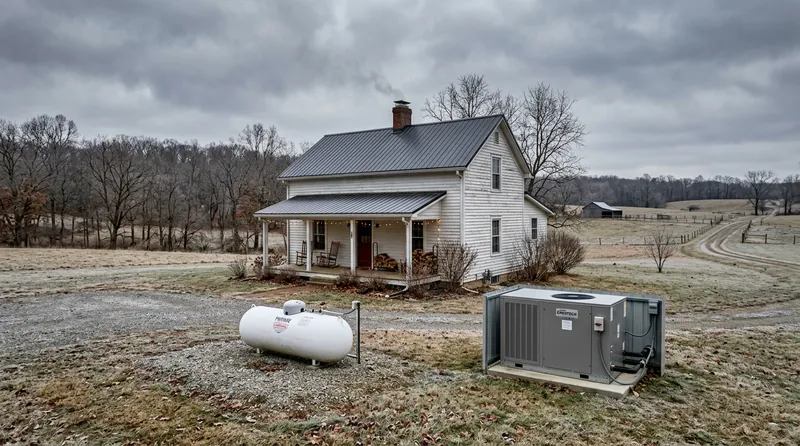
But here's what most of those homeowners don't know: if you're on propane, you're probably sitting on the ideal property for a geothermal installation. The rural land that surrounds your home is a massive financial advantage — one that cuts installation costs by $5,000–$15,000 compared to urban geothermal projects. That land advantage is now doing all the work: the 30% federal tax credit that used to sit on top of it expired for property placed in service after December 31, 2025.
Let's go through it.
Who This Article Is For
This comparison is written for rural homeowners who:
- Currently heat (and possibly cool) with propane
- Have at least a quarter to half an acre of property
- Spend $1,500 or more per year on propane — ideally $2,000+
- Plan to stay in their home for at least 10 years
If you're in a dense suburb with a postage-stamp lot, this article is less relevant — your geothermal economics look different. But if you've got a farmhouse, a rural property, or even a rural subdivision lot with room to dig, read on.
How Propane Heating Works (and Its Weaknesses)
A propane furnace works by burning liquefied petroleum gas to produce heat, which is then distributed through your home via ductwork. Modern high-efficiency propane furnaces achieve AFUE ratings of 90–98% — meaning 90–98 cents of every propane dollar turns into usable heat. That's genuinely efficient combustion.
The problem isn't the equipment. It's the fuel.
Propane Price Volatility
Propane is a commodity, traded on global markets and subject to supply disruptions, crude oil price swings, cold-snap demand spikes, and delivery logistics. The national average residential propane price has ranged from under $2.00/gallon in mild years to over $3.20/gallon during the 2022–2023 heating season — a swing that adds hundreds of dollars to a typical heating bill in a single winter.
According to EIA weekly heating fuel data, average residential propane prices have increased roughly 5–6% per year over the past decade when measured across full heating seasons. That's not a trend that favors staying on propane long-term.
No Cooling — A Hidden Cost
Propane furnaces don't cool your home. That's obvious, but the financial implication is often ignored in comparison articles. If you're in a climate that needs summer cooling — and most propane home markets do — you either pay for a separate central AC system or rely on window units. Central AC installation typically runs $3,500–$8,000 for a new system.
We'll come back to this. It matters a lot for the real comparison.
Annual Propane Costs: The Baseline
A typical rural home consuming 700–950 gallons of propane per year (EIA RECS 2020 estimates for heating-dominated climates) spends:
- At $2.40/gallon: $1,680–$2,280/year for heating
- At $2.60/gallon: $1,820–$2,470/year for heating
- During a high-price winter ($3.00+/gallon): $2,100–$2,850/year
Add $400–$800/year for summer cooling (window units or central AC operating costs) and you're looking at a $2,000–$3,500 annual combined heating and cooling budget for a mid-size rural home in a cold climate.
How Geothermal Heating Works
A ground-source heat pump doesn't burn anything. It uses electricity to move heat between your home and the earth — extracting warmth from the ground in winter and rejecting heat back into the ground in summer.
The key efficiency metric is COP (Coefficient of Performance). Where a 96% AFUE propane furnace converts $1.00 of propane into $0.96 of heat, a geothermal system with a COP of 4.0 converts $1.00 of electricity into $4.00 of heat by moving it rather than generating it. For a deeper explanation of the physics, see our guide on how geothermal heat pumps work.
Two other things worth noting:
- It both heats and cools. One system replaces your furnace and your AC. That's not a minor detail — it fundamentally changes the comparison.
- It can heat domestic hot water. Many geothermal systems include desuperheater functionality that provides free or heavily discounted water heating as a byproduct of operation. That's another $300–$600/year off your utility bill depending on your current water heating method.
For rural homeowners thinking about open-loop vs. closed-loop system options: if you have a well with sufficient flow rate and your local regulations permit it, an open-loop system using groundwater can be even more efficient — and in some cases, cheaper to install than a horizontal closed loop.
The Cost Comparison — Year by Year
This is where things get concrete. Let's build out a real comparison using a 1,800 sq ft rural home in a cold climate (upper Midwest, Northern New England) that currently has propane heat and no central AC.
Upfront System Costs
| Item | Propane System | Geothermal System |
|---|---|---|
| Heating equipment | $3,500–$6,000 (furnace) | $8,000–$14,000 (heat pump unit) |
| Cooling equipment | $3,500–$7,000 (separate AC) | Included above |
| Ground loop / loop field | N/A | $7,000–$10,000 (horizontal, rural) |
| Installation / labor | $1,500–$3,000 | Included in loop + unit costs |
| Total before incentives | $8,500–$16,000 | $18,000–$28,000 |
| Federal 30% tax credit (§25D) | None | $0 — expired for property placed in service after Dec 31, 2025 |
| 2026 out-of-pocket | $8,500–$16,000 | $18,000–$28,000 |
At the midpoint of these ranges: propane system ~$12,250, geothermal ~$23,000 out of pocket. The gap is roughly $10,750. Under the 30% federal credit the geothermal midpoint was about $16,000 and the gap about $4,000, which is why older articles describe this as a near-toss-up on upfront cost. It isn't anymore — but it's still well short of the $20,000 gap many homeowners assume when they hear "geothermal is more expensive," because rural land keeps the loop cost down.
For details on what drives those installation costs and where you can reduce them, see our full geothermal installation cost guide.
Annual Operating Costs
This is where geothermal's structural advantage becomes clear. Using a COP of 4.0 and a rural electricity rate of $0.12/kWh (below the national average — rural electric cooperatives often have lower rates):
- Propane heating: 825 gallons × $2.50/gallon = $2,063/year
- Propane home summer cooling (window units or AC): ~$400–$600/year
- Propane total heating + cooling: ~$2,463–$2,663/year
vs.
- Geothermal heating: ~$650–$850/year in electricity (same thermal output, 4x the efficiency)
- Geothermal cooling: ~$150–$250/year (same COP logic in reverse — very efficient)
- Geothermal total heating + cooling: ~$800–$1,100/year
Annual savings: approximately $1,400–$1,600/year in a mid-range scenario. With hot-water desuperheater savings added, call it $1,600–$2,000/year in total energy savings.
10-Year and 20-Year Picture
| Timeframe | Propane System (cumulative) | Geothermal (cumulative) | Geothermal Savings |
|---|---|---|---|
| Year 1 | $14,500 | $24,600 | −$10,100 |
| Year 5 | $26,000 | $29,600 | −$3,600 |
| Year 10 | $38,000 | $35,600 | +$2,400 |
| Year 20 | $62,000 | $47,600 | +$14,400 |
Assumptions: $12,000 propane system, $23,000 geothermal out-of-pocket, $2,500/yr propane operating costs, $950/yr geothermal operating costs. No propane price escalation factored in — the real savings are higher. These rows previously used a $16,000 net geothermal figure, which assumed the 30% federal §25D credit; that credit is not available for property placed in service after December 31, 2025, so each geothermal row is $7,000 higher than we published before.
The crossover now lands around year 7 against a propane system you were going to buy anyway, rather than the year-4 crossover the credit used to produce. Measured against doing nothing, simple payback on the full $23,000 is roughly 15 years. With a modest 3% annual propane price escalation (well below the 10-year historical trend), both numbers come in meaningfully faster.
The Rural Advantage: Why Propane Homes Are Perfect Geothermal Candidates
On urban lots without room to trench horizontally, installers drill vertically instead — sometimes 400 feet down. That's expensive: vertical boring adds roughly $5,000–$15,000 compared to horizontal trenching. Homeowners on small lots often have no choice.
Rural propane homeowners almost always do.
A horizontal closed-loop system needs roughly a quarter to a half acre of trenchable land for a 3-ton system (sized for a typical 1,500–2,500 sq ft home). The trenches run 4–6 feet deep, and the land is backfilled and usable afterward — you can drive over it, mow it, park on it. Most rural properties have this space without even thinking about it.
That space advantage is worth real money:
- Horizontal loop install: $7,000–$10,000
- Vertical bore install (same home, tight lot): $15,000–$22,000
Rural propane homeowners get the cheaper option by default. And because they're off the natural gas grid — no cheap alternative fuel — geothermal is competing against a genuinely expensive heating source rather than against $1.20/therm natural gas.
Add to that: rural electric rates are often lower than urban rates. Many rural co-op members pay $0.10–$0.13/kWh compared to the national average of $0.17/kWh. Lower electricity costs improve geothermal's operating economics further.
Federal and State Incentives
The federal incentive picture changed sharply at the end of 2025, and not in homeowners' favor.
Section 25D Residential Clean Energy Credit — Expired
❌ The federal 30% credit is no longer available
The 30% credit under IRC §25D applied to ground-source heat pumps placed in service through December 31, 2025. It is not available for property placed in service after that date (One Big Beautiful Bill Act, P.L. 119-21). If you are installing in 2026, budget the full cost. Source: IRS — Residential Clean Energy Credit, verified July 2026.
For historical reference, here is what the credit did for a propane-to-geothermal conversion placed in service through the end of 2025 — and what those same systems cost today:
- $18,000 installed system → netted $12,600 under the credit → $18,000 out of pocket in 2026
- $22,000 installed system → netted $15,400 under the credit → $22,000 out of pocket in 2026
- $28,000 installed system → netted $19,600 under the credit → $28,000 out of pocket in 2026
The IRA had scheduled the credit to run at 30% through 2032 with step-downs in 2033 and 2034; that schedule was repealed before it took effect. If you placed a system in service in 2025 or earlier and haven't claimed the credit, talk to a tax professional about the return year it belongs on. For more, see our 2026 federal geothermal tax credit guide.
State Incentives
With the federal credit gone, state and utility programs are the only incentives left — and they were not affected by the federal repeal. A few examples relevant to high-propane states:
- Maine: Efficiency Maine offers rebates up to $2,000 on qualifying heat pump installations, including geothermal
- Minnesota: Xcel Energy and other utilities offer demand-side management rebates for high-efficiency heat pumps
- Vermont: Efficiency Vermont has heat pump incentive programs; Vermont also allows utility on-bill financing
- Wisconsin, Iowa, and other Midwest states: Check with your rural electric cooperative — many have their own equipment rebates that aren't in state databases
The most complete database of current state and utility incentives is DSIRE (dsireusa.org). Always check there before finalizing your budget — utility programs in particular change frequently.
When Geothermal Doesn't Make Sense for Propane Homes
I'm not here to tell you geothermal is the right answer for every propane homeowner. It isn't. Here's when to walk away:
You're Selling in Under 5–7 Years
Geothermal does add resale value — studies show meaningful premiums for energy-efficient homes — but it's not guaranteed to recoup full installation costs in a short sale. If you're planning to move in less than 5 years, the payback math doesn't work in your favor. Consider a high-efficiency propane upgrade instead, which will also improve resale appeal at lower cost.
Very Small Lot (<¼ Acre)
If you're on a rural lot that's smaller than a quarter acre — some rural subdivisions do exist — you may not have room for horizontal boring and would need vertical bores. That changes the cost equation. Get actual quotes with a site assessment before dismissing the option, though. Directional drilling and slinky-style horizontal loops can sometimes work on tighter lots than expected.
Your Annual Propane Bill Is Under $1,000
If you heat a small, well-insulated home in a mild climate and your propane cost is genuinely low, the payback timeline stretches out considerably. The economic case strengthens with higher propane usage — if you're only spending $900/year, you'd need 20+ years to break even.
Rocky or Difficult Soil Conditions
Some rural properties — particularly in New England's rocky glacial terrain — have soil conditions that significantly increase excavation costs. A site assessment from a qualified installer will reveal this before you commit. Don't skip the assessment step.
Real-World Example: A Minnesota Farmhouse Conversion
Note: This is an illustrative example based on typical system parameters and real EIA data. Actual costs vary by property, contractor, and local conditions.
A 2,200 sq ft farmhouse outside Rochester, Minnesota. (For a Southeast example, see our East Tennessee propane analysis — similar dynamics, warmer winters, shorter payback.) The family burns about 900 gallons of propane per year — $2,250 at $2.50/gallon. They also run two window AC units in summer, adding about $350 in electricity. Total annual heating/cooling: ~$2,600.
Their property: 3 acres of farmland. Soil: clay loam, easy to trench.
A local IGSHPA-certified installer quotes a 4-ton horizontal closed-loop system at $24,000 installed. Federal §25D credit: $0 — expired for property placed in service after December 31, 2025. Out-of-pocket: $24,000.
At $1,600 in annual savings (from $2,600 down to ~$1,000 in electricity), their simple payback is 15 years. If Minnesota propane prices increase just 3% per year — less than the historical trend — that shortens to roughly 12 years. Under the 30% federal credit this same project netted $16,800 and paid back in 10.5 years (8.5 with escalation), so the repeal added about four and a half years. The ground loop is warranted for 50 years and the heat pump unit will last 20–25, so the system still outlives its payback comfortably — but this is now a long-horizon decision.
They'll never call a propane delivery service again.
How to Get Started
If you're ready to take the next step, here's the actual process:
- Find a certified installer. Look for IGSHPA-certified contractors in your area. IGSHPA certification is the industry standard for loop designers and installers. This matters more than it does with regular HVAC — geothermal loop design requires actual engineering competence.
- Request a site assessment. A reputable installer will assess your soil conditions, lot size, existing ductwork, and heating load before quoting. Beware anyone who gives you a firm price without visiting the property.
- Get itemized quotes for horizontal AND vertical options. Even if you think you have room for horizontal, get both quoted. Sometimes the difference is smaller than expected, and vertical loops have their own advantages (smaller land disturbance, consistent performance regardless of surface temperature).
- Check DSIRE for state and utility incentives before signing anything. These now stand on their own — there is no federal credit left to layer them on top of.
- Do not plan on a federal credit. IRS Form 5695 no longer applies to geothermal placed in service after December 31, 2025 — the §25D credit expired. Keep your receipts and contractor invoices anyway; state and utility rebate applications will ask for them.
Bottom Line
The summary version: if you're heating a rural home with propane, spending $1,500+ per year on fuel, and you own the land around your house, geothermal is worth a serious look. The reasons that propane homeowners are often the best geothermal candidates are:
- Land for horizontal loops — the cheaper installation option by $5,000–$15,000
- No cheap alternative fuel — you're not competing against $1.20/therm natural gas
- High operating costs — propane price volatility creates a large savings opportunity
- Missing central AC — geothermal replaces propane heat AND adds cooling you likely don't have
Quick Reference: Propane vs. Geothermal at a Glance
💰 ~$8,500–$16,000 installed
📆 ~$2,000–$2,800/yr operating
🔄 System lifespan: 15–20 years
📈 Fuel cost: market-variable
❄️ Requires separate cooling system
✅ Lower upfront cost
💰 ~$18,000–$28,000 out of pocket (no federal credit)
📆 ~$800–$1,100/yr operating
🔄 System lifespan: 20–24 years (50+ loop)
📈 Fuel cost: stable electricity
❄️ Heating AND cooling included
✅ Lower lifetime cost
The 30% federal tax credit is already gone — it expired for property placed in service after December 31, 2025. What still argues for acting is the propane bill itself, the rural land advantage on loop cost, and whatever your state and utility currently offer.
Questions about whether your specific property is a good candidate? Start with our property suitability guide, then get a site assessment from a qualified installer. That conversation is usually free and will tell you more than any article can.