
In This Article
Let's cut right to what everyone actually wants to know: is geothermal worth the money?
You've probably heard the pitch — "saves 50-70% on heating costs!" and "pays for itself!" But you've also probably seen the price tags and thought, "There's no way that math works out." The truth, as usual, is somewhere in the middle. And it depends a lot on your specific situation.
This isn't a sales pitch for geothermal. It's an honest look at the numbers, using real 2025-2026 market data and DOE figures. We'll walk through upfront costs, operating costs, tax incentives, lifespan differences, and total cost of ownership. Then you can decide for yourself.
Upfront Costs: Let's Get the Sticker Shock Out of the Way
There's no sugarcoating this part. Geothermal heat pumps cost significantly more to install than a traditional furnace and air conditioning setup. Here's what you're looking at in 2025-2026:
Traditional HVAC (Gas Furnace + Central AC)
Replacing both your furnace and central air conditioning at the same time — which is what most contractors recommend — typically runs $5,000 to $12,500, with an average around $7,500 according to Angi's 2025 data. Higher-end systems or complicated installations can push that toward $18,000, but most homeowners land somewhere in the middle.
Geothermal Heat Pump
Now here's where things get real. Based on multiple cost tracking sources (HomeAdvisor, HomeGuide, and Fixr), here's the current range:
- Horizontal closed-loop: $15,000 to $50,000+ (average around $30,000)
- Vertical closed-loop: $20,000 to $80,000+ (average around $42,000)
Yeah. That's a wide range, and the numbers at the top end might make you close this tab. But those high-end numbers usually involve large homes, difficult soil conditions, or vertical drilling in expensive markets. A typical 2,000 sq ft home with horizontal loops and decent soil conditions is more likely in the $18,000-$30,000 range before incentives.
Why Such a Wide Price Range?
Geothermal installation costs vary wildly because the biggest expense is the ground loop, and that's driven by your specific property. Horizontal loops need trenching (cheaper, but need yard space). Vertical loops need drilling (expensive, but use less land). Rock soil costs more to drill than clay. Rural areas with fewer installers may charge more. The heat pump unit itself is fairly standardized — it's the ground work that creates the price spread.
Operating Costs: Where Geothermal Fights Back
Here's where the story starts to flip. Geothermal systems are dramatically cheaper to operate than conventional heating and cooling.
According to the DOE's Federal Energy Management Program, which models energy costs across different U.S. climate regions, ENERGY STAR-rated geothermal systems cost roughly:
- $360/year in the Southwest
- $664/year in Northern climates
- $893/year in the Southeast
For comparison, ENERGY STAR estimates that a typical U.S. household spends about $1,900/year on energy, with almost half going to heating and cooling — roughly $950/year on average for climate control.
So geothermal is saving most homeowners somewhere between $200 and $600 per year on heating and cooling, depending on climate, home size, and what system they're replacing. Homes replacing older, less efficient equipment or switching from expensive fuels like propane or oil will see the biggest savings — sometimes over $1,500/year.
"Geothermal heat pumps can reduce energy consumption by 25% to 50% compared to air-source heat pump systems."
— U.S. Department of Energy, Guide to Geothermal Heat Pumps (2025)
That's not marketing hype — that's the DOE. But notice they said "compared to air-source heat pumps," which are already more efficient than a traditional furnace + AC combo. Against older conventional systems, the savings can be even bigger.
Don't Forget Maintenance
Traditional HVAC systems need annual professional maintenance — typically $150-$300/year for the furnace and AC together. Filters, combustion checks, refrigerant levels, ductwork inspections. Plus the occasional expensive repair as components age.
Geothermal systems have fewer moving parts and no outdoor unit exposed to the elements. Maintenance costs are generally lower — mostly filter changes and periodic checks of the circulating pump and heat exchanger. No outdoor compressor to replace, no defrost cycles to worry about, no refrigerant lines running through your walls to the outside.
The Federal Tax Credit (and a 2026 Update)
This is where things get interesting — and a little complicated.
Under the Inflation Reduction Act (IRA), geothermal heat pumps have been eligible for a 30% federal tax credit under Section 25D of the tax code. That's a dollar-for-dollar credit against your tax bill — not just a deduction. On a $25,000 installation, that's $7,500 off your federal taxes.
Both ENERGY STAR and the IGSHPA have promoted this credit as available through 2032, with a step-down afterward.
⚠️ Important 2026 Update: Check the Current Status
The 2025 IRS Form 5695 instructions (published January 2026) include language suggesting residential clean energy credits cannot be claimed for expenditures after December 31, 2025. This appears to conflict with earlier IRA guidance showing the credit available through 2032. As of March 2026, the IRS website shows mixed language on this point. If you're planning a 2026 installation, consult a tax professional for the most current guidance before relying on this credit. We'll update this article as the situation clarifies.
Regardless of the federal credit's current status, many states offer their own geothermal incentives — rebates, state tax credits, property tax exemptions, or utility rebates. Check our state-by-state guides for what's available in your area.
Lifespan: The Hidden Cost Advantage
This is the part most cost comparisons gloss over, and honestly, it's one of geothermal's strongest arguments.
According to the DOE:
- Geothermal indoor components: up to 24 years
- Geothermal ground loop: 50+ years
And from ENERGY STAR's replacement guidance:
- Central air conditioner: consider replacing after 10 years
- Gas furnace: consider replacing after 15 years
See the math here? Over a 50-year period, you'd potentially go through 3-5 air conditioners and 2-3 furnaces with traditional HVAC. With geothermal, the ground loop — the most expensive part — keeps going the entire time. You replace the indoor heat pump unit once or twice, and each replacement costs a fraction of the original installation because the ground loop's already in place.
Let's put some rough numbers on this. Assuming 2026 costs:
- Traditional HVAC over 50 years: 3 furnace replacements ($6,000 each) + 4 AC replacements ($4,500 each) = roughly $36,000 in equipment alone, not counting inflation or maintenance
- Geothermal over 50 years: 1 original install + 1-2 indoor unit replacements ($5,000-$8,000 each) = original cost + roughly $10,000-$16,000 for replacements
Total Cost of Ownership Over 20 Years
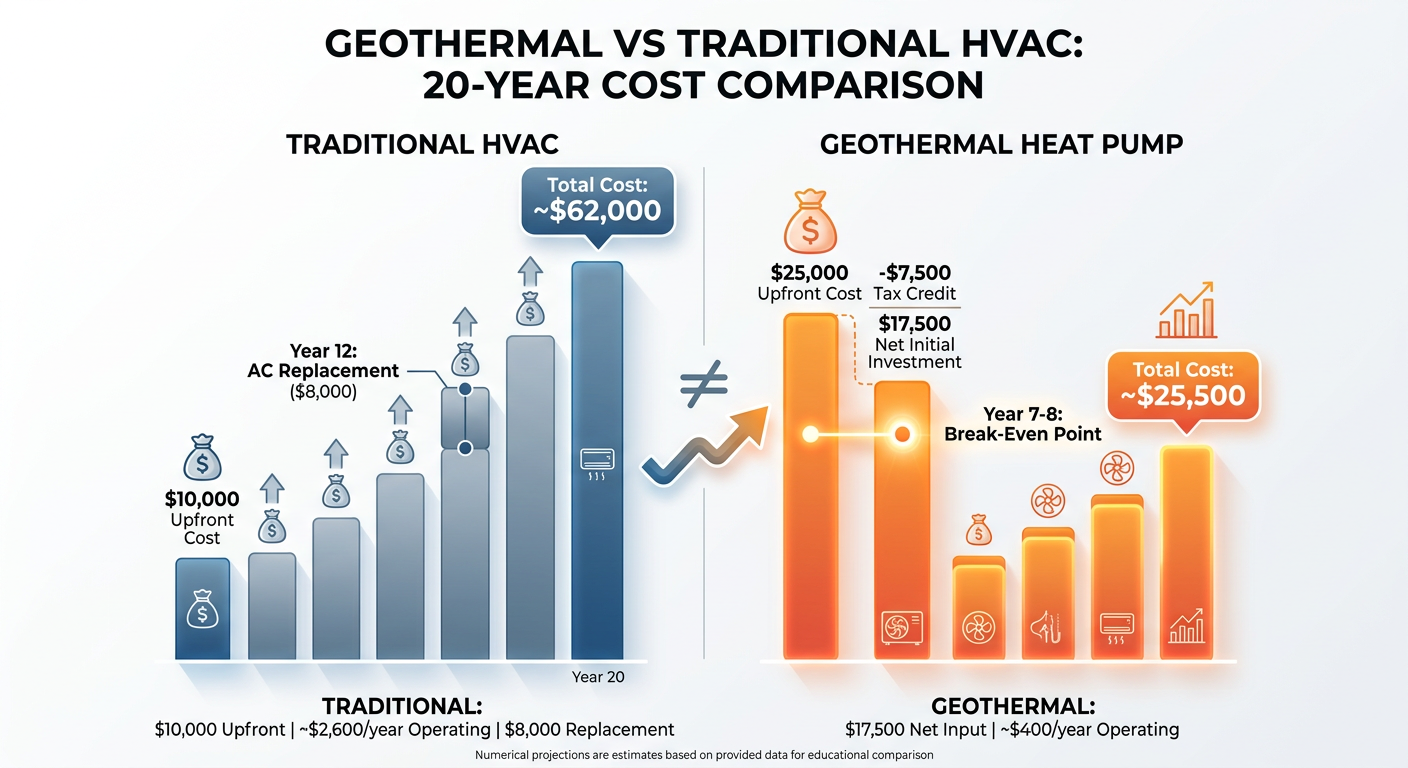
Alright, let's try to put this all together with a realistic 20-year comparison. We'll use middle-of-the-road numbers for a typical 2,000 sq ft home:
Scenario: Traditional Gas Furnace + Central AC
- Initial installation: $8,000
- Annual operating cost: ~$950/year × 20 = $19,000
- AC replacement at year 12: $5,000
- Annual maintenance: $200/year × 20 = $4,000
- 20-year total: ~$36,000
Scenario: Geothermal (Horizontal Closed-Loop)
- Initial installation: $25,000
- Federal tax credit (30%, if available): -$7,500
- Net upfront: $17,500
- Annual operating cost: ~$550/year × 20 = $11,000
- Annual maintenance: $100/year × 20 = $2,000
- 20-year total: ~$30,500
Without the tax credit, geothermal's 20-year cost is ~$38,000 — roughly a wash with traditional. With the credit, geothermal saves about $5,500 over 20 years. If you're replacing propane or oil heat (where annual costs can be $2,000-$3,000), the savings are much more dramatic.
The break-even point in this scenario? About 7-8 years with the tax credit, or 12-14 years without it.
These Numbers Are Illustrative
Every home is different. Your actual costs depend on your climate, home size, soil conditions, local energy prices, existing ductwork, and available incentives. These scenarios use national averages to show the general dynamics. Get quotes from qualified installers for your specific situation — the numbers could be significantly better or worse.
When Geothermal Makes Financial Sense
The economics of geothermal are strongest when several of these factors line up:
- You have high heating costs. Homes heated with propane, oil, or electric resistance see the biggest savings. If you're paying $3,000+/year on heating, geothermal's payback accelerates dramatically.
- You're building new. Installing geothermal during new construction is significantly cheaper — the yard's already torn up, ductwork is being designed from scratch, and horizontal trenching is easy before landscaping.
- Tax credits and rebates are available. A 30% federal credit plus state incentives can take $10,000-$15,000 off the installed price. That changes the math completely.
- You plan to stay long-term. If you're in your forever home (or at least planning 10+ years), you'll see the full payback. The system also adds real estate value — studies have shown geothermal homes sell for a premium.
- Both heating and cooling loads are significant. Geothermal handles both. If you're in a climate that needs real heating AND real cooling, you're getting double the value from one system.
- Your property supports horizontal loops. If you've got the yard space for horizontal trenching, installation costs drop compared to vertical drilling.
When It Probably Doesn't
Be honest with yourself about these:
- Very mild climates. If your heating and cooling costs are already under $600/year, there's not enough savings to justify the upfront investment.
- You're moving soon. If you're not staying at least 7-10 years, the economics probably don't work unless you're in a very high-energy-cost situation.
- Difficult site conditions. Solid rock close to the surface, tiny lot with no drilling access, or restrictive HOA rules can make installation impractical or very expensive.
- Cheap natural gas area. If you're heating with inexpensive natural gas (under $1/therm), the annual savings gap narrows enough that payback stretches beyond 15 years.
- You can't handle the upfront cost. Even with financing, a $20,000+ project isn't feasible for everyone. There's no shame in that — a high-efficiency conventional system is still a solid choice.
The Verdict
Geothermal is not a slam dunk for every homeowner. The upfront costs are real, and anybody who tells you otherwise is selling something.
But here's what the data shows: for homeowners who plan to stay in their home long-term, who face significant heating and cooling costs, and who can take advantage of available incentives, geothermal is often the cheaper option over the life of the system. Not by year one or year five, necessarily — but by year ten or fifteen, and dramatically so by year twenty.
The ground loop lasting 50+ years is the real game-changer. Traditional HVAC is a revolving door of replacements every 10-15 years. Geothermal is a one-time infrastructure investment that keeps paying you back.
The smartest thing you can do? Get real quotes for your specific home and situation, run the numbers with your actual energy costs and available incentives, and make the decision with your eyes open. The math either works or it doesn't — and now you know what to look for.
Sources
- U.S. Department of Energy, Energy Saver — "Geothermal Heat Pumps"
- U.S. DOE, Federal Energy Management Program — "Purchasing Energy-Efficient Geothermal Heat Pumps"
- ENERGY STAR — "Geothermal Heat Pumps Tax Credit"
- ENERGY STAR — "When Is It Time to Replace?"
- IGSHPA — "About Geothermal" and "IRA Provisions"
- IRS — 2025 Form 5695 Instructions (January 2026)
- HomeAdvisor — Geothermal Installation Costs (2025)
- HomeGuide — Geothermal Heat Pump Costs (2026)
- Fixr — Geothermal Heat Pump Installation Costs (2026)
- Angi — Furnace + AC Replacement Costs (2025)