
In This Guide
- Why New Construction Changes the Math
- The Real Incremental Cost
- Payback: 3–5 Years (Not 8–12)
- Builder Advantages
- Buyer Advantages
- Energy Code Compliance
- Builder Programs & Production Housing
- Design Considerations for New Builds
- Full Cost Comparison: New Construction
- New Construction Case Studies
- Financing Options for Buyers
- Frequently Asked Questions
- Sources
Why New Construction Changes the Math
Most geothermal cost discussions focus on retrofits — replacing an existing HVAC system with a ground-source heat pump. That comparison produces intimidating numbers: $20,000–$38,000 gross cost. But new construction is fundamentally different.
In a new build, you're installing HVAC regardless. The question isn't "geothermal vs. nothing" — it's "geothermal vs. the conventional system you were going to install anyway." That reframes the math entirely:
- No existing system to scrap. In a retrofit, you're throwing away a working furnace/AC. In new construction, the conventional system hasn't been bought yet.
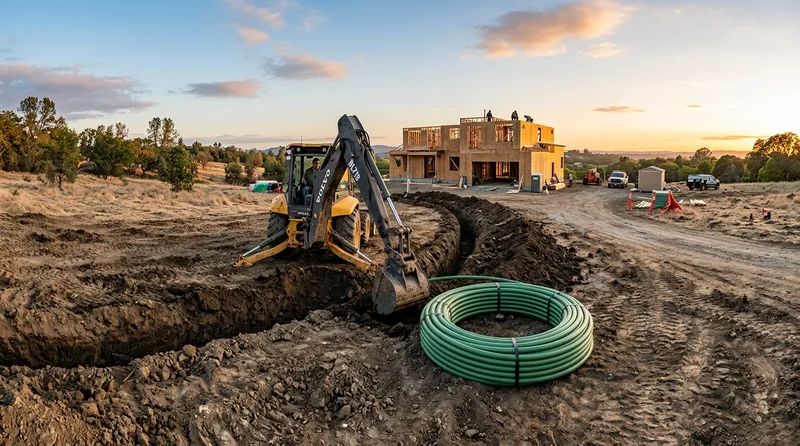
- Ground is already torn up. Foundation excavation, utility trenching, and grading are already happening. Adding ground loop trenches to an active construction site costs a fraction of excavating a finished yard.
- Ductwork is being designed anyway. No need to retrofit ducts into existing walls. The geothermal system is designed into the house from the start.
- The cost is rolled into the mortgage. Instead of writing a $25,000 check, the incremental cost adds $40–$75/month to a mortgage payment — often less than the monthly energy savings.
The Real Incremental Cost
| System | Typical New Construction Cost |
|---|---|
| Conventional: Gas furnace + central AC (14 SEER) | $8,000–$14,000 |
| High-efficiency: Gas furnace (96% AFUE) + AC (18 SEER) | $12,000–$18,000 |
| Air-source heat pump (cold-climate) | $10,000–$16,000 |
| Geothermal heat pump + ground loop | $20,000–$32,000 |
The Incremental Premium
| Comparison | Incremental Cost | After 30% ITC |
|---|---|---|
| Geo vs. standard gas+AC | $12,000–$18,000 | $6,000–$8,400 |
| Geo vs. high-efficiency gas+AC | $8,000–$14,000 | $2,000–$5,200 |
| Geo vs. air-source heat pump | $10,000–$16,000 | $4,000–$7,200 |
The federal 30% ITC applies to the FULL geothermal system cost — not just the increment. This is one of the most misunderstood aspects of the tax credit. If your geothermal system costs $24,000, you get a $7,200 credit — even though the incremental cost over conventional was only $12,000. That $7,200 credit against a $12,000 increment means you're effectively paying only $4,800 more than you would have for a standard system.
In some scenarios — particularly when comparing against high-efficiency conventional systems with state incentives stacked — the net incremental cost of geothermal in new construction can be under $3,000.
Payback: 3–5 Years (Not 8–12)
Retrofit payback is typically quoted at 8–12 years because you're paying the full system cost. New construction payback is calculated on the increment — the extra cost above what you'd have spent anyway.
| Scenario | Incremental Cost (After ITC) | Annual Savings | Payback |
|---|---|---|---|
| Geo vs. gas furnace+AC (cold climate) | $6,000–$8,400 | $800–$1,400 | 4–7 years |
| Geo vs. gas furnace+AC (moderate climate) | $6,000–$8,400 | $500–$900 | 7–12 years |
| Geo vs. oil boiler+AC (Northeast) | $4,800–$7,200 | $1,200–$2,000 | 3–5 years |
| Geo vs. propane+AC (rural) | $4,800–$7,200 | $800–$1,600 | 3–6 years |
| Geo vs. electric resistance (any region) | $4,000–$6,000 | $1,500–$2,500 | 2–3 years |
Annual savings calculated against the fuel cost of the conventional alternative. In regions where the conventional system would have been oil or propane, the payback is fastest because those fuels are most expensive.
Builder Advantages
Product Differentiation
In competitive housing markets, geothermal is a genuine differentiator. Buyers increasingly research energy costs before purchasing. A listing that says "geothermal heating and cooling — estimated $100/month" stands out against competitors at $250–$400/month.
Energy Code Compliance
As building codes tighten (IECC 2021 and 2024 adoption), geothermal makes compliance easier. The system's COP of 3.5–4.5 exceeds code minimums by a wide margin, often allowing builders to simplify envelope specifications while still meeting or exceeding energy requirements. Geothermal can offset the need for triple-pane windows, continuous exterior insulation, or other expensive envelope upgrades.
Reduced Warranty Calls
Geothermal systems have fewer moving parts than a furnace+AC combination. The ground loop has a 50+ year warranty. The indoor heat pump unit typically lasts 20–25 years (vs. 15–20 for a furnace and 12–15 for an AC compressor). Fewer equipment failures mean fewer warranty callbacks.
Marketing Value
"Net-zero ready," "ENERGY STAR certified," "LEED for Homes" — geothermal helps builders qualify for green certifications that command premium pricing. Studies show green-certified homes sell for 3–8% more than comparable non-certified homes.
Buyer Advantages
Mortgage-Rolled Cost
The incremental cost of geothermal in new construction gets absorbed into the mortgage. On a $6,000 increment at 6.5% over 30 years, that's ~$38/month added to your payment. If your monthly energy savings are $80–$150/month, you're cash-flow positive from the first mortgage payment.
No Disruption
In a retrofit, installing geothermal means drilling in your yard, possibly tearing out ductwork, and living through construction. In new construction, it happens before you move in. You never experience the mess.
Right-Sized System
New construction allows proper Manual J load calculations on the final building design — not estimated from an existing home with unknown insulation, air leakage, and window performance. The result: a perfectly sized system that runs efficiently without the oversizing that plagues many retrofit installations.
Appraisal Value
Geothermal is increasingly recognized in home appraisals. The Appraisal Institute has published guidance on valuing green features including geothermal systems. In a new home, the appraised value increase often exceeds the incremental cost — meaning your equity position is actually better with geothermal than without.
Energy Code Compliance
The IECC (International Energy Conservation Code) is tightening residential energy requirements with each cycle. Geothermal's high COP provides a massive compliance advantage:
IECC 2021
- Energy Rating Index (ERI) path: geothermal systems score exceptionally well, often achieving ERI 40–50 (code requires 52–55 depending on climate zone)
- Performance path: geothermal's COP 3.5–4.5 exceeds minimum equipment efficiency by 200–300%, creating substantial "credit" that can offset other building components
IECC 2024 (Adoption Underway)
- Stricter envelope requirements in most climate zones
- Electric-ready provisions in some jurisdictions
- Geothermal allows builders to meet the tighter standards without maxing out every envelope specification
State-Level Codes and Mandates
- New York: All-electric new construction required starting 2026 (Local Law 154). Geothermal is the most efficient electric heating option, especially in upstate NY where winter temperatures challenge air-source heat pumps.
- Massachusetts: Stretch Energy Code and Specialized Opt-in Code push toward electrification. Communities adopting these codes see geothermal as the premium compliance path.
- Washington State: 2021 code requires electric space heating or very high-efficiency gas. Geothermal qualifies with margin.
- California: 2022 code effectively requires heat pumps in new residential construction. Geothermal exceeds requirements by wide margin in all climate zones.
Builder Programs & Production Housing
Dandelion Energy — Northeast New Construction
Dandelion Energy has emerged as the leading residential geothermal installer in the Northeast, with a growing new construction program. Their approach: standardized system packages designed for production builders, with streamlined permitting and installation. Dandelion has partnered with builders in New York, Connecticut, and Vermont — including a notable collaboration with Green Mountain Power in Vermont.
Production Builder Interest
While geothermal has historically been a custom-home feature, production builders are beginning to explore it:
- Planned community installations: When an entire subdivision uses geothermal, the per-home drilling cost decreases 15–25% due to mobilization efficiencies (one drill rig moves from lot to lot without re-mobilizing)
- Lennar and KB Home: Have explored geothermal in select communities in Colorado and other Western states, though these remain pilot-scale programs [NEEDS VERIFICATION]
- Community geothermal districts: Some developments are installing shared ground loop fields that serve multiple homes — reducing per-unit cost and eliminating individual lot drilling requirements
Community Geothermal / District Systems
An emerging model: shared ground loop infrastructure serving 10–200+ homes. The developer installs a central bore field (or horizontal field) during site development, and each home connects via a header pipe. Advantages:
- 30–40% lower per-home loop cost vs. individual installations
- Thermal load diversity — one home's cooling load benefits another's heating, improving overall system efficiency
- Simpler utility billing model — geothermal "service" included in HOA or utility charge
- Cities exploring this: Framingham MA, Brooklyn NY pilot programs, Whisper Valley TX (operational since 2019 with 7,500+ planned homes)
Design Considerations for New Builds
Loop Type Selection
New construction opens options that retrofits often don't:
- Horizontal loops: If the lot is large enough and excavation is already happening for foundation/utilities, horizontal loops can be installed during grading — the cheapest possible loop installation
- Vertical loops: Standard for smaller lots. Can be drilled before foundation pour to avoid access conflicts later
- Shared/district loops: Only possible in planned developments, but offer the best per-unit economics
Ductwork Design
Geothermal delivers air at 90–110°F (vs. 130–160°F for a furnace). This means:
- Ducts should be sized for slightly higher airflow at lower temperature
- Supply registers should be located in floors or low walls (warm air rises naturally)
- Consider dedicated dehumidification in humid climates — geothermal's lower supply temperature can cause comfort issues if ductwork isn't designed for it
Domestic Hot Water
Add a desuperheater during installation — it captures waste heat from the heat pump's cooling cycle to preheat domestic hot water. In summer, it can provide 50–70% of your hot water essentially free. Cost: $500–$1,500 as an add-on during new construction (vs. $2,000–$3,000 as a retrofit add-on).
Future-Proofing
New construction is the time to install conduit for future solar connections, prewire for an integrated solar+geothermal system, and size the electrical panel to handle the heat pump's load alongside EV charging.
Full Cost Comparison: New Construction
For a 2,400 sq ft new construction home in Climate Zone 5 (Northeast/Midwest):
| Cost Category | Gas Furnace + AC | Air-Source HP | Geothermal |
|---|---|---|---|
| Equipment | $5,000–$8,000 | $6,000–$10,000 | $7,000–$12,000 |
| Installation + ductwork | $3,000–$6,000 | $4,000–$6,000 | $4,000–$7,000 |
| Ground loop | — | — | $10,000–$16,000 |
| Gas line installation | $1,500–$3,000 | — | — |
| Gross total | $9,500–$17,000 | $10,000–$16,000 | $21,000–$35,000 |
| Federal ITC (30%) | — | $3,000–$4,800 | $6,300–$10,500 |
| State incentives (typical) | — | $500–$2,000 | $2,000–$7,000 |
| Net cost | $9,500–$17,000 | $6,500–$9,200 | $8,700–$17,500 |
| Incremental vs. gas | — | −$3,000 to −$7,800 | −$800 to +$500 |
With strong state incentives (NY 25% credit, VT $2,100/ton, ME $3,000 flat), geothermal in new construction can be cost-neutral or even cheaper than a conventional gas system — before you save a single dollar on operating costs. The gas line installation you DON'T need ($1,500–$3,000) is a hidden savings.
25-Year Total Cost of Ownership
| System | Net Install | 25-yr Operating | Equipment Replacement | 25-yr Total |
|---|---|---|---|---|
| Gas furnace + AC | $12,000 | $37,500 | $10,000 (yr 15) | $59,500 |
| Air-source HP | $7,500 | $32,000 | $8,000 (yr 15) | $47,500 |
| Geothermal | $12,000 | $25,000 | $0 (25-yr life) | $37,000 |
Over 25 years, geothermal saves $22,500 vs. gas and $10,500 vs. air-source in new construction. The ground loop (50+ year life) outlasts the mortgage and the first two owners.
New Construction Case Studies
Case Study 1: Carmel, Indiana — 2,600 sq ft New Build, 2.7-Year Incremental Payback
- Home: 2,600 sq ft two-story, gas available, Hamilton County
- Builder's standard HVAC quote: $14,000 (96% AFUE furnace + 16 SEER AC + gas line)
- Geothermal installed cost: $26,000 (3-ton vertical, 3 bores at 250ft in glacial till)
- Incremental cost: $12,000
- Federal ITC 30% (on full $26,000): −$7,800
- Net incremental cost: $4,200
- Annual savings vs. gas: $1,560/year (Indiana electricity at 12.87¢/kWh)
- Incremental payback: $4,200 ÷ $1,560 = 2.7 years
- Mortgage impact: $4,200 at 6.5% over 30 years = $27/month. Monthly savings = $130. Net: +$103/month from day one.
The critical math: the 30% ITC applies to the full $26,000, not just the $12,000 increment. That $7,800 credit against a $12,000 increment means the buyer paid only $4,200 more — and saves $1,560/year. This is the new construction advantage. See our Indiana geothermal guide for more.
Case Study 2: Stowe, Vermont — Ski Area Custom Home, Cash-Flow Positive From Month 1
- Home: 2,800 sq ft custom timber frame, no gas service, propane alternative
- Propane HVAC quote: $16,000 (high-efficiency propane furnace + AC + propane tank)
- Geothermal installed cost: $32,000 (3.5-ton vertical, mountain schist geology)
- Incremental cost: $16,000
- VT rebate ($2,100 × 3.5): −$7,350
- Federal ITC 30% (on $32,000 − $7,350): −$7,395
- Net incremental cost: $1,255
- VT 0% loan available: Finance the $1,255 at 0% = $10/month
- Annual savings vs. propane: $2,100+ (propane at $3.55/gal in mountain areas)
- Monthly savings: $175
- Net cash flow: +$165/month from day one
In states with strong incentives (Vermont, Maine, New York), new construction geothermal can be nearly free on an incremental basis — especially when the alternative is propane. The VT triple-stack (rebate + ITC + 0% loan) brings the net increment under $1,300. See our Vermont guide.
Financing Options for Buyers
- Roll into mortgage: Most common. The $8,000–$15,000 increment adds $50–$95/month at current rates. If monthly savings exceed this, you're cash-flow positive from day one.
- Energy-efficient mortgage (EEM): FHA and VA offer energy-efficient mortgages that allow borrowers to finance energy improvements beyond the standard loan limit. The geothermal increment can qualify.
- State 0% financing: Vermont ($25,000/15yr), Connecticut (Energize CT), New York (GJGNY) — these programs also apply to new construction, not just retrofits.
- Builder buy-down: Some builders absorb part of the geothermal cost as a marketing investment, knowing it helps sell the home. Ask.
Frequently Asked Questions
The incremental cost over standard gas+AC is $8,000–$15,000 before incentives. After the 30% federal credit (which applies to the full system cost, not just the increment), the effective premium drops to $2,000–$8,000. In strong-incentive states, it can be under $2,000.
3–7 years on an incremental basis (comparing to what the conventional system would have cost). This is significantly faster than retrofit payback (8–12 years) because you're only paying the cost difference, not the full system cost.
Yes — and ask early, ideally before the HVAC subcontract is signed. Geothermal requires coordination with excavation scheduling (loop installation should happen during grading) and electrical panel sizing. If you wait until the house is framed, you've missed the best installation window and costs increase.
Yes — in new construction, the geothermal system is part of the home's total cost and automatically included in the mortgage. A $6,000 net increment at 6.5% over 30 years adds ~$38/month. If your energy savings are $80–$150/month, you're net positive from the first payment.
Studies and appraisal guidance suggest $10,000–$20,000 in added value for geothermal homes. In new construction, this often exceeds the net incremental cost — meaning your equity position is actually better with geothermal than without it.
Shared ground loop fields serving multiple homes can reduce per-unit cost by 30–40%. These are most common in planned developments. Whisper Valley in Austin, TX is the largest example (7,500+ planned homes). If you're buying in a community that offers shared geothermal, it's likely the most cost-effective heating/cooling option available.
Yes — the Section 25D Residential Clean Energy Credit applies to geothermal heat pumps installed in new primary or secondary residences. The 30% applies to the full installed cost of the geothermal system. See our federal tax credit guide for claiming details.
Sources
- DOE — Geothermal Heat Pumps (cost and payback overview)
- IRS — Residential Clean Energy Credit (30% ITC, Section 25D)
- ENERGY STAR — Geothermal Heat Pump Specifications
- ICC — 2021 International Energy Conservation Code (Residential)
- Appraisal Institute — Valuation of Green and Energy-Efficient Features
- IGSHPA — Ground Source Heat Pump Design Standards
- Dandelion Energy — Residential Geothermal Installation (Northeast)
- Whisper Valley Austin — Community Geothermal Development
- NAHB — National Association of Home Builders