
In This Guide
- Vermont's Geothermal Opportunity
- Quick Verdict: Should You Go Geothermal?
- Vermont by the Numbers
- Four Distinct Vermont Markets
- Regional Costs & Three-Scenario ROI
- Case Studies
- Month-by-Month Energy Profile
- Open-Loop System Assessment
- Loop Type Cost Comparison
- Vermont's Complete Incentive Stack
- Solar + Geothermal Stacking
- Vacation Rental & Second Home Analysis
- USDA REAP for Vermont Farms
- How to Claim the Federal Tax Credit
- Vermont Ground Conditions
- Policy Backstop: Why Vermont's Incentives Are Durable
- Geothermal vs. Air-Source in Vermont
- Permits & Getting Started
- Finding a Vermont Installer
- Vermont vs. Neighboring States
- Frequently Asked Questions
- Bottom Line
- Sources
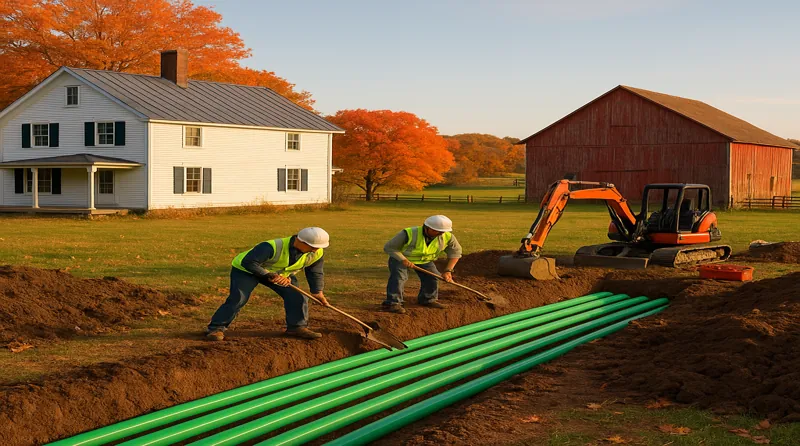
Vermont's Geothermal Opportunity
Roughly 56% of Vermont households heat with oil or propane — two of the most expensive and volatile heating fuels in the country. A typical 2,000 sq ft Vermont home burns ~850 gallons of oil per year. At $3.80/gal, that's $3,230 annually — before a single light turns on.
Geothermal heat pumps change this equation at COP 3.5: 3.5 units of heat per unit of electricity. At Vermont's 18.41¢/kWh rate (EIA 2024), heating that same home costs ~$1,813/year — a $1,417 savings that recurs every year for 25+ years.
Then there's Vermont's incentive stack — the most aggressive in New England:
- Up to $2,100/ton in state/utility rebates through Efficiency Vermont
- 0% financing up to $25,000 over 15 years
- Global Warming Solutions Act legal backstop ensuring these programs persist
The federal piece is gone. The 30% credit under IRC §25D applied to systems placed in service through December 31, 2025 and is not available for property placed in service after that date (One Big Beautiful Bill Act, P.L. 119-21). The Inflation Reduction Act had scheduled 30% through 2032 with step-downs in 2033 and 2034; that schedule was repealed before it took effect. Vermont's state and utility programs were not touched by that repeal.
Fully stacked with what remains, an income-eligible Vermont homeowner can reduce a $24,000 installation to ~$17,200 out of pocket — and finance the rest at 0% interest. That is worse than the ~$9,500 the same stack produced through 2025, but Vermont's state-level package is still the strongest in New England, and no other state in the region comes close.
Quick Verdict: Should You Go Geothermal in Vermont?
| Your Situation | Verdict | Typical Payback |
|---|---|---|
| Oil heat — rural Vermont, most of the state | ✅ Strong yes | ~12 years (full) — longer than the 7–10 published under the federal credit |
| Propane heat — rural VT, no gas service | ✅ Strong yes | Longer than the 6–9 years published under the federal credit |
| New construction — anywhere in VT | ✅ Strong yes | Longer than the 3–5 years (incremental) published under the federal credit |
| 0% loan + oil heat | 🟡 Check the math on your quote | No longer automatically cash-flow positive — see the worked example below |
| USDA REAP eligible farm | ✅ Excellent | ~4 years — longer than the 3–6 published under the federal credit, still the best case in the state |
| Vacation rental — Stowe, Mad River, Okemo area | ✅ Yes — enhanced ROI | Longer than the 5–8 years published under the federal credit |
| Electric resistance heat | ✅ Yes | Longer than the 6–9 years published under the federal credit |
| Natural gas — Burlington, limited areas | ❌ Not on payback alone | Well beyond 35 years |
Payback figures reflect 2026 conditions with no federal tax credit. The 30% credit under IRC §25D applied to systems placed in service through December 31, 2025 and is not available for property placed in service after that date (One Big Beautiful Bill Act, P.L. 119-21). Earlier versions of this table showed shorter paybacks because they netted out that credit. Vermont's state and utility incentives below are unaffected.
Find Vermont Geothermal Installers
Start with an Efficiency Vermont energy audit to right-size the system, then get three quotes. Make sure installers enroll you in the rebate program before breaking ground.
Start with Efficiency Vermont → Free energy audit available · Rebate pre-approval required before installationVermont by the Numbers
| City / Region | HDD | CDD | Ground Temp (°F) | Primary Heating Fuel |
|---|---|---|---|---|
| Burlington / Champlain Valley | 7,000 | 350 | 47–49 | Gas / Oil |
| Montpelier / Central VT | 7,500 | 300 | 46–48 | Oil / Propane |
| Rutland / Western Foothills | 7,200 | 300 | 46–48 | Oil / Propane |
| Stowe / Northern Highlands | 8,000 | 250 | 45–47 | Propane / Oil |
| Brattleboro / Connecticut River Valley | 6,600 | 400 | 48–50 | Oil / Gas |
| Northeast Kingdom (St. Johnsbury, Newport) | 8,500 | 200 | 44–47 | Oil / Propane |
Ground temps of 44–50°F support COP of 3.2–3.8. The Northeast Kingdom's extreme HDDs (8,500+) mean the highest annual savings hours — but also the coldest ground and thin contractor markets. Vermont's minimal cooling season (200–400 CDD) means summer savings are modest; geothermal's value here is overwhelmingly about heating.
Four Distinct Vermont Markets
1. Champlain Valley (Burlington Metro)
Vermont's most populous region. Mix of gas and oil. Green Mountain Power territory. Best contractor access. Burlington Electric Department customers should contact BED directly for current programs. Moderate geology — glacial till with accessible bedrock.
2. Central Vermont / Washington Electric Co-op Territory
Montpelier, Barre, Northfield — WEC serves much of Washington County with historically aggressive per-ton rebates. Predominantly oil/propane. Varied geology: till, hardpan, fractured schist. Strong installer market in central Vermont.
3. Mountain Vacation Markets (Stowe, Mad River, Okemo, Sugarbush)
Propane-dominant. High HDDs. Year-round rental economy — ski season + foliage + summer hiking. Geothermal's stable operating cost is a genuine advantage vs. propane delivery logistics to mountain properties. Large lots often enable horizontal loops where terrain allows.
4. Connecticut River Valley / Southeast VT
Brattleboro, Springfield, Windsor — mildest climate in VT (6,600 HDD), best bedrock conditions (marble, quartzite), strongest open-loop potential in state. Access to both VEC and Efficiency Vermont programs depending on utility territory.
Regional Costs & Three-Scenario ROI
| Region | 3-Ton Vertical (Gross) | 2026 Out-of-Pocket (After VT Rebate) | Geology | Contractor Access |
|---|---|---|---|---|
| Champlain Valley | $20,000–$28,000 | ~$13,700–$21,700 | Till — moderate drilling | Best in VT |
| Central VT (WEC) | $22,000–$32,000 | ~$15,700–$25,700 | Variable — hardpan possible | Good |
| Mountain / Ski Areas | $24,000–$36,000 | ~$17,700–$29,700 | Hard schist/granite on ridges | Moderate |
| CT River Valley | $20,000–$28,000 | ~$13,700–$21,700 | Best — marble/quartzite, open-loop potential | Good |
"2026 Out-of-Pocket" assumes the $2,100/ton rebate ($6,300 for 3-ton) only. There is no federal credit to subtract: §25D applied to property placed in service through December 31, 2025 and is not available after that date. The income-eligible bonus ($500) reduces these further. Verify current incentive amounts at efficiencyvermont.com before budgeting. (For reference, the same jobs landed at ~$8,200–$18,000 when the 30% federal credit still applied.)
Scenario 1: Heating Oil (36.5% of VT Homes)
- Annual oil cost (850 gal × $3.80): ~$3,230/year
- Geothermal cost (18.41¢/kWh, COP 3.5): ~$1,813/year
- Annual heating savings: ~$1,417/year
- Payback (~$17,700 out of pocket after the VT rebate, no federal credit): ~12.5 years
- 0% loan scenario: $17,700 financed at 0% over the full 15-year term = $98/month. Monthly oil savings ~$118. Still cash-flow positive — but only on the 15-year term. On a 10-year term the payment is $148/month, which is $30/month underwater. Run your own term.
- Through 2025 the 30% federal credit brought this to ~$10,200 net and a 7–8 year payback. That credit is not available for property placed in service after December 31, 2025.
Scenario 2: Propane (19.6% of VT Homes)
- Annual propane cost (700 gal × $3.50): ~$2,450/year
- Geothermal cost: ~$1,813/year
- Annual savings: ~$637–$1,400/year (depends on home size)
- Payback (~$17,700 out of pocket, no federal credit): ~13–28 years
- Note: Propane payback varies more widely based on consumption. Large propane users (900+ gal) see stronger economics than average users (550 gal) — that spread is what drives the wide range. The 7–16 year range we published previously assumed the 30% federal credit, which expired for property placed in service after December 31, 2025.
Scenario 3: Natural Gas (17.2% of VT Homes)
- Annual gas cost: ~$1,000–$1,200/year (Burlington rates)
- Geothermal cost: ~$1,813/year
- Net effect: Negative or marginal on operating cost alone
- Payback: Well beyond 35 years. Vermont's rebate helps, but gas-to-geo does not pencil for most existing homes — and it got worse when the 30% federal credit expired for property placed in service after December 31, 2025.
25-Year Total Cost of Ownership
| System | 2026 Install Out-of-Pocket (after VT rebate) | 25-yr Operating | 25-yr Total |
|---|---|---|---|
| Geothermal | $13,700–$25,700 | $45,000–$50,000 | $58,700–$75,700 |
| Oil boiler + window AC | $5,000–$8,000 | $80,750–$103,000 | $85,750–$111,000 |
| Propane furnace + AC | $4,500–$7,000 | $61,250–$75,000 | $65,750–$82,000 |
| Gas furnace + AC | $5,000–$8,000 | $30,000–$37,500 | $35,000–$45,500 |
Oil homes still save roughly $27,050–$35,300 over 25 years vs. staying on oil — down from the $32,550–$45,400 we published when the 30% federal credit applied, because the install column no longer nets it out. The 25-year picture continues to favor geothermal for oil and propane homes; it is the natural-gas comparison that never worked and still doesn't.
About the examples below
The homes in these examples are representative scenarios, not real customers. We do not install geothermal systems and we have not visited these properties. Each scenario models a typical home for the area using real equipment pricing, local fuel and electricity rates, and the incentive programs described above — but the house, the owner and the invoice are constructed to show how the arithmetic works. Treat them as worked examples, and get quotes for your own home before budgeting.
Vermont Case Studies
Case Study 1: Northfield Oil-Heated Farmhouse — 10-Year Payback
- Location: Northfield, Washington County (WEC territory, central VT)
- Home: 2,200 sq ft farmhouse, 1888 construction, oil boiler + window AC units
- Prior fuel: Oil — 880 gal/year at $3.85 = $3,388/year + $210 window AC
- System: 3.5-ton vertical closed-loop (3 × 280ft bores in glacial till/schist)
- Gross cost: $27,000
- WEC + Efficiency Vermont rebate ($2,100/ton × 3.5): −$7,350
- Federal ITC (Section 25D): $0 — expired for property placed in service after Dec 31, 2025
- Income-eligible bonus: −$500
- 2026 out-of-pocket: $19,150
- Annual geo cost: ~$1,680/year (heating + light cooling)
- Annual savings: ($3,388 + $210) − $1,680 = $1,918/year
- Payback: $19,150 ÷ $1,918 = 10.0 years (was 6.9 years when the 30% federal credit applied)
- 0% loan: $19,150 at 0% over 15 years = $106/month. Monthly savings ~$160. Still net positive from month 1 on the full term — on a 10-year term the payment is $160/month and it's a wash.
This 1888 farmhouse had an oil boiler running off a cast-iron radiator system. The installer used a hydronic geothermal heat pump (compatible with low-temp radiators at 110°F) rather than converting to forced air — saving ~$8,000 in ductwork costs. The income-eligible bonus and WEC's strong per-ton rebate made the difference. Desuperheater covers ~60% of DHW in summer.
Case Study 2: Stowe Vacation Rental — 11.1-Year Payback
- Location: Stowe, Lamoille County (GMP territory, mountain terrain)
- Home: 2,400 sq ft ski chalet, year-round VRBO rental, propane + electric AC
- Prior fuel: Propane — 950 gal/year at $3.55 = $3,372/year + $380 AC electricity
- System: 3-ton vertical closed-loop (3 × 300ft — hard schist at surface)
- Gross cost: $30,000 (mountain granite premium)
- GMP + Efficiency Vermont rebate ($2,100/ton × 3): −$6,300
- Federal ITC (Section 25D): $0 — expired for property placed in service after Dec 31, 2025
- 2026 out-of-pocket: $23,700
- Annual geo cost: ~$1,620/year (heavy heating + summer cooling for rentals)
- Annual savings: ($3,372 + $380) − $1,620 = $2,132/year
- Payback: $23,700 ÷ $2,132 = 11.1 years (was 7.8 years when the 30% federal credit applied)
- Note: this is a rental property. Business-use systems fall under the separate Section 48 commercial credit rather than residential §25D — different provision, different rules. Consult a tax professional about what §48 offers for your placed-in-service year.
- Rental premium: "Eco-friendly geothermal chalet" — $15–$25/night premium ski season; reliable year-round climate control enables shoulder season bookings
Stowe schist required 300ft bores (vs. 250ft in till). The drilling premium of ~$4,000 is the visible mountain cost — but the 950-gallon propane baseline is extremely high (cold mountain winters + rental occupancy). Year-round rental income from eco-differentiated listing partially offsets the capital cost.
Month-by-Month Energy Profile
Based on the Northfield farmhouse (Case Study 1, 2,200 sq ft, central Vermont):
| Month | Old Oil + AC Cost | Geothermal Cost | Monthly Savings | Notes |
|---|---|---|---|---|
| January | $530 | $245 | $285 | Peak heating — ground at 47°F, COP 3.4 |
| February | $495 | $230 | $265 | Cold month — oil delivery week |
| March | $390 | $185 | $205 | Mud season — heating tails off |
| April | $185 | $95 | $90 | Light heating |
| May | $60 | $38 | $22 | Shoulder — DHW savings begin |
| June | $40 | $32 | $8 | Vermont summer — minimal conditioning |
| July | $55 | $40 | $15 | Warmest month — light cooling |
| August | $50 | $38 | $12 | Light cooling + desuperheater DHW |
| September | $60 | $40 | $20 | Autumn — heating starts early |
| October | $235 | $115 | $120 | Heating ramp-up — foliage peak |
| November | $430 | $200 | $230 | Heavy heating |
| December | $508 | $240 | $268 | Near-peak — holiday heating demand |
| Annual Total | $3,038 | $1,498 | $1,540 |
Vermont's minimal cooling season (300 CDD) means most savings are concentrated in the 5 heating months (Oct–Feb). Those five months account for 82% of annual savings. Vermont winters are where geothermal earns its keep.
Open-Loop System Assessment by Region
| Region | Open-Loop Viability | Key Considerations |
|---|---|---|
| Champlain Valley / Lake Champlain plain | ✅ Often viable | Sand/gravel aquifers with good yields. Clean water. VT ANR review required. Best open-loop territory in VT. |
| Connecticut River Valley (Brattleboro, Springfield) | ✅ Often viable | Alluvial deposits along river. Good yields. Marble/quartzite bedrock aquifers also viable in some areas. |
| Central VT / WEC Territory | ⚠️ Site-specific | Glacial till dominates — yields variable. Some outwash zones adequate. Test well recommended before committing. |
| Green Mountains / Ski Areas | ❌ Generally not viable | Hard schist/granite, low fractured rock yields (1–3 gpm). Vertical closed-loop is standard. |
| Northeast Kingdom | ⚠️ Site-specific | Highland areas: low yields. River valleys (Missisquoi, Lamoille): potentially viable alluvial deposits. |
Loop Type Cost Comparison
| Loop Type | Typical VT Cost (3-ton) | Land Needed | Best For | Vermont Notes |
|---|---|---|---|---|
| Vertical closed-loop | $20,000–$36,000 | Small — 15×15 ft/bore | Everywhere — default for VT | Most sites hit bedrock within 3–24 inches; vertical is standard |
| Horizontal slinky | $14,000–$22,000 | ½–1 acre deep soil | Champlain Valley farm fields | Only viable in deep till areas — rare; ledge at surface in most VT locations |
| Pond/lake loop | $15,000–$22,000 | ½+ acre pond, 8ft+ | Farm ponds in valley locations | VT ANR review if near public waters; farm ponds common in dairy country |
| Open-loop | $17,000–$25,000 | Existing well + discharge | Champlain Valley, CT River Valley | VT ANR permit required; avoid in headwater/highland areas |
Vermont's Complete Incentive Stack
| Incentive | Amount | Status | Source |
|---|---|---|---|
| Federal ITC (Section 25D) | 0% (expired) | ❌ Expired — applied to property placed in service through Dec 31, 2025 only (OBBBA, P.L. 119-21) | IRS — Residential Clean Energy Credit |
| Efficiency Vermont standard rebate | $2,100/ton | ✅ Active — verify current 2026 amount | efficiencyvermont.com |
| Green Mountain Power integrated path | $2,100/ton total (GMP + EVT combined) | ✅ Active | GMP + Efficiency Vermont |
| Washington Electric Co-op | $2,100/ton (first 10 tons) | ✅ Active — verify 2026 rates with WEC | washingtonelectric.coop |
| Vermont Electric Co-op | Varies — per unit thermal credit | (unverified — contact VEC) | vermontelectric.coop |
| Income-eligible bonus | +$500 on top of standard rebate | ✅ Active — income threshold varies | Efficiency Vermont |
| 0% Home Energy Loan | Up to $25,000 / 15-year term | ✅ Active | Efficiency Vermont |
| VT property tax exemption | Assessed value exempt | ✅ Statewide — automatically applies | VT RSA — no opt-in required |
| USDA REAP (farms/rural biz) | 25–50% grant | ✅ Active | USDA Rural Dev. VT |
Full Stack Example: GMP Customer, 3-Ton System
| Item | Amount |
|---|---|
| Gross installed cost | $24,000 |
| GMP + Efficiency Vermont rebate ($2,100 × 3) | −$6,300 |
| Income-eligible bonus | −$500 |
| Federal ITC (Section 25D) | $0 — expired for property placed in service after Dec 31, 2025 |
| 2026 out-of-pocket | $17,200 |
| 0% loan (optional — finance the $17,200 at 0% over the full 15-year term) | $96/month |
| Monthly oil savings | ~$118/month |
| Net monthly cash flow | +$22/month from day one — on the 15-year term only |
Under the pre-2026 rules this same stack netted to $12,040 because the 30% federal credit applied on top of the rebates, and a 10-year 0% term still cleared cash-flow positive. Only the federal component was repealed — the Efficiency Vermont rebate, the income-eligible bonus, and the 0% loan are unchanged. On a shorter term the monthly payment now exceeds the oil savings, so ask your installer to model your actual term before assuming day-one positive cash flow.
Critical: Register with Efficiency Vermont BEFORE installation begins. Rebates require pre-approval. Installing first and applying second may disqualify you.
Solar + Geothermal Stacking
Vermont's net metering laws support residential solar, and the state has strong SREC markets. The combined case for oil homes:
- Geothermal alone: Reduces oil spend by ~44% — from $3,230/yr to ~$1,813/yr electricity
- 6–7 kW solar array: roughly $13,500–$15,700 out of pocket in 2026 — solar fell under the same §25D credit as geothermal and lost it on the same date, so the ~$9,500–$11,000 net figure we published previously no longer applies. It can still offset most geo electricity in summer; partial offset in winter
- Combined effect: Annual heating/cooling cost near zero — complete fossil fuel elimination
- Combined payback: Longer than the 11–15 years published under the credit, since neither system draws a federal credit for property placed in service after December 31, 2025. You are still eliminating ALL conditioning costs for 25+ years at the Vermont grid's already-low-carbon profile
Vermont's grid is already ~95% non-carbon (hydro, wind, nuclear imports) — adding solar to geothermal in Vermont is more about economics than carbon (the grid is already clean). The economic case: at 18.41¢/kWh, solar kWh savings are meaningful, and net metering ensures you capture full retail value.
Vacation Rental & Second Home Analysis
Vermont's ski and leaf-peeping economy creates a strong second-home geothermal market:
- Stowe, Mad River Glen, Sugarbush, Okemo, Killington: Ski rentals are propane-heavy, high HDD, and subject to propane price volatility during peak season. Geothermal eliminates price risk and delivery logistics.
- Northeast Kingdom (Burke, Jay, Craftsbury): Emerging destination with the best combination of low land prices and high geothermal ROI — 8,500 HDD means the highest annual savings in Vermont.
- Lake Champlain islands and waterfront: Summer rentals, moderate climate, good open-loop potential in some areas. Year-round capability with geothermal attracts off-season bookings.
Vermont's property tax exemption (unlike NH's municipal opt-in, VT's applies statewide) means installing geothermal in a rental property doesn't raise your assessed value. Business-use properties are also governed by MACRS depreciation and the separate Section 48 commercial credit rather than the residential §25D credit that expired after 2025 — §48 is a distinct provision with its own rules, so have a tax professional confirm what it provides for your placed-in-service year rather than assuming it mirrors the old residential credit.
USDA REAP for Vermont Farms
Vermont's dairy farms, maple operations, and diversified agricultural properties are natural REAP candidates — many run propane for farm buildings and operate at scale that makes geothermal cost-effective.
| Item | Amount |
|---|---|
| 5-ton system (farmhouse + milking parlor heat) | $36,000 |
| USDA REAP grant (25%) | −$9,000 |
| Efficiency Vermont rebate ($2,100 × 5) | −$10,500 |
| Federal ITC (Section 25D) | $0 — expired for property placed in service after Dec 31, 2025 |
| 2026 out-of-pocket after both remaining programs | $16,500 |
| Annual propane savings | $4,200/year |
| Payback | 3.9 years |
Vermont farms can still stack REAP + Efficiency Vermont — a double-stack that few states match, and 54% of gross cost covered here. Neither program was repealed; the federal §25D credit that used to make this a triple-stack and take the payback to 2.8 years applied only to property placed in service through December 31, 2025. 50% REAP grants (competitive rounds) reduce out-of-pocket further. Apply through USDA Rural Development Vermont.
The Federal Tax Credit (IRS Form 5695) — Expired After 2025
If your Vermont system is placed in service in 2026, there is no federal residential credit to claim. The 30% credit under IRC §25D applied to property placed in service through December 31, 2025 and is not available after that date (One Big Beautiful Bill Act, P.L. 119-21). Vermont's rebate, income-eligible bonus, and 0% loan are unaffected — but do not let an installer net a federal credit out of your quote.
- Confirm the placed-in-service date. On or before December 31, 2025 qualifies for §25D. After that date does not. The date is when installation was completed, not when you signed.
- Pre-register with Efficiency Vermont. Do this BEFORE installation. Rebate pre-approval is required and is now the incentive that actually moves your number. Your installer should facilitate this.
- Gather documentation. Final itemized invoice, AHRI certificate, Efficiency Vermont rebate approval, proof of residence.
- For qualifying 2022–2025 installs only — calculate the credit base. Enter total installed cost on Form 5695, Line 12a. Subtract Efficiency Vermont/utility rebates and any REAP grants — only net out-of-pocket qualified for the federal credit. Multiply by 0.30.
- Transfer to Form 1040. Credit flows to Schedule 3, Line 5 — reduces tax liability dollar-for-dollar. Unused credit from a qualifying year still rolls forward.
- Rental and farm properties. Business use never fell under §25D. Those systems are governed by the separate Section 48 commercial credit, which is a different provision — ask a tax professional what §48 provides for your placed-in-service year.
- Retain records 7+ years. Invoice, AHRI cert, Efficiency Vermont approval, REAP grant docs, ANR well permits.
Vermont Ground Conditions
Vermont's geology is varied and affects both cost and feasibility:
- Glacial till (most of VT): Jumbled clay, sand, gravel, boulders. Generally supports vertical drilling. Moisture retention improves thermal conductivity. Boulder-heavy sites may slow drilling and affect cost.
- Hardpan (some central VT): Dense cemented glacial sediment — slows drilling significantly. Ask your driller explicitly about hardpan risk and how they handle change orders.
- Fractured bedrock (ridges, Green Mountains): Schist, quartzite, marble, granite. Once through overburden, excellent thermal conductivity. Fractures with high groundwater flow can support open-loop.
- Champlain Valley / CT River Valley: Deep sand/gravel deposits — best open-loop territory in Vermont. Fast horizontal trenching where soil depth allows.
The practical rule: vertical closed-loop works everywhere in Vermont. Horizontal and open-loop are situational bonuses where geology and lot size align.
Policy Backstop: Why Vermont's Incentives Are Durable
Vermont's geothermal programs are embedded in legislation that makes them unusually stable:
- 2022 Comprehensive Energy Plan: Binding targets of 30% renewable thermal by 2025, 45% by 2032, 70% by 2042. Geothermal counts. These targets require the programs to continue.
- Global Warming Solutions Act (2020): Makes Vermont's emissions reduction targets legally enforceable — citizens can sue the state if it fails to meet them. A political backstop that no other New England state has.
- Efficiency Vermont's statutory mandate: Not a voluntary program — it's a legislatively created entity funded through a mandatory utility surcharge. Has operated continuously since 2000.
In practical terms: Vermont's $2,100/ton rebate isn't a promotional offer that might disappear. It's tied to legislatively mandated targets that are legally enforceable. The specific dollar amounts may change — but the underlying commitment is durable in a way that most state incentive programs simply aren't.
Geothermal vs. Air-Source in Vermont
Vermont's programs support both. The honest comparison:
- Air-source (mini-splits) cost: $3,000–$7,000/zone vs. geothermal's $20,000–$36,000
- Cold-weather COP: Air-source drops from 3.5 at 40°F to 1.5–2.0 at -10°F. Geothermal maintains 3.4–3.8 at all outdoor temps (ground is constant 47°F).
- Vermont's coldest weeks: When you need heat most, geothermal maintains full efficiency. Air-source works but labors.
- 20-year operating cost difference: At 18.41¢/kWh, a COP difference of 1.0–1.5 saves $300–$500/year — over 20 years, $6,000–$10,000.
When air-source wins in Vermont: Budget constraints where post-rebate geo cost is still out of reach; supplemental zone heating; properties with drill access problems; homeowners with 7-year time horizons. See our full geo vs. air-source comparison.
Permits & Getting Started
- VT ANR well permit: Required for boreholes. Licensed driller required. 2–4 weeks typical.
- ANR Shoreland permit: Properties within 250ft of lakes/ponds — additional review. Common in Lakes Region/Champlain Valley.
- Local permits: Building/electrical from municipality. Vermont's towns vary — some process quickly, some take 4–6 weeks.
- Pre-installation checklist: (1) Energy audit with Efficiency Vermont; (2) Register project for rebate pre-approval; (3) Get three installer quotes; (4) Confirm no quote nets out a federal tax credit — §25D expired for property placed in service after December 31, 2025.
Finding a Vermont Installer
Vermont has an established geothermal contractor community, stronger than NH or ME per capita. Efficiency Vermont maintains a qualified contractor list at efficiencyvermont.com — using a listed installer is typically required for rebate eligibility.
Also check IGSHPA's directory. NY, NH, and MA contractors also serve Vermont. Key questions:
- Are you registered with Efficiency Vermont for rebate processing?
- What's your experience in this specific region's geology (till vs. schist vs. marble)?
- Have you done hydronic retrofits for hot-water radiator systems? (Common in old Vermont farmhouses.)
- Can you walk me through the rebate application sequence?
Vermont vs. Neighboring States
| Factor | VT | NH | ME | MA | NY |
|---|---|---|---|---|---|
| Electricity rate | 18.41¢ | 24.56¢ | 21.04¢ | 25.31¢ | 20.51¢ |
| State rebate/ton | $2,100 ✅ | $250 standard / $2K electric | $3,000 flat ✅ | Mass Save (unverified) | 25% credit ($10K cap) |
| 0% financing | $25,000 ✅ | NHSaves 0% (limited) | Limited | Mass Save 0% | GJGNY 0% |
| Policy durability | GWSA backstop ✅ | Moderate | Strong | Strong | Strong |
| Oil home payback (under the old federal credit) | 7–10 yr | 7–10 yr | 6–9 yr | 7–9 yr | 7–9 yr |
| Oil home payback (2026, no federal credit) | ~12 yr | Longer than the row above in every state — the §25D repeal was federal and hit all of them equally. See each state's guide for its recomputed figure. | |||
| Best scenario | Oil/propane + full stack | Electric resistance + $2K/ton | Oil + Eff. Maine | Oil + Mass Save | LI oil homes |
Vermont's advantage: The highest per-ton rebate in New England ($2,100 vs. NH's $250 standard), the strongest 0% financing program ($25,000), and the most legally durable policy backstop (Global Warming Solutions Act). Vermont is the best-incentivized state for geothermal in the Northeast. The moderate electricity rate (18.41¢ — lower than NH, MA, CT) also keeps operating costs reasonable, unlike NH's 24.56¢ which crimps the gas-home scenario.
Frequently Asked Questions
(1) Start with an Efficiency Vermont energy audit. (2) Get installer quotes — use an Efficiency Vermont-registered contractor. (3) Pre-register your project with Efficiency Vermont for rebate approval BEFORE installation begins. (4) Install. (5) Submit rebate claim. There is no longer a step 6: the federal §25D credit applied only to property placed in service through December 31, 2025 and is not available after that date. Installing before pre-approval is the most common mistake — it can disqualify the rebate.
Yes — Vermont's rebate and 0% loan still combine, though the math is tighter than it was. Example: $24,000 system − $6,300 rebate = $17,700 out of pocket. There is no federal credit to subtract; §25D applied only to property placed in service through December 31, 2025. Finance that $17,700 at 0% over the full 15-year term = $98/month. Your oil savings are ~$118/month, so you are still net positive from day one — but only on the long term. On a 10-year term the payment is $148/month and you are underwater by $30. Ask for the payment schedule on your actual term.
Yes — two paths. (1) Hydronic geothermal heat pump compatible with low-temperature water (100–130°F) feeding your existing radiators — no ductwork needed, potentially no radiator replacement if your system was oversized for the oil boiler. (2) Install forced-air geothermal with new ductwork — adds $8,000–$15,000 but gives you central A/C. Vermont's many 19th-century farmhouses use path 1 successfully. Ask your installer about both options explicitly.
Pre-approval (before installation): 1–3 weeks. Rebate payout after installation completion: 2–6 weeks. Total: budget 4–8 weeks from project start to check in hand. Your installer handles most of the paperwork. Cash flow: the rebate is now the only incentive arriving — the federal §25D credit that used to follow via your tax return applied only to property placed in service through December 31, 2025. Plan your financing around the rebate and nothing after it.
As of July 2026, yes — but Efficiency Vermont adjusts rebate amounts periodically based on program funding and market conditions. Verify at efficiencyvermont.com before finalizing your budget. The direction has historically been stable to increasing as Vermont pursues its mandatory renewable thermal targets.
For a whole-home oil or propane replacement: geothermal wins in Vermont. Vermont's $2,100/ton rebate and 0% financing narrow the capital gap, and geothermal's stable cold-weather COP advantages are most valuable in Vermont's winters. For supplemental zone heating or budget-constrained partial displacement: cold-climate mini-splits are the practical choice. Many Vermont households are doing both — mini-splits for quick zones, with plans to go full geothermal when the boiler needs replacement.
Significant. Vermont's electric grid is ~95% non-carbon (hydro, wind, nuclear imports). Geothermal on this grid displaces oil combustion almost entirely with clean electricity. A typical oil-heated Vermont home burning 850 gallons/year emits roughly 9 metric tons of CO₂ annually. Converting to geothermal cuts that to near-zero — one of the highest per-household emission reductions of any state in the US.
WEC has historically offered $2,100/ton — the same headline number as GMP, but funded differently. Verify 2026 rates directly with WEC before budgeting. WEC territory (central VT, Washington and Orange counties) has some of the best geothermal adoption in the state partly because WEC has been aggressive on heat pump programs for over a decade.
Yes — the Efficiency Vermont rebate applies to qualifying installations at your Vermont property. There is no federal residential credit anymore: Section 25D covered secondary residences but applied only to property placed in service through December 31, 2025 and is not available after that date. Pure rental properties fall under the separate business energy credit (Section 48), a different provision with its own rules — consult a tax professional. Vermont's statewide property tax exemption applies to vacation properties as well.
The Northeast Kingdom (8,500 HDD) has the highest annual savings per system — but also thinner contractor markets. Central Vermont in WEC territory has historically had the most active adoption due to WEC's program maturity. Oil homes throughout the state are strong candidates — Vermont's geographic uniformity of incentives means the rebate advantage applies statewide, unlike states where incentives vary by utility territory. Gas homes in Burlington are the one weak scenario.
Bottom Line: Vermont Is the Best-Incentivized State for Geothermal in New England
Strong candidates:
- Oil-heated homes throughout Vermont — roughly 10–12.5 year payback; can still be cash-flow positive from day one on a full-term 0% loan, though the margin is thin now
- Propane-heated homes, especially large users (900+ gal/year) — around 13 years for heavy users, longer for average ones
- New construction anywhere in Vermont — Efficiency Vermont programs extend to new builds
- Farm and agricultural properties — double-stack (REAP + Efficiency VT) can hit roughly 4-year payback; it was a 3-year triple-stack before the federal credit expired
- Vacation rentals (ski areas, lake properties) — rental income + eco-premium + property tax exemption
Every figure above reflects 2026 conditions with no federal tax credit. The 30% §25D credit applied to property placed in service through December 31, 2025 only.
Honest challenges:
- Natural gas homes in Burlington — well beyond 35 year payback; Vermont's incentives help but don't make it financially compelling
- Mountain ski area installations — granite drilling premium + limited contractor access can add $4,000–$8,000 to project cost
Ready to Go Geothermal in Vermont?
Start with Efficiency Vermont — they offer free energy audits, administer the rebate, and maintain a qualified contractor list. Pre-register before installation begins.
Start with Efficiency Vermont → Free energy audit · 0% financing up to $25,000 · $2,100/ton rebateFor neighboring state comparisons: New Hampshire (weaker incentives, similar geology), Maine (strong flat rebate, similar climate), New York (25% state credit). For the heating comparison: geothermal vs. heating oil. For the heat pump comparison: ground-source vs. air-source.
🎬 Video: Geothermal in Vermont
Coming soon — Chuck the Contractor visits a Vermont farmhouse retrofit, walks through the 0% loan math, and explains why Vermont is the best place in New England to go geothermal.
Sources
- Efficiency Vermont — Ground-Source Heat Pump Rebates ($2,100/ton)
- Efficiency Vermont — Home Energy Loan Program (0%, up to $25,000)
- Green Mountain Power — Heat Pump Integrated Rebate Path
- Washington Electric Co-op — Efficiency Rebates
- Vermont Electric Cooperative — Efficiency Programs
- EIA — Vermont State Energy Profile (18.41¢/kWh, oil/propane 56%)
- Vermont DPS — 2022 Comprehensive Energy Plan (30/45/70% renewable thermal targets)
- Vermont Legislature — Global Warming Solutions Act (H.688, 2020)
- IRS — Residential Clean Energy Credit (Section 25D) — 30% credit applied to property placed in service through Dec 31, 2025; not available after that date (OBBBA, P.L. 119-21). Verified July 2026.
- IGSHPA — Find a Certified Contractor
- Vermont ANR — Well Drilling Standards
- USDA — Rural Energy for America Program (REAP)
- DSIRE — Vermont Incentives and Policies
- NOAA — U.S. Climate Normals (Vermont HDD/CDD)
Figures marked (unverified) are our best reading of program documentation that we were not able to confirm independently. Rebate and incentive terms change often — confirm current amounts with the utility or program administrator before you budget against them.