
In This Guide
- The Good News: Most Properties Qualify
- Factor 1: Lot Size and Layout
- Factor 2: Soil and Geology
- Factor 3: Your Climate
- Factor 4: Your Current Heating System
- Factor 5: Budget and Financing
- Factor 6: How Long You Plan to Stay
- Factor 7: Existing Home vs. New Construction
- The Actual Dealbreakers
- Your Quick Assessment Checklist
- Next Steps
📊 Key Feasibility Factors
"Can I even get geothermal at my house?"
That's the first question most homeowners ask, and it's the right one. Before you start researching incentives, getting quotes, and comparing systems, you need to know whether geothermal is physically and financially feasible for your specific property. The good news: ground temperatures across the lower 48 range from about 45°F to 72°F (NOAA data) — and geothermal heat pumps work efficiently across that entire range.
The short answer: probably yes. Geothermal heat pumps work in every U.S. state, in every climate, and on most residential properties. But "works" and "makes sense" aren't always the same thing. Some properties are ideal candidates. Others would work but don't pencil out financially. And a small number have genuine site constraints that make geothermal impractical.
This checklist will help you figure out which category your property falls into — before you spend time and money on site evaluations and contractor quotes.
The Good News: Most Properties Qualify
Let's start with some perspective. The U.S. Department of Energy notes that geothermal heat pumps can be used "in virtually any area of the United States." The ground temperature 6 feet below the surface stays between 40°F and 70°F year-round across the lower 48 states — that's enough thermal energy for a heat pump to work with, regardless of your surface climate.
The question isn't usually can you install geothermal — it's should you, given your specific circumstances. Here's how to evaluate that.
Factor 1: Lot Size and Layout
This is the most common concern, and it's the most misunderstood.
Horizontal Loops Need Space
If you want a horizontal closed-loop system — where pipes are buried in trenches 4-6 feet deep — you'll need a certain amount of yard space. The general rule of thumb:
- Minimum lot size for horizontal loops: Roughly 1/4 to 1/2 acre of usable, accessible land
- The loop field typically needs about 400–600 linear feet of trench per ton of heating/cooling capacity
- A typical 3-ton residential system might need 1,200–1,800 feet of trenching (often in multiple parallel trenches)
- The area above the loop field can be used — lawn, garden, even light structures — but no trees with deep roots and no paved surfaces directly over it
Vertical Loops Work on Smaller Lots
Don't have a big yard? Vertical loops solve that problem. Vertical boreholes are drilled 150–400 feet deep and require much less surface area — sometimes as little as a typical driveway-width access path for the drill rig.
- Minimum lot requirement for vertical: Much smaller — even 1/8 acre can work if the drill rig can access the site
- Boreholes are typically spaced 15–20 feet apart
- A typical residential system needs 2–5 boreholes
- The trade-off: vertical loops cost more due to drilling, but they're the reason geothermal works in suburban and even some urban settings
Access Matters
Whether horizontal or vertical, the installation equipment needs to reach your yard. Consider:
- Can a drill rig or trenching machine access the installation area?
- Are there overhead power lines, underground utilities, or septic systems in the way?
- Will the installation crew need to cross a neighbor's property?
- Is there a clear path from the loop field to where the heat pump will be installed inside your home?
Your installer will evaluate access during the quoting process, but thinking about it ahead of time saves everyone time.
Factor 2: Soil and Geology
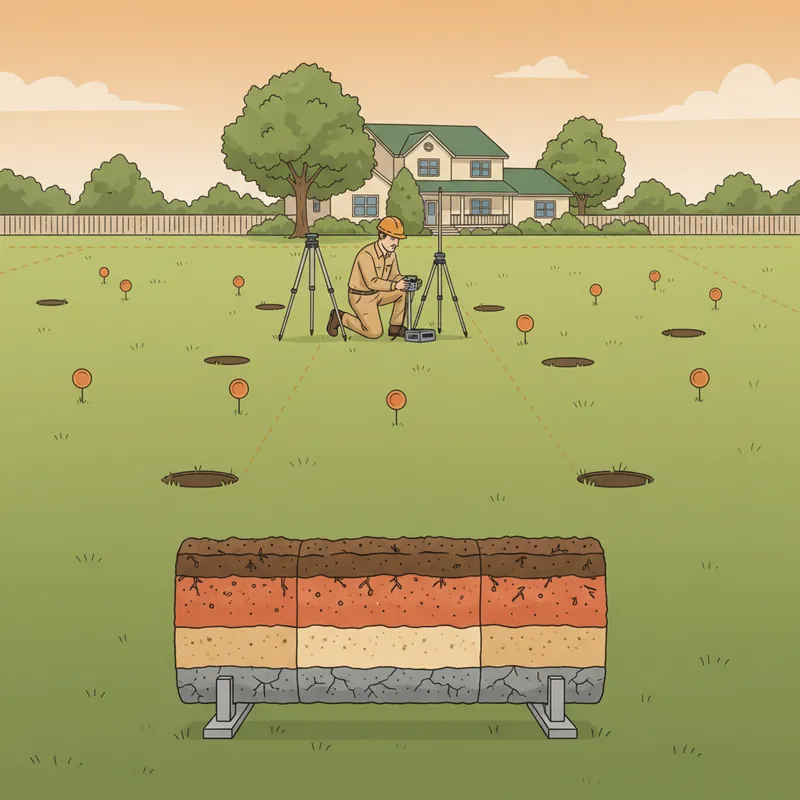
Soil type affects two things: how easy (and expensive) it is to install the loop, and how well the loop transfers heat once it's in the ground.
Favorable Soil Types
- Clay: Excellent thermal conductivity. One of the best soil types for geothermal loops.
- Moist sand/gravel: Good conductivity, easy to trench or drill through.
- Saturated soils: Water-logged soil transfers heat very well. If your yard is naturally damp, that's actually a geothermal advantage.
Challenging Soil Types
- Dry sand: Poor thermal conductivity. The loop has to work harder. Not a dealbreaker, but the loop field may need to be larger to compensate.
- Solid rock / bedrock: Harder and more expensive to drill, which increases vertical loop costs. Some types of rock (granite, basalt) actually conduct heat well once the borehole is drilled — the challenge is the drilling itself.
- Extremely rocky or shallow-bedrock sites: Can push drilling costs up significantly. Worth getting a site assessment before committing.
Don't Guess — Get Tested
Any reputable geothermal installer will evaluate your soil conditions as part of the quoting process. For larger projects, they may conduct a thermal conductivity test — drilling a test borehole and measuring how well your soil transfers heat. This data is used to precisely size the loop field.
If you're curious about your general soil type before talking to an installer, the USDA's Web Soil Survey provides free soil maps for any property in the country.
Factor 3: Your Climate
Geothermal works in every climate, but it makes the most financial sense in climates with significant heating or cooling demand. The sweet spot is both.
Best Climates for Geothermal ROI
- Cold climates (5,000+ HDD): The strongest case. High heating demand = large energy savings = faster payback. This is where geothermal dramatically outperforms air-source heat pumps.
- Hot and humid climates: Geothermal provides very efficient cooling, and in humid areas it dehumidifies better than conventional AC. The ground acts as a heat sink that doesn't get saturated the way outdoor air does on a 95°F day.
- Mixed climates with both heating and cooling demand: You get value from the system year-round, which improves the payback math.
Marginal Climates
- Mild climates with low heating demand (under 3,000 HDD): Geothermal still works, but the annual savings may be small enough that the payback period stretches to 15-20+ years. In very mild areas (coastal Southern California, Hawaii), an air-source heat pump or even a standard AC system may make more financial sense.
Not sure about your area's heating demand? Check your state guide for regional specifics.
Factor 4: Your Current Heating System
What you're replacing matters enormously for the payback calculation.
Strongest Upgrade Paths (Fastest Payback)
- Propane heating → Geothermal: Propane is expensive ($2–$3+/gallon) and inefficient. Switching to geothermal can cut heating costs 60–70%. This is consistently the strongest financial case.
- Oil heating → Geothermal: Similar to propane — expensive fuel with high consumption. Strong savings potential.
- Electric resistance heating → Geothermal: Baseboard heaters, electric furnaces, and radiant ceiling heat all use electricity at a COP of 1.0. Geothermal operates at COP 3.5–5.0 — a massive efficiency jump.
Moderate Upgrade Paths
- Old/inefficient gas furnace → Geothermal: If your gas furnace is 20+ years old and running at 80% efficiency or below, the savings from switching are meaningful — especially if gas prices rise.
- Standard air-source heat pump → Geothermal: You're already on an efficient system. The savings exist but the payback is longer.
Weakest Upgrade Paths (Longest Payback)
- New high-efficiency gas furnace → Geothermal: A 96% AFUE gas furnace is already efficient, and natural gas is cheap in many areas. The operating cost savings from switching to geothermal may be modest, stretching the payback to 15+ years.
- New cold-climate air-source heat pump → Geothermal: You're replacing an already-efficient system. The incremental savings may not justify the cost premium unless you have a very long time horizon.
Factor 5: Budget and Financing
Let's talk money. Geothermal requires a larger upfront investment than most alternative heating systems. Here's a realistic view:
What You'll Need
- Total installed cost: $20,000–$50,000 depending on system type, home size, and site conditions
- After 30% federal tax credit: $14,000–$35,000 net
- After additional state/utility incentives: Varies widely by location
See our installation cost guide for detailed breakdowns.
Financing Options
You don't need to write a check for the full amount. Common financing approaches:
- Home equity loan or HELOC: Often the lowest interest rates. The interest may be tax-deductible (consult a tax advisor).
- Geothermal-specific financing: Some manufacturers and dealers offer financing programs designed for geothermal installations.
- PACE (Property Assessed Clean Energy) loans: Available in some states and municipalities. The loan is repaid through your property tax bill.
- FHA Energy Efficient Mortgage: If you're buying or refinancing, FHA allows you to roll energy efficiency improvements into your mortgage.
- Utility on-bill financing: Some utilities offer financing that's repaid through your monthly electric bill.
The key principle: if your monthly loan payment is less than your monthly energy savings, geothermal pays for itself from day one in terms of cash flow. Many homeowners achieve this, especially when replacing expensive fuel like propane.
Factor 6: How Long You Plan to Stay
Geothermal is a long-term investment. The payback period after incentives typically ranges from 5–15 years depending on your climate, fuel costs, and installation expenses.
- Staying 10+ years: Geothermal is very likely to pay for itself and then some.
- Staying 5–10 years: The economics are tighter. You may not fully recoup the investment, but geothermal does add to resale value — studies suggest homes with geothermal sell at a premium.
- Staying less than 5 years: Geothermal is hard to justify financially unless you're in a market where energy-efficient homes command a significant premium.
Factor 7: Existing Home vs. New Construction
This is a bigger deal than most people realize.
New Construction: The Ideal Scenario
Installing geothermal during new construction is dramatically easier and cheaper than retrofitting:
- The yard isn't landscaped yet — no lawn, garden, or hardscaping to restore
- Excavation equipment is already on site
- Ductwork can be designed around the geothermal system from the start
- The incremental cost over a conventional HVAC system is much less than the full retrofit cost — often $10,000–$20,000 more rather than the full $30,000–$50,000
- Some builders and developers are offering geothermal as a standard or optional feature
If you're building a new home, now is the time to seriously evaluate geothermal. The math is better than it will ever be for your property.
Existing Homes: Still Feasible
Retrofitting an existing home with geothermal is more disruptive and more expensive, but it's done all the time. Things to consider:
- Your yard will be torn up during installation — plan for this and budget for landscape restoration if needed
- Existing ductwork may need modification to work efficiently with a heat pump (heat pumps deliver air at a lower temperature than a gas furnace, so ductwork sizing matters)
- The installation may take 2–5 days depending on the loop type and site conditions
- It's easiest when combined with another major project — re-landscaping, HVAC replacement, addition, or renovation
The Actual Dealbreakers
Very few properties are truly unsuitable for geothermal, but here are the real dealbreakers:
- No ground access at all: If you're in a high-rise condo or a building with no adjacent land and no possibility of drilling, geothermal isn't an option. (Exception: some multi-building developments install shared loop fields.)
- Contaminated soil: If your property has known soil or groundwater contamination, drilling may not be permitted or may require expensive remediation.
- Protected areas: Some environmental protections (wetlands, endangered species habitat, certain historic designations) may restrict drilling or trenching.
- Extremely shallow bedrock with no drilling option: If solid, undrillable rock is at 3 feet and you don't have room for a horizontal loop — though this is rare.
- HOA restrictions: Some homeowners associations restrict construction activity. Check your covenants before proceeding. (Note: geothermal loops are underground and invisible once installed — the argument for approval is usually strong.)
If none of those apply to you, geothermal is physically feasible on your property. The remaining questions are financial.
Your Quick Assessment Checklist
Run through this quick checklist. The more boxes you check, the stronger the case for geothermal:
✅ Geothermal Suitability Checklist
- ☐ Lot size: At least 1/4 acre (for horizontal), OR drill rig access for vertical
- ☐ Soil: No known contamination; no restrictions on drilling/trenching
- ☐ Climate: 4,000+ heating degree days annually (or significant cooling demand)
- ☐ Current system: Replacing propane, oil, electric resistance, or aging gas furnace
- ☐ Budget: Can finance $20,000–$35,000 (after federal tax credit)
- ☐ Timeline: Plan to stay in the home 7+ years
- ☐ New construction: Building a new home (bonus — dramatically better economics)
- ☐ Existing ductwork: Home already has ductwork (or willing to install ductless system)
- ☐ Federal tax liability: Enough tax liability to use the 30% credit
Checked 7+? Geothermal is very likely a strong fit. Get quotes from 2–3 installers.
Checked 4–6? Geothermal could work but requires careful financial analysis. Get quotes and run the numbers.
Checked 3 or fewer? Geothermal may not be the best choice right now. Consider a cold-climate air-source heat pump as an alternative.
Next Steps
If your property looks like a good candidate, here's how to move forward:
- Learn the basics: Read how geothermal heat pumps work and understand the different system types.
- Check your state incentives: Visit your state guide for local rebates, tax credits, and permitting requirements.
- Understand the costs: Review our installation cost guide for realistic pricing.
- Get multiple quotes: Contact at least 3 IGSHPA-certified installers in your area. Compare not just price but system design, equipment brands, and warranty terms.
- Ask about financing: Many installers offer financing or can point you to options. Compare monthly payments to your current energy bills.
- Check the tax credit: Make sure you have enough federal tax liability to benefit from the 30% Section 25D credit. Consult a tax professional if you're unsure.
The ground beneath your property has been absorbing and storing solar energy for as long as the earth has existed. A geothermal heat pump is just a way to borrow some of that energy — efficiently, quietly, and for decades. If your property passes this checklist, it might be time to tap in.
Key Takeaway
Most properties in the continental U.S. can support geothermal. You need: adequate land (or vertical bore option), soil that isn't solid rock, access for drilling equipment, and a home with existing ductwork or planned radiant floors. Lot size under ¼ acre? Vertical bores solve it. Rocky soil? It costs more but it's doable. The only real dealbreakers are extremely small lots with no bore access, or properties with severe groundwater contamination issues.
Sources
- U.S. DOE — "Geothermal Heat Pumps"
- USDA — "Web Soil Survey"
- IRS — "Residential Clean Energy Credit" (Section 25D)
- IGSHPA — "International Ground Source Heat Pump Association"
- ENERGY STAR — "Geothermal Heat Pumps"