
In This Guide
- Why HVAC Contractors Are Moving Into Geothermal
- The Numbers: What Geothermal Jobs Actually Pay
- Getting Certified: IGSHPA and What It Takes
- Equipment Partnerships: Who to Work With
- The Drilling Question: Subcontract vs. In-House
- Marketing to Your Existing Customer Base
- Startup Costs and Realistic Timeline
- Real Talk: What to Expect in Year One
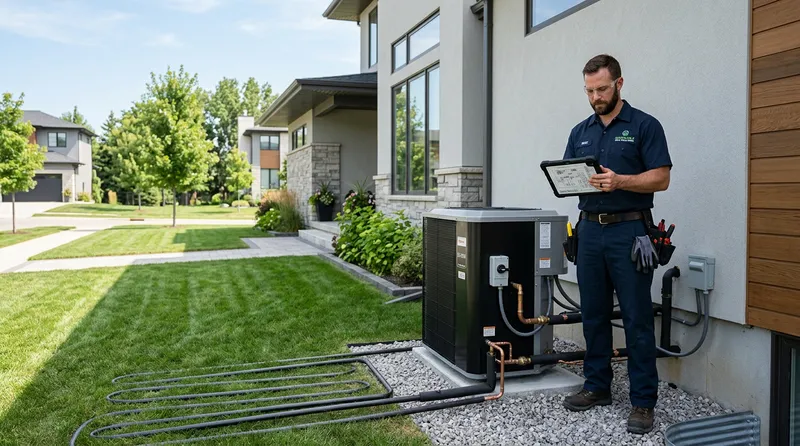
I've been doing geothermal work for 12 years. I've drilled loops in clay, glacier till, granite, and everything in between. I started as a traditional HVAC contractor and made the jump into ground-source work because the economics were impossible to ignore. Now I want to give you the honest picture — not the trade press cheerleading version, but what actually happens when you try to add this to your business.
Short version: the opportunity is real. The path is harder than the sales brochures suggest. And the contractors who succeed are the ones who treat it like a specialty trade, not just another furnace swap.
Why HVAC Contractors Are Moving Into Geothermal
The conventional residential HVAC market is brutal. Margins get squeezed by competition, parts costs climb, and customers increasingly treat replacement furnaces and AC units like commodities. You're grinding through $3,000–$8,000 jobs in a market where everyone's on Google, comparing prices, and waiting for the next promo from the big franchise operation down the street.
Geothermal is different. Here's why contractors are moving in this direction:
The Federal Tax Credit Changes the Sales Conversation
The 30% federal tax credit under Section 25D is the most powerful sales tool in residential geothermal. A $25,000 geothermal system becomes a $17,500 system after the federal credit. Your customer's payback period compresses meaningfully. The objection "it's too expensive" gets a genuine, documented answer.
Homeowners who understand the tax credit are already sold on the concept — they just need a contractor they trust. If you're in a market where nobody is offering this clearly, you have a window.
Average Job Value Is 3–5x a Standard HVAC Replacement
Standard forced-air furnace + AC replacement: $8,000–$15,000. Geothermal system installation: $18,000–$35,000. That's before the fact that geothermal jobs are typically less competitive, meaning you're not shaving margin to win the bid. You set your price based on the actual scope of work.
The Market Is Still Thin
Look up IGSHPA-certified contractors in your region. In most markets, you'll find a handful — sometimes just one or two. The solar industry had similar low contractor density 15 years ago. Those early movers built dominant local businesses before the market filled up. Geothermal is at a similar inflection point.
Long-Term Customer Relationships
A customer who invests $25,000 in a geothermal system is not going to shop their maintenance contract on price. They're invested in the technology and in keeping it running well. Geothermal customers tend to be high-income, homeowner-for-life types who become loyal, high-margin service accounts.
The Numbers: What Geothermal Jobs Actually Pay
Let's be direct about the economics, because this is where the conversation gets real.
Gross Revenue per Job
A residential geothermal installation in a typical single-family home will run $20,000–$32,000 in total installed cost to the homeowner. Your gross revenue on that job, assuming you're acting as the general contractor and subcontracting the drilling, might look like this:
| Line Item | Your Cost | What You Bill | Gross Margin |
|---|---|---|---|
| Heat pump equipment (3-ton unit) | $4,500 | $6,500 | $2,000 |
| Drilling (2 wells × 200 ft) | $8,000 | $11,000 | $3,000 |
| Loop pipe, grout, header | $2,200 | $3,200 | $1,000 |
| Installation labor (your team, 3 days) | $3,000 | $4,500 | $1,500 |
| Controls, distribution modifications | $1,500 | $2,500 | $1,000 |
| Total | $19,200 | $27,700 | $8,500 (31%) |
That's illustrative, not a quote. Your numbers will vary by region, equipment choice, and loop configuration. But the structural point holds: geothermal jobs can run 25–35% gross margins when you're managing the project properly and have established your drilling subcontractor relationship.
Compare that to a typical HVAC service call at 15–20% gross, or a furnace replacement at 20–25%. The per-job economics are genuinely better — as long as you're doing the work efficiently and not eating cost overruns on the loop.
The Break-Even Calculus
Here's the honest version: your first five jobs will probably be less profitable than these numbers suggest. You're learning — estimating loop lengths, coordinating with drillers, managing the permitting, figuring out which heat pump brands and distributors work best in your region. Budget for a 12-18 month ramp-up where margins are thinner.
Getting Certified: IGSHPA and What It Takes
The industry standard credential is IGSHPA (International Ground Source Heat Pump Association) certification. Starting in 2023, IGSHPA overhauled its training in partnership with CSA Group, building a new program around the CSA/ANSI/IGSHPA C448:25 standard — the current design and installation standard for commercial and residential GSHP systems.
The New Training Structure
The new program is modular and self-paced in its foundational layer:
- 9 self-paced online core modules: Covering GSHP fundamentals, geology, drilling methods, loop design, heat fusion, system controls, and commissioning. Available through the CSA Group store. Each module takes 1–3 hours; 90 days of course access per module.
- GSHP Residential System Design Workshop: Instructor-led (in-person or virtual). This is the core practical training. Prerequisites are the relevant core modules.
- GRSD Certification Exam (optional): The GSHP Residential System Designer credential. A formal exam administered through CSA Group that validates your design competency.
IGSHPA members get a 25% discount on training. Membership pays for itself quickly if you're serious about the certification. You can start self-paced modules immediately; the instructor-led workshops run on a calendar schedule posted at igshpa.org.
What Certification Gets You
Practical benefits of IGSHPA certification:
- Credibility with homeowners shopping geothermal — they're more likely to Google the certification than for a conventional HVAC install
- Some utility rebate programs require IGSHPA-certified installers
- Manufacturer dealer programs (WaterFurnace, ClimateMaster) look for certified contractors
- Defensible design documentation if you ever have a performance dispute
- Access to the IGSHPA contractor directory — passive lead generation
What Certification Doesn't Get You
A certificate doesn't replace experience. The gap between passing an exam and designing a loop system that performs correctly in your regional geology is real. Budget time for your first few systems to be learning experiences. Develop a relationship with an experienced geothermal contractor in another market who you can call with questions — most will help if you're not direct competition.
Equipment Partnerships: Who to Work With
Three manufacturers dominate the residential geothermal market in North America:
WaterFurnace International
The category leader by brand recognition. WaterFurnace units have a strong reputation for efficiency and reliability, and homeowners who research geothermal often come in asking for WaterFurnace by name. Their dealer program requires application and some training, but an authorized dealer relationship gives you access to their distributor network, tech support, and marketing co-op programs. Start at their website to find your regional distributor and begin the conversation.
Bosch / ClimateMaster
ClimateMaster was acquired by Bosch and is now branded under both names depending on the market. Solid equipment, well-regarded in the industry, competitive pricing. If WaterFurnace distributors aren't active in your region, ClimateMaster is a strong alternative. Bosch's distribution network is broad and their tech support is responsive.
Florida Heat Pump / Nortek / Others
Several other manufacturers serve the market — Florida Heat Pump, Nordic (Canadian), and others. Some HVAC distributors carry private-label geothermal units. For a new entrant, I'd recommend starting with either WaterFurnace or ClimateMaster — the brand recognition supports your customer conversations and the dealer programs provide meaningful support.
Talk to Your Current Distributor First
Before approaching manufacturers directly, check what your current HVAC distributor carries. Many regional distributors have added geothermal lines to their catalog. Building on an existing relationship is easier than starting from scratch, and your distributor can often facilitate manufacturer training.
The Drilling Question: Subcontract vs. In-House
This is the biggest operational decision you'll face moving into geothermal. The loop installation — boring vertical wells or trenching horizontal loops — is a specialized operation that requires dedicated equipment and experience. Your choices:
Option 1: Subcontract the Drilling
This is how most HVAC contractors start, and honestly, how many stay for years. You act as general contractor. A licensed well driller (or a geothermal loop contractor with a track record) handles the bore hole, loop installation, and grouting. You handle everything else: heat pump, loop pump assembly, distribution, controls.
Advantages: No capital investment in drilling equipment. Drilling crews handle permits in most states. You can scale with demand without owning machinery. If a driller has a bad day (they will), it's their insurance, not yours.
Disadvantages: You're dependent on their schedule and quality. You're marking up their invoice, which caps your margin on that portion of the job. In tight markets, good drillers book out 6–8 weeks and you can't control your timeline.
Typical drilling subcontractor rates: $10–$18 per linear foot for vertical closed-loop wells, depending on region and geology. Horizontal trenching by the hour or by the foot. Get quotes from multiple drillers before committing to any job pricing.
Option 2: In-House Drilling
Buying a dedicated geothermal drilling rig is a significant capital commitment — a used rig capable of residential geothermal work starts around $80,000–$150,000. A new rig from manufacturers like Geoprobe, Boart Longyear, or similar starts at $200,000+. Add a flatbed truck to haul it, an operator who knows what they're doing, and the ongoing cost of drill bits, casing, grout, and you're looking at $300,000+ to enter this business properly.
That makes sense if you're doing 30+ geothermal jobs per year. It doesn't make sense in year one or two. Build your installation volume with subcontracted drilling, then revisit the capital question when you have a predictable pipeline.
Some contractors find a middle path: partnering with a driller to co-market in a region, referring each other business, and eventually formalizing a joint venture. If you find a driller who wants to get into geothermal but doesn't have the HVAC side, that's a partnership worth exploring.
Marketing to Your Existing Customer Base
Your existing customer base is your biggest advantage over a new entrant. You have established trust, local reputation, and a service history with homeowners who already think of you when their HVAC needs work. Geothermal marketing doesn't require starting from scratch.
Who In Your Customer Database Is a Geothermal Prospect?
Look for customers who:
- Own their home (renters don't buy geothermal)
- Have systems approaching end-of-life (10+ years old)
- Are in markets where heating/cooling costs are high (propane, high natural gas rates, high electricity)
- Have property with room for a loop — at least a 60×60 ft yard for horizontal, or vertical wells near the house for smaller lots
- Mentioned energy costs as a concern in past service interactions
For a typical HVAC contractor with 500–2,000 service customers, a reasonable estimate is 10–15% of the database has the profile for a geothermal conversation. That's 50–300 prospects you already have a relationship with.
The 30% Credit Is Your Opening
When homeowners are replacing a system, reach out with a simple message: "Before you replace your old system with another conventional unit, did you know you can get 30% of a geothermal system back in federal tax credits? We're now certified to install geothermal systems, and I'd like to show you the numbers." That's it. No hard sell. You're opening a conversation about an option they probably don't know they have.
Educate Before You Sell
Geothermal customers are typically more researched than standard HVAC replacement customers. They've read articles, watched YouTube videos, and come in with detailed questions. Give them access to good information — send them to resources like the how geothermal works guide or walk them through the cost breakdown. An educated customer who understands what they're getting is a better customer to sell to — and a better customer to work for.
Startup Costs and Realistic Timeline
Here's what you're actually committing to in year one:
| Item | Cost Range | Notes |
|---|---|---|
| IGSHPA membership + training | $1,500–$3,000 | Core modules + instructor-led workshop + GRSD exam fee |
| CSA/ANSI/IGSHPA C448:25 standard | $300–$600 | Required reading before training; member discount available |
| Loop design software (GLD or similar) | $1,000–$3,000/year | Ground Loop Designer or equivalent sizing software |
| Manufacturer training / dealer application | $0–$1,500 | Some manufacturer programs charge; many are free with application |
| Additional installation tooling | $2,000–$5,000 | Heat fusion equipment for HDPE loop connections, pressure testing gear |
| Marketing and sales materials | $1,000–$3,000 | Updated website, customer proposals, reference materials |
| First job contingency buffer | $3,000–$8,000 | Budget for learning curve cost overruns on jobs 1–3 |
| Total startup investment | $9,000–$24,000 | Before any revenue; recovered within first 2–4 jobs if priced correctly |
Realistic Timeline
- Month 1–3: Complete core training modules, apply to manufacturer dealer programs, identify and vet 2–3 drilling subcontractors in your market
- Month 3–5: Attend instructor-led design workshop, begin marketing to existing customer base, generate first geothermal leads
- Month 5–8: Install first 2–3 systems (expect to spend extra time on design, permitting coordination, and driller coordination)
- Month 8–18: Build to a pace of 1–3 systems per month; margin improves as you develop efficiencies
- Year 2–3: Evaluate whether volume justifies dedicated marketing, a second certified tech, or equipment investment
Real Talk: What to Expect in Year One
You will get a job where the driller hits unexpected rock and the loop cost runs over. Build contingency into your contracts.
You will get a customer who read something on the internet and thinks their system should perform better than the Manual J says it will. Set realistic expectations before installation, in writing.
You will lose a bid to a competitor who quotes lower because they're cutting corners on loop length or using cheaper equipment. Let it go. Underperforming geothermal systems create dissatisfied customers and warranty headaches. Price your work correctly.
You will find that some homeowners are fantastic to work with — bought-in, patient, excited about the technology, genuinely grateful when the system performs. Those customers become your best marketing. Get their testimonials. Ask for referrals. This market is word-of-mouth to a greater degree than standard HVAC.
The Bottom Line
Adding geothermal to your HVAC business is a 2–3 year investment before it becomes a significant revenue contributor. The contractors who make it work treat it as a specialty service line with its own training, relationships, and processes — not a bolt-on to an existing business model. If you're willing to do that, the economics are compelling and the competition is still thin enough to build a real position in your market.
For a detailed look at the certification requirements specifically, see our IGSHPA certification guide. For the homeowner-facing perspective on what goes into a geothermal installation, the installation cost guide is worth a read — it's a useful tool for explaining the numbers to your customers.