
In This Guide
- Why Loop Design Is the Make-or-Break Step
- Start With Loads, Not Rules of Thumb
- Vertical vs. Horizontal: How to Choose
- Ground Conditions That Change the Design
- Loop Sizing: The Numbers Behind the Rules
- Slinky Loop Design
- Pond and Lake Loops
- Fluid Design: Antifreeze Selection and Concentration
- Pressure Testing, Flushing, and Commissioning
- Commercial Design and ASHRAE 90.1
- Common Mistakes That Kill Performance
- The Software Stack
- Selling the Loop to the Customer
- Sources
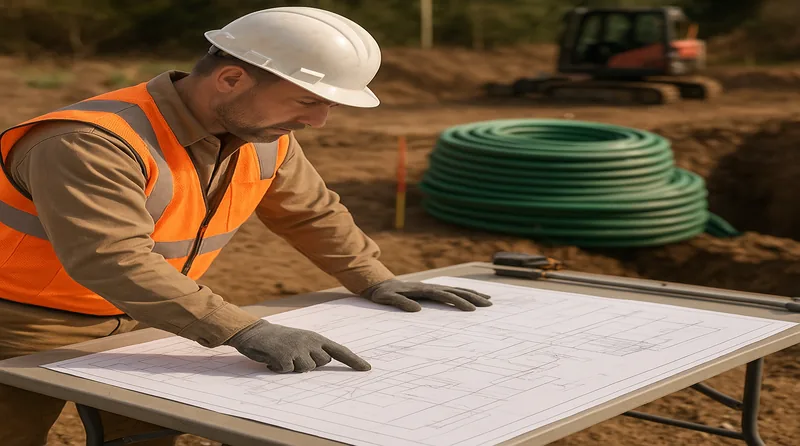
The ground loop is what makes geothermal different from every other HVAC system you've installed. Get it right and the system performs beautifully for 50 years. Get it wrong — undersized loops, poor soil coupling, unbalanced circuits, bad grout — and you've built a callback that never goes away. You can't swap out a loop field the way you swap an air handler.
This guide is written for contractors who already understand how geothermal heat pumps work and are moving into loop field design and sizing. It's not a homeowner explainer. It covers the design decisions that separate systems that perform from systems that underperform from day one.
Why Loop Design Is the Make-or-Break Step
The heat pump itself is remarkably tolerant. Give it fluid at the right entering-water temperature (EWT), and it performs at rated efficiency. The loop field's entire job is to hold that EWT within the operating range the manufacturer specifies — typically 25–90°F depending on system and mode.
An undersized loop lets EWT drift too cold in winter (lowering COP, eventually tripping safeties) or too warm in summer (killing cooling efficiency). An improperly balanced loop — circuits of unequal length, no reverse-return manifolding — means some circuits see more flow than others, reducing effective loop area. Neither problem shows up on day one. Both show up in years two through five when the homeowner notices their bills don't match the quote.
Design the loop right the first time. It's buried under the lawn.
Start With Loads, Not Rules of Thumb
Manual J or Block Load First
Every ground loop sizing exercise starts with a verified building load — not a square-footage estimate, not what the previous HVAC contractor sized. Run a Manual J (or a full block load for commercial). That number drives equipment selection, and equipment selection drives loop sizing.
This matters because rules of thumb are built around typical loads. A poorly insulated 1980s ranch in Minnesota has a dramatically different load per square foot than a well-insulated new build in Maryland. Using square footage as a shortcut will either oversize your loop (leaving money on the table) or undersize it (creating the performance problems described above).
Entering Water Temperature Drives Equipment Selection
Once you have loads, you need to decide your design EWT — the coldest fluid the loop will deliver to the heat pump in winter and the warmest in summer. That EWT drives both equipment selection and loop sizing. Lower your design EWT in winter and you need more loop length; raise it and you get shorter loops but a heat pump that works harder at the design condition.
Most manufacturers rate their equipment at specific EWT points (typically 32°F, 45°F, and 50°F for heating; 77°F and 86°F for cooling). Design your loop around what the equipment needs at rated conditions, not around what the equipment can technically survive.
Vertical vs. Horizontal: How to Choose
This is the first real design decision on every job. It's primarily a site constraint question, not a performance question — both loop types work well when properly sized.
When Vertical Wins
Vertical closed-loop systems drill boreholes 100–400 feet deep and insert U-tube HDPE pipe. DOE guidance cites typical bore depths of roughly 150–220 feet per ton in northern climates and 250–300 feet per ton in southern climates (the variation reflects the smaller delta-T between loop and ground in warmer soil). Bores are typically spaced at least 20 feet apart to prevent thermal interference between adjacent boreholes.
Vertical systems win when:
- The lot is small — most suburban lots under half an acre don't have horizontal trench room
- The ground is rock — drilling through solid rock costs more per foot but produces excellent thermal contact
- High water table or unstable soils make trench excavation problematic
- The customer needs the lawn preserved — vertical footprint is minimal after grout cures
For more on site feasibility factors homeowners ask about, see our property suitability guide.
When Horizontal Wins
Horizontal loops run pipe at 4–6 feet deep in trenches. DOE guidance gives rough trench pipe requirements of roughly 125–300 feet of pipe per ton (northern climates) to 700–1,800 feet per ton (southern climates), with land area requirements of approximately 2,000–3,500 square feet per ton. These are wide ranges because soil moisture and conductivity dominate.
Horizontal systems win when:
- The lot has available area — typically 0.5 acres minimum for a residential system
- Soil is good (moderate moisture, decent conductivity) — ideal conditions dramatically reduce trench footage needed
- Drilling costs are high in your market — horizontal excavation with a backhoe often costs less than vertical drilling per equivalent loop length
- The building is new construction — trenching before landscaping has no lawn disruption penalty
The Cost Trade-Off
In markets where drilling costs run $15–$25 per bore-foot and excavation runs $3–$6 per linear foot, horizontal usually wins on cost when the lot permits. But "when the lot permits" is the constraint that eliminates horizontal for most suburban jobs. See our installation cost guide for regional cost benchmarks.
Ground Conditions That Change the Design
Soil and rock thermal conductivity is the single biggest variable in loop sizing. Get it wrong and your loop length is wrong by 20–50%.
Thermal Conductivity Ranges
ASHRAE provides conductivity values for common geological materials (values in BTU/hr·ft·°F):
| Material | Conductivity (BTU/hr·ft·°F) | Notes |
|---|---|---|
| Heavy clay, 15% moisture | 0.8–1.1 | Poor — needs longer loops |
| Heavy sand, 15% moisture | 1.6–2.2 | Good — typical Coastal Plain |
| Granite | 1.3–2.1 | Good — common in Northeast |
| Limestone | 1.4–2.2 | Good — common in Midwest |
| Dry sand or gravel | 0.2–0.5 | Very poor — avoid if possible |
ASHRAE's conductivity correction factors for horizontal loops illustrate how dramatically this matters: soil conductivity of 0.7 BTU/hr·ft·°F requires multiplying your calculated loop length by 1.22; conductivity of 1.7 allows multiplying by 0.82. That's a 49% swing in required pipe length for the same load — a difference that can easily determine whether a horizontal loop is cost-competitive with vertical on a given job.
Moisture and Groundwater
Moisture dramatically improves soil conductivity. Dry sand is terrible; saturated sand is decent. If you're designing for a site above the water table with dry sandy soil, build in a significant length margin. Groundwater movement actually helps loop performance — moving water replenishes the thermal reservoir. Standing water in clay does less.
For this reason, a Thermal Response Test (TRT) is worth doing on larger commercial bore fields before finalizing design. It gives you actual in-situ conductivity rather than estimated values. On residential jobs, using conservative conductivity assumptions and verifying against expected EWT performance in year one is a reasonable alternative.
Loop Sizing: The Numbers Behind the Rules
Vertical Loop Rules of Thumb
DOE contractor training guidelines give a field rule of approximately 1 bore per ton, 20 ft minimum bore spacing, 3 GPM per ton flow rate, and typical vertical depth of 150–200 ft/ton in northern climates and 250–300 ft/ton in southern climates.
Use these for initial screening and bid-stage estimates. They break down when:
- Soil conductivity deviates significantly from the assumed baseline (~1.2 BTU/hr·ft·°F for the tables these rules derive from)
- The building's heating-to-cooling load ratio is highly imbalanced (high cooling load in southern climates creates ground heat buildup without sufficient winter recovery)
- You're doing more than 5 tons — bore field thermal interference between bores becomes significant
Horizontal Loop Rules of Thumb
DOE guidelines: 1 circuit and 3 GPM per ton. Pipe footage of 600–1,000 ft per ton in northern climates, 700–1,800 ft per ton in southern climates. Keep all circuits within 5% of each other in length.
The wide range in southern climates reflects the higher sensitivity to soil conditions when the delta-T between loop and ground is smaller (55°F ground vs. 75°F+ design EWT in summer). In low-conductivity southern soil, you can need 3× the pipe length of a well-sited northern installation. Never use a northern-climate rule of thumb on a Georgia job.
When to Move Beyond Rules of Thumb
For anything beyond a straightforward 3–5 ton residential job with average soils, move to software before finalizing your design. ASHRAE's GCHP simulation methods account for bore field geometry, soil stratification, long-term heat accumulation, and climate-specific factors that rules of thumb can't capture. The software section below covers your options.
Slinky Loop Design
Slinky (overlapping coil) loops are a hybrid between traditional horizontal and a shorter trench footprint. The pipe is coiled in overlapping loops and laid in a trench, typically at 4–6 ft depth. They use more pipe per linear foot of trench than straight pipe — roughly 4 ft of pipe per 1 ft of trench in a typical 2 ft coil spacing — but they let you achieve adequate loop length in a shorter trench.
When Slinky Is the Right Compromise
Slinky makes sense when:
- You have enough yard for horizontal but not enough length for a straight-pipe horizontal layout
- The trench dig cost is low relative to additional pipe cost
- Soil conditions are good — slinky underperforms in low-conductivity soil because the overlapping coils create more pipe-to-pipe thermal interaction
Slinky Penalties to Account For
Slinky loops have more pipe surface in a given soil volume, which means higher pumping energy (more pipe = more friction) and slightly reduced thermal performance per linear foot compared to straight pipe in the same trench. For a tight energy budget, factor in the pump penalty. Keep coil spacing generous (at least 2 ft between coils) to reduce thermal short-circuiting between overlapping sections.
Pond and Lake Loops
When a suitable water body exists on or adjacent to the property, a submerged loop system is often the lowest first-cost option. DOE guidelines cite minimum pond criteria: at least ½ acre surface area, minimum 8 ft depth (to avoid thermal stratification problems in cold climates), and within 300 ft of the building.
Loop sizing: roughly 300–500 ft of pipe circuit length per ton, submerged on weighted mats or coiled at depth. In cold climates, all loops should be placed at least 8 ft below the surface to stay below the thermocline and avoid ice formation around the coils.
Permitting Reality
Pond and lake loops require permits in most states — typically from the state environmental or water resources agency. Some states prohibit introducing antifreeze-bearing closed loops into navigable waters. Verify your state's requirements before proposing a pond loop. Open-loop systems (drawing water directly from a well or surface water) face even more permitting scrutiny and aren't covered in depth here — see our open vs. closed loop guide for the overview.
Fluid Design: Antifreeze Selection and Concentration
Any closed-loop system operating in a climate where entering water temperature can drop below 40°F needs antifreeze. The two primary options are methanol and propylene glycol — each has trade-offs.
Freeze Protection Concentrations
DOE contractor training guidelines provide the following volume concentrations by target freeze protection temperature:
| Target Protection (°F) | Methanol % by volume | Propylene Glycol % by volume |
|---|---|---|
| 25°F | 10% | 15% |
| 20°F | 16% | 22% |
| 15°F | 21% | 25% |
| 10°F | 25% | 38% |
Methanol vs. Propylene Glycol
Methanol: Lower viscosity at low temperatures — better heat transfer performance than propylene glycol at equivalent freeze protection. Lower cost per gallon. The trade-off: methanol is flammable and a health hazard; most jurisdictions require it to be installed below ground only, and handling requires appropriate PPE. Check your local code — some states ban methanol in certain applications entirely.
Propylene glycol: Non-toxic (food-grade versions exist), no flammability concerns, easier to handle. The penalty: significantly higher viscosity at low temperatures, which increases pump energy consumption and can reduce heat transfer in the heat exchanger. At 38% concentration for 10°F protection, propylene glycol's viscosity penalty is material. Use it where methanol is prohibited or where non-toxicity is a requirement (school systems, municipal buildings).
Match your antifreeze selection to your design EWT floor, not to the coldest possible outdoor temperature. A system designed to maintain a 25°F minimum EWT doesn't need 10°F protection — you're just adding viscosity penalty for no reason.
Pressure Testing, Flushing, and Commissioning
The loop goes in the ground exactly once. Commission it correctly before burial — there's no second chance.
Hydrostatic Pressure Testing Before Burial
Always hydrostatically pressure-test the loop before backfilling. Not pneumatically — hydrostatically. The DOE contractor workshop guidance is explicit: the loop should always be hydrostatically pressure-tested before burial. Pneumatic testing with air or nitrogen doesn't find small leaks reliably and creates a pressure vessel safety risk with HDPE if a fitting lets go.
Follow ASTM F2164 for polyethylene pressure system hydrostatic testing procedures — the Plastics Pipe Institute references this standard for PE pressure system leak testing. Specific test pressure and hold time should follow your project specifications and the pipe manufacturer's guidance. Document the test: record starting pressure, hold duration, and ending pressure. That documentation protects you.
Flushing and Purging
After pressure test, flush and purge the loop to remove:
- Construction debris (pipe cuttings, grout dust)
- Air — air pockets kill heat transfer and cause pump cavitation
- Any residual water that would dilute your antifreeze concentration
Use a dedicated purge cart with enough flow velocity to achieve turbulent flow through each circuit (roughly 2 ft/sec minimum, higher is better for air removal). Flush until the return fluid is clean and verify flow through each circuit individually. Then add antifreeze to concentration, verify with a refractometer, and pressurize the system per manufacturer specs.
Verify Flow Rates and Document
Measure and record: total system flow (GPM), pressure drop across the loop field, antifreeze concentration, static pressure, and entering/leaving water temperatures during initial operation. These baseline numbers are your reference point if the system ever underperforms — you need to know what "normal" looks like.
Commercial Design and ASHRAE 90.1
For commercial projects, ground loop design intersects with code compliance in ways that residential work doesn't. A few things to know:
ASHRAE 90.1-2022 and the H05 Energy Credit
ASHRAE 90.1-2022 includes an H05 energy credit pathway specifically for ground-source heat pump systems serving individual zone water-to-air heat pumps. The DOE's 90.1-2022 Energy Credits Application Guide describes the bore field sizing requirement: the simulated bore field should be sized to handle the cooling load for approximately 90% of operating hours.
This is not a blanket "geothermal = compliant" path. It's a specific credit with specific documentation requirements. Don't promise your commercial client that installing geo automatically satisfies energy code — it satisfies the H05 credit if properly designed and documented.
COMcheck and Jurisdiction Variation
COMcheck-Web supports ASHRAE 90.1-2022 compliance workflows, but local adoption of 90.1-2022 varies by state. [NEEDS VERIFICATION — confirm which version of 90.1 your jurisdiction has adopted before committing to an H05 compliance path.] When in doubt, get confirmation from the local building official before designing to a code version the AHJ hasn't adopted.
When to Bring In a PE
On commercial bore fields above 10 tons, or any project where the loop design is a significant cost item or where local permitting requires stamped engineering drawings, bring in a licensed Professional Engineer familiar with GCHP design. Software gives you a defensible design; PE stamps give you the documentation commercial projects require.
Common Installation Mistakes That Kill Performance
These are documented failure modes, not hypotheticals. DOE contractor training materials specifically call out most of these as field problems.
Unequal Circuit Lengths
If your loop circuits differ in length by more than 5%, the shorter circuits will carry more flow than the longer ones (lower resistance). The longer circuits — the ones with more pipe area — end up underutilized. Net effect: less effective loop than the total pipe footage suggests. Keep all circuits within 5% of each other.
No Reverse-Return Manifolding
Reverse-return (also called "reverse return header") ensures all circuits see approximately equal pressure drop by routing the supply and return headers in opposite directions. Without it, the circuit closest to the manifold sees much lower resistance than circuits at the far end, creating the same flow imbalance problem as unequal lengths. This is basic hydronic balancing — apply it to every loop field.
Loops Too Shallow in Cold Climates
Horizontal loops less than 4 feet deep in northern climates see significant seasonal ground temperature variation — exactly what you're trying to avoid. In climates with frost penetration, consider 5–6 ft minimum. DOE guidance specifies "at least 4 ft deep" as a minimum; treat that as a floor, not a target in a northern climate.
Rock Damage and Kinks During Backfill
HDPE is durable but not indestructible. Sharp rocks against pipe during backfill, kinks from improper coiling, and pulled fittings from pipe-to-pipe contact during bore insertion are all documented failure modes. Inspect the pipe before it goes in the ground. Use proper insertion weights on vertical U-tubes. Backfill in lifts with appropriate material — don't dump a cubic yard of chunk rock directly onto the pipe.
Skipping the Grout on Vertical Bores
Vertical bore grout (thermally enhanced grout is the pro choice) does two things: it fills the annular space to create thermal contact between the pipe and the bore wall, and it seals the bore against cross-contamination between aquifer zones. Ungrouted or poorly grouted bores reduce effective thermal conductivity and can create regulatory violations where grouting is required by state well regulations. Don't skip it; don't thin it to save materials cost.
Antifreeze Mixed Wrong
Mixing antifreeze by eye rather than by concentration measurement is how you end up with a loop that freezes in January. Mix by volume from a known starting point, then verify concentration with a refractometer calibrated to your fluid type (propylene glycol and methanol read differently). Document the final concentration in your commissioning report.
The Software Stack
Rules of thumb are for screening. Software is for design. Here's what contractors actually use:
LoopLink RLC (Residential and Light Commercial)
LoopLink RLC is the standard tool for residential and light commercial vertical and horizontal loop design. It uses calculation methods from the IGSHPA Residential/Light Commercial Design Manual. Cloud-based, produces professional output reports suitable for customer quotes and permitting. If you're doing production residential geo work, this is the starting point. (looplinkrlc.com)
GLHEPro and Ground Loop Design (Commercial Bore Fields)
For larger commercial bore fields where long-term thermal drift and bore-to-bore interactions matter, GLHEPro (from Oklahoma State's HVAC-BETSRG group) and Ground Loop Design (from Thermal Dynamics, listed by IGSHPA) are the engineering-grade tools. These implement transient simulation methods that capture how bore field temperatures evolve over years of operation — critical for large commercial systems with imbalanced heating/cooling loads. (IGSHPA software page)
When to Go Beyond Software
Software gives you a design. When local permitting requires stamped drawings, or when the bore field is a significant cost item on a commercial project, layer in a PE review. Software output plus a licensed engineer's stamp is the standard commercial delivery.
Selling the Loop to the Customer
One aspect of geothermal sales that differentiates it from conventional HVAC: the ground loop is the permanent asset. The heat pump gets replaced every 15–20 years, like any HVAC equipment. The loop stays in the ground for 50+ years.
DOE explicitly states that ground loops should last 50-plus years, and the Plastics Pipe Institute notes HDPE piping has been in water service for over 50 years with documented longevity. That's your selling point: the customer is making a one-time ground investment that will outlast multiple heat pump replacements. Frame the loop cost as infrastructure — more like a well or septic system than HVAC equipment.
When customers push back on loop cost, compare it to what they'd spend on HVAC equipment and fuel over the same 50-year period. The loop is the permanent fixed cost; fuel and equipment are the variable costs the loop eliminates or reduces. That framing shifts the conversation from "why does this cost so much up front?" to "what does the 25-year total cost of ownership look like?"
For the business development side of adding geothermal to your service lines, see our guide to adding geothermal to an HVAC business. For the certification path that backs up your technical credentials, see the IGSHPA certification guide.
Sources
- U.S. DOE — Geothermal Heat Pumps (EnergySaver)
- DOE EERE — Ground-Source Heat Pump Overview (sizing reference)
- DOE EERE — GHP Contractor Workshop (Johnson) — rules of thumb, antifreeze, commissioning
- ASHRAE Handbook — Chapter 34: Geothermal Energy (conductivity tables, correction factors)
- Plastics Pipe Institute — Hydrostatic Pressure Testing of PE Systems
- DOE — ASHRAE 90.1-2022 Energy Credits Application Guide (H05 pathway)
- DOE — COMcheck-Web (ASHRAE 90.1 compliance tool)
- IGSHPA — Ground Loop Design Software Resources
- LoopLink RLC — Residential/Light Commercial Loop Design Tool
- DOE — 5 Things to Know About Geothermal Heat Pumps (50-year loop lifespan)