
In This Guide
- Why Arkansas Is Geothermal's Best-Kept Southern Secret
- Quick Verdict: Should You Go Geothermal?
- The Hot Springs Connection
- Climate & Geology: Two States in One
- Geology & Drilling Conditions by Region
- Regional Costs & ROI
- Case Study: Carroll County Ozarks Propane Home
- Case Study: Saline County New Construction
- Case Study: Washington County Poultry Farm — REAP + Pond Loop
- Month-by-Month Energy Profile
- Open-Loop System Assessment by Region
- Loop Type Cost Comparison
- Incentive Stacking: Federal ITC & USDA REAP
- Arkansas Poultry Industry: A Unique Opportunity
- Solar + Geothermal: The Southern Combo
- The Honest Gas Assessment
- Permits & Licensing Requirements
- Finding & Vetting a Qualified Installer
- Maintenance & System Longevity
- Vacation Rental & Tourism Property Economics
- How to Claim the Federal Tax Credit (IRS Form 5695)
- Arkansas vs. Neighboring States
- Frequently Asked Questions
- Bottom Line
- Sources
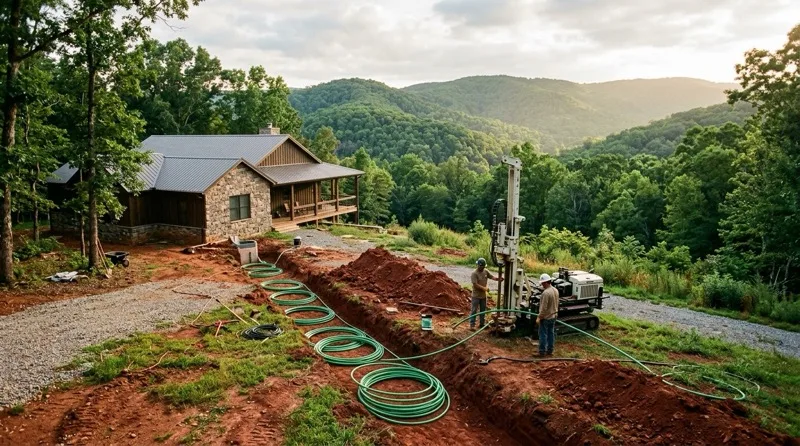
Why Arkansas Is Geothermal's Best-Kept Southern Secret
Arkansas is the only state in America named after the earth's own heating system. Hot Springs National Park has been drawing visitors to its naturally heated 143°F waters for centuries — proof that the ground beneath Arkansas holds enormous thermal energy. The irony is that most Arkansans have never heard of ground-source heat pumps, the technology that taps that same stable earth temperature to heat and cool homes at a fraction of the cost of conventional systems.
At 9.59¢/kWh (rank 43 nationally — the 8th cheapest state) and cheap natural gas from the Fayetteville Shale, Arkansas has the same challenge as every gas-producing Southern state: the fuel you're replacing is already cheap. But for the roughly 120,000 Arkansas homes heating with propane — concentrated in the Ozarks, the Ouachitas, and rural areas across the state — and for the state's massive agricultural sector, geothermal makes compelling financial sense.
Three things set Arkansas apart from other Southern geothermal markets:
- The poultry industry. Arkansas is the #3 poultry-producing state in America, with over 4,300 poultry farms generating $4.1 billion annually. Most growers live on-site in propane-heated farmhouses that are textbook USDA REAP candidates. No other state has this concentrated an agricultural REAP opportunity in such close proximity to propane dependency.
- The geological split. Northern Arkansas (Ozarks, Ouachitas) has ancient mountain terrain with excellent thermal conductivity limestone — great for vertical loops but more expensive to drill. Eastern and southern Arkansas (Delta, Coastal Plain) has deep alluvial soil perfect for cheap horizontal loops. This means the cheapest installations and the most expensive installations in the state can be just 90 miles apart. Location drives everything.
- The balanced climate. Arkansas has genuine four-season demand. Little Rock logs 3,200 HDD and 1,900 CDD. El Dorado is actually cooling-dominant (2,100 CDD vs. 2,600 HDD). This balanced load keeps ground loops thermally stable and maximizes equipment utilization year-round — you're not paying for a system that sits idle half the year.
Quick Verdict: Should You Go Geothermal in Arkansas?
| Your Situation | Verdict | Estimated Payback |
|---|---|---|
| Ozarks propane home | 🟢 Strong yes | 6–10 years |
| Electric resistance heating | 🟢 Yes | 5–8 years |
| Farm/poultry operation (USDA REAP) | 🟢 Excellent | 3–6 years |
| New construction (any region) | 🟢 Best opportunity | 4–7 years (incremental) |
| Rural propane (Delta/Ouachitas) | 🟢 Yes | 7–11 years |
| Aging heat pump replacement | 🟢 Good upgrade | 5–9 years |
| All-electric home (existing heat pump) | 🟡 Moderate | 10–15 years |
| Natural gas (LR/NWA/Fort Smith metro) | 🔴 Probably not | 25–45+ years |
The honest story: if you heat with natural gas in Little Rock, Fayetteville, Fort Smith, or Jonesboro, geothermal payback stretches beyond what most people are willing to wait. Arkansas sits atop the Fayetteville Shale, gas infrastructure is mature, and rates are among the nation's lowest. But step off the gas grid — and in Arkansas, that happens fast once you leave city limits — and the propane-to-geothermal conversion is one of the best investments in home energy you can make.
The Hot Springs Connection
Arkansas holds a unique place in American geothermal history. Hot Springs National Park — protected since 1832, making it the oldest federally protected area in the United States — draws its water from rainwater that percolates 6,000–8,000 feet underground, heats to 143°F through contact with deep rock, and rises back to the surface through fault lines in the Ouachita Mountains.
This is direct-use geothermal — a different technology than the ground-source heat pumps this guide covers. But the principle is the same: the earth stores enormous thermal energy, and we can use it.
What's relevant for homeowners: the geology that creates Hot Springs tells us Arkansas has significant geothermal gradient — the rock gets hot faster as you go deeper than in many states. This doesn't meaningfully affect residential heat pump installations (which operate at shallow depths where temperature is dominated by surface climate, not deep geothermal gradient), but it does confirm that Arkansas's geology is thermally active and well-studied. The Arkansas Geological Survey has extensive subsurface data that helps installers assess site conditions with more confidence than in less-studied states.
And there's a cultural dimension: Arkansans already understand intuitively that the earth holds heat. Hot Springs is literally in the name. That familiarity makes the conceptual leap to "ground-source heat pump" shorter than in states where geothermal is a completely foreign concept.
Climate & Geology: Two States in One
Arkansas is geologically split down the middle. The northern half is ancient mountain terrain; the southern and eastern portions are flat coastal plain and river delta. This dramatically affects your geothermal options.
Ozark Plateau (NW Arkansas)
Limestone, dolomite, and chert over Ordovician-age bedrock. The Ozarks present the same Midwest karst challenge seen in Missouri and Tennessee — caves, sinkholes, and irregular bedrock depth. Closed-loop vertical systems are the standard here. Drilling through Ozark limestone costs more per foot than soft soil, but the rock has excellent thermal conductivity (1.4–1.8 BTU/hr·ft·°F). Some installers in the Fayetteville/Bentonville corridor are experienced with these conditions. Ground temperatures: 57–59°F.
Karst caution: In areas with active cave systems (especially the Springfield Plateau), site assessment should check for voids. Grouting bore holes is critical to prevent aquifer contamination across karst layers. Your driller should be using tremie-pipe grouting from the bottom up, not gravity pouring — this is non-negotiable in karst terrain.
Arkansas River Valley (Central)
Transition zone — shale and sandstone ridges alternate with alluvial valleys. The valley floors have 20–80 feet of unconsolidated sediment, workable for horizontal loops on larger lots. The ridges push toward vertical. Conway, Russellville, and Clarksville sit in this zone. Ground temperatures: 59–61°F. Good balance of heating (3,400 HDD) and cooling (1,600 CDD) demand.
Ouachita Mountains (West-Central)
Folded Paleozoic shale and sandstone. The Ouachitas run east-west (unlike the north-south Ozarks) and present folded, tilted rock layers. Drilling is harder and less predictable than the Ozarks — you can hit soft shale at 50 feet and dense quartzite at 80 feet. Vertical bore costs are 15–25% higher here. But this is deep propane country — Hot Springs, Mena, and Mount Ida have some of the highest propane delivery premiums in the state. Ground temperatures: 60–62°F.
Gulf Coastal Plain (South/Southeast)
Deep, unconsolidated alluvial and deltaic sediments. Pine Bluff, El Dorado, and the timber country south of Little Rock sit on 100–500+ feet of sand, clay, and gravel. This is horizontal loop paradise — cheap to trench, good moisture retention, easy excavation. Ground temperatures are warmer here (61–64°F at 50 ft), which slightly improves cooling-mode efficiency. The cooling-dominant climate (El Dorado: 2,100 CDD) means geothermal's ground-temperature advantage for cooling is the primary financial driver in southern Arkansas.
Mississippi Alluvial Plain (Eastern AR / Delta)
Deep alluvial deposits from millennia of Mississippi River flooding. Jonesboro, West Memphis, and the entire Delta region have some of the easiest digging conditions in the country. Horizontal loops go in fast and cheap. Ground temperatures: 59–62°F. The challenge is less geological and more economic — the Delta has lower household incomes, and most homes are already on natural gas or electric resistance. For the propane and electric-resistance pockets that do exist, the installation costs are among the lowest in the state.
Geology & Drilling Conditions by Region
Arkansas's geological split creates dramatically different drilling experiences within a two-hour drive. Understanding what's underneath your property is the single most important factor in determining your installation cost.
| Region | Dominant Geology | Thermal Conductivity (BTU/hr·ft·°F) | Typical Bore/Trench Depth | Drilling Cost/ft | Key Challenges |
|---|---|---|---|---|---|
| NW Arkansas / Ozark Plateau (Fayetteville / Bentonville / Harrison) | Springfield Plateau limestone, Boone Formation chert/limestone, karst features | 1.4–1.8 | Vertical: 150–250 ft | $14–$19/ft | Karst voids require careful site assessment. Chert dulls bits. Tremie-pipe grouting mandatory. Excellent conductivity partially offsets higher drill cost. |
| Arkansas River Valley (Russellville / Conway / Clarksville) | Alternating shale/sandstone ridges with alluvial valley fill (20–80 ft unconsolidated) | 0.9–1.3 (shale/alluvium) / 1.2–1.5 (sandstone) | Vertical: 175–250 ft; Horizontal: 6–7 ft (valley floors) | Vertical: $12–$16/ft; Horizontal: $3–$5/ft | Ridge sites: vertical only. Valley floors: horizontal feasible if 20+ ft of soil. Formation changes at 50–100 ft depth common. |
| Ouachita Mountains (Hot Springs / Mena / Mt. Ida) | Folded Paleozoic shale, sandstone, novaculite, some quartzite | 0.8–1.4 (highly variable — folded layers) | Vertical: 200–300 ft | $15–$20/ft | Folded formations mean unpredictable transitions. Novaculite is extremely hard (Arkansas whetstone rock). 15–25% premium over Ozarks. Limited horizontal options (thin mountain soil). |
| Little Rock Metro (Pulaski / Saline / Lonoke) | Arkansas River alluvium (sand/gravel/clay, 30–100 ft), Cretaceous/Tertiary sediments | 1.0–1.3 | Vertical: 150–200 ft; Horizontal: 6–7 ft | Vertical: $11–$15/ft; Horizontal: $3–$5/ft | Best of both worlds — alluvial soil for horizontal, sedimentary rock for vertical. Best installer availability. Some clay-rich zones in west LR have lower conductivity. |
| Gulf Coastal Plain (Pine Bluff / El Dorado / Texarkana) | Deep unconsolidated Cretaceous/Tertiary sands, clays, gravels (100–500+ ft) | 0.9–1.2 | Horizontal: 6–7 ft; Vertical: 150–200 ft | Horizontal: $2.50–$4.50/ft; Vertical: $10–$14/ft | Easiest and cheapest horizontal installation in the state. Saturated conditions improve conductivity. Some areas have high clay content — loop design should account for shrink/swell cycles. |
| Mississippi Delta (Jonesboro / W. Memphis / Helena) | Mississippi River alluvium — sand, silt, clay (50–200+ ft unconsolidated) | 0.9–1.2 | Horizontal: 5–7 ft; Vertical: 150–200 ft | Horizontal: $2–$4/ft; Vertical: $10–$13/ft | Cheapest drilling conditions in Arkansas. Flat terrain, deep soft soil. Shallow water table (10–30 ft) may require dewatering during horizontal trenching. Some flood-prone areas need above-grade manifold vaults. |
| Crowley's Ridge (NE Arkansas corridor) | Loess (wind-deposited silt) over Tertiary gravel and clay, 50–150 ft | 0.8–1.1 | Horizontal: 6–7 ft; Vertical: 150–225 ft | Horizontal: $3–$5/ft; Vertical: $11–$15/ft | Loess is easy to trench but has low thermal conductivity when dry. Oversized loops recommended. Unique geological feature — an island of hill terrain in the flat Delta. |
Pre-Drill Intelligence: Arkansas Geological Survey Resources
Before committing to a loop design, check the Arkansas Geological Survey's well log database. The AGS maintains drilling records from water wells across the state — revealing formation types, water-bearing zones, and drilling rates at various depths. This data is accessible through the AGS website at geology.arkansas.gov.
For Ozark and Ouachita installations specifically, the USDA-NRCS Web Soil Survey (websoilsurvey.nrcs.usda.gov) shows soil depth to bedrock — critical for determining whether horizontal loops are even possible on your property. In the Ozarks, soil depth can range from 2 feet (rocky hilltop) to 40 feet (valley bottom) within the same county. A site visit by an experienced local driller is essential in mountain regions.
For the Delta and Coastal Plain, the key pre-drill question is water table depth. Shallow water tables (10–30 ft in some Delta areas) can complicate horizontal trenching during wet seasons but actually improve loop performance — saturated soil has significantly better thermal conductivity than dry soil.
Regional Costs & ROI
| Region | Avg. System Cost (3–4 ton) | Best Loop Type | Typical Annual Savings | Payback (Before Incentives) | Payback (After 30% ITC) |
|---|---|---|---|---|---|
| NW Arkansas (Bentonville/Fayetteville) | $22,000–$42,000 | Vertical (Ozark limestone) | $700–$1,100 (vs. gas); $1,800–$2,500 (vs. propane) | 30–60 yr (gas); 9–16 yr (propane) | 21–42 yr (gas); 6–11 yr (propane) |
| Little Rock Metro | $20,000–$38,000 | Horizontal or vertical | $600–$1,000 (vs. gas); $1,500–$2,200 (vs. propane) | 33–63 yr (gas); 9–17 yr (propane) | 23–44 yr (gas); 6–12 yr (propane) |
| Ouachita Mountains (Hot Springs/Mena) | $20,000–$38,000 | Vertical (folded shale/sandstone) | $1,600–$2,400 (vs. propane) | 8–16 yr (propane) | 6–11 yr (propane) |
| Central AR (Conway/Russellville) | $18,000–$34,000 | Horizontal (valley) or vertical (ridge) | $1,400–$2,100 (vs. propane) | 9–17 yr (propane) | 6–12 yr (propane) |
| Delta/Eastern AR (Jonesboro/Pine Bluff) | $17,000–$32,000 | Horizontal (deep alluvial soil) | $1,200–$1,800 (vs. propane/resistance) | 9–18 yr (propane) | 7–13 yr (propane) |
| Gulf Coastal Plain (El Dorado/Texarkana) | $17,000–$30,000 | Horizontal | $1,100–$1,700 (vs. propane) | 10–18 yr (propane) | 7–13 yr (propane) |
Regional cost drivers: The Ozarks and Ouachitas present the classic mountain challenge — rocky terrain pushes installations toward vertical loops, which cost $6,000–$10,000 more than horizontal. But these are also the regions where propane is most common and most expensive, so the savings offset the higher installation cost. The Delta, by contrast, has the cheapest installation costs in the state but most homes are already on natural gas — the savings gap is smaller. The sweet spot: Ozarks/Ouachita propane homes where high savings offset high installation costs for sub-10-year payback.
Case Study: Carroll County Ozarks Propane Home
The Setup
A 2,200 sq ft log home on 3 acres near Eureka Springs. Built 1992. Heating with a 500-gallon propane tank, supplemental wood stove. Window AC units for summer cooling (no central air). Elevation: 1,400 ft on the Springfield Plateau.
The Old System Costs
- Annual propane: 800 gallons × $3.00/gallon = $2,400/year heating
- Annual cooling (window units): $380/year
- Wood stove supplement: ~$300/year in wood
- Total HVAC: $3,080/year
The Geothermal System
- Equipment: 3-ton WaterFurnace 5 Series, two-stage + desuperheater
- Loop: Vertical closed-loop — 2 bores × 250 ft in Ozark limestone (deeper bores needed in karst terrain)
- Installed cost: $28,000
- Federal ITC (30%): −$8,400
- Net cost: $19,600
The Math
- Annual geothermal electricity: ~$840/year (at 9.59¢/kWh, COP 3.6 heating / EER 18 cooling)
- Annual savings: $3,080 − $840 = $2,240/year (eliminated propane + wood + window AC)
- Simple payback (after ITC): $19,600 ÷ $2,240 = 8.8 years
- At $3.40/gallon propane (winter delivery premium in the Ozarks): payback drops to 7.5 years
- 20-year net savings: ($2,240 × 20) − $19,600 = $25,200
Verdict: Classic Ozarks conversion — propane elimination plus first-ever central air. The family got even heating throughout the log home (the propane furnace had significant temperature variation between floors), proper summer cooling, and eliminated the hassle of firewood sourcing and propane delivery scheduling on mountain roads.
Case Study: Saline County New Construction
The Setup
A 2,600 sq ft home in a new Bryant/Benton subdivision south of Little Rock. Builder spec'd a 95% AFUE gas furnace + 16 SEER AC. The buyers chose to upgrade to geothermal during the design phase. Lot: 0.4 acres — just enough for a horizontal slinky loop in the Arkansas River alluvium.
Conventional HVAC Quote
- 95% gas furnace + 16 SEER AC + ductwork: $14,000 installed (builder bid)
- Estimated annual gas + electric (conventional): $1,950/year (significant cooling load — central AR summers)
The Geothermal System
- Equipment: 4-ton ClimateMaster Tranquility 30, two-stage + desuperheater
- Loop: Horizontal slinky — trenched at 7 ft in alluvial clay/sand during foundation excavation
- Total installed cost: $28,500
- Incremental over conventional: $28,500 − $14,000 = $14,500
- Federal ITC (30% of $28,500): −$8,550
- Net incremental cost: $19,950 − $14,000 = $5,950
The Math
- Annual geothermal electricity: ~$1,020/year
- Annual savings vs. conventional: $1,950 − $1,020 = $930/year
- Incremental payback: $5,950 ÷ $930 = 6.4 years
- Eliminate gas line connection ($2,000–$3,500): payback drops to 3.7–4.3 years
- 20-year net savings on incremental: ($930 × 20) − $5,950 = $12,650
Verdict: Even in the Little Rock metro where natural gas is available, new construction changes the economics dramatically. The incremental cost after the tax credit is under $6,000, and if you skip the gas line hookup, it's under $4,000. The family's mortgage increased by roughly $35/month for the geothermal upgrade while their energy bills dropped by $78/month — cash-flow positive from day one.
Case Study: Washington County Poultry Farm — REAP + Pond Loop
The Setup
A broiler operation in Washington County (NW Arkansas) running four chicken houses. The grower's 2,400 sq ft farmhouse sits 200 feet from a 0.7-acre catfish/stock pond, 10 feet deep. The house heats with propane ($2,600/year) and cools with a 15-year-old 10 SEER central AC ($520/year). The family earns 90%+ of gross income from poultry production — solidly REAP-eligible.
The Old System Costs
- Annual propane (heating + DHW): 870 gallons × $2.95/gallon = $2,567/year
- Annual cooling: $520/year (aging 10 SEER AC)
- Total HVAC: $3,087/year
The Geothermal System
- Equipment: 4-ton WaterFurnace 5 Series, two-stage + desuperheater
- Loop: Pond loop — 8 slinky coils sunk in the catfish pond, 200 ft header pipe to the house
- Pond loop installation: $3,800 (coils fabricated off-site, sunk with weighted anchors, header trenched)
- Equipment + installation + ductwork mods: $17,200
- Total system cost: $21,000
REAP + ITC Stack
| Line Item | Amount |
|---|---|
| Total geothermal system cost | $21,000 |
| USDA REAP grant (35% — competitive round, strong poultry operation) | −$7,350 |
| Remaining eligible for ITC | $13,650 |
| Federal ITC (30%) | −$4,095 |
| Net out-of-pocket | $9,555 |
| Annual savings (vs. propane + old AC) | $2,247 |
| Simple payback | 4.3 years |
The Math
- Annual geothermal electricity (heating + cooling + partial DHW): ~$840/year (8,760 kWh at 9.59¢)
- Annual savings: $3,087 − $840 = $2,247/year
- 20-year net savings: ($2,247 × 20) − $9,555 = $35,385
Verdict: This is the Arkansas geothermal home run — a poultry farm with a pond. The pond loop eliminated drilling entirely (the most expensive component in the Ozarks), the REAP grant rewarded the existing agricultural operation, and the family saves $2,200+/year while gaining dramatically better cooling than their dying 10 SEER AC. The catfish pond continues to function normally — the slinky coils sit on the bottom and don't interfere with fish or water access.
The REAP application was submitted through the USDA Arkansas State Office in Little Rock. The poultry grower's established operation scored well on the competitive criteria — existing agricultural businesses with proven income have higher approval rates than startup operations. The installer helped prepare the required energy audit and technical feasibility report. Total timeline from application to award: 5 months.
Month-by-Month Energy Profile
This profile models the Carroll County Ozarks home (2,200 sq ft, 3-ton system) after the geothermal conversion.
| Month | Old Propane/Wood Cost | Old Electric (AC) | Geo Electric Cost | Monthly Savings |
|---|---|---|---|---|
| January | $480 | $0 | $120 | $360 |
| February | $390 | $0 | $100 | $290 |
| March | $250 | $0 | $70 | $180 |
| April | $80 | $20 | $40 | $60 |
| May | $0 | $55 | $40 | $15 |
| June | $0 | $85 | $65 | $20 |
| July | $0 | $110 | $85 | $25 |
| August | $0 | $100 | $80 | $20 |
| September | $0 | $65 | $50 | $15 |
| October | $60 | $0 | $30 | $30 |
| November | $260 | $0 | $70 | $190 |
| December | $430 | $0 | $110 | $320 |
| Annual Total | $1,950 | $435 | $860 | $1,525 |
Propane at $3.00/gallon (Ozarks delivery premium). Electric at 9.59¢/kWh (EIA 2024). Wood cost allocated to heating months. Arkansas has moderate but meaningful cooling demand — July averages 80–92°F depending on region.
For southern Arkansas (El Dorado, Texarkana), shift the profile: winter heating costs drop 25–30%, but summer cooling becomes the dominant expense. June through September would show larger geothermal electricity costs ($90–$110/month) but correspondingly larger savings over conventional AC struggling against 95°F+ heat with high humidity.
Open-Loop System Assessment by Region
| Region | Open-Loop Viability | Key Considerations |
|---|---|---|
| NW Arkansas (Ozarks) | 🔴 Not recommended | Karst geology; unpredictable aquifers; sinkhole risk; cave contamination potential. |
| Fayetteville/Bentonville Metro | 🔴 Not recommended | Municipal water protection; Beaver Lake watershed; karst complications. |
| Arkansas River Valley | 🟡 Site-specific | Alluvial aquifers in valley floors may support; ridge areas unlikely. |
| Ouachita Mountains | 🔴 Not recommended | Complex folded geology; unreliable aquifer access; difficult discharge planning. |
| Gulf Coastal Plain | 🟢 Generally viable | Sparta and Wilcox aquifers; adequate yield; ANRC registration required. |
| Mississippi Delta | 🟢 Viable where permitted | Alluvial aquifer; high yields; irrigation well infrastructure exists; Critical Groundwater Area restrictions may apply. |
Arkansas Natural Resources Commission (ANRC) regulates groundwater use. Open-loop systems require a water use registration. In the Delta, some counties are designated Critical Groundwater Areas where the alluvial aquifer is declining — new non-agricultural wells may be restricted. Contact ANRC at (501) 682-1611 before planning an open-loop system.
Loop Type Cost Comparison
| Loop Type | Typical Cost (3-ton) | Best For | Arkansas Notes |
|---|---|---|---|
| Horizontal slinky | $12,000–$18,000 | Delta, Coastal Plain, river valleys | The go-to for flat southern/eastern AR. Deep alluvial soil is perfect. |
| Horizontal straight | $14,000–$20,000 | Farms, large rural lots | 400–600 ft trench per ton. Easy in alluvial soil, impossible on Ozark ridgetops. |
| Vertical closed-loop | $20,000–$32,000 | Ozarks, Ouachitas, small urban lots | Standard in mountain regions. Ozark limestone drills well; Ouachita shale is harder. |
| Open-loop | $10,000–$16,000 | Southern AR with well access | ANRC registration required. Cheapest per ton where viable. Not for karst. |
| Pond/lake loop | $8,000–$14,000 | Properties with farm ponds | Arkansas has thousands of farm and catfish ponds. Min ½ acre, 8 ft deep. The cheapest option available. |
A note on Arkansas ponds: the state has a significant aquaculture industry (catfish, baitfish) and recreational pond culture. Many rural properties — especially in the Ozarks and River Valley — have stock ponds or catfish ponds that qualify for pond loops. If your property has a pond within 200 feet of the house, it should be the first option investigated. The coils sit on the bottom, anchored with weights, and don't interfere with fish, livestock, or recreation.
Incentive Stacking: Federal ITC & USDA REAP
Arkansas has no state-level geothermal incentive. The federal credit does the heavy lifting, and USDA REAP is the game-changer for the state's massive agricultural sector.
Federal Investment Tax Credit (ITC) — 30%
The federal residential clean energy credit under IRC Section 25D provides 30% back on the total installed cost — equipment, loops, drilling, trenching, ductwork, desuperheater, and all labor. No cap. Available through 2032, stepping down to 26% in 2033 and 22% in 2034. Unused credit carries forward.
USDA REAP — Arkansas's Agricultural Advantage
Arkansas's agricultural economy creates a unique REAP opportunity. Grants cover up to 50% of project costs; loan guarantees cover up to 75%. Nearly all of rural Arkansas qualifies geographically (communities under 50,000), and agricultural producers qualify on income basis regardless of location.
Arkansas REAP highlights:
- 4,300+ poultry farms — the state's largest agricultural sector, with built-in REAP eligibility
- 49,700 total farms covering 13.8 million acres — 42% of the state's land
- Rice, soybean, cotton, and timber operations across the Delta and southern regions qualify
- Rural small businesses (including vacation rental operations in tourism areas) also qualify
REAP + ITC Stack: Best Case for Arkansas Farm
| Line Item | Amount |
|---|---|
| 3-ton horizontal slinky system (installed) | $24,000 |
| USDA REAP grant (25%) | −$6,000 |
| Remaining eligible for ITC | $18,000 |
| Federal ITC (30%) | −$5,400 |
| Net cost | $12,600 |
| Annual propane savings | $2,000 |
| Payback | 6.3 years |
At 50% REAP (competitive round): net drops to $6,600 → payback 3.3 years. REAP applications are submitted to the USDA Arkansas State Office in Little Rock. Deadlines are typically March 31 and October 31. Plan 4–6 months from application to award notification.
Utility Programs
| Utility | Geothermal Rebate | Status | Notes |
|---|---|---|---|
| Entergy Arkansas | No current GSHP rebate | [NEEDS VERIFICATION] | Has offered efficiency programs. Check annually. |
| Electric Cooperatives (17 in AR) | Varies by co-op | [NEEDS VERIFICATION] | Some co-ops offer heat pump incentives. Call your co-op directly. |
| SWEPCO (SW Arkansas) | Varies | [NEEDS VERIFICATION] | Southwestern Electric Power. Check current efficiency programs. |
| Arkansas Valley Electric Cooperative | Check directly | [NEEDS VERIFICATION] | Serves River Valley region. Has historically offered energy efficiency incentives. |
Arkansas Poultry Industry: A Unique Geothermal Opportunity
Arkansas is the #3 poultry-producing state in America, with over 4,300 poultry farms generating $4.1 billion annually. While chicken house climate control is a separate (and massive) topic from residential geothermal, the farmhouse opportunity is significant and largely untapped.
The poultry-geothermal connection works on three levels:
- Built-in REAP eligibility. Poultry growers have established agricultural operations with documented income — exactly what USDA REAP scoring rewards. Poultry growers are among the highest-approval-rate REAP applicants in Arkansas.
- Propane dependency. Most poultry farms are in the Ozarks and River Valley regions, beyond natural gas infrastructure. The farmhouse heating bill is just one of many propane costs on a poultry operation (chicken house heating is far larger), but every dollar saved on the house is a dollar that stays in the operation.
- On-site ponds. Many poultry operations have stock ponds or catfish ponds — perfect infrastructure for the cheapest geothermal loop type. The Reno County case study pattern applies directly to Arkansas poultry farms.
The opportunity is concentrated: Washington, Benton, Carroll, Madison, and Sebastian counties account for a disproportionate share of Arkansas poultry production. An installer who establishes a presence in NW Arkansas with poultry-farm-focused marketing and REAP application expertise could build significant volume.
Solar + Geothermal: The Southern Combo
Arkansas gets 4.5–5.5 peak sun hours per day — good solar resource, especially in the southern half. The state has net metering for systems up to 25 kW (residential) through Act 464 of 2019.
| Component | Cost | After 30% ITC |
|---|---|---|
| 3-ton geothermal system | $24,000 | $16,800 |
| 7 kW solar array | $19,500 | $13,650 |
| Total | $43,500 | $30,450 |
| Annual energy savings (vs. propane + grid) | ~$2,200/year | |
| Combined payback | ~13.8 years | |
The cooling synergy: Arkansas's significant cooling load (1,900 CDD in Little Rock, 2,100 in El Dorado) coincides with peak solar production. Your solar array generates the most power exactly when your geothermal system needs it most for cooling. This synergy is stronger than in heating-dominant northern states. In southern Arkansas, the solar + geothermal combination can reduce summer electricity costs to near zero.
The Honest Gas Assessment
Arkansas produces natural gas. The Fayetteville Shale in north-central Arkansas has been a major production zone since the mid-2000s. Gas infrastructure is extensive. Rates are cheap.
The Math for a Little Rock Gas Home
- Average gas heating cost: ~$650–$1,000/year for a 2,000 sq ft home
- Geothermal operating cost: ~$550–$800/year
- Annual savings: $150–$300
- Net system cost after credit: $12,600–$19,600
- Payback: 40–100+ years
Not viable as a financial investment. If you have working gas infrastructure in Little Rock, Fayetteville, Fort Smith, or Jonesboro, keep it.
When Gas Homes SHOULD Consider Geothermal
- New construction — skip the gas line hookup ($2,000–$3,500 savings) and the incremental cost drops dramatically
- Furnace is dying — compare incremental cost of replacement furnace vs. geothermal upgrade
- Adding central air — if you're installing AC anyway, geothermal provides both heating and cooling at a smaller incremental premium
- Deep environmental commitment — though at 960 lbs CO2/MWh, Arkansas's grid isn't especially clean (Arkansas Nuclear One helps)
- Future energy price hedge — if gas prices rise significantly (possible as Fayetteville Shale production declines over the next decade)
Permits & Licensing Requirements
Arkansas has a relatively straightforward permitting environment, but there are distinct layers for different loop types and locations.
Mechanical / Building Permit (All Installations)
Every geothermal installation requires a mechanical permit from your local building department covering the heat pump, ductwork, refrigerant, and electrical connections.
- Little Rock / Pulaski County: City of Little Rock Building and Codes Division, (501) 371-4790. Standard mechanical permit, $75–$175. Turnaround: 5–10 business days.
- NW Arkansas (Fayetteville/Bentonville/Rogers): City-specific building departments. The NW Arkansas metro has experienced rapid growth with well-staffed permit offices. Fees: $75–$200. Similar turnaround.
- Fort Smith / Sebastian County: Fort Smith Building Inspections, (479) 784-2207. Standard HVAC permit.
- Hot Springs / Garland County: City Building Inspections or county office. Standard permit process.
- Rural / unincorporated areas: Many rural Arkansas counties have minimal permitting requirements for residential HVAC. Some counties outside the metro areas don't require mechanical permits for single-family residential work. Confirm with your county judge's office.
Well and Borehole Permits
- Closed-loop vertical bores: Arkansas does not have a separate state-level permit requirement specifically for closed-loop geothermal boreholes. However, bore construction must comply with Arkansas well construction standards administered by the Arkansas Department of Health (ADH) and ANRC. Proper grouting is required to prevent aquifer contamination — especially critical in Ozark karst terrain. Your driller should follow IGSHPA grouting standards or Arkansas-specific guidelines.
- Open-loop systems: Require registration with the Arkansas Natural Resources Commission (ANRC). New water wells require a Notification of Water Well Construction filed with ADH. In Critical Groundwater Areas (parts of the Delta), additional ANRC approval is required and may be denied if the aquifer is overallocated. Processing: 2–8 weeks for standard registration; longer in critical areas.
- Pond loops: Generally do not require water-use permits since no water is withdrawn from the pond — the loop circulates antifreeze through closed HDPE pipe. Check with your county for any earth-disturbance permits if significant trenching is required for the header pipe.
Contractor Licensing
Arkansas requires HVAC contractors to be licensed through the Arkansas Department of Health, HVAC/R Licensing Board. Key requirements:
- HVAC/R Contractor License: Required for any mechanical contractor installing geothermal heat pump equipment. Verify at the ADH HVAC/R Licensing Board website or by calling (501) 661-2164.
- Journeyman or Master HVAC/R License: The person physically performing the installation must hold at least a Journeyman license.
- Well driller: If vertical bores or water wells are involved, the driller should be registered with ANRC. Arkansas does not have as formal a well driller licensing system as some states — verify experience and insurance carefully.
- Electrical work: Electrical connections require a licensed electrician. The HVAC contractor typically handles this or subcontracts.
Ozark Karst Special Considerations
In karst terrain (NW Arkansas, parts of north-central Arkansas), additional care is warranted:
- Sinkhole avoidance: Do not drill in areas with visible sinkholes, cave entrances, or known subsurface voids. The AGS karst hazard maps (available at geology.arkansas.gov) should be consulted.
- Tremie-pipe grouting: All bore holes in karst terrain must be grouted from the bottom up using a tremie pipe — gravity pouring from the surface is NOT acceptable and risks channeling grout into cave systems rather than sealing the bore annulus.
- Beaver Lake watershed: Installations near Beaver Lake (which supplies drinking water to most of NW Arkansas) may face additional scrutiny from the Beaver Water District. Consult your installer about watershed-specific requirements.
Typical Permit Timeline
| Step | Timeframe | Notes |
|---|---|---|
| Mechanical permit application | 5–10 business days | Metro areas; rural may be faster or unnecessary |
| ANRC registration (open-loop) | 2–8 weeks | Critical Groundwater Areas may take longer |
| ADH well construction notification | 1–2 weeks | Required for water wells; advisable for geo bores |
| Drilling/trenching | 1–3 days | Ozark limestone: 2–3 days; Delta horizontal: often 1 day |
| Equipment installation | 2–4 days | Includes piping, ductwork (if new), controls, commissioning |
| Final inspection | 1–3 business days | Schedule proactively |
| Total (closed-loop) | 2–5 weeks | Straightforward process in most of Arkansas |
| Total (open-loop) | 4–10 weeks | ANRC registration is the variable |
Finding & Vetting a Qualified Installer
Arkansas has a growing but still modest installer base, concentrated in the NW Arkansas metro and the Little Rock corridor. The state benefits from proximity to IGSHPA headquarters in Stillwater, Oklahoma — some Oklahoma-based installers serve western Arkansas.
Where to Find Installers
- IGSHPA Accredited Installer Directory: igshpa.org/accredited-installer — search Arkansas AND neighboring states (OK, MO, TX, TN).
- WaterFurnace Dealer Locator: waterfurnace.com/dealer-locator
- ClimateMaster Dealer Network: climatemaster.com/residential/find-a-dealer — ClimateMaster is headquartered in Oklahoma City, so the regional dealer network is strong.
- Bosch Geothermal: bosch-thermotechnology.us
- GeoExchange Directory: geoexchange.org
- Arkansas electric cooperatives: Some of the 17 distribution co-ops maintain referral lists. Call your co-op's energy efficiency coordinator.
- University of Arkansas Cooperative Extension: County extension offices occasionally have energy efficiency contractor referrals, especially for REAP-eligible agricultural projects.
Regional Installer Availability
| Region | Estimated Qualified Installers | Wait Time (Typical) | Notes |
|---|---|---|---|
| NW Arkansas (Fayetteville/Bentonville/Rogers) | 4–7 | 4–8 weeks | Best availability in the state. Growing market driven by NWA economic boom. Some OK-based installers serve this area. |
| Little Rock Metro (LR/Conway/Benton) | 4–6 | 4–8 weeks | Good availability. Central location makes it a base for installers serving outstate. |
| Fort Smith / River Valley | 2–4 | 6–10 weeks | Mix of local and NWA/LR-based firms. OK contractors also cross the border. |
| Hot Springs / Ouachitas | 2–3 | 6–12 weeks | Limited. LR-based firms travel here. Mountain terrain requires specific experience. |
| Jonesboro / NE Arkansas | 2–3 | 6–10 weeks | Some Missouri-based contractors serve this area. Memphis-based firms also travel. |
| Southern AR (El Dorado/Texarkana/Pine Bluff) | 1–3 | 8–14 weeks | Very limited. LR or TX-based firms travel. Mobilization surcharge ($1,000–$2,500) common. |
8-Point Vetting Checklist
- Valid Arkansas HVAC/R contractor license — verify with ADH HVAC/R Licensing Board at (501) 661-2164. Non-negotiable.
- IGSHPA accreditation or manufacturer certification (WaterFurnace, ClimateMaster, Bosch) — proves geothermal-specific training.
- Experience with your specific geology — an Ozarks limestone installer and a Delta alluvial installer are different skill sets. Ask for references in your region specifically.
- Karst awareness (Ozarks only) — if you're in NW Arkansas, ask specifically about tremie-pipe grouting, sinkhole assessment, and Beaver Lake watershed compliance. A contractor unfamiliar with karst should not drill in karst.
- Manual J load calculation in the proposal — Arkansas's mixed heating/cooling demand requires careful sizing. Oversizing wastes money; undersizing leaves you uncomfortable.
- Humidity management addressed — Arkansas's summer humidity (especially in the southern half) affects comfort. The system should be designed for latent (moisture) load, not just sensible (temperature) load. Ask about dehumidification capability.
- Written warranty covering equipment, labor, and loop — equipment: 10 years minimum; labor: 1–2 years; HDPE loop: 25–50 years from manufacturer.
- Itemized bid with drilling/trenching, equipment, labor, and permits separated — see each cost component clearly.
Red Flags
- Same loop design proposed for Benton County limestone and Desha County Delta clay — these are completely different geological environments
- No mention of karst assessment or grouting procedure for Ozark installations
- Humidity/latent load not addressed in system design (critical in southern Arkansas summers)
- No familiarity with USDA REAP application process (a knowledgeable installer adds significant value for farm clients)
- Gravity grouting (pouring from surface) instead of tremie-pipe grouting in any bore hole
Maintenance & System Longevity
Arkansas's climate — warm, humid summers and mild-to-moderate winters — creates specific maintenance considerations. The humidity factor is the key differentiator from Plains and Western states.
Maintenance Schedule
| Task | Frequency | DIY or Pro? | Arkansas-Specific Notes |
|---|---|---|---|
| Check/replace air filter | Every 1–3 months | DIY | Monthly during peak cooling season (June–Sept). Arkansas's high pollen counts (spring) and humidity accelerate filter loading. |
| Inspect/clean condensate drain | Monthly during cooling season | DIY | Critical in Arkansas. High summer humidity produces heavy condensate. Algae growth in drain lines is common in AR's warm, moist environment. Use condensate drain tablets or diluted bleach flush quarterly. |
| Check loop pressure/antifreeze | Annually (fall) | Pro | Arkansas's mild winters (-5°F to 10°F design temps) require less freeze protection than northern states. Propylene glycol at 15–20% is standard. Test before first cold snap. |
| Desuperheater inspection | Annually | Pro | Some Arkansas water sources (especially Ozark well water) are moderately hard. Annual inspection; descale if needed. |
| Compressor and electrical check | Every 2–3 years | Pro | Arkansas's balanced year-round usage means steady compressor hours. Check refrigerant, electrical connections, thermostat calibration. |
| Coil cleaning (indoor air handler) | Annually (spring) | Pro | Arkansas pollen and humidity can coat indoor coils. Clean before cooling season to maintain airflow and dehumidification performance. |
| Ductwork inspection/sealing | Every 5–7 years | Pro | Crawl space ducts (common in older AR homes) are prone to moisture damage and pest intrusion. Leaky ducts in humid air waste cooling capacity and can cause mold issues. |
| Full system commissioning check | Every 5 years | Pro | Flow rates, entering/leaving water temps, COP/EER verification. The "geothermal physical." |
System Lifespan
| Component | Expected Lifespan | Replacement Cost | Notes |
|---|---|---|---|
| Heat pump unit (indoor) | 20–25 years | $5,000–$9,000 | Protected indoors from Arkansas weather (ice storms, tornadoes, summer UV). Balanced year-round usage reduces thermal shock cycling. |
| Ground loop (HDPE pipe) | 50–75+ years | $0 (doesn't need replacing) | Buried underground, protected from everything. Arkansas's warm, moist soil is benign for HDPE — no freeze/thaw stress at loop depth. |
| Circulating pump | 10–15 years | $500–$1,200 | Variable-speed pumps last longer. Year-round usage means more hours but at lower stress. |
| Compressor | 15–20 years | $2,000–$4,000 | Arkansas's moderate ground temps (58–63°F) keep compressor operating conditions in the sweet spot. |
| Antifreeze solution | 12–18 years | $200–$450 | Arkansas's mild winters mean less glycol stress than northern states. Lower concentration = slower degradation. |
| Condensate drain/pan | 15–20 years | $100–$300 | AR's heavy condensate production means more wear on drain components than in dry climates. Regular cleaning extends life. |
| Thermostat/controls | 10–15 years | $200–$500 | Smart thermostats with humidity sensing (Ecobee, Honeywell) recommended for Arkansas's humidity management needs. |
Arkansas-Specific Longevity Advantages
- No outdoor unit in storm country: Arkansas averages 39 tornadoes per year and frequent severe thunderstorms with damaging hail. Conventional AC condensers are exposed to all of this. Your geothermal heat pump sits indoors — protected from tornadoes, hail, ice storms, and summer UV degradation.
- Warm, stable ground: Arkansas's ground temperatures (58–64°F) are among the most favorable in the country for geothermal — warm enough for good heating COP, cool enough for excellent cooling EER. The soil never freezes at loop depth, eliminating freeze/thaw stress on the HDPE pipe.
- Balanced thermal load: Arkansas's near-equal heating and cooling demand keeps the ground around your loop at stable temperature year-round. No thermal drift over decades — unlike cooling-dominant states where the ground can gradually warm.
Vacation Rental & Tourism Property Economics
Arkansas's tourism industry is growing, and several niches align well with geothermal:
Ozarks Lake Properties (Beaver Lake / Bull Shoals / Greers Ferry)
NW Arkansas lake cabins are overwhelmingly propane-heated. The Beaver Lake corridor from Rogers to Eureka Springs has a booming short-term rental market driven by the NW Arkansas economic boom (Walmart, Tyson, J.B. Hunt corporate headquarters). Geothermal provides year-round comfort (critical for shoulder-season bookings) while eliminating propane logistics. REAP-eligible if operated as a rural small business.
Hot Springs Area
The irony of selling "geothermal-heated lodging" in Hot Springs — the city named for natural geothermal phenomena — is a marketing angle that practically writes itself. Vacation rental properties in Garland County are increasingly competing on eco-credentials, and "heated by the same earth that heats the famous springs" is a differentiator no competitor can match.
Buffalo National River Corridor
The nation's first national river draws 1.5 million visitors annually. Cabin rentals along the Buffalo are predominantly propane-heated with remote delivery surcharges. Geothermal + REAP could transform operating costs while adding a "heated by the Ozark earth" story that nature-focused guests appreciate.
Devil's Den / Ozark National Forest
Year-round outdoor recreation destination — hiking, mountain biking (the NWA trail system is world-class), and nature tourism. Cabin properties are propane-dependent. The growing "adventure tourism" segment pays premium rates and values sustainability credentials.
Vacation Rental Tax Treatment
For business-use rental properties, geothermal qualifies for the Section 48 commercial ITC (same 30%) and can be depreciated using MACRS 5-year schedule. Rental property owners in the 24–32% bracket can recover 60–70% of system cost through credits and depreciation in the first 5 years. Consult an Arkansas-based tax professional familiar with rental property energy improvements.
How to Claim the Federal Tax Credit (IRS Form 5695)
- Confirm system eligibility. ENERGY STAR certified geothermal heat pump at your primary or secondary residence.
- Gather all documentation. Itemized invoices, ENERGY STAR certification, proof of payment, REAP award letter if applicable.
- Calculate eligible costs. Total cost minus any REAP grant. ITC applies to the net amount.
- Complete Form 5695, Part I. Line 4 for geothermal costs. Calculate 30% on Line 6b.
- Transfer to Form 1040. Schedule 3, Line 5. Dollar-for-dollar tax reduction.
- Handle carryover. Unused credit carries forward to future tax years indefinitely.
- File and retain records for 7 years minimum.
Arkansas vs. Neighboring States
| Factor | Arkansas | Oklahoma | Missouri | Texas | Tennessee | Mississippi | Louisiana |
|---|---|---|---|---|---|---|---|
| Avg. Electricity Rate | 9.59¢ | 9.09¢ | 11.98¢ | 11.37¢ | 12.87¢ | 10.54¢ | 9.37¢ |
| Grid CO2 (lbs/MWh) | 960 | 670 | 1,305 | 880 | ~830 | ~780 | ~850 |
| State Incentive | None | None | None | None | TVA [NV] | None | None |
| Propane Payback | 6–10 yr | 5–10 yr | 6–10 yr | 7–12 yr | 5–9 yr | 7–12 yr | 8–14 yr |
| Gas Payback | 25–45+ yr | 20–45 yr | 18–26 yr | 25–50 yr | 20–35 yr | 25–45 yr | 30–60 yr |
| Horizontal Loop Potential | Good (south/east); Limited (mountains) | Good (plains) | Good (outside Ozarks) | Good (east TX) | Good (west/middle) | Excellent | Excellent |
| Installer Density | Low-Moderate | Moderate (IGSHPA HQ) | Moderate | Moderate | Low-Moderate | Low | Low |
| REAP Eligibility | Nearly statewide | Most areas | Most areas | Most areas | Most areas | Nearly statewide | Most areas |
| Permitting Complexity | Low | Low | Low-Moderate | Low | Low-Moderate | Low | Low |
| Unique Advantage | Poultry REAP + Hot Springs heritage | IGSHPA HQ / cheapest electricity | Highest gas savings delta | Huge rural propane market | TVA potential + east TN propane | Deep alluvial soil | Cooling-dominant savings |
Arkansas's unique position: the poultry industry creates the most concentrated REAP-eligible agricultural population of any neighboring state. Oklahoma has IGSHPA headquarters (stronger installer network), Missouri has higher electricity rates (larger savings gap), and Tennessee may gain TVA incentives. But Arkansas's combination of cheap electricity (9.59¢), massive agricultural REAP eligibility, and the Hot Springs cultural connection creates a distinctive market opportunity.
Frequently Asked Questions
How much does geothermal cost in Arkansas?
$17,000–$42,000 before incentives; $11,900–$29,400 after 30% federal credit. Delta horizontal: $17,000–$24,000. Ozark vertical: $22,000–$42,000. Location and geology drive cost more in Arkansas than almost any other state.
Does Arkansas offer geothermal rebates?
No state-level credit. Federal 30% ITC is the primary incentive. USDA REAP (up to 50%) is available for farms, ranches, and poultry operations. Some electric cooperatives may offer incentives — check with your provider.
Can I install geothermal in the Ozarks with all the rock?
Yes — vertical closed-loop works well in Ozark limestone (excellent 1.4–1.8 BTU conductivity). Drilling costs are 15–25% higher than soft soil. Key: karst assessment for sinkholes and tremie-pipe grouting from the bottom up. An Ozarks-experienced installer is essential.
Is the Hot Springs geothermal related to heat pumps?
Same principle (earth stores heat), different technology. Hot Springs draws from 6,000–8,000 ft depth at 143°F. Residential heat pumps operate at 50–250 ft using 58–63°F ground. The cultural connection makes the concept intuitive for Arkansans.
Does geothermal work for Arkansas summers?
Extremely well. Dumping heat into 60°F ground vs. 95°F air is dramatically more efficient. Southern AR (2,100 CDD in El Dorado) sees geothermal cooling as the primary financial driver. Proper dehumidification is key — ask about latent load handling.
Is geothermal worth it for a poultry farm?
For the farmhouse, absolutely. REAP + ITC can cover 47–73% of costs. Poultry growers have the highest REAP approval rates in AR. If you have a stock pond, pond loops are the cheapest option available.
What's the best loop type for Arkansas?
Delta/Coastal Plain: horizontal slinky ($12K–$18K). Ozarks/Ouachitas: vertical ($20K–$32K). Farm pond available: pond loop ($8K–$14K — cheapest option anywhere). River Valley: site-dependent.
How do I find an installer?
IGSHPA directory (igshpa.org) + manufacturer locators. NW Arkansas: 4–7 firms (best). Little Rock: 4–6 firms. Southern AR: expect travel from metro ($1K–$2.5K surcharge). Oklahoma contractors serve western AR. Verify AR HVAC/R license.
How's the grid for environmental impact?
960 lbs CO2/MWh — above average. Strongest environmental case is replacing propane or electric resistance, not gas. Arkansas Nuclear One helps with baseload. Grid will clean up over time.
How long does it last?
Indoor unit: 20–25 years. Ground loop: 50–75+ years. Arkansas's warm, moist soil and balanced climate create ideal conditions. No freeze/thaw stress at loop depth. Year-round usage prevents thermal drift.
What permits are needed?
Mechanical permit (metro areas). Closed-loop: comply with ADH/ANRC well standards, no water right needed. Open-loop: ANRC registration (2–8 weeks). Ozark karst: tremie grouting and site assessment critical. Valid AR HVAC/R license required.
How does humidity affect performance?
Properly designed, geothermal provides excellent dehumidification — consistent operation removes moisture better than short-cycling conventional AC. System must be sized for latent (moisture) AND sensible (temperature) load. Smart thermostats with humidity sensing recommended.
Bottom Line
Arkansas is a state of geological and economic contrasts for geothermal heat pumps. The Ozarks and Ouachitas have expensive drilling but cheap propane to replace — making for solid payback. The Delta has cheap installation but most homes are already on gas — making the savings gap slim. The sweet spots are clear:
- Ozarks/Ouachita propane homes: 6–10 year payback even with expensive vertical drilling. Eliminate propane delivery hassles and gain proper central air. This is where Arkansas geothermal starts.
- Poultry farms with REAP: The #3 poultry state has 4,300+ farms with built-in REAP eligibility. Stacking REAP + ITC cuts costs by 47–73%. Add a stock pond and the economics are extraordinary — sub-5-year payback.
- New construction anywhere: The incremental cost over conventional HVAC is modest ($5,000–$8,000 after ITC). Skip the gas line hookup and you might be cash-flow positive from day one.
- Lake and vacation properties: Beaver Lake, Buffalo River, Hot Springs — propane-dependent rental properties where geothermal provides year-round comfort, eliminates fuel logistics, and adds a marketing differentiator.
- Gas homes in Little Rock/NWA: Honestly, wait until your furnace dies. Then evaluate geothermal as a replacement option, especially if you're adding AC at the same time.
Arkansas is the only state in America literally named after geothermal energy. It's time the Natural State started using the natural heat beneath its feet — not just in Hot Springs, but in homes, farms, and businesses across all 75 counties.
Sources
- U.S. Energy Information Administration — Arkansas Electricity Profile 2024. Average residential rate: 9.59¢/kWh.
- U.S. Energy Information Administration — Arkansas Natural Gas Prices.
- Internal Revenue Service — Form 5695: Residential Energy Credits. 30% credit through 2032.
- USDA Rural Development — Rural Energy for America Program (REAP).
- USDA National Agricultural Statistics Service — Arkansas Agricultural Statistics. 49,700 farms, 4,300+ poultry operations, $4.1B poultry industry.
- Arkansas Natural Resources Commission (ANRC) — Groundwater Regulation and Water Use Registration.
- Arkansas Geological Survey — Geological Maps, Well Logs, and Karst Hazard Data.
- Arkansas Department of Health — HVAC/R Licensing Board. Contractor licensing verification.
- National Park Service — Hot Springs National Park. Geothermal water origin and history.
- Database of State Incentives for Renewables & Efficiency (DSIRE) — Arkansas Incentives.
- International Ground Source Heat Pump Association (IGSHPA) — Accredited Installer Directory.
- WaterFurnace International — Dealer Locator.
- ClimateMaster — Dealer Network. Headquarters in Oklahoma City; strong regional presence.
- GeoExchange — Geothermal Heat Pump Industry Directory.
- NRCS Web Soil Survey — Arkansas Soil Types and Properties.
- Entergy Arkansas — Rate Information and Energy Efficiency Programs.
- EPA eGRID — Emissions & Generation Resource Integrated Database. Arkansas grid: 960 lbs CO2/MWh.
- National Renewable Energy Laboratory — Solar Resource Maps. Arkansas: 4.5–5.5 peak sun hours/day.
- University of Arkansas Cooperative Extension — Agricultural Energy and REAP Resources.