
In This Guide
- Why California Is Geothermal's Most Complex State
- Quick Verdict: Should You Go Geothermal?
- Does Geothermal Work in California?
- The Seismic Misconception
- The High Electricity Rate Paradox
- Regional Costs & ROI
- Real-World Case Studies
- Month-by-Month Energy Profile
- Open-Loop System Assessment
- Loop Type Cost Comparison
- Incentive Stacking: Federal, State & Utility
- Permits & Licensing Requirements
- Finding & Vetting a California Installer
- Solar + Geothermal: The NEM 3.0 Killer Angle
- Title 24 & New Construction
- Pool Heating & Desuperheaters
- Wildfire Resilience: WUI Zone HVAC
- Maintenance & System Longevity
- Vacation Rental & Airbnb Analysis
- Data Center Cooling
- How to Claim the Federal Tax Credit
- California vs. Neighboring States
- Frequently Asked Questions
- Bottom Line
- Sources
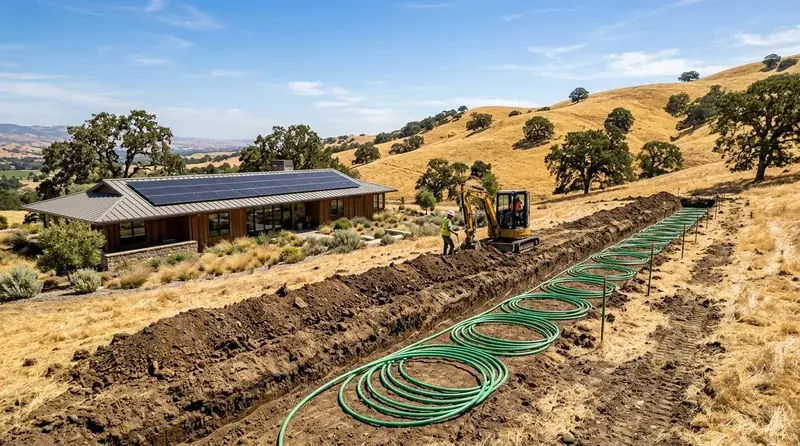
Why California Is Geothermal's Most Complex State
California is a state of contradictions for geothermal heat pumps. It has the second-highest electricity rates in the nation at 27.04¢/kWh (EIA 2024, behind only Hawaii). It has 16 distinct CEC building climate zones — from Tahoe snowpack at 6,200 feet to Palm Springs summers at 130°F. It banned gas in new construction before a federal court overturned the ban. And its NEM 3.0 policy just gutted the economics of solar export, making on-site electricity consumption more valuable than ever.
That last point is the story. California's ground-source heat pump case isn't just about heating and cooling efficiency — it's about what happens when you combine geothermal with solar panels in a post-NEM 3.0 world. The result is a synergy that doesn't exist anywhere else in the country.
Three things define the California geothermal conversation:
- Climate diversity. California stretches from heating-dominant mountain communities (7,500 HDD in Tahoe) to extreme-cooling desert (3,500 CDD in Palm Springs) to mild coastal zones where neither load is large. The geothermal case varies wildly across the state.
- NEM 3.0 solar synergy. The Net Billing Tariff (April 2023) slashed solar export credits by 75%. Suddenly, the smartest thing a solar homeowner can do is use more electricity on-site — and a geothermal heat pump is the ultimate "solar sponge." It replaces gas heating with electric heating, consuming your solar production instead of exporting it for pennies.
- Policy momentum. Title 24 already requires heat pumps in new construction. TECH Clean California has deployed $199M+ in heat pump incentives. The cultural shift toward all-electric homes is real — and geothermal is the premium tier of that electrification wave.
Let's be direct: if you heat with natural gas in a mild coastal California home, geothermal payback will likely take 15–25 years. Gas is still cheap per BTU, coastal heating loads are small, and the upfront cost is significant. But if you're on propane in the mountains, running electric resistance in the Central Valley, building new anywhere, or stacking geothermal with solar under NEM 3.0 — the numbers are surprisingly strong despite those headline electricity rates.
Quick Verdict: Should You Go Geothermal in California?
| Your Situation | Verdict | Typical Payback |
|---|---|---|
| Mountain/rural — propane heating (Tahoe, Mammoth, Shasta) | ✅ Best CA scenario | 6–10 years |
| Central Valley — electric resistance heating | ✅ Strong — high cooling load too | 5–8 years |
| New construction — anywhere (Title 24 baseline) | ✅ Incremental cost is low | 4–8 years |
| USDA REAP eligible — rural agricultural property | ✅ 55% cost coverage possible | 4–7 years |
| Desert — extreme cooling load (Palm Springs, Riverside) | ✅ Ground is 30°F+ cooler than air | 8–14 years |
| Pool owner — desuperheater value-add | ✅ Free pool heat is a major bonus | 7–11 years (with pool credit) |
| NEM 3.0 solar stacking — replacing gas with electric load | ✅ Excellent combined ROI | 5–9 years (combined system) |
| Coastal gas home — Bay Area, LA, San Diego | ⚠️ Honest: long payback | 15–25 years |
Does Geothermal Work in California?
Geothermal heat pumps work everywhere in California — but the economics and system design vary enormously across the state's 16 CEC building climate zones. The ground temperature profile is favorable in every region; the question is whether your heating and cooling loads are large enough to justify the upfront cost.
Ground Temperatures by Region
| Region | Climate Zone(s) | Ground Temp (50ft) | HDD | CDD | Dominant Load |
|---|---|---|---|---|---|
| North Coast (Eureka) | CZ1 | 52–55°F | 4,900 | 50 | Heating |
| Bay Area (SF/Oakland) | CZ3–4 | 55–58°F | 3,000 | 200 | Mixed (heating-lean) |
| Sacramento Valley | CZ12 | 60–63°F | 2,600 | 1,300 | Mixed |
| Central Valley (Fresno/Bakersfield) | CZ13 | 62–65°F | 2,400 | 1,800 | Cooling-dominant |
| LA Basin / San Diego | CZ6–9 | 60–65°F | 1,200–1,500 | 800–900 | Cooling-dominant |
| Desert (Palm Springs/Riverside inland) | CZ15 | 68–72°F | 1,000 | 3,500 | Extreme cooling |
| Mountain (Tahoe/Mammoth) | CZ16 | 48–52°F | 7,500 | 100 | Heating-dominant |
The Mountain and North Coast regions are the strongest geothermal candidates because they have serious heating loads — propane costs $3.50–$5.00/gallon in remote areas, and the ground temperature advantage is enormous. The Central Valley and desert are strong because the cooling load is massive — dumping heat into 63°F ground instead of 108°F summer air is a dramatic COP improvement. Coastal areas are the weakest because the climate is already mild — neither heating nor cooling loads are large enough to generate big savings.
Regional Drilling Conditions & Geology
California's geology is as diverse as its climate. Drilling conditions directly affect installation cost and loop design — sometimes by $10,000 or more for the same size system.
| Region | Dominant Geology | Drilling Rate | Thermal Conductivity | Notes |
|---|---|---|---|---|
| Central Valley | Deep alluvial sediments, sandy loam | $12–$16/ft | 0.8–1.2 BTU/hr·ft·°F | Easiest drilling in the state. Excellent for horizontal loops — flat terrain, deep soft soil, no rock. |
| Bay Area | Mixed — sandstone, shale, clay, fill | $16–$24/ft | 1.0–1.6 BTU/hr·ft·°F | Variable. Urban fill adds cost. Some areas hit bedrock at 30–50ft. Tight lots require vertical-only. |
| Sierra Nevada | Granite, granodiorite | $18–$28/ft | 1.5–2.2 BTU/hr·ft·°F | Hard rock means slower drilling but better thermal conductivity — fewer bore feet needed per ton. |
| LA Basin | Marine sediments, clay, alluvium | $15–$22/ft | 0.9–1.4 BTU/hr·ft·°F | Similar to Bay Area constraints. Dense neighborhoods mean vertical-only with tight access. |
| Desert (Coachella/Mojave) | Sand, caliche, decomposed granite | $14–$20/ft | 0.7–1.0 BTU/hr·ft·°F | Dry soils have lower thermal conductivity. Deeper bores needed to reach cooler ground. Grout quality matters more here. |
| North Coast | Mixed sedimentary, some basalt | $14–$20/ft | 1.0–1.5 BTU/hr·ft·°F | Wetter soils boost conductivity. More horizontal loop opportunities on larger rural properties. |
| Wine Country (Napa/Sonoma) | Volcanic soils, loam, clay | $15–$22/ft | 1.0–1.4 BTU/hr·ft·°F | Variable terrain. Some areas have excellent volcanic soil conductivity. Hillside properties may need directional boring. |
Thermal conductivity matters more than drilling cost. Sierra granite costs more to drill per foot, but its superior conductivity means a 3-ton system might need 450ft of bore vs. 600ft in Central Valley clay. A competent designer runs a thermal conductivity test (or uses local geological survey data) before specifying bore depth — if your installer skips this step, that's a red flag.
The Seismic Misconception
Here's a question we hear constantly: "California has earthquakes — isn't geothermal risky?"
No. This confusion stems from conflating two completely different technologies:
- Deep geothermal power (The Geysers, enhanced geothermal systems) — drills 2–10 miles deep, injects water into hot rock, generates electricity. This technology has been linked to induced seismicity in some locations. It has nothing to do with residential HVAC.
- Geothermal heat pumps (GSHP) — installs closed-loop HDPE pipe 150–400 feet deep in your yard. No rock fracturing, no water injection, no interaction with geologic faults. It's a heat exchanger in the ground, not a power plant.
Ground-source heat pump loops are flexible HDPE pipe — the same material used for water mains. They bend and flex with ground movement. In the unlikely event of a major earthquake, your ground loop is the least vulnerable part of your home's infrastructure. Your foundation, water lines, and gas connections are all at greater risk.
There are tens of thousands of ground-source heat pump installations in seismically active Japan, New Zealand, and yes — California. Zero have failed due to earthquake activity.
The High Electricity Rate Paradox
At 27.04¢/kWh, California's electricity looks like a geothermal killer. It's not — and understanding why requires thinking about units of heat delivered per dollar, not just the price per kilowatt-hour.
The COP Math
A geothermal heat pump with a heating COP of 4.0 delivers 4 units of heat for every 1 unit of electricity consumed. That means:
- Geothermal cost per 100,000 BTU: 27.04¢ ÷ 4.0 COP × 29.3 kWh = $1.98
- Natural gas cost per 100,000 BTU: $1.50/therm ÷ 0.95 AFUE = $1.58
- Propane cost per 100,000 BTU: $3.50/gal × 1.09 gal/therm ÷ 0.85 AFUE = $4.49
- Electric resistance per 100,000 BTU: 27.04¢ × 29.3 kWh = $7.92
Against gas, geothermal heating is roughly 25% more expensive per BTU at today's rates. That's why coastal gas homes face long paybacks — the heating savings are minimal or negative. But the cooling side changes everything. In cooling mode, geothermal runs at COP 4.5–5.5 compared to a conventional AC at SEER 14–16 (COP 4.1–4.7). In the Central Valley and desert, where cooling is 60–70% of HVAC energy use, that cooling efficiency advantage generates real annual savings.
The other factor: gas rates are rising faster than electricity rates in California. PG&E gas rates increased 33% between 2022 and 2025. If that trend continues, the heating cost crossover point comes sooner than the static math suggests.
Regional Costs & ROI
Installed System Cost by Region
California installation costs run 15–30% above the national average due to higher labor rates, permitting complexity, and constrained lot sizes in urban areas.
| Region | Typical Home Size | System Size | Installed Cost | After 30% ITC | Primary Loop Type |
|---|---|---|---|---|---|
| Bay Area / LA Metro | 1,800–3,000 sqft | 3–5 ton | $35,000–$65,000 | $24,500–$45,500 | Vertical (lot size limits) |
| Sacramento / Central Valley | 2,000–3,200 sqft | 3–5 ton | $28,000–$50,000 | $19,600–$35,000 | Horizontal or vertical |
| San Diego | 1,800–2,800 sqft | 3–5 ton | $30,000–$55,000 | $21,000–$38,500 | Vertical (coastal restrictions) |
| Mountain (Tahoe/Mammoth) | 1,800–3,000 sqft | 3–5 ton | $25,000–$45,000 | $17,500–$31,500 | Vertical (granite bedrock) |
| Desert (Palm Springs/Riverside) | 2,000–3,500 sqft | 4–5 ton | $30,000–$55,000 | $21,000–$38,500 | Vertical (deeper for cooler ground) |
| Rural / North Coast | 1,600–2,600 sqft | 2.5–4 ton | $22,000–$40,000 | $15,400–$28,000 | Horizontal (land available) |
Why Bay Area and LA cost more: Urban lot constraints often mean vertical-only installations. Drilling permits in dense neighborhoods take longer and cost more. Labor rates for IGSHPA-certified installers in the Bay Area run 30–50% above Central Valley or mountain rates. And traffic — getting a drill rig into a Berkeley or Pasadena backyard through narrow streets adds logistical cost.
Annual Savings by Fuel Replaced
| Current Fuel | Annual Cost (Typical) | Geo Annual Cost | Annual Savings |
|---|---|---|---|
| Propane ($3.50–$5.00/gal) + old AC | $5,200–$8,000 | $2,000–$3,000 | $3,200–$5,000 |
| Electric resistance + old AC | $4,500–$7,200 | $1,800–$2,800 | $2,700–$4,400 |
| High-efficiency gas + new AC (SEER 16+) | $2,400–$3,600 | $1,600–$2,600 | $800–$1,000 |
| Standard gas furnace + aging AC (SEER 10–13) | $3,200–$4,800 | $1,600–$2,600 | $1,600–$2,200 |
Real-World Case Studies
Case Study 1: Truckee Mountain Home — Propane to Geothermal
- Home: 2,400 sqft cabin on 1.5 acres, Truckee (near Lake Tahoe, elev. 5,817ft)
- Previous system: Propane furnace (82% AFUE) + window AC units for 6 summer weeks
- Climate zone: CZ16 — 7,500 HDD, 100 CDD, heating-dominant
- Propane cost: $4.25/gallon (mountain delivery premium), ~1,100 gallons/year ($4,675 heating)
- AC cost: ~$320/year (minimal cooling season)
- Total previous energy cost: $4,995/year
- New system: 4-ton ClimateMaster Tranquility 30, 3×300ft vertical bores in decomposed granite
- Installed cost: $38,000 (granite drilling adds ~$5,000 premium)
- After 30% ITC: $26,600 net cost
- Geothermal annual cost: $2,150 (electricity at 27¢/kWh, COP 3.8 average in cold climate)
- Annual savings: $2,845
- Simple payback: 9.3 years
- 25-year savings: $44,525 (after system cost, before maintenance savings)
Key insight: Mountain propane is the clearest win in California. Even with granite drilling and high electricity rates, replacing $4.25/gallon propane at 82% efficiency with COP 3.8 geothermal cuts heating costs by 54%. The propane tank is gone, eliminating the delivery truck access problem during heavy snow winters. Bonus: the system provides efficient cooling during increasingly warm Tahoe summers — something the old propane furnace never offered.
Case Study 2: Fresno Central Valley — Electric Resistance Replacement
- Home: 2,200 sqft ranch in Fresno, built 1978, original electric baseboard + SEER 10 AC
- Climate zone: CZ13 — 2,400 HDD, 1,800 CDD, cooling-dominant
- Electric heating cost: ~$2,400/year (baseboard at 27¢/kWh, 100% efficient)
- AC cost: ~$2,800/year (SEER 10, 7+ months of cooling, 100°F+ summer peaks)
- Total previous energy cost: $5,200/year HVAC
- New system: 4-ton WaterFurnace 7 Series, horizontal slinky loop (1/3 acre lot, alluvial soil)
- Installed cost: $32,000 (horizontal loops in excellent Central Valley soil)
- After 30% ITC: $22,400 net cost
- Geothermal annual cost: $1,850 (COP 4.2 heating, COP 5.0 cooling in moderate ground temps)
- Annual savings: $3,350
- Simple payback: 6.7 years
- 25-year savings: $61,350 (after system cost)
Key insight: Electric resistance replacement in the Central Valley is the math slam dunk. You're replacing COP 1.0 heating with COP 4.2 (75% less electricity for heating) AND replacing SEER 10 cooling with COP 5.0+ (50% less electricity for cooling). Fresno's alluvial soils are some of the best in the state for horizontal loops — excellent thermal conductivity, easy trenching, no rock. The cooling savings alone nearly justify the system; heating savings are a bonus.
Case Study 3: Sacramento NEM 3.0 Solar Stacking — Gas + Solar to Geo + Solar
- Home: 2,600 sqft two-story in Elk Grove (Sacramento metro), built 2008
- Previous system: 90% AFUE gas furnace + SEER 13 AC, 7.2kW solar array (NEM 2.0, grandfathered through 2036)
- Climate zone: CZ12 — 2,600 HDD, 1,300 CDD, balanced loads
- Gas heating cost: ~$1,650/year (PG&E baseline + Tier 2 gas rates)
- AC cost: ~$1,800/year (offset ~60% by solar, net $720)
- Total previous HVAC cost: $2,370/year (net, after solar offset)
- Problem: NEM 2.0 grandfathering expires 2036. Planning ahead — will lose ~$1,200/year in solar export value when switched to NEM 3.0 rates. Gas bills climbing 8–12%/year under PG&E rate increases.
- New system: 4-ton WaterFurnace 5 Series, 4×250ft vertical bores in Sacramento Valley alluvium
- Installed cost: $36,000
- After 30% ITC: $25,200 net cost
- Geothermal annual cost: $1,100 (electricity largely covered by solar self-consumption — gas bill eliminated entirely)
- Annual savings (current): $1,270 (modest — gas was relatively cheap)
- Annual savings (post-NEM 3.0 switch): $2,470 (solar self-consumption value jumps when export credits drop)
- Effective payback: 10.2 years using blended pre/post NEM timeline
- 25-year savings: $42,350 (accounting for gas rate escalation at 6%/year and NEM transition)
Key insight: This is the NEM 3.0 play in action. Today's savings are modest because this homeowner still has NEM 2.0 grandfathering. But they're building for the future: when NEM 3.0 kicks in, every kWh of geothermal electricity consumption that displaces a solar export is worth 21¢ (27¢ self-consumption vs. 6¢ export). The gas bill disappears entirely. And PG&E's gas rate trajectory (33% increase 2022–2025) means the decision looks better every year. For homeowners whose NEM 2.0 grandfathering is expiring in the next 5 years, this is the strategic move.
Month-by-Month Energy Profile
Based on a 2,400 sqft home in Sacramento (CZ12) replacing a gas furnace + SEER 12 AC with a 4-ton geothermal system:
| Month | Old System Cost | Geo Cost | Monthly Savings | Notes |
|---|---|---|---|---|
| January | $410 | $195 | $215 | Peak heating — Tule fog, 35°F lows. Gas furnace vs. COP 4.0 |
| February | $350 | $170 | $180 | Continued heating demand, occasional mild days |
| March | $240 | $130 | $110 | Transition month — some heating, first AC days |
| April | $180 | $110 | $70 | Mild — minimal HVAC, shoulder season |
| May | $290 | $140 | $150 | Cooling begins — 85°F+ days, ground at 61°F |
| June | $410 | $175 | $235 | Heavy cooling — old AC working hard at SEER 12 |
| July | $520 | $200 | $320 | Peak cooling — 100°F+ days, geo COP 5.0 advantage |
| August | $510 | $195 | $315 | Sustained heat — ground stays 61°F while air hits 105°F |
| September | $380 | $160 | $220 | Cooling continues — 90°F highs through month |
| October | $210 | $115 | $95 | Transition — pleasant shoulder season |
| November | $280 | $145 | $135 | First heating demand, gas vs. geo |
| December | $370 | $180 | $190 | Full heating season, morning frost |
Annual total: Old system $4,150 → Geothermal $1,915 = $2,235 savings
Note: Sacramento's balanced heating/cooling climate means savings come from both modes. July and August deliver the biggest monthly savings because the gap between outdoor air (100°F+) and ground temperature (61°F) is largest. Unlike Texas, California's winter savings are meaningful too — Sacramento winters are milder but gas prices are significantly higher.
Open-Loop System Assessment
California's complex water rights system — managed by the State Water Resources Control Board (SWRCB) — makes open-loop geothermal systems more difficult to permit than in most states. The state's ongoing drought concerns and prior-appropriation water rights doctrine add layers of regulatory review that closed-loop systems avoid entirely.
| Region | Open-Loop Viability | Key Considerations |
|---|---|---|
| Central Valley (Sacramento/San Joaquin) | ⚠️ Site-specific | Abundant groundwater but heavy agricultural demand. Sustainable Groundwater Management Act (SGMA) restricts new pumping in many basins. Some critically over-drafted basins are off-limits for new wells. |
| Mountain Communities (Tahoe/Sierra) | ❌ Generally not recommended | Lahontan RWQCB and Tahoe Regional Planning Agency (TRPA) have strict discharge regulations. Groundwater quality protections make return-flow permitting extremely difficult. |
| Bay Area / Coastal | ❌ Rarely viable | Saltwater intrusion concerns along the coast. High population density limits well spacing. Municipal water supply competition. Most Bay Area installers don't even quote open-loop. |
| Desert (Coachella/Imperial Valley) | ⚠️ Limited areas | Some agricultural wells could support open-loop, but water scarcity issues and Colorado River allocation politics make new groundwater permits contentious. |
| North Coast (Eureka/Mendocino) | ⚠️ Site-specific | Better water availability than southern regions. Fewer regulatory barriers. May be viable on larger rural properties with existing well infrastructure. |
| LA Metro / San Diego | ❌ Not recommended | Groundwater basins are adjudicated (court-managed). New pumping rights essentially unavailable. Closed-loop is the only practical option. |
Bottom line: The vast majority of California geothermal installations are and should be closed-loop systems. Unlike Midwest and Northeast states where open-loop is common and straightforward, California's water rights complexity, SGMA compliance requirements, and environmental review process make closed-loop the default recommendation. The few open-loop opportunities exist on large rural properties with existing permitted wells and adequate return-flow capacity.
Loop Type Cost Comparison
| Loop Type | Cost Range (3-ton) | Land Needed | Best California Application |
|---|---|---|---|
| Horizontal (trenched) | $14,000–$22,000 | 1,500–2,500 sqft | Central Valley, rural North Coast — flat land, deep alluvial soil |
| Slinky (coiled horizontal) | $15,000–$23,000 | 800–1,500 sqft | Moderate lots — 30% less trench than straight horizontal |
| Vertical (bored) | $22,000–$35,000 | Minimal (drill pads) | Bay Area/LA suburbs, mountain granite, any constrained lot |
| Open-loop (well-based) | $16,000–$26,000 | Well pad + discharge | Rare — rural properties with existing permitted wells only |
| Pond/lake loop | $12,000–$18,000 | ½ acre+ pond | Wine country estates, ranch properties with irrigation ponds |
California-specific note: Vertical boring in Sierra granite runs $18–$28/ft vs. $12–$18/ft in Central Valley alluvial soil. However, granite's superior thermal conductivity (1.5–2.2 BTU/hr·ft·°F vs. 0.8–1.2 in clay) means fewer total bore feet are needed. A good designer will account for this — don't compare raw drilling costs without understanding bore-per-ton requirements.
Incentive Stacking: Federal, State & Utility
Unlike Texas, California has a layered incentive landscape. The federal ITC is the foundation, but state programs and utility rebates can stack on top — though the geothermal-specific availability of some programs requires verification with your installer and utility.
| Incentive | Amount | Status | Notes |
|---|---|---|---|
| Federal ITC (IRC §25D) | 30% of cost | ✅ Confirmed | Through 2032. No income limit. No cap. |
| TECH Clean California | Varies by system | [NEEDS VERIFICATION] | 75,800+ heat pump units installed, $199M+ deployed statewide. GSHP-specific rebate amounts vary — most TECH incentives have targeted air-source heat pumps. Verify GSHP eligibility with your installer. |
| Utility rebates (PG&E, SCE, SDG&E) | Varies | [NEEDS VERIFICATION] | Major IOUs offer heat pump HVAC rebates through TECH Clean CA partnership. Amounts and GSHP eligibility vary — check your utility's current program. |
| SMUD (Sacramento) | Up to $3,000+ | [NEEDS VERIFICATION] | SMUD is California's most aggressive electrification utility. Has offered substantial heat pump incentives including both ASHP and GSHP. |
| LADWP (Los Angeles) | $3,000–$5,000 | [NEEDS VERIFICATION] | LADWP has offered heat pump system incentives. Verify current amounts and GSHP eligibility. |
| IRA Rebates (HOMES/HEEHRA) | Up to $8,000 | [NEEDS VERIFICATION] | California allocated ~$291M from IRA rebate programs. Income-qualified (up to 150% AMI for max rebate). Administered by CEC. |
| USDA REAP (rural/ag) | Up to 25% grant + 25% loan | ✅ Available | Rural properties and ag operations — stacks with ITC. Strong option for Central Valley farms, North Coast ranches, mountain properties. |
| Property tax exclusion | Assessment exclusion | ✅ Available | CA Revenue & Taxation Code §73 excludes active solar energy systems from property tax reassessment. GSHP applicability should be verified with your county assessor. |
Example: Mountain Home Incentive Stack
A rural property near Quincy, CA (Plumas County) replacing propane with a $36,000 geothermal system:
- USDA REAP grant (25%): −$9,000
- Federal ITC (30% of $27,000 remaining): −$8,100
- Potential utility rebate: −$1,000 to −$3,000 [NV]
- Net cost: $15,900–$17,900 (50–56% reduction)
- Annual savings (replacing propane): $3,200
- Payback: 5.0–5.6 years
Note: Incentive amounts marked [NEEDS VERIFICATION] change frequently. Always confirm current program details with your installer and utility before making financial projections. See the federal geothermal tax credit guide for detailed ITC information. Last verified: March 2026.
Permits & Licensing Requirements
California's permitting landscape is more complex than most states, but it's navigable. Your installer handles most of this — but understanding the process helps you vet contractors and avoid surprises.
Required Permits & Agencies
| Permit/Requirement | Agency | Typical Cost | Timeline | Notes |
|---|---|---|---|---|
| Mechanical permit (HVAC) | Local building department | $150–$500 | 1–4 weeks | Standard HVAC permit. Required everywhere. Covers indoor equipment installation. |
| Well/boring permit (vertical loops) | County environmental health or local water district | $200–$800 | 2–6 weeks | Required for vertical bore installations. Some counties classify geothermal bores differently than water wells — ask your installer which agency has jurisdiction. |
| Grading/excavation permit (horizontal loops) | Local building department | $100–$400 | 1–3 weeks | Required when trenching exceeds certain depths (typically 5ft+). Not all jurisdictions require this for residential horizontal loops. |
| Electrical permit | Local building department | $75–$250 | 1–2 weeks | For new circuit/panel work. May be included in mechanical permit in some jurisdictions. |
| Well permit (open-loop only) | State Water Resources Control Board + local groundwater agency | $500–$2,000+ | 2–6 months | Only for open-loop systems. Requires SGMA compliance review in designated basins. This is why open-loop is rare in CA. |
| Coastal development permit | California Coastal Commission | $500–$5,000 | 2–12 months | Only for properties within the Coastal Zone. Vertical boring may trigger CCC review. Check your property's zoning. |
| TRPA permit (Tahoe Basin) | Tahoe Regional Planning Agency | $300–$1,500 | 4–12 weeks | Only for properties within the TRPA boundary. Additional environmental review for ground disturbance. |
CSLB Contractor Licensing
California law requires any contractor performing geothermal heat pump work to hold a valid license from the Contractors State License Board (CSLB). The relevant license classifications:
- C-20 (Warm-Air Heating, Ventilating and Air-Conditioning): Covers installation of the heat pump unit, ductwork, and indoor components. This is the primary license for the HVAC portion.
- C-57 (Well Drilling): Required for vertical bore drilling operations. Your general HVAC contractor may subcontract the drilling to a C-57 licensed driller — this is common and acceptable as long as both licenses are active.
- C-36 (Plumbing): May be required for ground loop piping connections, particularly for open-loop systems involving water supply plumbing.
- B (General Building): A general contractor license that may cover the full scope if the project is part of new construction or major renovation.
How to verify: Every California contractor license can be verified instantly at CSLB License Check. Enter the license number or business name. Check for: active status, correct classification, workers' comp insurance on file, no disciplinary actions, and bond status. Do this for every contractor who gives you a quote — it takes 30 seconds.
The Typical Permitting Timeline
For a standard residential closed-loop vertical system in a non-coastal, non-Tahoe location:
- Weeks 1–2: Installer files mechanical permit + well/boring permit with your local building department and county environmental health.
- Weeks 2–4: Permit review and approval. Some jurisdictions require plan review; others issue over the counter.
- Weeks 4–6: Installation (drilling + indoor equipment).
- Week 6–7: Final inspection by building department. System commissioning.
Total timeline: 6–8 weeks from contract signing to system operating. Bay Area and LA can stretch to 10–12 weeks due to busier permitting offices. Mountain areas during winter may have seasonal drilling restrictions.
Your installer should handle all permit applications, inspections, and fees as part of the project. If a contractor asks you to pull your own permits, that's a red flag — it may mean they aren't properly licensed.
Finding & Vetting a California Installer
California's GSHP installer market is smaller than you'd expect for a state of 39 million people. Air-source heat pumps dominate the market thanks to TECH Clean California's push, so finding an installer who truly specializes in ground-source takes some effort.
Where to Find GSHP Installers
- IGSHPA Installer Directory — igshpa.org/directory. Search by state. IGSHPA-accredited installers have completed geothermal-specific training. This is your primary source.
- Manufacturer dealer locators:
- GeoExchange.org — The Geothermal Exchange Organization maintains a contractor directory.
- CSLB license search — Search for C-20 licensed contractors in your area who also hold C-57 (well drilling) or have established drilling subcontractor relationships.
The Vetting Checklist
Before signing a contract, verify these for every contractor:
- CSLB license verification. Go to cslb.ca.gov. Confirm active C-20 license (minimum). Check for disciplinary history, workers' comp policy, and bond status.
- IGSHPA certification. Ask for their IGSHPA Accredited Installer credential. Not all HVAC contractors with C-20 licenses have geothermal-specific training. This matters — loop design mistakes are expensive.
- Geothermal-specific experience. Ask: "How many ground-source systems have you installed in the past 3 years?" If the answer is under 10, they may be learning on your project. Aim for installers with 20+ GSHP installations.
- Manual J load calculation. Any legitimate installer will perform a Manual J heating/cooling load calculation before quoting a system size. If someone quotes you "4 tons" based on square footage alone — without measuring windows, insulation, orientation, and ductwork — walk away.
- Thermal conductivity test. For vertical systems, the installer should either perform an in-situ thermal conductivity test or reference local geological data. This determines bore depth per ton. Skipping this step leads to undersized or oversized loop fields.
- Equipment brand. Ask what brand and model they install. Established GSHP brands: WaterFurnace, ClimateMaster, Bosch/GeoStar, Carrier/Bryant. Be cautious of generic or unfamiliar heat pump units being sold as "geothermal."
- Written warranty. The heat pump should carry a manufacturer warranty (typically 5–10 years parts, with extended options). The ground loop should be warranted for 25–50 years. Get both in writing.
- References. Ask for 3 recent California GSHP installation references. Call them. Ask about the installation process, any issues, and current system performance.
Get at least 3 quotes. California's market is thin enough that pricing varies significantly between contractors. A $15,000 difference between quotes for the same system isn't unusual — and it doesn't always mean the cheaper one cut corners. Sometimes it means the expensive one doesn't do enough geothermal work to be efficient at it.
Solar + Geothermal: The NEM 3.0 Killer Angle
This is California's most important geothermal story — and it doesn't exist anywhere else in the country.
What Changed with NEM 3.0
In April 2023, California's Net Billing Tariff (NEM 3.0, CPUC Decision 22-12-056) replaced traditional net metering. The key change: solar export credits dropped by approximately 75%. Under NEM 2.0, excess solar energy exported to the grid earned roughly retail rate (25–30¢/kWh). Under NEM 3.0, export credits average 5–8¢/kWh depending on time of day and season.
This fundamentally changed the economics of residential solar. The new math is simple: every kWh you consume on-site is worth 27¢. Every kWh you export is worth 6¢. Self-consumption became 4–5x more valuable than export.
Why Geothermal Is the Perfect "Solar Sponge"
A geothermal heat pump replaces gas combustion with electric heating and provides efficient electric cooling. That creates a large new on-site electricity load — exactly what NEM 3.0 rewards:
- Heating electrification. A gas furnace uses zero electricity. A geothermal system uses ~6,000–10,000 kWh/year for heating (at COP 4.0). That's 6,000–10,000 kWh/year of solar production you're consuming on-site instead of exporting for pennies.
- Cooling efficiency. Geothermal cooling runs during peak solar production hours (afternoon). Your solar panels are generating maximum output at the same time your cooling system is running hardest.
- Year-round load matching. Solar produces most in summer (cooling season) and least in winter (heating season). Geothermal needs most electricity in winter (heating) and some in summer (cooling). The loads don't perfectly match, but a well-designed system with time-of-use rate optimization can capture 60–75% of solar production on-site.
Combined System Economics
For a 2,400 sqft Sacramento home replacing gas furnace + SEER 12 AC:
- Geothermal only: $32,000 gross → $22,400 net → $2,235/yr savings → 10.0yr payback
- Solar (8kW) only: $22,000 gross → $15,400 net → $1,200/yr savings (NEM 3.0 reduced) → 12.8yr payback
- Combined geo + solar: $54,000 gross → $37,800 net → $3,800/yr savings → 9.9yr payback with near-zero grid dependence
The combined payback is better than either system alone because the interaction creates value: solar production that would export at 6¢ instead powers geothermal loads worth 27¢. That 21¢/kWh delta is the "stacking bonus" unique to California's post-NEM 3.0 landscape.
The sweet spot: Homes that currently use gas for heating and have solar panels (or are planning solar). By adding geothermal, you electrify your heating load — creating demand for solar energy that you're currently exporting at wholesale. This can dramatically accelerate payback on both systems.
Title 24 & New Construction
California's 2022 Title 24 Building Energy Efficiency Standards (effective January 2023) made California the first state to require heat pumps for space heating and water heating in all new residential construction. While the code allows air-source heat pumps as the baseline, ground-source systems exceed code by a significant margin — and that has financial implications.
Why Title 24 Matters for Geothermal
- Heat pump baseline: New homes are already required to have heat pump HVAC. The incremental cost to upgrade from air-source to ground-source is $8,000–$15,000 — far less than the full retrofit cost.
- Energy compliance margin: GSHP systems exceed Title 24 performance targets by 40–60%, allowing builders to reduce spending on other energy features (insulation, windows) while still meeting code.
- Zero-net-energy synergy: California's ZNE goals for new construction pair naturally with geothermal — the lower energy consumption makes it easier (and cheaper) to reach net-zero with a smaller solar array.
For new construction buyers: ask your builder about ground-source as an upgrade option before the slab is poured. The loop field is dramatically cheaper to install during construction when trenching equipment is already on-site.
Pool Heating & Desuperheaters
California has more residential swimming pools than any other state — an estimated 1.8 million. If you have a pool and are installing geothermal, the desuperheater option is essentially free money.
How It Works
A desuperheater is a small heat exchanger added to your geothermal heat pump (cost: $500–$1,200 as an add-on). In cooling mode, the superheated refrigerant passes through the desuperheater before entering the ground loop, transferring waste heat to your pool water. Result: your pool is heated as a free byproduct of air conditioning your home.
California-Specific Value
- Central Valley & desert: You're running AC 7–9 months/year. The desuperheater heats your pool during those entire 7–9 months at zero marginal cost. Gas pool heater savings: $1,200–$2,400/year.
- Bay Area & coastal: Shorter AC seasons mean less desuperheater output, but pool heating is needed year-round. Savings of $600–$1,200/year — the desuperheater covers spring through fall, and the geothermal system can provide supplemental pool heating in winter.
- Mountain: Short pool season, but the desuperheater captures waste heat during the brief summer cooling period. Modest savings.
For a Central Valley pool owner, the desuperheater alone can shave 1–2 years off the system payback. It's the single most cost-effective add-on in the geothermal world — and California's climate and pool density make it more relevant here than anywhere else.
Wildfire Resilience: WUI Zone HVAC
California's wildfire seasons are growing longer and more intense. In 2020 and 2021, wildfires destroyed thousands of homes across the state. If you live in or near a Wildland-Urban Interface (WUI) zone — and over 4.5 million California homes do — your HVAC system's vulnerability matters.
Why Geothermal Is the Most Fire-Resilient HVAC
- No outdoor condenser. A conventional split-system AC or air-source heat pump has a large outdoor unit with plastic fan blades, aluminum fins, and refrigerant lines. Ember exposure and radiant heat can melt, warp, or ignite these components. A geothermal system's heat exchange happens underground — there is no outdoor unit.
- No propane tank. Mountain and rural California homes on propane have a 250–1,000 gallon tank in the yard. In a wildfire, that tank is a hazard. Geothermal eliminates it entirely.
- Underground loops are fire-proof. HDPE pipe buried 5+ feet underground is completely unaffected by surface wildfire. Even if the home above is lost, the ground loop survives intact and can be connected to a rebuilt structure.
- Reduced insurance risk profile. While no insurance company currently offers a specific geothermal discount, the elimination of an outdoor condenser and propane storage removes two fire vulnerability points that insurers increasingly assess. In a state where major insurers (State Farm, Allstate) have stopped writing new homeowner policies in fire-prone areas, anything that reduces your risk profile matters.
For homes in CAL FIRE's mapped WUI zones — especially in the Sierra foothills, East Bay hills, Malibu, and San Diego backcountry — geothermal's resilience advantage goes beyond financial payback. After the 2018 Camp Fire destroyed 18,804 structures in Paradise, every rebuilt home is making infrastructure resilience decisions that didn't feel important before.
Maintenance & System Longevity
One of geothermal's most underappreciated advantages is its longevity and low maintenance cost. California's mild-to-moderate climate (outside the mountain zones) is particularly easy on geothermal equipment — no extreme cold cycling stress, no salt air corrosion on outdoor units (because there are none).
Maintenance Schedule
| Task | Frequency | DIY or Pro | Cost | Notes |
|---|---|---|---|---|
| Air filter replacement | Every 1–3 months | DIY | $5–$20 | Same as any forced-air system. More frequent in dusty Central Valley or fire season (wildfire smoke). |
| Thermostat check & calibration | Annually | DIY | Free | Verify programming matches seasonal needs. Smart thermostats auto-adjust. |
| Condensate drain cleaning | Annually | DIY | Free | Clear the drain line to prevent clogs. Quick flush with vinegar. |
| Professional system inspection | Annually | Pro | $150–$300 | Check refrigerant charge, electrical connections, blower motor, heat exchanger, and loop pressure. |
| Loop fluid check (closed-loop) | Every 3–5 years | Pro | $100–$200 | Test antifreeze concentration and pH. Top off if needed. California's mild ground temps mean less thermal stress on loop fluid. |
| Ductwork inspection | Every 5 years | Pro | $150–$400 | Check for leaks, especially in unconditioned attic spaces common in California ranch homes. |
| Desuperheater maintenance | Annually (if installed) | Pro | Included in inspection | Check heat exchanger for scale buildup. California hard water (especially Central Valley) can scale faster. |
Expected Lifespan
| Component | Expected Life | Replacement Cost | Comparison |
|---|---|---|---|
| Indoor heat pump unit | 20–25 years | $5,000–$10,000 | Conventional AC/furnace: 15–20 years. No outdoor unit means no weather exposure degradation. |
| Ground loop (HDPE pipe) | 50+ years | $0 (outlasts the home) | No moving parts, no weather exposure, no corrosion. HDPE is rated for 50+ year underground service life. |
| Circulating pump | 10–15 years | $300–$800 | The only moving part in the loop system. Easy replacement. |
| Compressor | 15–20 years | $1,500–$3,000 | Scroll compressors in modern units are extremely reliable. Less cycling stress in California's moderate climate. |
| Desuperheater | 15–20 years | $500–$1,200 | May need descaling in hard water areas. Otherwise, no moving parts. |
Total annual maintenance cost: $200–$500/year, compared to $300–$600 for a conventional gas furnace + AC system (which also needs combustion safety checks, heat exchanger inspection, and outdoor unit cleaning/coil replacement). Over 25 years, you'll also avoid 1–2 outdoor condenser replacements ($3,000–$6,000 each) that conventional AC systems typically need.
California-specific advantage: No outdoor unit means no wildfire smoke damage to condenser coils, no salt air corrosion for coastal installations, and no summer heat stress that shortens conventional AC compressor life when ambient temps exceed 115°F in the desert. The indoor unit operates in conditioned space year-round.
Vacation Rental & Airbnb Analysis
California's short-term rental market is one of the largest in the nation. Three regions present distinct geothermal opportunities:
Lake Tahoe / Mountain Rentals
Tahoe-area vacation rentals run heating 8+ months per year, often for guests who keep thermostats at 72°F. Propane costs are brutal — $4.00–$5.00/gallon with delivery fees. Geothermal cuts heating costs by 50–60% while marketing as an "eco-luxury" experience. The sustainability angle resonates with the Bay Area and LA guests who dominate Tahoe tourism. Premium positioning potential: $30–$60/night for "carbon-neutral mountain lodge" branding.
Wine Country (Napa/Sonoma/Paso Robles)
Wine country properties serve affluent, environmentally conscious guests. These homes need both heating (winter fog and 40°F nights) and cooling (summer harvest season, 90°F+ in inland valleys). A geothermal system with desuperheater (for the pool most upscale rentals have) eliminates propane or gas costs and aligns with the wine industry's sustainability narrative. WUI zone wildfire resilience is increasingly relevant — several wine country fires have destroyed rental properties since 2017.
Desert Rentals (Palm Springs/Joshua Tree)
Desert short-term rentals face extreme cooling loads — 115°F+ summer days with guests running AC at full blast. Conventional AC systems are overworked and fail frequently (outdoor condensers bake in direct desert sun). Geothermal maintains efficiency regardless of air temperature because the heat exchange is underground. Lower operating costs, fewer maintenance calls, longer equipment life — all advantages for remote rental management. The "desert modern eco-retreat" brand commands premium pricing in the Joshua Tree/Palm Springs market.
Data Center Cooling
Northern California — particularly Sacramento and the Bay Area — is experiencing massive data center growth. While this is a commercial/industrial application, it's relevant to the residential geothermal conversation for two reasons:
- Installer workforce expansion. Commercial geothermal projects bring more IGSHPA-certified drillers and designers to California. A larger installer base means more competition, better pricing, and shorter wait times for residential projects.
- Technology normalization. When major tech companies (Meta, Google, Microsoft) adopt geothermal cooling for data centers, it validates the technology in a state that trends toward tech-forward solutions. California homeowners who see "Google uses geothermal" are more likely to consider it.
Sacramento's data center corridor is particularly relevant — the region's alluvial soil, moderate ground temperatures (60–63°F), and relatively lower land costs make it ideal for both commercial and residential ground-source systems.
How to Claim the Federal Tax Credit
- Confirm system qualifies. Must be an ENERGY STAR-certified ground-source heat pump installed in a U.S. home you own. Both primary residences and second homes (including vacation rentals you use personally) qualify. Rental-only investment properties do not qualify for the residential credit (§25D), but may qualify for the commercial credit (§48).
- Keep all documentation. Save the installer contract, itemized invoice (equipment, labor, drilling separated), ENERGY STAR certification, manufacturer spec sheets, and any permits. California permitting paperwork is especially important for audit support.
- Calculate your credit. Total installed cost × 30% = your credit amount. Include everything: equipment, ground loop materials, drilling, trenching, piping, manifolds, antifreeze, labor, permits, and commissioning. The desuperheater qualifies if it's part of the integrated system.
- File IRS Form 5695. Complete Part I (Residential Clean Energy Credit). Enter total qualified costs on Line 1. The 30% credit calculates on Line 6a.
- Transfer to Form 1040. The credit from Form 5695 carries to Schedule 3 (Form 1040), Line 5, then to Form 1040, Line 20. This directly reduces your tax liability — it's a credit, not a deduction.
- If credit exceeds tax liability: Unused credit carries forward to the next tax year. You don't lose it — it applies when you have sufficient tax liability. California's generally higher incomes mean most homeowners can absorb the credit in 1–2 tax years.
- Coordinate with state incentives: If you received a TECH Clean California rebate or utility rebate, you may need to subtract it from your cost basis before calculating the ITC. Consult your tax professional — stacking rules between federal credits and state/utility rebates have specific IRS treatment. A USDA REAP grant definitively reduces your ITC basis.
California vs. Neighboring States
| Factor | CA | OR | NV | AZ |
|---|---|---|---|---|
| Avg. electricity rate | 27.04¢ | 12.21¢ | 13.77¢ | 12.95¢ |
| CO2 (lbs/MWh) | 407 | 282 | 650 | 738 |
| State incentive | TECH Clean CA [NV] | Energy Trust of OR | None | None |
| Typical payback (propane) | 6–10yr | 7–11yr | 8–12yr | 10–15yr |
| Open-loop potential | Very limited | Moderate | Limited | Very limited |
| Dominant load | Region-dependent | Heating | Cooling | Extreme cooling |
| Solar + geo synergy | Excellent (NEM 3.0) | Good (net metering) | Good (net metering) | Good (net metering) |
| Permitting complexity | High | Moderate | Low | Low |
| Installer availability | Low (growing) | Moderate | Low | Low |
California's high electricity rates are partially offset by the strongest state incentive landscape in the region and the unique NEM 3.0 solar stacking opportunity. Oregon offers lower electricity rates and Energy Trust incentives, making it a strong neighboring-state comparison. Nevada and Arizona have extreme cooling loads where geothermal excels at efficiency — but neither state offers meaningful incentives beyond the federal ITC, and both have limited water resources that constrain open-loop options.
The key California advantage: NEM 3.0 makes solar + geothermal stacking more valuable here than in any neighboring state because the penalty for solar export (and therefore the reward for self-consumption) is highest in California. If you're in a border area and considering both states, California's incentive landscape and solar synergy often outweigh the electricity rate disadvantage.
Frequently Asked Questions
This is the most common misconception. At 27¢/kWh, California electricity is expensive — but a geothermal heat pump uses 60–75% less electricity than electric resistance heating (COP 3.5–4.5 vs. COP 1.0). For cooling, geothermal uses 30–40% less electricity than conventional AC. You're paying more per kWh but buying far fewer kWh. Against propane ($3.50–$5.00/gal in mountain areas) and electric resistance, geothermal saves money even at California rates. Against natural gas, the heating math is tighter — but cooling savings and the NEM 3.0 solar stacking benefit change the equation.
Absolutely. Residential geothermal heat pump ground loops use flexible HDPE pipe buried 5–400 feet deep. They are not related to deep geothermal power plants (The Geysers) that drill miles into the earth. GSHP loops bend and flex with ground movement — they're among the most earthquake-resistant building infrastructure components. Thousands of GSHP systems operate in seismically active Japan, New Zealand, and California with zero earthquake-related failures.
NEM 3.0 actually increases geothermal's value. Under the new Net Billing Tariff, solar export credits dropped to 5–8¢/kWh (from ~27¢ under NEM 2.0). This means every kWh you consume on-site is worth 4–5x more than exporting it. A geothermal heat pump creates a large new on-site electrical load (replacing gas heating with efficient electric heating), turning solar energy that would be exported for pennies into valuable self-consumed energy. Solar + geothermal is the ideal NEM 3.0 strategy.
In most cases, no. California's complex water rights system (State Water Resources Control Board), the Sustainable Groundwater Management Act (SGMA), and regional water quality regulations make open-loop permits difficult to obtain. Most California installers recommend and install closed-loop systems exclusively. The few open-loop opportunities exist on large rural properties with existing permitted wells in basins that aren't critically over-drafted. Consult your local groundwater sustainability agency before planning open-loop.
We'll be honest: for a coastal California home (Bay Area, LA, San Diego) with an efficient gas furnace, geothermal payback is typically 15–25 years on heating/cooling savings alone. Coastal climates are mild — neither heating nor cooling loads are large enough to generate big annual savings. The scenarios where coastal geothermal makes sense: (1) new construction where the incremental cost is lower, (2) combined with solar under NEM 3.0 where the self-consumption value accelerates payback, (3) you're replacing aging equipment anyway and want long-term gas price protection, or (4) environmental motivation beyond pure financial return.
The federal 30% ITC (IRC §25D) is your guaranteed foundation — no income limit, no cap, through 2032. On top of that, TECH Clean California, utility-specific rebates (PG&E, SCE, SDG&E, SMUD, LADWP), and IRA-funded rebate programs (HOMES/HEEHRA) may provide additional incentives. Rural properties may qualify for USDA REAP grants (up to 25%). However, many state and utility programs are evolving — verify current amounts and GSHP eligibility with your installer before relying on specific numbers.
Geothermal is the most fire-resilient HVAC system available. The heat exchange happens underground — no outdoor condenser to melt from radiant heat or ember exposure. It eliminates propane tank storage (a fire hazard). Even if the home is destroyed, the underground loop survives and can be reconnected to a rebuilt structure. For homes in WUI (Wildland-Urban Interface) zones, geothermal removes two fire vulnerability points: the outdoor unit and the combustible fuel supply.
Yes — with a desuperheater ($500–$1,200 add-on). In cooling mode, waste heat from your geothermal system heats your pool for free. In California's Central Valley and desert, where AC runs 7–9 months/year, the desuperheater provides pool heating during the entire swimming season at zero marginal cost. Gas pool heater savings: $1,200–$2,400/year. This alone can shave 1–2 years off system payback. California has more pools than any state — the desuperheater opportunity is uniquely valuable here.
Not specifically. Title 24 (2022 code, effective 2023) requires heat pumps for space heating and water heating in new residential construction — but air-source heat pumps satisfy the requirement. Ground-source is a premium upgrade that exceeds code by 40–60%. The advantage: since new homes already must have heat pump HVAC, the incremental cost to upgrade to geothermal is $8,000–$15,000 rather than the full $25,000–$65,000 retrofit cost. Ask your builder about ground-source before the slab is poured.
California installations run 15–30% above national average. Typical 3–5 ton residential system: $22,000–$65,000 installed, depending on region. Bay Area and LA metro are most expensive ($35,000–$65,000 due to lot constraints and labor costs). Rural and mountain areas are cheapest ($22,000–$45,000). After the 30% federal ITC, net costs range from $15,400–$45,500. Central Valley horizontal loops in alluvial soil represent the best value. Get at least 3 quotes — regional cost variation in California is extreme. See our geothermal vs. traditional HVAC comparison for detailed cost analysis.
Your installer needs a valid CSLB C-20 (Warm-Air Heating, Ventilating and Air-Conditioning) license at minimum. For vertical bore drilling, they or their subcontractor also need a C-57 (Well Drilling) license. Verify any contractor's license instantly at cslb.ca.gov — check for active status, correct classification, workers' comp insurance, and no disciplinary actions. Beyond CSLB licensing, look for IGSHPA (International Ground Source Heat Pump Association) certification, which indicates geothermal-specific training that general HVAC contractors typically don't have.
The indoor heat pump unit lasts 20–25 years (compared to 15–20 for conventional furnace/AC). The ground loop — the buried pipe — lasts 50+ years and will outlast your home. The HDPE pipe used has no moving parts, no weather exposure, and no corrosion. You'll replace the indoor unit once during the loop's lifetime, but you'll never need to re-drill or re-trench. California's moderate climate is particularly easy on equipment — no extreme cold cycling stress, no outdoor unit degradation from weather.
Bottom Line
California's geothermal story is one of extremes. The state has the highest installation costs, the second-highest electricity rates, and the most complex permitting landscape in the country. It also has the strongest incentive programs, the most compelling solar stacking opportunity (NEM 3.0), and climate diversity that creates genuine geothermal sweet spots from Tahoe to the Coachella Valley.
- Mountain propane homes: 6–10 year payback. The clearest win in California. Eliminates propane delivery hassles, adds wildfire resilience, and provides cooling for increasingly warm mountain summers.
- Central Valley electric resistance: 5–8 year payback. The math slam dunk — 75% less electricity for heating, 50% less for cooling, in soil that's ideal for horizontal loops.
- NEM 3.0 solar stacking: 5–9 year combined payback. California's unique advantage. Turn exported solar energy worth 6¢ into self-consumed energy worth 27¢ by electrifying your heating load.
- New construction: 4–8 year payback on incremental cost. Title 24 already requires a heat pump — geo is the premium upgrade at a fraction of retrofit cost.
- Coastal gas homes: 15–25 year payback. Be honest with yourself. The financial case is weak unless you're stacking with solar, building new, or prioritizing environmental impact over ROI.
California's aggressive electrification policy, rising gas rates, and NEM 3.0 solar economics are all pushing in the same direction: toward on-site electric heating and cooling. Geothermal is the most efficient way to get there. The question is whether the upfront cost works for your specific home, location, and current heating fuel.
Get three quotes minimum. Verify CSLB licenses and IGSHPA certification. Ask about loop type options specific to your soil and lot. And run the numbers honestly — California rewards informed decisions, not wishful thinking.
Last verified: March 2026. EIA rate data: 2024 annual average. Federal tax credit status: confirmed through 2032 per IRC §25D. NEM 3.0: CPUC Decision 22-12-056, effective April 2023. TECH Clean California data: 75,800+ units installed, $199M+ in incentives paid. CSLB licensing: verified against current classification requirements.
Sources
- U.S. Energy Information Administration — California Electricity Profile 2024
- U.S. Energy Information Administration — California State Electricity Data Tables
- TECH Clean California — Statewide Heat Pump Initiative (75,800+ units, $199M+ deployed)
- California Energy Commission — Title 24 Building Energy Efficiency Standards
- California Public Utilities Commission — NEM 3.0 / Net Billing Tariff (Decision 22-12-056)
- California State Water Resources Control Board — Groundwater Management and Water Rights
- California Contractors State License Board — License Classifications and Verification (C-20, C-57)
- ENERGY STAR — Geothermal Heat Pumps Tax Credit
- IRS — Form 5695: Residential Energy Credits
- USDA Rural Development — Rural Energy for America Program (REAP)
- CAL FIRE — Fire Hazard Severity Zone Maps (WUI Zones)
- IGSHPA — International Ground Source Heat Pump Association Standards
- NOAA — Climate Data: Western Region
- California Energy Commission — Building Decarbonization Programs
- U.S. DOE — Geothermal Heat Pumps Technical Reference
- California Department of Water Resources — Sustainable Groundwater Management Act (SGMA)
- Tahoe Regional Planning Agency — Environmental Review Standards for Lake Tahoe Basin
- California Coastal Commission — Coastal Development Permits
- GeoExchange (Geothermal Exchange Organization) — Industry Standards and Contractor Resources