
In This Guide
- The Connecticut Paradox: Expensive Electricity, Cheaper Heat
- Connecticut by the Numbers
- The Heating Oil Problem
- The Full Cost Comparison
- Federal 30% Tax Credit
- Energize CT Rebates and Programs
- Connecticut Green Bank Financing
- Connecticut's Geology
- Permitting in Connecticut
- Finding a Qualified Installer
- Bottom Line: Who Should Go Geothermal in CT
📊 Connecticut by the Numbers
The Connecticut Paradox: Expensive Electricity, Cheaper Heat
Connecticut has the highest residential electricity rate of any state in the contiguous U.S. — 29.38¢/kWh as of 2025, according to EIA data. If you're a Connecticut homeowner who's looked into electric heating before and run from the numbers, that's a rational response. Electric baseboard heat at 29¢/kWh is brutal. An air-source heat pump is significantly better but still gets squeezed at that rate.
Geothermal is different. And it's worth doing the math carefully, because a lot of Connecticut homeowners dismiss it too quickly based on the electricity rate headline.
A ground-source heat pump doesn't consume electricity to generate heat — it uses electricity to move heat from the earth into your home. The ratio of heat delivered to electricity consumed is the Coefficient of Performance (COP). A properly sized Connecticut geothermal system typically operates at a COP of 3.5 to 4.0. That means for every $1 of electricity, you get $3.50–$4.00 worth of heat. Even at 29.38¢/kWh, your effective cost per unit of heat is about 8–9¢ per kWh equivalent.
Heating oil at $3.50 per gallon, through a furnace operating at 85% efficiency, costs roughly $30 per million BTU. Geothermal at Connecticut's 29.38¢ rate, with a COP of 3.5, costs roughly $25 per million BTU. The math works — even with the most expensive grid electricity in the lower 48 states. And when oil prices spike — as they did in 2022 when residential heating oil hit $5.00–$6.00 per gallon in Connecticut — the gap widens dramatically.
This is the Connecticut paradox: the state that would seem most hostile to electric heating is actually one of the best markets for geothermal, because it has 524,000 homes on a fuel that costs more per BTU than geothermal can deliver even at a 29¢ electric rate.
The Heating Oil Problem
Nationally, about 4% of homes use heating oil as their primary heating fuel. In Connecticut, that figure is 37% — 524,863 homes, per the 2023 Census American Community Survey. This is one of the highest rates in the nation, concentrated in a relatively small and wealthy state with older housing stock. The typical Connecticut colonial or cape — built before 1980, running an aging oil boiler in the basement — is exactly the profile that makes the strongest geothermal case.
The Cost and Volatility Problem
Heating oil prices in Connecticut follow global crude oil markets, regional refinery capacity, and delivery infrastructure — none of which Connecticut homeowners control. A typical CT home burns 700–900 gallons of heating oil per year. At recent prices:
- At $3.50/gallon: $2,450–$3,150/year
- At $4.00/gallon (2021–2022 average): $2,800–$3,600/year
- At $5.50/gallon (peak winter 2022): $3,850–$4,950/year
That 2022 peak wasn't a fluke — it was the third major heating oil price spike in 15 years. Many Connecticut families spent $5,000+ heating their homes that winter. Geothermal removes that exposure permanently, replacing it with a predictable electricity bill that's structurally lower and benefiting from an electricity grid that Connecticut is actively decarbonizing.
Boiler Replacement Timing
If your oil boiler is 15–25 years old, you're approaching the replacement decision anyway. That's the optimal window for a geothermal conversion: you're already spending the money on a new heating system. The incremental cost of geothermal over a standard boiler replacement is far smaller than the headline installation number suggests, especially after the 30% federal tax credit.
The Full Cost Comparison
Let's build this out for a typical Connecticut home: 2,000 sq ft colonial, currently on heating oil, needs both heating system and central AC replacement.
Upfront System Costs
| System | Installed Cost | After 30% ITC |
|---|---|---|
| Oil boiler replacement + central AC | $12,000–$20,000 | No incentive |
| Geothermal (vertical loop, typical CT) | $22,000–$35,000 | $15,400–$24,500 |
Connecticut's suburban lot sizes make vertical bore loops the most common installation type — horizontal loops need more land than most CT lots provide. Vertical loops cost more but still work very well. After the 30% ITC, the net cost gap between oil+AC and geothermal narrows to roughly $3,000–$10,000 depending on system size.
Annual Operating Costs
| Scenario | Annual Heating Cost | Annual Cooling Cost | Total |
|---|---|---|---|
| Oil boiler + central AC (normal year) | $2,800 (800 gal @ $3.50) | $400–$600 | $3,200–$3,400 |
| Oil boiler + central AC (high oil price year) | $4,000+ (800 gal @ $5.00+) | $400–$600 | $4,400–$4,600 |
| Geothermal (heating + cooling combined) | Combined electricity for both | $1,100–$1,500 | |
Annual savings at normal oil prices: $1,700–$2,300. At high oil prices: $2,900–$3,100. With a net geothermal cost of $20,000 after the 30% ITC, and average savings of $2,000/year, payback runs about 10 years — at today's normal oil prices. Factor in historical oil price escalation and the payback shortens meaningfully.
For more on the efficiency math behind these numbers, see our guide to how geothermal heat pumps work and our full installation cost guide.
Federal 30% Tax Credit
The Section 25D Residential Clean Energy Credit gives Connecticut homeowners a 30% federal income tax credit on the full installed cost of a ground-source heat pump system. No dollar cap. Runs through 2032 at 30%, steps down after.
On a $28,000 Connecticut installation: $8,400 federal credit, net cost $19,600. That credit comes off your tax bill directly — not a deduction. Unused credit carries forward to future tax years. For details on how to claim it and what qualifies, see our 2026 federal tax credit guide.
Connecticut does not currently offer a state income tax credit specifically for residential geothermal. The federal ITC is the primary tax incentive; Energize CT programs below handle the utility side.
Energize CT Rebates and Programs
Energize CT is the statewide energy efficiency program administered by Connecticut's electric and gas utilities (Eversource and United Illuminating) under oversight from the Public Utilities Regulatory Authority (PURA). It's one of the more active state efficiency programs in New England.
Ground-Source Heat Pump Rebates
Energize CT has historically offered rebates on geothermal/GSHP installations for residential customers. Rebate amounts have ranged from approximately $700–$1,400 per ton of installed capacity, though program terms change annually based on funding levels and PURA approval.
[NEEDS VERIFICATION] — Current 2026 Energize CT rebate amounts for ground-source heat pumps should be confirmed directly at energizect.com or by calling 877-WISE-USE before finalizing your budget. A 3-ton system at $1,000/ton in rebates would add $3,000 to offset your upfront cost on top of the federal ITC.
Home Energy Solutions
Energize CT's Home Energy Solutions (HES) program provides subsidized energy audits and weatherization services. If you're replacing an oil system with geothermal, getting the HES audit first makes sense — tightening your building envelope before sizing the geothermal system ensures you're not oversizing the equipment (which wastes money) and maximizes your annual savings.
Connecticut Green Bank Financing
The Connecticut Green Bank is one of the most sophisticated clean energy finance programs in the country. For geothermal, the most relevant products are:
Smart-E Loan
Unsecured home improvement loans at below-market interest rates (historically 5.49–6.99% depending on credit) specifically for energy-efficient upgrades including ground-source heat pumps. No home equity required. Terms up to 12 years. Available through a network of participating lenders. This is often the cleanest financing path for Connecticut homeowners who don't want to tap home equity for a geothermal project.
C-PACE (Commercial)
Commercial C-PACE financing is available for commercial and multi-family properties — long-term, low-rate financing repaid through property tax assessments. If you're installing geothermal on a commercial building or a multi-unit property, this is the first call to make.
Stacking incentives — federal 30% ITC + Energize CT rebate + Green Bank Smart-E Loan at 5.99% — puts geothermal within reach for most Connecticut homeowners replacing aging oil systems.
Connecticut's Geology and What It Means for Your System
Connecticut sits on a complex mix of metamorphic and igneous bedrock with varying glacial deposits on top. This directly affects how geothermal loops are installed.
The Bedrock Situation
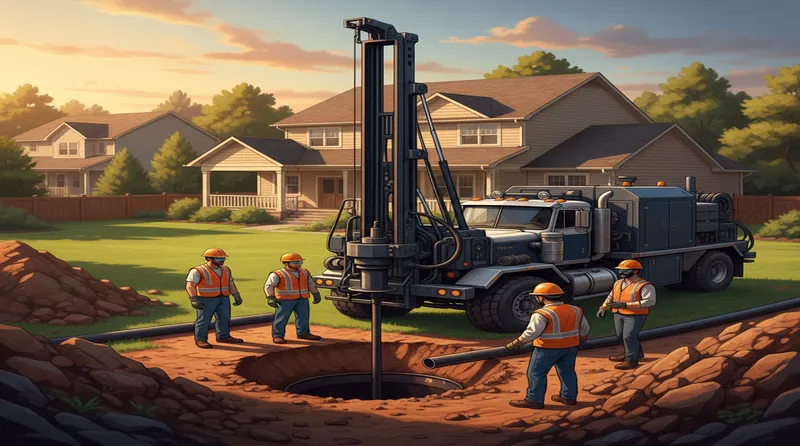
Much of Connecticut — particularly the central valley (Hartford, Middletown) and the eastern and western highlands — has bedrock relatively close to the surface. This means vertical boring is not only the standard approach for most CT lots but also straightforward, since the rock is hard and provides good thermal conductivity for loop exchange. Connecticut installers drill through bedrock routinely.
Coastal and Valley Areas
Long Island Sound coastal areas and the Connecticut River valley have deeper glacial deposits, softer soils, and in some cases higher groundwater tables. Open-loop systems (using groundwater) can be feasible in these areas where well yields are sufficient, and typically cost less than a closed vertical loop. Worth asking your installer about during the site assessment.
Typical Bore Depth
Connecticut vertical loops are typically drilled 200–350 feet per ton of capacity. With ground temperatures around 52°F — warmer than Minnesota's 44°F — the thermal exchange is efficient, and loop lengths can be on the shorter end of national ranges. That's a slight cost advantage for Connecticut despite the bedrock drilling.
Permitting in Connecticut
Connecticut geothermal installations require permits at both state and local levels:
State Well Drilling Permit
Vertical bore wells require a permit from the Connecticut Department of Energy and Environmental Protection (DEEP). Only licensed water well drilling contractors can pull this permit, and most geothermal installers work with licensed drillers as subcontractors. This process is routine in Connecticut — DEEP processes these regularly.
Building and Mechanical Permits
Most Connecticut municipalities require building and mechanical permits for heating system replacement. Your installer handles this. In larger cities (Hartford, Bridgeport, New Haven), expect the permitting process to take slightly longer. In smaller towns, it's often faster.
Zoning and Setbacks
Vertical bore wells typically require setback distances from property lines, septic systems, and water wells. In dense Connecticut suburbs, this can occasionally be a constraint. Your installer's site assessment should flag any setback issues before you commit to a project.
Finding a Qualified Connecticut Geothermal Installer
Connecticut's geothermal installer market is relatively mature given the state's long history with heating oil and the active Energize CT program, which maintains lists of qualified contractors.
Where to Start
- Energize CT Trade Ally Network: Energize CT maintains a list of participating contractors who are familiar with the rebate process — start at energizect.com
- IGSHPA Installer Directory: Search for IGSHPA-certified Accredited Installers in Connecticut — the certification covers loop design and installation quality
- Connecticut Heating and Cooling Contractors Association: Trade association for licensed HVAC contractors in the state
For a full breakdown of what IGSHPA certification means and why it matters, see our IGSHPA certification guide.
Questions to Ask Before Signing
- Are you a licensed Connecticut mechanical contractor?
- Do you have IGSHPA Accredited Installer certification?
- Who does the bore drilling — in-house or subcontractor? (subcontractor is fine, just confirm they're licensed)
- Will you perform a Manual J heat load calculation before sizing?
- Are you familiar with Energize CT rebate paperwork, and will you handle the application?
- Do you offer Green Bank Smart-E Loan financing?
Get three quotes. Connecticut's geothermal market has enough competition that prices vary — a $4,000–$7,000 spread on the same project is not unusual. Don't just take the cheapest; make sure the loop design is properly sized for your heating load.
Bottom Line: Who Should Go Geothermal in Connecticut
Connecticut is genuinely one of the top geothermal markets in the country. The combination of 524,000 heating oil homes, an active rebate program, strong federal incentives, a sophisticated financing ecosystem through the Green Bank, and a bedrock geology that makes vertical drilling straightforward — it all points in the same direction.
Best Cases in Connecticut
- Heating oil homeowners approaching system replacement: This is the bull's-eye. If your boiler is 15+ years old, the incremental cost over a standard replacement is modest and the long-term economics are compelling.
- High annual oil usage (800+ gallons/year): Bigger fuel bills mean bigger savings. If you're spending $3,000+ per year on oil, geothermal's payback accelerates significantly.
- Homes also needing central AC: Geothermal replaces both systems. If you're pricing AC and boiler replacement at the same time, the true incremental cost of geothermal is small.
- Long-term owners (10+ years): Payback requires time. If you're in your forever home or a home you plan to own for a decade plus, geothermal makes financial sense.
Harder Cases
- Natural gas homes (36.5% of CT): Natural gas at $1.50–$2.00/therm is cheaper per BTU than fuel oil. The payback on geothermal replacing natural gas is longer — 15+ years in many scenarios. Still makes sense environmentally and for long-term owners, but the financial case is weaker than the oil displacement story.
- Very small urban lots with no variance potential: Dense Hartford or Bridgeport lots with extreme setback constraints may not accommodate vertical bores. A site assessment will tell you quickly.
- Short-term ownership plans: If you're selling in under 7 years, payback is unlikely. High-efficiency oil boiler replacement is the right call.
Connecticut Geothermal at a Glance
🌡️ 6,202 HDD/year
🌍 Ground temp: ~52°F stable
⚡ Electric rate: 29.38¢/kWh (highest in contiguous US)
🏠 524,863 homes on heating oil (37%)
📊 Median home value: $343,200
✅ Federal 30% ITC (no cap, through 2032)
✅ Energize CT rebates [verify current amounts]
✅ CT Green Bank Smart-E Loan (low-rate financing)
✅ C-PACE for commercial properties
❌ No CT state income tax credit currently
Next steps: visit energizect.com to check current rebate amounts, then request site assessments from two or three IGSHPA-certified installers. Also check our property suitability guide before your first installer call — it'll help you ask better questions and understand what they find.
Connecticut's 524,000 heating oil homes have been overpaying for heat for decades. Geothermal is the exit ramp — and with today's federal incentives and the Green Bank's financing tools, the math is better than it's ever been.