
📊 Connecticut by the Numbers
Should You Get Geothermal in Connecticut? The Verdict
Before diving into the full analysis, here's the honest assessment by situation:
| Your Situation | Typical Payback | Verdict | Notes |
|---|---|---|---|
| 🟢 Replacing heating oil (Fairfield County) | 13–21 years | Strong investment | Higher install costs offset by $3K+ oil bills |
| 🟢 Replacing propane (Eastern CT/NW hills) | 12–18 years | Do it | Rural lots allow horizontal loops — cheaper |
| 🟢 New construction (any region) | Longer than the 4–7 years incremental published under the credit | Design it in | Loop field during site work cuts costs 30–40% |
| 🟢 REAP-eligible farm/rural property | Longer than the 4–6 years published under the credit | Best payback — apply | 50% REAP still applies; the 30% federal 25D credit that took this to 80% covered expired Dec 31, 2025 |
| 🟢 Vacation rental (Litchfield/shoreline) | Longer than the 6–10 years published under the credit | Premium justified | Eco-premium + no fuel delivery logistics |
| 🟡 Replacing electric resistance | Longer than the 7–11 years published under the credit | Solid long-term | 24.37¢ rate makes COP 3.5 still expensive-ish |
| 🟡 Replacing aging heat pump (15+ years) | Longer than the 8–14 years published under the credit | Worth evaluating | Incremental cost over ASHP replacement is key |
| 🔴 Replacing natural gas | Well over 30 years | Not financial — environmental only | CT gas is cheap; savings too small |
Payback figures reflect 2026 conditions with no federal tax credit. The 30% credit under IRC §25D applied to systems placed in service through December 31, 2025 and is not available for property placed in service after that date (One Big Beautiful Bill Act, P.L. 119-21). Earlier versions of this table showed shorter paybacks because they netted out that credit. Energize CT rebates, the CT Green Bank Smart-E Loan, and USDA REAP were not repealed and are factored in where noted. Rows carried over from the credit era are marked as such.
The Connecticut Paradox: Expensive Electricity, Cheaper Heat
Connecticut has the third-highest residential electricity rate in the nation — 24.37¢/kWh as of 2024, according to EIA data. If you're a Connecticut homeowner who's looked into electric heating before and run from the numbers, that's a rational response. Electric baseboard heat at 24¢/kWh is brutal.
Geothermal is different. A ground-source heat pump doesn't consume electricity to generate heat — it uses electricity to move heat from the earth. The ratio of heat delivered to electricity consumed is the Coefficient of Performance (COP). A properly sized Connecticut geothermal system typically operates at a COP of 3.5–4.0. That means for every $1 of electricity, you get $3.50–$4.00 worth of heat. Even at 24.37¢/kWh, your effective heating cost is about 7–8¢ per kWh-equivalent.
Heating oil at $3.50/gallon through an 85% efficient furnace costs roughly $30 per million BTU. Geothermal at Connecticut's rate with a COP of 3.5 costs roughly $21 per million BTU. The math works — and when oil spikes to $5.00+ as it did in 2022, the gap widens dramatically.
This is the Connecticut paradox: the state that seems most hostile to electric heating is actually one of the best geothermal markets, because it has 524,000 homes on a fuel that costs more per BTU than geothermal can deliver even at a 24¢ rate.
Installation Costs by Connecticut Region
Connecticut is small but costs vary meaningfully by geography. Fairfield County's proximity to New York City inflates labor and equipment costs, while eastern Connecticut and the northwest hills offer more competitive pricing.
| Region | Typical Lot | Common Loop Type | Installed Cost (3-ton) | 2026 Out-of-Pocket (before Energize CT rebate) | Ground Temp |
|---|---|---|---|---|---|
| Fairfield County (Greenwich, Stamford, Westport, Danbury) | ½–2 acres | Vertical | $28,000–$55,000 | $28,000–$55,000 | 52°F |
| Hartford Metro (Hartford, West Hartford, Farmington, Glastonbury) | ¼–1 acre | Vertical | $20,000–$38,000 | $20,000–$38,000 | 51°F |
| New Haven / Coastal (New Haven, Guilford, Old Saybrook, Mystic) | ¼–1 acre | Vertical / Horizontal | $22,000–$42,000 | $22,000–$42,000 | 52°F |
| Eastern CT / NW Hills (Willimantic, Litchfield, Putnam, Torrington) | 1–5+ acres | Horizontal / Vertical | $18,000–$32,000 | $18,000–$32,000 | 50°F |
Out-of-pocket equals gross cost before the Energize CT rebate: the 30% federal §25D credit applied only to property placed in service through December 31, 2025 and is not available after that date (One Big Beautiful Bill Act, P.L. 119-21). For reference, these same jobs netted $12,600–$38,500 under the old credit, before any state rebate. Energize CT rebates and the CT Green Bank Smart-E Loan were not repealed — see the incentives section.
What drives the range: Lot size and access are the big variables. Fairfield County's smaller lots and higher labor rates push costs up. Eastern Connecticut and the northwest hills have larger lots that allow horizontal loops — which are 20–30% cheaper than vertical. System size (2-ton condo vs. 5-ton colonial) accounts for the rest.
About the examples below
The homes in these examples are representative scenarios, not real customers. We do not install geothermal systems and we have not visited these properties. Each scenario models a typical home for the area using real equipment pricing, local fuel and electricity rates, and the incentive programs described above — but the house, the owner and the invoice are constructed to show how the arithmetic works. Treat them as worked examples, and get quotes for your own home before budgeting.
Case Study 1: Westport — Fairfield County Oil Colonial
The home: 2,800 sq ft colonial in Westport, built 1972. Oil-fired boiler (22 years old, failing), window AC units. 900 gallons of oil per year.
System installed: 4-ton WaterFurnace 7 Series, 3 vertical bores at 300 ft, desuperheater for hot water assist
| Item | Amount |
|---|---|
| Gross installed cost | $42,000 |
| Federal ITC (Section 25D) | $0 — expired for installs placed in service after Dec 31, 2025 |
| Energize CT rebate (unverified) | −$3,600 (est. $900/ton) |
| 2026 out-of-pocket | $38,400 |
| Previous oil + AC cost | $3,850/yr ($3,350 oil at $3.72 + $500 window AC) |
| New geothermal operating cost | $1,940/yr (at 24.37¢/kWh, COP 3.5 heating / EER 16 cooling) |
| Annual savings | $1,910 |
| Simple payback | 20.1 years at current oil / 13.4 years at $4.50/gal oil |
Under the pre-2026 rules this same job netted to $25,800 — a 13.5-year payback at current oil, 9.0 years at $4.50/gal — because the 30% federal credit applied on top of the Energize CT rebate. That rebate was not repealed; only the federal 25D component came out.
Why it can still make sense at 20 years: The Westport homeowner was facing a $14,000 boiler replacement plus $6,000 for central AC — $20,000 total. The incremental cost of geothermal over that baseline is $38,400 − $20,000 = $18,400. At $1,910/year savings, the incremental payback is 9.6 years. That's the number that matters when you're already spending money on HVAC — though it used to be 3.0 years when the federal credit applied, and that difference is entirely the repeal.
Case Study 2: Willimantic — Eastern CT Propane Ranch
The home: 1,600 sq ft ranch in Willimantic, built 1965. Propane furnace, 650 gallons/year. 1.5-acre lot with good soil.
System installed: 3-ton ClimateMaster Tranquility 30, horizontal slinky loop (cheaper — land allows it), desuperheater
| Item | Amount |
|---|---|
| Gross installed cost | $22,500 |
| Federal ITC (Section 25D) | $0 — expired for installs placed in service after Dec 31, 2025 |
| Energize CT rebate (unverified) | −$2,700 (est. $900/ton) |
| 2026 out-of-pocket | $19,800 |
| Previous propane + AC cost | $2,700/yr ($2,400 propane at $3.70/gal + $300 window AC) |
| New geothermal operating cost | $1,300/yr |
| Annual savings | $1,400 |
| Simple payback | 14.1 years |
Under the pre-2026 rules this same job netted to $13,050 for a 9.3-year payback. The Energize CT rebate still applies; the federal 30% credit does not, for property placed in service after December 31, 2025.
The eastern CT advantage: Larger lots mean horizontal loops, which cut $4,000–$8,000 off the installation vs. vertical bores. Willimantic's rural character means more propane homes — and propane at $3.70/gallon is even more expensive per BTU than oil.
Month-by-Month Energy Profile
What a typical Hartford-area oil home looks like before and after geothermal conversion:
| Month | Oil Heat Cost | AC Cost | Geo Cost | Monthly Savings |
|---|---|---|---|---|
| January | $520 | — | $285 | +$235 |
| February | $480 | — | $265 | +$215 |
| March | $380 | — | $210 | +$170 |
| April | $180 | — | $95 | +$85 |
| May | $40 | $30 | $45 | +$25 |
| June | — | $110 | $65 | +$45 |
| July | — | $160 | $95 | +$65 |
| August | — | $140 | $85 | +$55 |
| September | $40 | $60 | $50 | +$50 |
| October | $180 | — | $95 | +$85 |
| November | $340 | — | $185 | +$155 |
| December | $480 | — | $260 | +$220 |
| ANNUAL TOTAL | $2,640 | $500 | $1,735 | +$1,405 |
Assumptions: 2,200 sq ft Hartford home, 800 gallons oil/year at $3.30/gal, central AC SEER 13, geothermal COP 3.5 heating / EER 16 cooling, electricity at 24.37¢/kWh. Hot water assist via desuperheater not included (adds ~$200–$400/yr savings).
Connecticut's Geology: Three Zones That Determine Your Loop Design
Connecticut's geology breaks into three distinct zones that directly affect installation approach and cost:
Hartford Basin (Central Valley)
The Connecticut River valley — Hartford, Middletown, New Haven — sits on sedimentary brownstone and basalt. Drilling is straightforward, bore depths average 200–275 feet per ton. This is the most predictable and often the most cost-effective zone for vertical loops. The CT River valley also has excellent groundwater potential for open-loop systems.
Eastern & Western Highlands
The uplands flanking the central valley — from Litchfield to Windham County — feature metamorphic rock (gneiss, schist) and igneous intrusions. Harder rock means slower drilling but excellent thermal conductivity. Vertical bore costs are slightly higher, but the larger lot sizes here often make horizontal loops viable, offsetting the cost difference entirely.
Coastal Plain (Long Island Sound)
The shore towns from Greenwich to Stonington sit on glacial outwash deposits — sand, gravel, and clay over bedrock. Variable depth to bedrock (sometimes 30 ft, sometimes 150+) means bore costs are less predictable. High water tables can complicate horizontal trenching. Open-loop systems are not recommended in most coastal areas due to saltwater intrusion risk and DEEP groundwater protection rules.
Open-Loop System Viability by Region
Open-loop systems use groundwater directly and cost less to install — but they're not feasible everywhere in Connecticut.
| Region | Open-Loop Viability | Key Consideration |
|---|---|---|
| Connecticut River Valley | ✅ Generally Viable | Strong aquifer, good yields. DEEP permit required for discharge. |
| Housatonic Valley (west) | ✅ Generally Viable | Valley fill deposits with good flow. Marble/limestone zones may have karst. |
| Eastern Highlands | ⚠️ Site-Specific | Bedrock wells vary. Yields of 5+ gpm needed for residential systems. |
| Western Highlands / Litchfield Hills | ⚠️ Site-Specific | Hard metamorphic rock. Well yields vary widely — test pump required. |
| Coastal Plain (LI Sound) | ❌ Not Recommended | Saltwater intrusion risk. DEEP groundwater restrictions apply. |
| Dense Urban (Hartford, New Haven, Bridgeport) | ❌ Not Viable | Contamination risk, insufficient lot size, utility conflicts. |
Loop Type Cost Comparison
| Loop Type | CT Cost Range (3-ton) | Land Required | Best For |
|---|---|---|---|
| Vertical Closed-Loop | $22,000–$42,000 | 200–400 sq ft | Suburban CT lots (most common) |
| Horizontal Closed-Loop | $16,000–$30,000 | 1,500–3,000 sq ft | Eastern CT, NW hills (1+ acre lots) |
| Slinky Horizontal | $17,000–$32,000 | 800–1,500 sq ft | Medium lots — less land than straight horizontal |
| Open-Loop (Groundwater) | $15,000–$28,000 | Well + discharge | CT River valley, Housatonic valley with adequate yields |
| Pond/Lake Loop | $14,000–$26,000 | ½+ acre pond, 8+ ft deep | Properties with existing ponds (Litchfield County estates) |
Connecticut note: Vertical closed-loop dominates the CT market because most suburban lots — particularly in Fairfield, New Haven, and Hartford counties — don't have the yard space for horizontal trenching. If you have an acre or more, always get quotes for both vertical and horizontal.
Federal 30% Tax Credit — Expired
The Section 25D Residential Clean Energy Credit gave Connecticut homeowners a 30% federal income tax credit on the full installed cost, with no dollar cap. It applied to systems placed in service through December 31, 2025 and is not available for property placed in service after that date (One Big Beautiful Bill Act, P.L. 119-21). The Inflation Reduction Act had scheduled 30% through 2032 with step-downs in 2033 and 2034; that schedule was repealed before it ever took effect.
On a $28,000 Connecticut installation there is no longer an $8,400 federal offset — the out-of-pocket cost is $28,000 before any Energize CT rebate. If your system was placed in service on or before December 31, 2025, that credit still applies to your installation and any unused portion still carries forward. For the full picture, see our federal tax credit guide. Verified July 2026 against IRS.gov.
Connecticut does not offer a state income tax credit specifically for residential geothermal either. With the federal credit gone, what's left is the Energize CT rebate, CT Green Bank financing, and — for eligible rural and farm properties — USDA REAP.
Energize CT Rebates and Programs
Energize CT is the statewide energy efficiency program administered by Connecticut's electric and gas utilities (Eversource and United Illuminating) under PURA oversight.
Ground-Source Heat Pump Rebates
Energize CT has historically offered rebates on GSHP installations for residential customers. Rebate amounts have ranged from approximately $700–$1,400 per ton of installed capacity, though program terms change annually based on funding levels and PURA approval.
(unverified) — Current 2026 Energize CT rebate amounts should be confirmed directly at energizect.com or by calling 877-WISE-USE. A 3-ton system at $900/ton in rebates is worth $2,700 — and with the federal §25D credit unavailable for property placed in service after December 31, 2025, that rebate now stands on its own rather than stacking on top of a 30% credit.
Home Energy Solutions (HES)
Energize CT's HES program provides subsidized energy audits and weatherization services. Getting the HES audit before sizing your geothermal system ensures you're not oversizing equipment and maximizes annual savings.
Connecticut Green Bank Financing
The Connecticut Green Bank is one of the most sophisticated clean energy finance programs in the country.
Smart-E Loan
Unsecured home improvement loans at below-market rates (historically 5.49–6.99% depending on credit) specifically for energy-efficient upgrades including GSHPs. No home equity required. Terms up to 12 years.
The principal paydown strategy — what's left of it: This used to hinge on the federal tax credit. When a $28,000 system's $8,400 §25D credit came through in Year 1, applying it as a lump-sum principal payment on the Smart-E Loan cut the monthly payment from $274 to about $192 for the remaining 11 years — often below what the homeowner had been paying for oil. That credit is not available for property placed in service after December 31, 2025, so a 2026 borrower carries the full $274/month at 5.99% over 12 years unless they apply their Energize CT rebate the same way. On a 3-ton system, a $2,700 rebate paydown brings the payment to roughly $248/month. Many CT oil customers pay $250+/month averaged over the year, so the comparison is now a wash rather than a clear win.
C-PACE (Commercial)
Commercial C-PACE financing for commercial and multi-family properties — long-term, low-rate financing repaid through property tax assessments.
Incentive Stacking Summary
| Incentive | Amount (3-ton example) | Status | How to Access |
|---|---|---|---|
| Federal tax credit (§25D) | 0% (expired) | ❌ Expired — ended Dec 31, 2025 | Not available for property placed in service after Dec 31, 2025 (P.L. 119-21). Form 5695 applies only to pre-2026 installs. |
| Energize CT GSHP rebate | ~$2,700 ($900/ton est.) | ⚠️ (unverified) | Apply through Energize CT Trade Ally |
| CT Green Bank Smart-E Loan | Below-market rate (~5.49–6.99%) | ✅ Active | Apply through participating lender network |
| USDA REAP (rural/farm) | Up to 50% of project cost | ✅ Confirmed | Apply through USDA CT State Office |
| CT state income tax credit | None currently | ❌ N/A | — |
Best case (REAP farm): A $28,000 system could receive $14,000 REAP (50%), bringing 2026 out-of-pocket to $14,000. Payback roughly 7 years on propane. Under the pre-2026 rules this same stack added a $4,200 federal credit on the remaining $14,000 for $18,200 in total incentives and a ~$9,800 net cost — under 5 years' payback. REAP was not repealed; only the federal 25D component came out.
USDA REAP for Rural Connecticut Properties
Connecticut has more eligible rural properties than people think. Eastern Connecticut (Windham County), the northwest hills (Litchfield County), and parts of Middlesex County all qualify for USDA Rural Energy for America Program grants.
Eligible properties: Farms, small businesses in rural areas, agricultural operations (including nurseries, orchards, dairy, and horse farms — Connecticut has over 5,500 farms per USDA Census).
REAP stacking example — Litchfield County horse farm:
| Line Item | Amount |
|---|---|
| 4-ton system installed | $32,000 |
| USDA REAP grant (25% awarded) | −$8,000 |
| Federal ITC (Section 25D) | $0 — expired for property placed in service after Dec 31, 2025 |
| 2026 out-of-pocket | $24,000 |
| Annual propane savings | $2,800 |
| Payback | 8.6 years |
Under the pre-2026 rules this same stack netted to $16,800 for a 6.0-year payback, because the 30% federal credit applied on top of REAP.
Applications open annually. Contact the USDA Connecticut State Office in Tolland at (860) 871-4040.
Permitting in Connecticut
State Well Drilling Permit (DEEP)
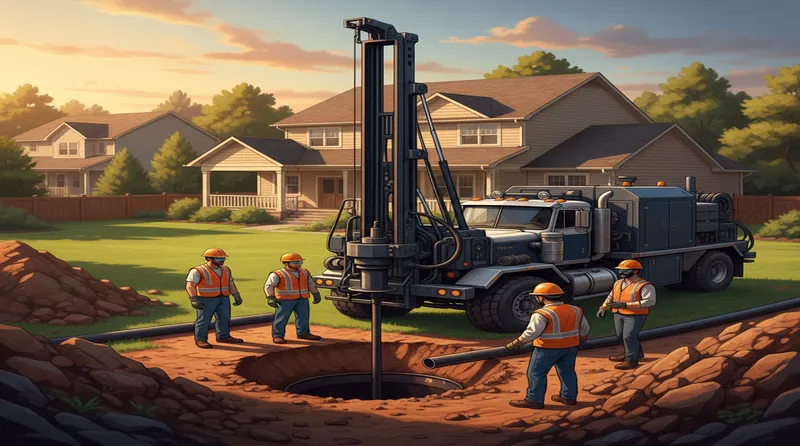
Vertical bore wells require a permit from the Connecticut Department of Energy and Environmental Protection (DEEP) through the Water Well Drilling Program. Only licensed water well drilling contractors registered with DEEP can perform the work.
Process:
- Licensed driller submits Well Drilling Application to DEEP
- DEEP reviews for setback compliance (100 ft from septic, 75 ft from property line for open-loop)
- Typical processing time: 2–4 weeks
- Post-drilling: Well Completion Report filed with DEEP within 90 days
- Fee: approximately $50–$100 per well
Building and Mechanical Permits
Most Connecticut municipalities require building and mechanical permits for heating system replacement. Your installer handles this. In larger cities (Hartford, Bridgeport, New Haven), expect 2–3 weeks; smaller towns are often faster.
Coastal Area Management
Properties within Connecticut's Coastal Area Management zone (roughly within 1,000 feet of tidal waters) may require additional DEEP Coastal Management review. This adds 2–4 weeks but is rarely a project-killer for closed-loop vertical systems.
Solar + Geothermal Stacking
Connecticut's aggressive Renewable Portfolio Standard (100% clean energy by 2040 under Public Act 22-5) makes solar+geo a compelling long-term combination.
How it works: Solar panels generate electricity; geothermal uses it. Connecticut's Residential Renewable Energy Solutions (RRES) program provides a 15-year declining rate for solar generation, replacing the old net metering system. The economics work best when your geothermal system's electricity consumption is partially or fully offset by your solar array.
Typical CT solar+geo stack:
- 8 kW solar array: ~$22,000 gross → ~$22,000 out of pocket in 2026
- 3-ton geothermal: ~$25,000 gross → ~$25,000 out of pocket in 2026 (before any Energize CT rebate)
- Federal 30% credit (§25D): $0 — expired for property placed in service after Dec 31, 2025
- Combined 2026 out-of-pocket: ~$47,000
- Combined annual savings (vs. oil + grid electricity): ~$4,200
- Combined payback: ~11.2 years
Under the pre-2026 rules §25D covered both systems at 30%, netting the pair to ~$32,900 for a ~7.8-year payback. Neither qualifies for property placed in service after December 31, 2025. An Energize CT rebate on the geothermal side still applies and shortens this.
The solar still dramatically improves the geothermal economics by reducing or eliminating the operating cost disadvantage of CT's high electricity rates — that part of the case is unaffected by the federal repeal.
Vacation Rental & Shoreline Property Economics
Connecticut's Litchfield Hills and shoreline communities (Old Lyme, Essex, Guilford, Stonington) have a growing vacation rental market where geothermal offers unique advantages:
Litchfield Hills:
- Weekend/seasonal rental properties on propane benefit from elimination of fuel delivery logistics and tank monitoring
- "Eco-cabin" positioning commands 10–15% booking premium on platforms like Airbnb and VRBO
- No outdoor condenser unit = quieter property = better guest experience
- Larger rural lots allow horizontal loops (cheaper installation)
Shoreline:
- Summer rental properties benefit from geothermal cooling efficiency — EER 16+ vs. conventional AC SEER 14
- Year-round comfort for shoulder-season bookings (October leaf peeping, spring beach weekends)
- Hurricane/storm resilience: no outdoor condenser vulnerable to coastal weather
- Desuperheater provides free hot water during cooling season (when guests use the most hot water)
Caveat: Shoreline properties near tidal waters are restricted to closed-loop vertical systems (see Coastal Area Management section above).
How to Apply for Energize CT Ground-Source Rebate
Step 1: Schedule a Home Energy Solutions (HES) Audit
Contact Energize CT at 877-WISE-USE or visit energizect.com to schedule a subsidized HES audit. Cost: $50–$124 (after subsidy). The audit establishes your baseline energy usage and identifies weatherization opportunities that should be completed before geothermal sizing.
Step 2: Select an Energize CT Trade Ally Contractor
Choose a geothermal installer from Energize CT's approved Trade Ally network. Only Trade Allies can submit rebate applications on your behalf. Verify their Connecticut mechanical contractor license at elicense.ct.gov and IGSHPA certification.
Step 3: Get Multiple Quotes and Confirm Rebate Eligibility
Get at least 3 quotes from qualified installers. Confirm that your system qualifies for the current rebate program — equipment must meet ENERGY STAR specifications and be properly sized per Manual J heat load calculation.
Step 4: Submit Pre-Approval Application (if required)
Some Energize CT programs require pre-approval before installation begins. Your Trade Ally contractor handles this paperwork. Do not begin installation until pre-approval is confirmed — retroactive rebates are typically not available.
Step 5: Complete Installation and Inspection
Your installer completes the geothermal system installation, including loop field, heat pump, ductwork modifications, and controls. Local building inspection must pass. Keep all receipts, invoices, and equipment specifications.
Step 6: Submit Final Rebate Paperwork
Your Trade Ally submits the final rebate application with proof of installation, inspection approval, and equipment documentation. Processing typically takes 4–8 weeks after submission.
Step 7: Do Not Plan on a Federal Tax Credit
IRS Form 5695 no longer applies to geothermal placed in service after December 31, 2025 — the Section 25D credit expired under the One Big Beautiful Bill Act (P.L. 119-21). If your system was placed in service on or before that date, file Form 5695 with the return for that year on the full installed cost before rebates; the 30% credit reduces liability dollar-for-dollar and any excess carries forward. For a 2026 installation there is no federal credit, so the Energize CT rebate is your lump sum — apply it as a principal payment on your Smart-E Loan to reduce total interest.
Finding a Qualified Connecticut Installer
Connecticut's geothermal installer market is relatively mature given the state's heating oil dependency and active Energize CT program.
Where to Start
- Energize CT Trade Ally Network: energizect.com — participating contractors familiar with the rebate process
- IGSHPA Installer Directory: igshpa.org — search for IGSHPA-certified Accredited Installers in Connecticut
- CT License Verification: elicense.ct.gov — verify any contractor's Connecticut mechanical license
Installer Vetting Checklist
Before signing a contract, confirm:
- ✅ Active Connecticut mechanical contractor license (verify at elicense.ct.gov)
- ✅ IGSHPA Accredited Installer certification (or equivalent NATE/manufacturer certification)
- ✅ Energize CT Trade Ally status (required for rebate processing)
- ✅ Licensed well driller subcontractor (registered with DEEP)
- ✅ Manual J heat load calculation included in quote (not rule-of-thumb sizing)
- ✅ References from at least 3 completed Connecticut geothermal installations
- ✅ Warranty terms: minimum 10-year parts, 50-year ground loop
- ✅ Familiar with CT Green Bank Smart-E Loan processing
Get three quotes. Connecticut's market has enough competition that a $4,000–$8,000 spread on the same project is common.
For a detailed breakdown of what these certifications mean, see our IGSHPA certification guide.
Connecticut vs. Neighboring States
How does Connecticut compare to its geothermal neighbors?
| Factor | Connecticut | Massachusetts | New York | Rhode Island |
|---|---|---|---|---|
| Electric Rate | 24.37¢ (#3) | 23.94¢ (#5) | 19.42¢ (#8) | 28.84¢ (#2) |
| Grid CO₂ (lbs/MWh) | 541 | 936 | 537 | 818 |
| Oil Home % | 37% | 24% | 22% | 25% |
| State Rebate | Energize CT ~$900/ton (unverified) | Mass Save $13,500 ✅ | PSEG LI $2,400/ton ✅ | None currently |
| State Tax Credit | None | None | IT-267 $10K cap | None |
| Green Bank Financing | Smart-E Loan ✅ | HEAT Loan 0% ✅ | NYSERDA programs | Limited |
| Typical Payback, Oil (published under the old 30% credit) | 9–14 years | 6–12 years | 7–12 years | 8–13 years |
| Typical Payback, Oil (2026 — no federal credit) | 13–21 years | Longer than the credit-era ranges above in every state — §25D is not available for property placed in service after Dec 31, 2025. State programs differ; see each state guide. | ||
| Unique Advantage | CT Green Bank ecosystem | Highest state rebate in US | LI oil + strong incentives | Smallest state — limited lots |
Connecticut's position: CT has a stronger geothermal case than Rhode Island (higher oil dependency, CT Green Bank financing) but weaker incentives than Massachusetts (Mass Save's $13,500 rebate is the best in the country). Connecticut's unique advantage is the Green Bank Smart-E Loan ecosystem, which makes financing more accessible than any neighboring state.
Maintenance and System Longevity
Geothermal systems in Connecticut require minimal maintenance compared to oil heating:
| Component | Lifespan | Maintenance |
|---|---|---|
| Ground loop (HDPE pipe) | 50+ years | None — sealed system |
| Heat pump unit | 20–25 years | Annual filter change, 5-year checkup |
| Circulating pump | 10–15 years | Monitor — replace when efficiency drops |
| Desuperheater | 15–20 years | Check annually with heat pump service |
Compare to oil: Oil boilers last 15–25 years, require annual cleaning/tuning ($200–$350/year), tank inspections, and eventual tank replacement ($2,000–$5,000). Underground oil tanks in Connecticut are a particular liability — DEEP requires reporting of any leaks, and remediation can cost $20,000–$100,000+.
Eliminating the oil tank alone removes significant environmental liability for Connecticut homeowners.
Frequently Asked Questions
Does geothermal make sense with Connecticut's expensive electricity?
Yes — this is the biggest misconception about geothermal in CT. A geothermal system with a COP of 3.5 effectively reduces your per-unit heating cost to about 7¢/kWh-equivalent, even at 24.37¢/kWh grid rate. Heating oil at $3.50/gallon costs ~$30/MMBTU vs. geothermal at ~$21/MMBTU. The COP multiplier overcomes the rate disadvantage.
What does a geothermal system cost in Connecticut?
For a typical 3-ton residential system: $18,000–$55,000 out of pocket depending on region, loop type, and home size, before any Energize CT rebate. That is the full number — the 30% federal §25D credit applied only to systems placed in service through December 31, 2025 and is not available after that date, so there is no longer a net-after-federal-credit figure to quote. (For reference, the same jobs netted $12,600–$38,500 under the old credit.) Energize CT rebates were not repealed and reduce this further. Fairfield County runs highest; eastern CT and the northwest hills are most affordable. Vertical loops (most common in suburban CT) cost 20–30% more than horizontal, but most CT lots require them.
What incentives are available for geothermal in Connecticut?
Not the federal one, anymore — the 30% credit under IRC §25D applied only to systems placed in service through December 31, 2025 and is not available after that date (One Big Beautiful Bill Act, P.L. 119-21). What remains: Energize CT per-ton rebates (historically $700–$1,400/ton — verify current amounts at energizect.com), the CT Green Bank Smart-E Loan for below-market financing (5.49–6.99%), and USDA REAP grants for rural farms and small businesses (up to 50% of project cost). None of those were repealed. There is no Connecticut state income tax credit for geothermal.
How does Connecticut's grid carbon intensity affect the environmental case?
Connecticut's grid is relatively clean at 541 lbs CO₂/MWh — well below the national average (~860) and cleaner than neighboring Massachusetts (936) and Rhode Island (818). Connecticut's grid mix includes nuclear (Millstone), natural gas, and growing renewables. This means a geothermal system in CT already delivers meaningful CO₂ reductions vs. oil heating, and the savings improve every year as the grid gets cleaner under CT's 100% clean energy target (Public Act 22-5, by 2040).
Can I use an open-loop system in coastal Connecticut?
Generally no. Properties near Long Island Sound face saltwater intrusion risk, and DEEP groundwater protection rules restrict open-loop discharge in coastal zones. Closed-loop vertical systems are the standard approach for shoreline properties. Inland areas along the Connecticut River valley and Housatonic valley can often use open-loop systems where well yields are adequate (5+ gpm for residential).
How long does geothermal installation take in Connecticut?
Typical timeline: 2–4 weeks for permitting (DEEP well permit + local building permit), 2–3 days for vertical bore drilling, 1–2 days for interior heat pump installation and duct connections, 1 day for commissioning. Total from contract signing to heating: 4–8 weeks, depending on season and permit processing speed. Spring and fall are the busiest installation seasons.
What about my underground oil tank?
If you're converting from oil to geothermal, you'll want to decommission your oil tank. Connecticut DEEP requires proper tank removal or abandonment-in-place by a licensed contractor. Aboveground tank removal: $500–$1,500. Underground tank removal: $1,500–$3,500 (more if soil testing reveals contamination). Consider this cost in your project budget — but also consider the ongoing liability of keeping an aging underground oil tank.
Is geothermal worth it if I'm replacing natural gas in Connecticut?
Financially, it's a much harder case. Natural gas in CT costs roughly $1.50–$2.00/therm, which translates to about $15–$20/MMBTU at furnace efficiency. Geothermal costs about $21/MMBTU at CT electric rates with COP 3.5. The savings per year are small ($200–$600), and with the 30% federal §25D credit unavailable for property placed in service after December 31, 2025, payback runs well over 30 years — the 18–30+ figure we published previously assumed that credit. The environmental case is real (eliminating direct combustion), but the financial case is weak unless you're building new or combining with solar to reduce your effective electric rate.
Can I install geothermal on a small suburban lot in Connecticut?
Yes — this is why vertical loops dominate CT installations. A vertical bore requires only 200–400 sq ft of surface area for a 3-ton system (about the size of a parking space). Even quarter-acre suburban lots can accommodate vertical loops. The main constraint is setback distances: 100 ft from septic systems, typically 10–15 ft from property lines for closed-loop, and adequate drill rig access to the bore location. Your installer's site assessment will confirm feasibility.
Will adding geothermal increase my Connecticut home's value?
Studies suggest geothermal systems add 3–6% to home value, with the premium being higher in energy-conscious markets like Fairfield County and the shoreline. More importantly, eliminating heating oil dependency and the associated tank liability is increasingly valued by Connecticut buyers. Homes listed as "geothermal heated" or "no oil" are a distinctive selling feature in CT's market. The CT Green Bank also offers a property-assessed financing option (C-PACE for commercial) that transfers with the property.
🎥 Video: Geothermal in Connecticut
Coming soon — we're producing a video walkthrough of a Connecticut oil-to-geothermal conversion in Fairfield County. Check back or subscribe to our newsletter for updates.
Sources
- U.S. Energy Information Administration — State Electricity Profiles (Connecticut rate: 24.37¢/kWh, 2024)
- EIA — Connecticut Electricity Profile (grid emissions: 541 lbs CO₂/MWh, 2024)
- U.S. Census Bureau — American Community Survey (heating fuel data, 2023)
- Energize CT — statewide energy efficiency programs
- Connecticut Green Bank — Smart-E Loan program
- CT Department of Energy and Environmental Protection (DEEP) — well drilling permits
- IRS Form 5695 — Residential Energy Credits
- International Ground Source Heat Pump Association (IGSHPA) — installer certification
- USDA REAP — Rural Energy for America Program
- NOAA Climate Normals — Connecticut heating/cooling degree days
- CT eLicense — contractor license verification
- DSIRE — Database of State Incentives for Renewables & Efficiency
- U.S. Department of Energy — Geothermal Heat Pumps
- Connecticut Public Utilities Regulatory Authority (PURA)
Last updated: March 2026. Energize CT rebate Amounts marked (unverified) should be verified at energizect.com before budgeting. Electric rates and oil prices fluctuate — run the numbers with current pricing for your specific situation.
Learn more: How Geothermal Heat Pumps Work · Installation Cost Guide · Payback Period Calculator · Geothermal vs. Heating Oil · Geothermal for New Construction