
In This Guide
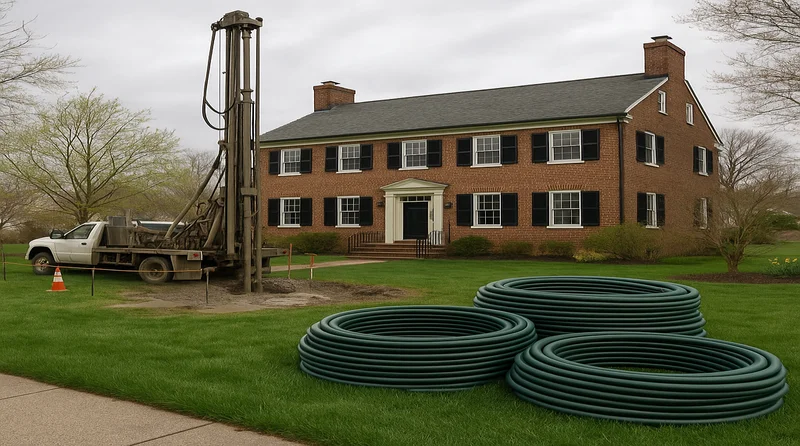
Delaware is easy to overlook. The smallest state. Squeezed between Maryland, Pennsylvania, and New Jersey, it doesn't come up much in geothermal conversations. But it should.
Delaware has one of the few state-level geothermal grants still active in the mid-Atlantic region — the DE Green Energy Program, administered by DNREC. Stack that with the federal 30% tax credit, and an oil-heated home in the Wilmington suburbs can realistically hit a 6–7 year payback on a geothermal installation. That's competitive with any state on the East Coast.
On top of that, Delaware sits entirely on the Atlantic Coastal Plain. That means sandy soil, no ledge rock to blast through, and cheaper drilling than you'll find in rocky Pennsylvania or Connecticut. The ground temperature runs 54–56°F year-round — warm enough for efficient heat pump operation through even the coldest Delaware winters.
The catch: roughly half of Delaware's homes heat with natural gas, and for those homeowners, the economics don't pencil out on payback alone. But for oil homes in New Castle County or propane homes in Sussex County — and especially for beach property owners in Rehoboth and Lewes — geothermal makes a compelling case.
Here's the full picture.
Does Geothermal Work in Delaware?
Yes, and the geology is actually a selling point. Delaware sits on Atlantic Coastal Plain sediments — unconsolidated layers of sand, silt, and clay over carbonate bedrock. There's no hard granite or limestone near the surface. Drillers move quickly here. A vertical bore field that might take three days in Connecticut or western Pennsylvania can be done in two in Delaware.
Ground temperatures hold steady at 54–56°F throughout the state — similar to Maryland's Eastern Shore, a couple degrees warmer than New Jersey. That translates to efficient heat pump performance. A well-designed system delivers a coefficient of performance (COP) of 3.8 to 4.5 in Delaware conditions: for every dollar of electricity you put in, you get $3.80 to $4.50 worth of heating. Nothing else does that.
Delaware has a genuine four-season climate — hotter and more humid than New England, milder than the Midwest. Wilmington averages around 4,500–4,700 heating degree days and about 800 cooling degree days. Southern Delaware, including Dover and the beach counties, runs a bit warmer: roughly 4,200 HDD in Dover, and 3,800 in Rehoboth Beach. The cooling season matters here more than it does in Vermont or Maine, and geothermal covers both — which improves the all-in economics compared to a heating-only furnace replacement.
Delaware's Energy Mix: Two Stories
Delaware has two distinct heating markets, roughly divided along geographic lines.
Northern Delaware (New Castle County): Wilmington, Newark, Pike Creek, Hockessin. This is where you find older housing stock — pre-1960s colonials and ranches, many of which were built when heating oil was the default. Roughly 20–25% of Delaware homes still heat with oil, concentrated heavily here. These are the homeowners with the strongest economic case for geothermal. Their fuel costs are high, their alternatives are limited (gas conversion isn't always feasible in older neighborhoods with undersized gas mains), and the payback math works.
Also in New Castle County: most of the natural gas customers. Newer subdivisions, post-1980 construction, and homes that converted from oil in the 1990s or 2000s. For these homeowners, geothermal is a tougher financial sell — gas rates in Delaware are moderate, and cutting a $700/year gas bill isn't going to produce a compelling payback period. That said, some homeowners in this group choose geothermal for reasons beyond pure ROI: energy independence, locking in predictable costs, or qualifying for green financing.
Southern Delaware (Kent and Sussex counties): Dover, Georgetown, Milford, and the Sussex County beach communities. Natural gas pipelines are sparse here — much of rural Kent and Sussex County runs on propane. Roughly 10–12% of Delaware homes use propane statewide, but in southern Delaware the concentration is higher. Propane homeowners have a strong economic case: at current prices, annual propane bills of $2,000–$2,500 make the payback comparison favorable. The beach communities add another layer — high summer cooling loads, investment-minded owners, and larger lots that sometimes allow horizontal loop installations.
Delaware's primary utility is Delmarva Power (a Pepco Holdings company, now under Exelon), which serves most of New Castle County and much of Kent County. Rural Sussex and parts of Kent are served by the Delaware Electric Cooperative. The statewide average electricity rate is 13.56¢/kWh (EIA, 2024) — middle of the pack nationally, rank 15 highest.
Costs and ROI by Heating Type
A typical 3-ton vertical closed-loop geothermal installation in Delaware runs $17,000–$25,000 gross. Delaware's Coastal Plain geology brings the drilling cost down compared to rockier mid-Atlantic states — expect to be toward the lower end of that range for most residential projects. After the federal 30% tax credit, you're looking at a net cost of roughly $11,900–$17,500, depending on system size and site conditions.
Here's how the payback math looks by heating fuel:
Scenario 1: Heating Oil (Older Wilmington Suburbs, Newark)
A typical older Delaware home burns 600–700 gallons of heating oil per year. At $3.80/gallon, that's roughly $2,280–$2,660 annually for heat alone. A 3-ton geothermal system covering the same load runs about $460–$520/year in electricity at Delaware's 13.56¢/kWh rate. Add in cooling season savings of $200–$300, and you're looking at total annual savings of $2,100–$2,400.
On a net-cost system of ~$14,700: payback period of roughly 6–7 years. That's a solid return by any measure, and it improves year after year as fuel prices rise.
Scenario 2: Propane (Rural Sussex and Kent Counties)
Propane homeowners run a similar calculation. A Delaware home heating with propane typically burns 650–750 gallons per year. At $3.20/gallon average, that's $2,080–$2,400/year. Geothermal drops that to the same $460–$520 range.
On a net-cost system of ~$13,700: payback of 7–9 years. Still strong, especially when you factor in that propane prices are volatile and have trended up over time.
Scenario 3: Natural Gas (Most of New Castle County)
This is where you have to be honest. A typical gas-heated Delaware home spends roughly $688/year on heating (about 550 therms at $1.25/therm). Geothermal drops that to $460–$520 in electricity — annual savings of only $168–$228 on heat, plus perhaps $200–$300 in cooling. Even optimistically, the payback period runs 25–35 years for a gas-to-geothermal conversion.
That's not a compelling investment case. If you're on natural gas and your existing furnace still has 10+ years of life, geothermal doesn't make financial sense right now. The calculation changes if you're replacing a broken system and want to make one decision, or if you're building new construction and eliminating the gas service entirely — but for existing gas customers, be realistic about the numbers.
Incentives: Federal Credit + DE Green Energy Grant
Delaware has a better incentive stack than most of its mid-Atlantic neighbors. Here's how it breaks down:
Federal Section 25D Tax Credit (30%)
This one applies nationwide. The residential clean energy credit under Section 25D of the tax code covers 30% of the installed cost of a qualifying geothermal heat pump system, with no cap through 2032. On a $20,000 system, that's a $6,000 federal tax credit — not a deduction, an actual dollar-for-dollar reduction in your federal tax bill.
The credit is non-refundable, meaning you need to have sufficient federal tax liability to claim it in a given year. If your credit exceeds your liability for the year, the unused portion carries forward to future tax years. For details, see our complete guide to the federal geothermal tax credit.
Delaware Green Energy Program (DNREC)
This is Delaware's standout incentive — and one of the few state-level geothermal grants still active in the mid-Atlantic.
The Delaware Green Energy Program, administered by DNREC's Division of Energy and Climate, has historically offered grants up to $3,000 for residential geothermal installations [NEEDS VERIFICATION — amounts and availability change, verify at DNREC before budgeting]. Applications are submitted through your utility (Delmarva Power or Delaware Electric Cooperative). The program is funded through a surcharge on electricity customers' bills, which means it can run out of funding — check current availability with DNREC before counting on it.
What makes this significant: most mid-Atlantic states rely entirely on utility rebate programs, which come and go. A state-level grant program with consistent administration through DNREC is more stable than a typical utility incentive. If the program is active when you install, it's worth the application process.
The Stack: What It Looks Like in Practice
For an oil-heated home installing a $20,000 geothermal system:
- Gross system cost: $20,000
- Federal 30% tax credit: −$6,000
- DE Green Energy grant [if available]: −$3,000
- Net cost: ~$11,000
- Annual savings vs. oil: ~$2,100–$2,400
- Payback: roughly 4.5–5.5 years
That's competitive with any state on the East Coast. Even without the state grant, the federal credit alone brings the 6–7 year payback we calculated earlier.
Utility Programs
Delmarva Power participates in EmPOWER programs and has historically offered rebates for qualifying heat pump installations [NEEDS VERIFICATION — verify current heat pump rebate amounts at delmarvapower.com or pepco.com]. Delaware Electric Cooperative may also offer efficiency incentives for members in rural Kent and Sussex counties [NEEDS VERIFICATION]. These tend to be modest ($200–$500) and supplement rather than anchor the financial case.
Beach Communities: The Overlooked Market
The stretch of Delaware coast from Lewes down through Rehoboth Beach, Dewey Beach, Bethany Beach, and Fenwick Island represents a geothermal opportunity that doesn't get much attention.
These communities have a specific economic profile that makes geothermal work well:
High cooling loads. Beach homes are occupied heavily during summer — Memorial Day through Labor Day — and often see significant cooling bills from May through September. Rehoboth averages around 800 cooling degree days per year. A geothermal system that dramatically cuts cooling costs adds real value here in a way it doesn't for a Vermont farmhouse.
Propane heat. Most older Sussex County beach properties are on propane, not gas. That's the fuel where geothermal's ROI is strongest. If you're running the AC from June through September and paying $2,000+ for propane heat in winter, geothermal covers both with one system.
Larger lots. Sussex County beach properties — especially older cottages and ranches set back from the water — often have enough yard for horizontal loop installations. Horizontal loops are cheaper to install than vertical bore fields when you have the space: no drilling rig, just an excavator trenching at 5–6 feet depth. If your lot can accommodate it, ask your installer to quote both options.
Investment horizon. Second-home and vacation property owners think differently about capital investments than primary residence buyers. If you own a Rehoboth beach house and plan to hold it for 20+ years, a 7-year payback with 40+ years of loop life is a genuinely attractive investment. And geothermal systems can add to resale value in a market where buyers increasingly look at operating costs.
One caveat for beach-area properties: Sussex County has extensive tidal wetlands along the Delaware Bay, Rehoboth Bay, Indian River Bay, and Assawoman Bay. Properties adjacent to these wetlands may need DNREC review for ground disturbance, including drilling. This is a manageable permitting requirement, not a deal-breaker — but know about it going in. Your installer should be familiar with Sussex County wetlands regulations.
Permits, Wells, and Wetlands
Delaware permitting for geothermal is relatively straightforward — certainly simpler than coastal Maryland or the New Jersey Pinelands.
DNREC well permits: Vertical boreholes require permits under Delaware's water well regulations, administered by DNREC. Your installer handles this as a standard part of the process. Typical turnaround is 2–4 weeks. This is routine.
Local building permits: New Castle County, Kent County, and Sussex County building departments each handle mechanical and electrical permits for the indoor equipment — the heat pump unit, ductwork modifications, and electrical service. If your home already has central ductwork, the indoor portion is a straightforward equipment swap. Permit timelines vary by county but are generally not the bottleneck.
No coastal buffer equivalent: Maryland has the Critical Area, a 1,000-foot buffer around the Chesapeake Bay where permitting for ground disturbance gets complicated. Delaware doesn't have an equivalent statewide coastal buffer restriction for residential ground loops. That's a meaningful advantage for waterfront and near-waterfront properties.
Wetlands: The exception to the above is tidal wetlands, which do require DNREC review for ground disturbance. If your property in Sussex County is near tidal water — or if there's any question about wetland delineation on your lot — get a wetlands determination from DNREC or a qualified wetlands consultant before drilling. Most residential lots in beach communities aren't directly affected, but the ones that are can face permitting complications worth knowing about upfront.
Open-loop considerations: Open-loop systems (drawing groundwater from a well, running it through the heat pump, and discharging it) are potentially viable in parts of Sussex County where groundwater quality and quantity support it. Well water in rural Sussex tends to be clean. Northern Delaware — Wilmington, Newark — has more legacy industrial contamination concerns; open-loop would require groundwater testing and likely more scrutiny. For most Delaware residential projects, closed-loop is the default and avoids the complications.
Finding a Geothermal Installer in Delaware
Delaware's geothermal contractor market is thin. The state is small, and the demand for ground-source heat pumps hasn't built the same contractor density you find in larger mid-Atlantic states. That's starting to change, but you should expect to cast a wider net than you would for a standard HVAC replacement.
A few practical notes:
Look into Maryland and Pennsylvania. Geothermal contractors based in Baltimore, southeastern Pennsylvania, or South Jersey regularly work in Delaware. The Coastal Plain geology is familiar to them, and they already have experience with Delmarva Power's utility territory. Don't limit yourself to contractors with a Delaware address.
IGSHPA certification matters. The International Ground Source Heat Pump Association runs a certification program for geothermal installers. An IGSHPA-certified contractor has demonstrated competency in system design and installation. For a $20,000+ investment, it's worth asking about credentials. You can search the IGSHPA contractor directory at igshpa.org.
Get multiple bids. With a thin contractor market, bids can vary significantly. Get at least three quotes before committing. Notably, bid differences often come down to loop design assumptions — how many tons, how many boreholes, what loop length per ton. If two bids differ substantially, ask each contractor to explain their load calculation.
Manual J load calculation. Any serious contractor should perform a Manual J residential load calculation on your home before sizing the system. This is the ACCA-standard method for determining actual heating and cooling loads based on your home's insulation, window area, orientation, and climate data. An undersized system won't cover your coldest days; an oversized system short-cycles and wears out faster. For more on how system design affects performance, see our guide on how geothermal heat pumps work.
Bottom Line
Delaware is a better geothermal market than its size suggests. Sandy Coastal Plain geology keeps drilling costs manageable. The DE Green Energy Program, if active, stacks on top of the federal 30% credit to produce some of the best net-cost figures in the mid-Atlantic. And for oil-heated homes in New Castle County and propane-heated properties in Sussex County — including the beach communities — the payback math is genuinely compelling.
If you're on natural gas, be honest with yourself: the numbers don't work for most gas-to-geothermal conversions right now. But if you're heating with oil or propane, or you own a beach house with high cooling loads, Delaware deserves a serious look.
Next steps:
- Verify current DE Green Energy Program grant availability at DNREC's website
- Check current Delmarva Power heat pump rebates at delmarvapower.com [NEEDS VERIFICATION]
- Search IGSHPA's contractor directory at igshpa.org for certified installers
- Get a Manual J load calculation and three competitive bids before committing
For the bigger financial picture, our geothermal payback period guide walks through how to model the ROI for your specific situation. And if you're comparing financing options for the upfront cost, see our geothermal financing guide.