
In This Guide
- Indiana's Geothermal Landscape
- Incentives and Tax Credits
- Northern Indiana: The Propane Belt
- Indiana's Flat Terrain Advantage
- Indianapolis and Urban Markets
- The Coal Grid Carbon Story
- Farm Operations and REAP Grants
- Geology and Installation Notes
- Costs and Payback Summary
- Permitting in Indiana
- Frequently Asked Questions
- Sources
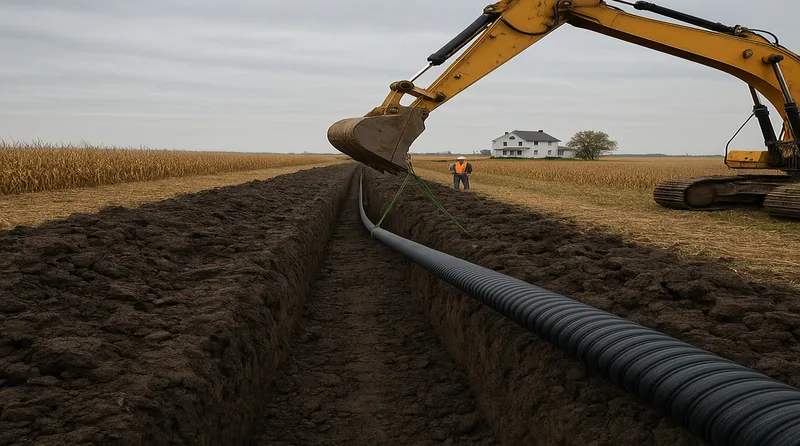
Indiana doesn't usually come up in geothermal conversations. It's landlocked Midwest — flat, agricultural, historically coal-powered. But that description actually contains two of Indiana's most compelling geothermal angles.
That flatness? It means horizontal ground loop systems — significantly cheaper than vertical boreholes — are practical across virtually the entire state. And that coal grid? It creates a carbon reduction story for geothermal that's actually stronger in Indiana than in states with cleaner electricity. When your grid produces 1,393 lbs of CO2 per megawatt-hour, a heat pump running at 3.5x efficiency delivers more carbon benefit per dollar than a natural gas furnace — a counterintuitive finding worth understanding.
This guide covers Indiana's market segments with real payback math, an honest look at the limited state incentive picture, and the specific angles — northern propane belt, flat-terrain cost advantage, Amish community market, and farm REAP grants — that make Indiana geothermal economics more interesting than the state's reputation suggests.
Indiana's Geothermal Landscape
Indiana's residential electricity rate is 11.38¢/kWh (EIA 2024, rank 27) — essentially the same as neighboring Ohio. The state's primary electricity source is coal, giving Indiana one of the highest grid carbon intensities in the country: approximately 1,393 lbs of CO2 per megawatt-hour. This is significant for geothermal's value proposition in a way we'll explore in the carbon section.
Indiana's major utilities serve distinct geographic territories. Duke Energy Indiana covers the south and central parts of the state, including Bloomington and a large share of the Indianapolis suburbs. Indiana Michigan Power (AEP) serves the northeast. NIPSCO (NiSource) covers northwest Indiana — the Gary/Hammond/South Bend corridor. CenterPoint Energy Indiana (formerly Vectren) serves southwest Indiana, including Evansville.
Climate in Indiana varies enough to matter. Northern Indiana — South Bend, Fort Wayne, Elkhart — sees 6,000–6,300 heating degree days annually, comparable to New England. Indianapolis runs around 5,600 HDD. Evansville in the southwest, pushed further south along the Ohio River, sees closer to 4,500 HDD. These differences affect the geothermal value calculation: more heating hours means more annual savings from the efficiency advantage.
Ground temperatures in Indiana run 52–55°F at loop depth — slightly warmer than Ohio due to more southerly latitude, well within geothermal's operational range, and favorable for efficient heating operation throughout Indiana's winters.
Incentives and Tax Credits
Federal 30% Section 25D Credit — Confirmed
The federal residential clean energy credit applies to all Indiana geothermal installations at 30% through 2032 (26% in 2033, 22% in 2034). It applies to the full installed cost — equipment, labor, and drilling or trenching. On a $30,000 installation, that's $9,000 back against your federal tax liability. The credit carries forward if your liability in year one doesn't absorb it.
No Indiana State Geothermal Credit
Indiana has no state income tax credit for residential geothermal heat pumps as of March 2026. The state's CHOICE (Comprehensive Hoosier Option to Incentivize Cleaner Energy) program is voluntary and targets utility-scale generation rather than homeowner incentives. Indiana's renewable policy framework has historically been utility-oriented; residential incentives beyond the federal credit are not available.
Utility Rebates — Unconfirmed for Ground-Source
Duke Energy Indiana offers rebates for heat pump water heaters ($800) and some HVAC equipment, but no confirmed ground-source heat pump rebate appears in their published residential programs. [NEEDS VERIFICATION — contact Duke Energy Indiana, NIPSCO, or Indiana Michigan Power directly to confirm whether ground-source systems qualify for any current heat pump incentive.] Programs change annually, and some utilities' "high-efficiency heat pump" categories may or may not include geothermal.
USDA REAP — For Agricultural and Rural Businesses
Indiana's large farm sector makes USDA REAP particularly relevant. Grants cover up to 25% of geothermal installation costs (maximum $500,000) for agricultural businesses and rural small businesses. Combined with the 30% federal ITC, Indiana farm operations can recover up to 55% of installation costs before calculating energy savings. Contact USDA Rural Development Indiana (Indianapolis office) for current grant funding availability.
Northern Indiana: The Propane Belt
Northern Indiana — roughly the counties from Fort Wayne and Elkhart westward through LaGrange, Kosciusko, Steuben, and DeKalb — is home to the largest Amish settlement in the world. Tens of thousands of rural homes in this corridor heat with propane, delivered by tanker truck on routes that extend deep into unmarked township roads.
The Amish community's practical, long-term approach to property stewardship has made them an interesting geothermal market. The economics align with their values — geothermal has low operating costs, high durability (25+ year lifespan), and zero combustion to maintain. Several IGSHPA-certified contractors in northern Indiana and nearby Ohio have noted growing geothermal adoption in the Elkhart/LaGrange Amish community over the past decade.
The propane-to-geothermal economics in this region are strong. A 2,400 square foot rural home in LaGrange County burning 1,100–1,400 gallons of propane per season at $2.50–$3.00 per gallon spends $2,750–$4,200 per year on heating. Geothermal at Indiana's 11.38¢/kWh rate runs the same home for approximately $650–$900 per year for combined heating and cooling. Annual savings: $1,850 to $3,300.
On a horizontal loop system (Indiana's flat terrain makes this the default), net installation cost after the 30% federal credit might be $14,000–$20,000 for a 3-ton system. Payback: 5–10 years in the propane-heavy scenario.
Northern Indiana's proximity to Chicago and the larger Midwest economy means there's a reasonable base of geothermal contractors serving this market from both the Indiana side and across the Illinois border. The NIPSCO service territory in northwest Indiana also extends into the South Bend metro, where a mix of urban gas-heated homes and rural propane properties creates a bifurcated market.
Indiana's Flat Terrain Advantage
This bears emphasis because it's genuinely significant: Indiana is one of the flattest states in the country. Almost the entire state was glaciated during the last ice age, leaving behind uniformly flat terrain covered by deep deposits of glacial till — clay and silt with embedded gravel and stones, consistent from surface to depth.
For geothermal installation, this means horizontal trench systems are practical virtually everywhere in Indiana outside the small unglaciated karst corner in the southeast. Horizontal systems cost $5,000–$8,000 per ton installed; vertical boreholes cost $7,000–$12,000 per ton. On a 3-ton residential system, that's potentially $6,000–$12,000 in savings before the federal credit — a meaningful difference.
The glacial till also has reliable thermal conductivity (~1.3–1.6 W/m·K), consistent soil temperatures at horizontal loop depth, and predictable excavation conditions. No surprise ledge rock, no inconsistent soil layers, no need to reroute a trench mid-dig.
In practice, horizontal loops require sufficient yard area — roughly 500 square feet per ton (with standard straight trench), or more for slinky configurations. Urban and suburban lots in Indianapolis or Fort Wayne may not have the space. Rural properties, farm acreage, and suburban homes with larger lots are the prime candidates for horizontal systems in Indiana. When space is limited, vertical boreholes remain the reliable option.
Indianapolis and Urban Markets
Most of Indianapolis runs on natural gas — Vectren (now CenterPoint Energy Indiana) and Citizens Energy Group serve the metro. Gas prices in Indiana have historically been moderate to low, partly supported by proximity to Appalachian production and Midwest pipeline infrastructure.
For existing gas-heated homes in Indianapolis, Fort Wayne, and South Bend, the energy-cost case for switching to geothermal is honest but not dramatic:
| City | Annual HDD | Gas Heating Cost (est.) | Geo Heating Cost (est.) | Total Annual Savings (heating + cooling) |
|---|---|---|---|---|
| South Bend / Fort Wayne | ~6,100–6,300 | ~$750–$1,050/yr | ~$550–$750/yr | ~$500–$900/yr |
| Indianapolis | ~5,600 | ~$650–$900/yr | ~$450–$650/yr | ~$400–$800/yr |
| Evansville | ~4,500 | ~$550–$750/yr | ~$400–$550/yr | ~$350–$700/yr |
Total annual savings for most urban Indiana gas homes: $400–$900/year. Against a net installation cost of $21,000–$31,500, payback is 23–35 years on energy savings alone. That's a long time, and we're not going to pretend otherwise.
The situations where urban Indiana geothermal makes more sense:
- New construction: Specifying geothermal at build time adds $8,000–$12,000 gross over standard HVAC, or $5,600–$8,400 after the credit. That incremental cost pays back in 5–8 years. Indianapolis suburbs like Carmel, Fishers, Zionsville, and Noblesville are high-growth new construction markets where geothermal makes strong financial sense as a builder specification.
- System replacement at end of life: When a 20-year-old furnace and AC die simultaneously, the comparison changes. You're choosing between replacing with standard equipment (cost: ~$8,000–$15,000) or upgrading to geothermal (cost: ~$28,000–$42,000 gross). The incremental decision of $20,000–$27,000 gross (or $14,000–$19,000 after credit) may justify itself over the new system's 25-year life, especially with high heating loads in northern Indiana.
- Environmental motivation: For homeowners prioritizing carbon reduction, Indiana's coal grid argument (see next section) creates a compelling case independent of energy cost payback.
The Coal Grid Carbon Story
Indiana is one of the few states where the carbon argument for geothermal is actually stronger than the energy-cost argument. Here's why.
Indiana's grid produces approximately 1,393 lbs of CO2 per megawatt-hour — one of the seven highest carbon intensities in the US (EIA 2024). That's primarily coal-fired generation. When you run an electric appliance in Indiana, the electrons behind it are mostly coal electrons.
A geothermal heat pump at COP 3.5 uses 1 kWh of electricity to deliver 3.5 kWh of heating. The carbon cost of that 1 kWh at Indiana's grid intensity: ~0.63 lbs of CO2. But you got 3.5 kWh of heat, so the effective carbon intensity of geothermal heating is 0.63 ÷ 3.5 = roughly 0.18 lbs CO2 per kWh of delivered heat.
A high-efficiency natural gas furnace (98% AFUE) burns about 0.116 lbs of CO2 per kWh of delivered heat from direct combustion. So geothermal on Indiana's coal grid delivers heat at roughly 50% more carbon intensity than a high-efficiency gas furnace — but not dramatically more. And geothermal completely handles cooling as well, where it replaces coal-fired central air conditioning with a much more efficient alternative.
More importantly: Indiana is retiring coal plants. The major utilities have announced significant coal plant retirements through 2035 as they transition to natural gas and renewables. Every coal plant that retires improves the carbon math for every geothermal system already in the ground. A geothermal system installed in 2026 that runs on 60% cleaner electricity by 2035 will have dramatically better lifetime carbon performance than its install-year carbon calculation suggests.
For homeowners focused on long-term carbon impact, Indiana's coal transition makes geothermal a high-value investment: you're locking in electric-efficiency infrastructure that improves with the grid, rather than locking in a gas appliance that doesn't.
Farm Operations and USDA REAP
Indiana's corn and soybean production ranks it among the top five agricultural states in the country. The USDA REAP program's 25% grant for farm operations is relevant across a large share of Indiana's geography.
For an Indiana farm installing geothermal in a barn, grain facility, hog operation, or the main farmhouse as part of a qualifying agricultural business:
- $35,000 installation → Federal 30% credit ($10,500) + REAP 25% grant ($8,750) = $19,250 in incentives → net cost $15,750
- Annual savings of $1,500–$2,500 on propane/electric → payback 6–10 years
Indiana also has abundant farm ponds. A closed pond loop on a farm pond — coiled HDPE sunk to the bottom — costs $3,000–$5,000 per ton installed, significantly below vertical borehole cost. Farm operations with existing ponds deep enough for loop placement (8+ feet at maximum depth) can combine REAP grants, federal credit, and pond loop cost savings for some of the best total geothermal economics available anywhere in the Midwest.
Geology and Installation Notes
Central and Northern Indiana — Glacial Till
The dominant geology across ~95% of Indiana. Deep clay-silt glacial till from the Wisconsin ice sheet. Consistent thermal conductivity (~1.3–1.6 W/m·K). Horizontal loops practical and cost-effective. Vertical boreholes also straightforward — no significant hard rock until deeper depths in some areas. Groundwater table depth varies; some areas in northwest Indiana have shallow water tables near Lake Michigan drainage systems — consult a local well driller about open-loop viability.
Southeast Indiana Karst Corner
Crawford, Harrison, Washington, and parts of Jackson and Lawrence counties sit on unglaciated limestone bedrock with karst features — similar to south-central Kentucky and parts of Tennessee. In this area: closed-loop systems recommended; open-loop not advised due to limestone fracture connectivity. Vertical boreholes work but require experienced karst contractors. Ask your drilling contractor about karst risk assessment before finalizing design.
Ground Temperatures
Indiana: 52–55°F at loop depth statewide, slightly warmer in the south. Fully within geothermal operational range. COP of 3.0–3.8 in heating mode at these temperatures, depending on the unit and entering water temperature.
Costs and Payback Summary
| Home Size | Horizontal (gross) | Vertical (gross) | After 30% Credit (horizontal) |
|---|---|---|---|
| 1,500 sq ft | $14,000–$18,000 | $22,000–$28,000 | $9,800–$12,600 |
| 2,000 sq ft | $18,000–$24,000 | $28,000–$36,000 | $12,600–$16,800 |
| 2,500 sq ft | $21,000–$29,000 | $33,000–$42,000 | $14,700–$20,300 |
| Scenario | Current Fuel | Annual Savings | Net Cost | Payback |
|---|---|---|---|---|
| North IN rural, propane + horizontal loop | Propane ~$2.75/gal | $1,850–$3,300/yr | $9,800–$16,800 (horizontal) | 4–9 years |
| Rural IN, electric strip heat | Electric resistance | $1,500–$2,200/yr | $12,600–$16,800 (horizontal) | 7–11 years |
| Indianapolis / Fort Wayne, gas | Natural gas | $400–$900/yr | $21,000–$31,500 (vertical) | 23–35 years (existing home) |
| New construction (incremental) | N/A | $1,200–$1,800/yr | $5,600–$8,400 (incremental) | 4–7 years |
| Farm operation + REAP + horizontal | Propane/gas | $1,500–$3,000/yr | $9,800–$16,800 (post-REAP+ITC, horizontal) | 4–8 years |
Note: Horizontal loop costs assume adequate yard space (~500 sq ft/ton minimum). Urban lots may require vertical boreholes. Get three quotes from IGSHPA-certified contractors.
Permitting in Indiana
Horizontal closed-loop: Standard local mechanical and building permits. No state water well permit required for closed horizontal trench systems. Township or county zoning rules may apply for agricultural land disturbance on farm properties — verify before excavating.
Vertical closed-loop: Indiana Department of Natural Resources (IDNR) oversees water well construction. A licensed well driller is required for vertical boreholes. Grouting requirements apply; your contractor should be familiar with Indiana's well construction rules.
Open-loop systems: IDNR well permit required for groundwater withdrawal. Adequate water quantity (typically 3 GPM per ton of capacity, or 1.5 GPM per ton for re-injection) must be confirmed. Discharge or re-injection permits from IDEM (Indiana Department of Environmental Management) may apply depending on volume and location.
Southeast Indiana karst: Additional scrutiny for any drilling or water withdrawal in karst areas. Consult with IDEM and your contractor about site-specific requirements in Crawford, Harrison, and Washington counties.
Find IGSHPA-certified installers at the IGSHPA contractor finder. Indiana has a growing base of certified geothermal contractors, concentrated in the Indianapolis metro and northern Indiana near the Ohio/Michigan markets.
Frequently Asked Questions
Does Indiana have a state geothermal tax credit?
No. No state-specific geothermal credit as of March 2026. The federal 30% Section 25D credit is the primary incentive. USDA REAP is available for qualifying agricultural and rural business operations.
Does Duke Energy Indiana offer geothermal rebates?
No confirmed ground-source rebate in their published programs. Duke Energy Indiana offers heat pump water heater rebates ($800). Contact them directly to verify current eligibility for ground-source systems. [NEEDS VERIFICATION]
Why does Indiana's coal-heavy grid matter for geothermal?
Indiana's coal grid produces ~1,393 lbs CO2/MWh. Geothermal at COP 3.5 still delivers heat at a carbon intensity comparable to or approaching that of direct gas combustion — and as Indiana retires coal plants, the carbon advantage grows. Geothermal infrastructure installed today gets progressively cleaner as the grid decarbonizes.
What are the best geothermal opportunities in Indiana?
Northern Indiana propane homes with horizontal loops (4–9 year payback — among the best in the Midwest) and new construction anywhere in Indiana (4–7 year incremental payback). Farm operations with REAP grants can achieve similar economics.
Why is Indiana terrain good for horizontal loops?
Flat glaciated terrain with deep clay-silt glacial till statewide. Horizontal loops cost $5,000–$8,000/ton vs. $7,000–$12,000 for vertical — saving $6,000–$12,000 on a residential system. Practical on any rural or suburban property with adequate yard space (~500 sq ft/ton).
Is geothermal worth it in Indianapolis with natural gas?
As a fuel-cost investment: 23–35 year payback for existing gas homes — not compelling. Better cases: new construction (4–7 years incremental), system replacement at end of HVAC life, and carbon motivation (coal grid makes geothermal's decarbonization benefit larger than in lower-carbon states).
Sources
- EIA Indiana Electricity Profile 2024 — U.S. Energy Information Administration
- DSIRE Indiana Programs — Database of State Incentives for Renewables & Efficiency
- Duke Energy Indiana Home Energy Improvement Programs
- IRS Section 25D Home Energy Tax Credits — Internal Revenue Service
- USDA REAP Program — Rural Development
- IGSHPA Certified Geothermal Contractor Finder
- Ohio Geothermal Guide — Geothermal Insider
- Geothermal Installation Cost Guide — Geothermal Insider