
In This Guide
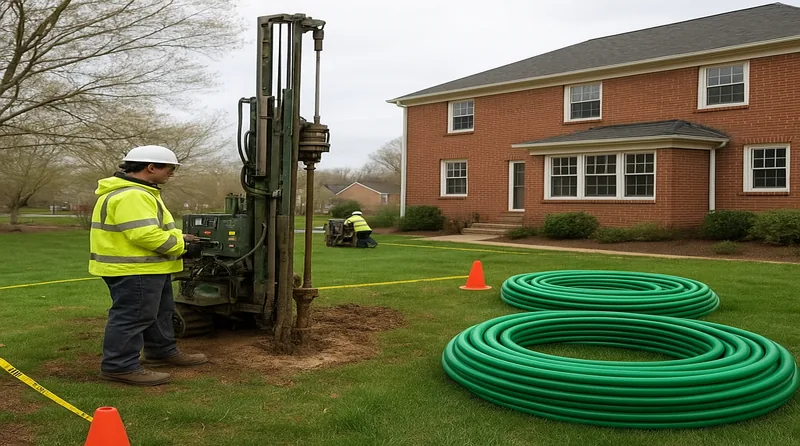
Maryland sits at a geothermal crossroads. The state has the right ground temperatures, a significant oil and propane market that makes the economics compelling, and some of the mid-Atlantic's best-informed contractors thanks to proximity to federal agencies and universities that have led geothermal adoption. At the same time, Maryland's Chesapeake Bay Critical Area rules add a permitting layer that affects a lot of homes near the Bay and its tributaries.
The honest assessment: if you're heating with oil or propane, geothermal is worth serious consideration — payback periods of 6–9 years are achievable. If you're on natural gas, the math is harder — 20–24 year payback is realistic. And if your property sits within 1,000 feet of tidal water, you'll want to understand the Critical Area process before you start planning.
This guide covers the real numbers, the regional geology, and the Maryland-specific regulatory landscape that most other guides skip entirely.
Does Geothermal Work in Maryland?
Ground Temperatures
Maryland's ground temperature runs 55–57°F throughout most of the state — the same mid-Atlantic range as New Jersey and Pennsylvania. That's your constant heat source in winter and heat sink in summer. At 55–57°F source temperature, a geothermal heat pump runs at a COP (coefficient of performance) of 3.8–4.5 in heating mode. For every unit of electricity you put in, you get nearly four to four and a half units of heat out.
Western Maryland runs slightly cooler in ground temps (53–55°F in the higher Appalachian elevations), but that region also has more heating degree days, which means the overall economics there are still strong.
Four-Season Value
Maryland has meaningful heating and cooling seasons, which matters for ROI. Unlike northern Maine or Minnesota where heating dominates, Maryland homeowners get real value from geothermal in both modes:
- Heating degree days: Baltimore: ~4,600. DC suburbs (Rockville): ~4,400. Frederick: ~4,800. Eastern Shore (Salisbury): ~3,900.
- Cooling degree days: Baltimore: ~850. DC suburbs: ~900–1,000. Eastern Shore: ~900.
In cooling mode, geothermal heat pumps run at a COP of 5.0 or higher — roughly twice the efficiency of a standard central air conditioner. For Maryland homeowners who run AC from May through September, that's $200–$300 per year in real savings compared to conventional cooling, regardless of what fuel they're replacing for heat.
Maryland's Geology: Region by Region
Maryland's geography spans four distinct physiographic provinces, and each has different implications for geothermal installation.
Western Maryland (Appalachian Ridge-and-Valley, Blue Ridge)
Garrett, Allegany, Washington, and western Frederick counties sit in the Appalachian mountains. Bedrock is predominantly limestone, shale, and sandstone in the Ridge-and-Valley province, with crystalline metamorphic and igneous rocks in the Blue Ridge. Excellent thermal conductivity. Drilling is consistent once through the weathered zone (typically 20–60 feet), and borehole stability is good.
Garrett County is a special case: elevations up to 3,300 feet mean heating degree days above 6,000 — more than most New England locations. For the significant number of vacation and year-round homes that heat with propane here, geothermal offers the most compelling ROI in the state.
Piedmont (Central Maryland)
Baltimore City, Baltimore County, Howard, Carroll, and Frederick counties occupy the Piedmont province — a belt of metamorphic and igneous crystalline rocks overlain by weathered residual soil. This is where most of Maryland's geothermal installations have happened, driven by the density of energy-conscious homeowners and proximity to experienced contractors.
Vertical loops are standard here. Drilling typically encounters bedrock at 20–80 feet. Borehole depths run 300–450 feet per ton for a well-designed system. A 3-ton system needs roughly 900–1,350 total bore-feet.
DC Suburbs (Metropolitan Washington Area)
Montgomery and Prince George's counties — served primarily by Pepco — are dense suburban markets with smaller average lot sizes. Like northern New Jersey, most installations here are vertical closed-loop. The contractor market is well-developed given proximity to federal facilities and universities that have used geothermal for decades. University of Maryland has one of the mid-Atlantic's largest campus geothermal systems.
Eastern Shore
The Delmarva Peninsula (Caroline, Dorchester, Somerset, Talbot, Wicomico, Worcester counties) sits on the Atlantic Coastal Plain — unconsolidated sandy and silty sediments that drill quickly and cheaply. System costs on the Eastern Shore are typically $2,000–$4,000 lower than in central Maryland for the same system size.
The trade-off: the Eastern Shore has extensive tidal waterways and wetlands. A significant percentage of properties fall within Maryland's Critical Area (within 1,000 feet of tidal water), which adds a permitting layer. See the permitting section below.
Open-loop systems are potentially viable on the Eastern Shore where groundwater quality and quantity support it, but environmental sensitivity to the Chesapeake Bay estuary means permitting scrutiny is higher. Most installers default to closed-loop.
Southern Maryland
Calvert, Charles, and St. Mary's counties are a mix of Coastal Plain and transitional Piedmont geology. Dominion Energy Maryland serves most of this region. The geothermal contractor market is thinner here than in central Maryland or the DC suburbs — get quotes from Baltimore and Northern Virginia contractors as well as locals.
Cost and ROI: Three Scenarios
Maryland's fuel mix creates three meaningfully different ROI stories. Here's the honest version of each.
System Costs
A 3-ton vertical closed-loop system in Maryland typically runs $18,000–$28,000 fully installed. The mid-Atlantic contractor market is moderately competitive — somewhat less expensive than New Jersey, but higher than the Midwest. After the 30% federal tax credit, your net cost is roughly $12,600–$19,600.
Scenario 1: Replacing Natural Gas (Most Common)
- Annual gas heating cost: ~550 therms × $1.30/therm = ~$715/year
- Geothermal operating cost: ~$350–$400/year electricity (at 15.04¢/kWh, COP 4.0)
- Heating savings: ~$315–$365/year
- Cooling savings vs. central AC: ~$200–$300/year
- Total annual savings: ~$515–$665/year
- Payback (after 30% credit, ~$16,000 net): ~20–24 years
This is a long payback. Maryland's relatively moderate natural gas prices make the pure financial case difficult. The honest recommendation for gas-heated homes: consider geothermal when you're already replacing a failing HVAC system, building new, or when long-term fuel price stability matters more than short-term payback.
Scenario 2: Replacing Heating Oil (Strong Case)
- Annual oil heating cost: ~650 gallons × $3.80/gal = ~$2,470/year
- Geothermal operating cost: ~$400–$460/year electricity
- Heating savings: ~$2,010–$2,070/year
- Cooling savings: ~$200–$300/year
- Total annual savings: ~$2,210–$2,370/year
- Payback (after 30% credit, ~$16,000 net): ~6–8 years
A 6–8 year payback on a 25-year system is an excellent investment. After payback, you're banking $2,000+ per year. Oil-heated homes in Maryland — particularly in Baltimore County, older DC suburb housing, and the Eastern Shore — are the strongest geothermal candidates in the state.
Scenario 3: Replacing Propane (Rural Maryland)
- Annual propane cost: ~700 gallons × $3.20/gal = ~$2,240/year
- Geothermal operating cost: ~$400–$460/year electricity
- Total annual savings: ~$1,980–$2,140/year + cooling ~$200–$300
- Payback (after 30% credit, ~$15,000 net): ~7–9 years
Rural Maryland — Garrett County, southern Maryland, rural Eastern Shore — has a substantial propane-heated housing stock. These homeowners often have more land (enabling lower drilling costs or even horizontal loops) and are further from natural gas infrastructure, meaning the propane versus geothermal comparison is the relevant one. The case here is strong.
25-Year Total Cost of Ownership
| Heating System | Net Install Cost | 25-yr Operating | 25-yr Total |
|---|---|---|---|
| Geothermal (after 30% credit) | $12,600–$19,600 | $8,750–$11,500 | $21,350–$31,100 |
| High-eff. gas furnace + central AC | $5,500–$8,500 | $22,500–$27,500 | $28,000–$36,000 |
| Oil boiler/furnace + central AC | $5,000–$8,000 | $61,750–$72,000 | $66,750–$80,000 |
| Propane furnace + central AC | $4,500–$7,500 | $56,000–$65,000 | $60,500–$72,500 |
Operating costs assume current MD energy prices and modest annual escalation. Individual results vary.
For a broader look at how these payback numbers compare across other states, see our geothermal payback period analysis.
Incentives and Financing
Federal Tax Credit (30% — Confirmed)
The Section 25D residential clean energy credit covers 30% of total installed cost — equipment, labor, drilling, all of it. Available through 2032 at full rate (steps to 26% in 2033, 22% in 2034). It's a tax credit, not a deduction, so it directly reduces what you owe. Unused credit carries forward to subsequent tax years.
On a $22,000 system, that's $6,600 back. See the full federal tax credit guide for documentation requirements.
Maryland Energy Administration (MEA) — [NEEDS VERIFICATION]
The Maryland Energy Administration has historically offered incentives for ground-source heat pump installations, but program availability and amounts change. Before making financial projections based on MEA rebates, verify current programs directly at energy.maryland.gov. MEA also administers the Residential Clean Energy Rebate Program — confirm whether geothermal qualifies under current program rules.
EmPOWER Maryland Utility Rebates — [NEEDS VERIFICATION]
EmPOWER Maryland is a state-mandated energy efficiency program funded through charges on electric bills. All Maryland electric utilities participate. Ground-source heat pumps may qualify as high-efficiency HVAC under these programs. Contact your utility directly to confirm current rebate amounts and requirements before installation — rebates often require pre-approval:
- BGE (Baltimore Gas & Electric): bgesmartenergy.com · 1-877-685-7377
- Pepco (DC suburbs): pepco.com — search "heat pump rebate"
- Delmarva Power (Eastern Shore): delmarvapower.com
- Dominion Energy Maryland (Southern MD): dominionenergy.com/maryland
Maryland Clean Energy Center (MCEC) Financing — [NEEDS VERIFICATION]
The Maryland Clean Energy Center's GreenStreet Lending program has historically offered low-interest loans for residential energy improvements. If available, these loans can reduce your out-of-pocket cost while you wait for the federal tax credit at year-end. Verify current terms at marylandcleanenergy.org.
Property Tax Exemption
Maryland generally exempts the added assessed value of renewable energy systems from property taxes. Geothermal heat pumps may qualify — confirm with your county assessor's office. This isn't a cash payment, but it means your property taxes don't increase because you installed a $20,000 geothermal system.
Other Financing Options
HELOC remains the most common financing path for Maryland homeowners given strong home equity positions in the DC and Baltimore metros. For a full breakdown of eight financing strategies, see our geothermal financing guide.
Permitting: Critical Area, Well Permits, and Local Requirements
Maryland Well Construction Permit
Vertical closed-loop boreholes are regulated as water wells in Maryland. The Maryland Department of the Environment (MDE) issues Well Construction Permits. Your installer handles this — it's standard procedure. Budget 3–6 weeks for permit issuance and roughly $100–$200 in permit fees.
Chesapeake Bay Critical Area — The Key MD-Specific Factor
Maryland's Critical Area Act establishes a 1,000-foot buffer around all tidal waters of the Chesapeake Bay and its tributaries, plus tidal wetlands. Within this buffer, any ground disturbance activity — including borehole drilling — requires Critical Area review by your local jurisdiction's Critical Area program.
This affects a significant portion of Maryland homeowners: essentially any property near the Bay, the Potomac River, the Patuxent, the Choptank, or their tributaries. Counties most commonly affected include Anne Arundel, Calvert, Talbot, Dorchester, Somerset, and Worcester, plus parts of Baltimore City and the DC shore counties.
What this means in practice: vertical loop installations within the Critical Area are generally approvable — they have a small surface footprint and no ongoing discharge. But the review process adds time (typically 4–8 weeks) and may require documentation showing the installation won't disrupt buffer vegetation or disturb sensitive habitat. Work with an installer experienced in Critical Area permitting.
Check whether your property is in the Critical Area using Maryland's iMAP system or by contacting your county planning office.
Local Building Permits
Mechanical and electrical permits are required from your county or municipality. Most Maryland jurisdictions are familiar with heat pump installations; geothermal is less common but not unusual. Budget $300–$700 for local permits depending on jurisdiction.
HOA and Community Restrictions
Planned unit developments and HOA communities — common in Howard County, Montgomery County, and Northern Virginia-adjacent areas — may have exterior work restrictions. Check your CC&Rs before signing a contract. Most HOAs don't prohibit geothermal outright, but some require board approval for drilling activity.
Finding a Qualified Maryland Installer
The mid-Atlantic contractor market is reasonably well-developed for geothermal, particularly in the Baltimore metro and DC suburbs. Here's how to find a good one.
IGSHPA Certification — Your Baseline
Start with the IGSHPA certified contractor directory. The International Ground Source Heat Pump Association certifies installers who've completed training in ground loop design and system sizing. Don't hire someone without this baseline.
Maryland-Specific Questions
- Is my property in the Critical Area? Have you done Critical Area installations?
- Do you handle the MDE well construction permit, or is that on me?
- Do you submit EmPOWER Maryland rebate paperwork? Who's responsible for pre-approval?
- Do you conduct a thermal response test (TRT) before finalizing the loop design, or do you use standard tables?
- What's the warranty on the ground loop? (Should be lifetime, or at least 50 years.)
Get Three Quotes
Pricing variation in the mid-Atlantic market is significant — $4,000–$6,000 spread for comparable systems is not unusual. Compare system size (tons), loop design, equipment brand, and warranty coverage. The lowest quote often cuts corners on loop sizing, which affects system efficiency for the system's entire lifespan. See our installation cost guide for what a fair quote looks like.
Frequently Asked Questions
My property is near the Chesapeake Bay. Does geothermal still work?
Yes, with extra steps. If you're in the Critical Area (within 1,000 feet of tidal water), your installer needs to factor in the Critical Area review process — typically 4–8 additional weeks. Vertical closed-loop systems are generally approvable. Budget for the added time and potentially a small additional permitting fee. Work with an installer who knows Critical Area procedures.
I live in Garrett County. Is geothermal worth it there?
Garrett County is arguably the best geothermal market in Maryland. At 6,000+ heating degree days and with most homes on propane (no natural gas distribution in most of Garrett County), the payback calculation is very favorable — often 6–8 years even with the slightly longer drilling depths at higher elevations. The colder ground temps (53–55°F at elevation) reduce COP slightly but the high heating load more than compensates.
Is the Eastern Shore a good market for geothermal?
Yes — the sandy Coastal Plain geology makes drilling fast and affordable, and there's a significant oil-heated housing stock on the Eastern Shore where the financial case is strong. The added consideration is the density of Critical Area-affected properties near tidal waterways. But most of the Eastern Shore's residential areas have parcels large enough for straightforward vertical installations.
What about new construction in Maryland?
New construction is often the best geothermal scenario. When you design geothermal in from the start — properly sized equipment, ductwork optimized for lower-temperature delivery, radiant floor options — you get better efficiency and avoid retrofit premiums. Many Maryland builders in Howard, Montgomery, and Frederick counties have done geothermal new construction. Ask your builder about it early in the design phase.
Does geothermal qualify under Maryland's Clean Energy Grant programs?
The Maryland Energy Administration has various clean energy programs that have historically included heat pumps. Program availability, amounts, and eligibility requirements change — verify directly with MEA at energy.maryland.gov before relying on state grants in your financial planning.
Bottom Line: Who Should Seriously Consider Geothermal in Maryland
After running the numbers across Maryland's fuel mix and geography, here's an honest summary:
Strong candidates:
- Homes heating with oil — 6–8 year payback, clear long-term financial win
- Homes heating with propane (especially Garrett County, rural Eastern Shore, southern MD) — 7–9 year payback
- New construction — geo designed in from the start avoids retrofit premium
- Homes replacing both failing furnace AND aging central AC — compare to full HVAC replacement cost
- Eastern Shore properties — lower drilling costs, significant oil-heated stock
Run the numbers carefully:
- Natural gas-heated homes — 20–24 year payback; only makes clear sense for new construction, system replacement, or long-term ownership with belief in rising gas prices
- Properties in the Critical Area — feasible but adds permitting time; plan accordingly
- Dense suburban lots in DC suburbs — vertical loops work, but tight scheduling for drilling access
The first step: get a site assessment from an IGSHPA-certified installer. For comparison with neighboring states, see our New Jersey geothermal guide and Pennsylvania geothermal guide — PA's oil-belt ROI story mirrors Maryland's in the southern counties. For the full incentive picture, see the federal tax credit guide. And if you're comparing geothermal to staying on propane in rural Maryland, see our geothermal vs. propane analysis.
Sources
- EIA — Maryland Electricity Profile (15.04¢/kWh, 2024 average)
- NOAA — U.S. Climate Normals (Maryland heating/cooling degree days)
- Maryland Energy Administration — Clean energy incentive programs
- Maryland Department of the Environment — Well Construction Permits
- Maryland Department of Natural Resources — Critical Area Program
- IRS — Residential Clean Energy Credit (Section 25D)
- IGSHPA — Find a Certified Geothermal Contractor