
In This Guide
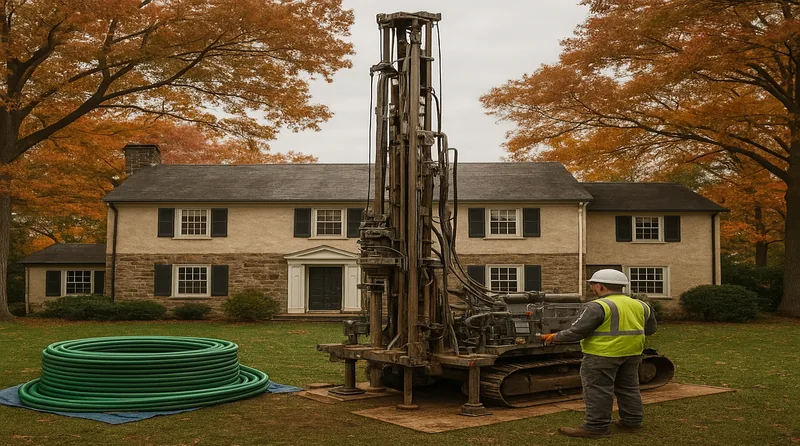
Pennsylvania's Energy Paradox
Pennsylvania sits atop the Marcellus Shale — the largest natural gas field in the United States, producing more gas than any state except Texas. You'd expect every PA home to be heating cheaply with natural gas. And in Pittsburgh and the western counties, that's mostly true.
But drive east to the Philadelphia suburbs — Delaware County, Chester County, Montgomery County — and you'll find neighborhood after neighborhood of pre-1960s colonial and split-level homes that were built before natural gas distribution reached suburban Philadelphia. Many still heat with oil. Some have never converted. And further north into the Pocono mountains and the rural counties stretching toward the New York border, natural gas infrastructure disappears almost entirely, replaced by propane tanks.
This geographic split creates two very different geothermal stories in Pennsylvania. For oil-heated southeastern PA suburbs and propane-dependent rural communities, geothermal is a compelling investment — payback periods of 6–9 years are realistic. For Pittsburgh-area homes on cheap Marcellus gas, the math is genuinely difficult, and we won't pretend otherwise.
Does Geothermal Work in Pennsylvania?
Ground Temperatures
Pennsylvania's ground temperature runs 50–54°F depending on location — slightly cooler than New Jersey or Maryland due to higher latitude. Southeastern PA (Philadelphia region) sits at the warmer end of that range, around 53–55°F. The Pocono plateau and northern counties run toward 50–52°F.
Those temperatures translate to a COP (coefficient of performance) of roughly 3.5–4.2 in heating mode — slightly lower than what MD or NJ installations achieve, but still delivering 3.5–4+ units of heat for every unit of electricity consumed. A high-efficiency gas furnace at 96% efficiency delivers 0.96 units. The efficiency advantage remains even in Pennsylvania's cooler soils.
Climate: Wide Variation Across the State
Pennsylvania's climate ranges considerably from southeast to northwest, and that variation affects geothermal ROI:
- Philadelphia: ~4,800 heating degree days, ~900 cooling degree days — similar to Maryland
- Harrisburg: ~5,400 HDD, ~700 CDD
- Pittsburgh: ~5,900 HDD, ~700 CDD
- State College: ~6,400 HDD, ~550 CDD
- Erie: ~6,500 HDD, ~550 CDD
The higher heating degree days in central and northern PA actually improve geothermal ROI — more heating load means more hours of efficient operation, faster payback, and more annual savings. The complication is that most of those high-HDD areas are also where natural gas infrastructure thins out and propane becomes the alternative — which is, paradoxically, a better scenario for geo ROI.
Philadelphia's cooling season is real — roughly 900 cooling degree days. Geothermal in cooling mode runs at COP 5.0+, meaning real savings on summer air conditioning that add $150–$250/year to the ROI calculation regardless of heating fuel.
Five Distinct Pennsylvania Markets
Southeastern PA / Philadelphia Suburbs (Piedmont Province)
Chester, Delaware, and Montgomery counties — the "collar counties" around Philadelphia — are geothermal's sweet spot in Pennsylvania. The geology is favorable: crystalline basement rock (gneiss, schist) with relatively thin weathered overburden, thermal conductivity of 1.2–1.8 BTU/hr·ft·°F, and ground temps of 53–55°F. Active geothermal contractors operate throughout the region.
The market driver: these counties have one of the highest concentrations of oil-heated homes in the mid-Atlantic. Pre-1960s housing stock that was built before gas mains reached the suburbs. Many of these homes have been on oil delivery for 50+ years. When an oil boiler fails — and they do, eventually — geothermal is a serious option that competes directly with gas conversion.
Ridge-and-Valley Province (Central PA)
Lancaster, Lebanon, Dauphin, Cumberland, and Juniata counties sit in the folded limestone, shale, and sandstone of the Ridge-and-Valley province. Limestone has excellent thermal conductivity (1.4–2.2 BTU/hr·ft·°F), and where carbonate aquifers yield sufficient water, open-loop systems are potentially viable — though most installers default to closed-loop for regulatory simplicity.
Lancaster County deserves a specific mention: it's one of the more active rural geothermal markets in Pennsylvania, driven in part by the agricultural community's interest in energy-efficient heating for homes, barns, and outbuildings. Farms with propane heating and large lots are natural horizontal loop candidates.
Pittsburgh / Appalachian Plateau (Western PA)
Pittsburgh and the surrounding Allegheny, Westmoreland, Fayette, and Somerset counties sit on the Appalachian Plateau — flat-lying sandstones and shales with moderate thermal conductivity. The geology supports vertical loop installations well. The challenge isn't the ground; it's the economics. Western PA is deeply embedded in the natural gas infrastructure. Cheap Marcellus gas makes geothermal's ROI case very difficult for most Pittsburgh-area homes. (More on this in the cost section.)
That said, Pittsburgh's HVAC market is sophisticated, and the handful of Pittsburgh-area homes on oil or propane — some older borough housing, some rural properties outside the gas distribution grid — do have a strong case for geothermal.
Pocono Plateau / Glaciated Northeast
Monroe, Pike, Wayne, and Susquehanna counties are Pennsylvania's recreational mountain region — the Poconos. The geology here is glacial till and outwash over sandstone bedrock, with variable soil thickness. Ground temps run toward 50–52°F. Heating dominates (ski season, cold winters). Propane is the standard fuel for homes outside the few town centers with gas distribution.
Vacation and second homes in the Poconos are an interesting geothermal opportunity: they often have larger wooded lots (enabling horizontal loops), they run propane at high cost for intermittent use, and they have substantial summer cooling loads if used as summer rentals. The combination of high heating load, propane economics, and generous lot sizes makes the Poconos worth a serious look.
Northern PA / Endless Mountains
Tioga, Potter, Cameron, Clinton, Sullivan, and Lycoming counties — the northern wilds of Pennsylvania — are almost entirely propane-dependent. Heating degree days exceed 6,000 in some locations. Lots are large. This is some of the most compelling geothermal territory in the state from a pure ROI standpoint, though thin contractor markets mean you may be working with an installer who travels from a larger metro. Get multiple quotes.
Cost and ROI: The Three-Scenario Breakdown
System Costs
A 3-ton vertical closed-loop system in Pennsylvania typically runs $18,000–$27,000 installed. The mid-Atlantic contractor market serves southeastern PA well; western PA and rural areas may see slightly higher costs due to fewer competing installers. After the 30% federal tax credit, your net cost is roughly $12,600–$18,900.
Scenario 1: Replacing Natural Gas (Pittsburgh and Most of Western PA)
Here's the hard truth for Pittsburgh-area homeowners: Pennsylvania sits on top of the Marcellus Shale, and that proximity means residential gas prices that are among the lowest in the country — roughly $1.00–$1.20/therm for residential customers.
- Annual gas heating cost: ~600 therms × $1.10/therm = ~$660/year
- Geothermal operating cost: ~$430–$490/year electricity (at 12.51¢/kWh, COP 3.8)
- Heating savings: ~$170–$230/year
- Cooling savings vs. central AC: ~$150–$250/year
- Total annual savings: ~$320–$480/year
- Payback (net ~$15,500): ~25–30+ years
Twenty-five to thirty years is beyond the financial planning horizon for most homeowners. We're not going to dress this up: geothermal does not make financial sense for most western PA gas-heated homes on pure payback math. The honest exceptions are new construction (where system economics look different), homes replacing failing HVAC systems, or homeowners who prioritize energy independence and long-term price stability over short-term payback.
Scenario 2: Replacing Heating Oil (Philadelphia Suburbs)
This is where geothermal's case in Pennsylvania is genuinely strong.
- Annual oil heating cost: ~700 gallons × $3.80/gal = ~$2,660/year
- Geothermal operating cost: ~$480–$540/year electricity
- Heating savings: ~$2,120–$2,180/year
- Cooling savings: ~$150–$250/year
- Total annual savings: ~$2,270–$2,430/year
- Payback (net ~$15,500): ~6–7 years
A 6–7 year payback on a system with a 25-year lifespan is an excellent investment. After payback, you're banking $2,000+ annually. For a Delaware County or Chester County home currently paying $3,000+ per year for oil delivery, geothermal converts a perpetual operating expense into a fixed upfront cost with low operating costs for the next two decades.
Scenario 3: Replacing Propane (Rural PA, Poconos, Northern Counties)
- Annual propane cost: ~700 gallons × $3.20/gal = ~$2,240/year
- Geothermal operating cost: ~$480–$540/year electricity
- Total annual savings: ~$1,850–$2,000/year + cooling savings
- Payback (net ~$14,000): ~7–9 years
Rural PA propane users are strong geothermal candidates. They're typically off the gas grid permanently (natural gas distribution is not coming to Potter County), they have larger lots that enable cost-effective horizontal loops, and the higher heating degree days in northern PA mean more annual savings hours. The propane-to-geothermal switch also removes the vulnerability to propane price spikes that periodically hit rural markets in cold winters.
PA's Deregulated Electricity Market: A Variable Worth Noting
Pennsylvania is a deregulated electricity market — residential customers can choose their retail electric supplier, and rates vary. The EIA average of 12.51¢/kWh is a statewide average; your actual rate may be higher or lower depending on your current supplier contract. Before doing your own ROI calculation, use your actual electric rate, not the state average. If you're on a high fixed-rate contract, switching suppliers when you install geothermal could improve your ROI further.
25-Year Total Cost of Ownership
| Heating System | Net Install Cost | 25-yr Operating | 25-yr Total |
|---|---|---|---|
| Geothermal (after 30% credit) | $12,600–$18,900 | $10,000–$13,500 | $22,600–$32,400 |
| High-eff. gas furnace + central AC | $5,500–$8,500 | $20,000–$25,000 | $25,500–$33,500 |
| Oil boiler/furnace + central AC | $5,000–$8,000 | $66,500–$77,000 | $71,500–$85,000 |
| Propane furnace + central AC | $4,500–$7,000 | $56,000–$65,000 | $60,500–$72,000 |
Operating costs assume current PA energy prices with modest annual escalation. Gas scenario shown at Pittsburgh Marcellus rates (~$1.10/therm). Individual results vary.
See our geothermal payback period analysis for how Pennsylvania compares to neighboring states.
Incentives and Financing
Federal Tax Credit (30% — Confirmed)
The Section 25D residential clean energy credit covers 30% of the total installed cost of a ground-source heat pump system — equipment, labor, drilling, all included. Runs at 30% through 2032. It's a direct tax credit, not a deduction. On a $22,000 installation, that's $6,600 back. See the complete federal tax credit guide for documentation requirements.
Utility Rebate Programs — [NEEDS VERIFICATION]
Pennsylvania's major utilities have historically offered rebates for high-efficiency HVAC through their demand-side management programs. Ground-source heat pumps may qualify. Verify current amounts and pre-approval requirements directly with your utility before installation:
- PECO (Philadelphia, Exelon): Smart Ideas program — peco.com/savings
- PPL Electric (eastern/central PA): EnergyWise program — pplelectric.com
- West Penn Power / FirstEnergy (western PA): — firstenergycorp.com
- Duquesne Light (Pittsburgh): — duquesnelight.com
Pennsylvania Energy Development Authority (PEDA) — [NEEDS VERIFICATION]
PEDA has historically offered low-interest loans and grants for clean energy projects in Pennsylvania. Residential program availability varies — verify current offerings at dep.pa.gov.
Property Tax Exemption — [NEEDS VERIFICATION]
Pennsylvania provides real estate tax exemptions for the added assessed value of certain clean energy systems. Ground-source heat pumps may qualify. Verify with your county assessor's office — rules and implementation vary by county.
Financing Options
For southeastern PA homeowners with substantial home equity (Delaware and Chester counties have some of the highest median home values in the state), a HELOC is typically the most cost-effective financing vehicle. For rural PA homeowners with less equity, USDA Rural Energy for America Program (REAP) loans may be an option for agricultural properties. See our geothermal financing guide for a full breakdown of eight financing paths.
Permitting in Pennsylvania
PA DEP Water Well Permits
Vertical closed-loop boreholes require a Water Well Permit from the Pennsylvania Department of Environmental Protection under the Water Resources Management Act. Standard procedure — your installer handles it. Pennsylvania's Act 32 specifies well construction standards, grouting requirements, and setback distances from property lines and water sources. Budget 2–4 weeks for permit issuance and $100–$200 in fees.
Local Permits
Mechanical and electrical permits are required from your municipality. Pennsylvania's fragmented local government structure (townships, boroughs, second-class cities) means permit processes vary more than in states with county-level administration. Most jurisdictions are familiar with heat pump installations; budget $300–$600 for local permits.
Simpler Than Some Neighbors
Compared to New Jersey's CAFRA zones or Maryland's Chesapeake Bay Critical Area, Pennsylvania has a relatively straightforward permitting landscape for most locations. There's no broad coastal overlay affecting large portions of the residential market. Properties near streams or wetlands have standard environmental setback requirements, but these are well-understood by experienced installers.
Finding a Qualified PA Installer
Start with the IGSHPA certified contractor directory. The Philadelphia metro area and southeastern PA have a reasonable number of IGSHPA-certified installers; western PA and rural areas are thinner. For rural northern PA, you may need to contact installers from Harrisburg, State College, or even from the New York Southern Tier who work across the border.
Questions to ask any PA installer:
- Do you handle the PA DEP water well permit, or is that my responsibility?
- What's your conductivity assumption for this soil type, and how did you arrive at that?
- Do you submit paperwork for PECO/PPL rebates, and who's responsible for pre-approval?
- What's the warranty on the ground loop itself? (Should be 50 years or lifetime on the HDPE pipe)
Get at least three quotes. In the Philadelphia suburbs, price competition is real and quotes can vary $5,000+ for comparable systems. In rural areas with fewer contractors, cast a wider geographic net. See our installation cost guide for what fair pricing looks like in the mid-Atlantic market.
Frequently Asked Questions
I'm in Pittsburgh on natural gas. Is geothermal ever worth it?
On pure payback, probably not for most Pittsburgh-area gas homes — we're talking 25–30+ year payback with Marcellus Shale gas prices. Where it might still make sense: new construction (the economics look better when geo replaces the whole HVAC system rather than a working gas system), commercial/larger scale installations where efficiency gains compound, or if you strongly value energy price stability and long-term ownership. But we won't sell you a number that doesn't pencil.
My Delaware County home still heats with oil. What should I actually expect?
A 6–7 year payback is realistic. Get a site assessment from an IGSHPA-certified installer — your specific lot (size, access, soil conditions), home size, and actual oil usage will give you a more precise number than any guide can. The structural case is sound: you're converting a variable operating expense (oil price × usage) into a fixed capital cost with much lower operating costs. After year 7, you're netting $2,000+ annually.
I have a vacation home in the Poconos. Does geothermal work for intermittent use?
Yes, with some caveats. Geothermal systems can be set to a lower setpoint when unoccupied — the loop field doesn't care whether the house is occupied. The key consideration for vacation homes is freeze protection: your antifreeze concentration needs to protect the loop down to the minimum expected temperature, and the building's domestic plumbing needs protection too. For a Pocono rental property with high summer occupancy and high winter heating costs, the ROI case is often better than a primary residence because the cooling savings add up in the summer rental season.
Can geothermal work for agricultural buildings in Lancaster County?
Yes — and some of the most creative geothermal applications in Pennsylvania have been on farms. Large lots enable horizontal loop systems that are more cost-effective than urban vertical installations. Year-round temperature control for poultry houses, dairy facilities, and farm offices creates a consistent heating and cooling load that maximizes system efficiency. USDA REAP loans may reduce upfront costs for agricultural properties. Talk to your county Farm Bureau or extension office about local resources.
Pennsylvania is deregulated. Does that affect my geothermal ROI?
It can, in your favor. If you're currently on a high-rate retail electric supplier contract, switching to a lower-rate supplier when you install geothermal reduces your operating cost — improving your payback. If you're already on a favorable rate, the EIA average of 12.51¢/kWh is a reasonable planning number. Run your ROI calculation at your actual rate, not the state average.
Bottom Line: Who Should Seriously Consider Geothermal in Pennsylvania
Strong candidates:
- Oil-heated homes in Delaware, Chester, Montgomery, Bucks counties — 6–7 year payback, clear long-term financial win
- Propane-heated rural PA (Poconos, northern counties, Lancaster County rural) — 7–9 year payback
- New construction anywhere in PA — system designed in from the start avoids retrofit premium
- Agricultural properties with large lots and year-round conditioning needs
- Pocono vacation/rental properties with high summer cooling load and propane heat
Think carefully:
- Natural gas homes in Pittsburgh and western PA — long payback; mainly makes sense at system replacement time or new construction
- Rural properties with very thin contractor markets — you may need to bring in an installer from 1–2 hours away; factor in the travel premium
First step: get a site assessment from an IGSHPA-certified installer. For comparison with neighboring states, see our New Jersey geothermal guide, Maryland guide, and New York guide. For propane-specific analysis, see our geothermal vs. propane comparison.