
In This Guide
- The Virginia Verdict: Is Geothermal Worth It?
- Virginia's Climate and Ground Temperatures
- Virginia Geology and Loop Design by Region
- Virginia Geothermal Costs by Region
- Virginia Case Studies
- Month-by-Month Energy Profile
- Open-Loop Viability by Region
- Loop Type Cost Comparison
- Virginia Incentives and Tax Credits
- Incentive Stacking Strategy
- How to Claim the Federal Tax Credit (Step by Step)
- Dominion vs Appalachian Power
- Permits and Regulatory Requirements
- Solar + Geothermal Stacking
- USDA REAP for Rural Virginia Properties
- Vacation Rental and Agritourism Economics
- Finding a Virginia Geothermal Installer
- Maintenance and System Longevity
- Virginia vs. Neighboring States
- Video Resources
- Virginia Geothermal FAQ
- Sources
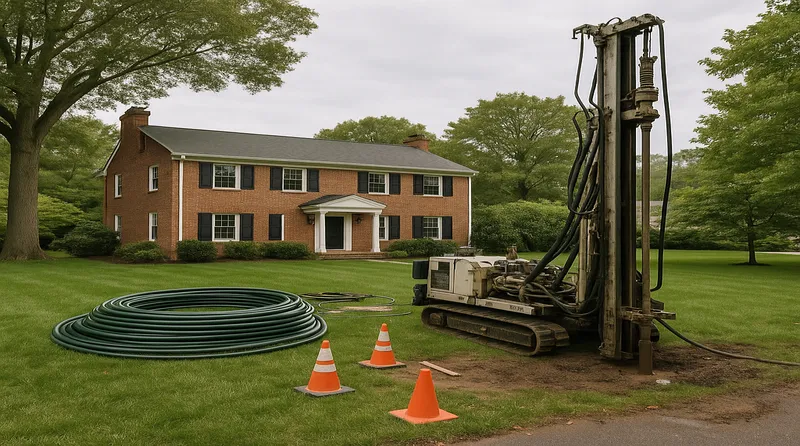
Virginia is a geothermal state caught between two realities. On one side: favorable ground temperatures across the entire commonwealth, a four-season climate that lets geothermal earn its keep in both heating and cooling, and an electricity rate trajectory that JLARC's own analysis says is headed up — significantly — thanks to the data center explosion in Loudoun County. On the other side: thin state-level incentives, a dominant natural gas network that makes payback math genuinely difficult for most suburban homeowners, and a utility landscape where Dominion Energy's geothermal rebate programs remain conspicuously absent.
The honest story is this: if you're heating with propane or fuel oil in western Virginia — the Roanoke Valley, Shenandoah, or the Appalachian highlands — geothermal is likely one of the best home investments you can make, with payback around 11 years. It was under 8 when the 30% federal §25D credit was still available; that credit applied only to systems placed in service through December 31, 2025 and is not available after that date (One Big Beautiful Bill Act, P.L. 119-21). If you're on natural gas in the Richmond suburbs or Northern Virginia, the numbers are harder still, and anyone telling you otherwise isn't being straight with you.
This guide gives you the real picture: verified costs by region, honest payback analysis by fuel type, the data center rate impact that changes long-term projections, and practical guidance on permits, installers, and incentive stacking. If you're new to how ground-source heat pumps work, start with our how geothermal heat pumps work primer, then come back for Virginia specifics.
The Virginia Verdict: Is Geothermal Worth It?
| Your Situation | 2026 Payback (No Federal Credit) | Verdict | Notes |
|---|---|---|---|
| Replacing propane (western VA / rural) | ~11 years — longer than the 6–9 published under the credit | ✅ Strong yes | $2.50–$3.50/gal propane = $2,400–$3,150/yr heating cost |
| Replacing fuel oil | Longer than the 7–11 years published under the credit | ✅ Yes | Concentrated in Piedmont and Northern Neck areas |
| Replacing electric resistance | Longer than the 5–8 years published under the credit — still the best case in the state | ✅ Best case | COP 4.0 vs 1.0 = 75% electricity reduction |
| New construction (any region) | Longer than the 4–8 years published under the credit | ✅ Best structural opportunity | Incremental cost $10K–$18K vs conventional HVAC |
| Replacing aging air-source HP | Well beyond the 10–16 years published under the credit | ⚠️ Moderate | Efficiency gap narrows in VA's mild climate |
| Vacation rental (Shenandoah / Blue Ridge) | Longer than the 5–9 years published under the credit | ✅ Strong yes | Year-round occupancy + premium positioning. Business use falls under the separate §48 commercial credit, not §25D. |
| USDA REAP farm/rural business | ~6 years — longer than the 3–6 published under the credit, still exceptional | ✅ Exceptional | Up to 50% REAP. The federal 25D credit that took combined coverage to 80% expired Dec 31, 2025. |
| Replacing natural gas (Richmond / NoVA) | Well beyond 35 years | ❌ Difficult | Gas is cheap. Non-financial motivations dominate. |
Payback figures reflect 2026 conditions with no federal tax credit. The 30% credit under IRC §25D applied to systems placed in service through December 31, 2025 and is not available for property placed in service after that date (One Big Beautiful Bill Act, P.L. 119-21). The Inflation Reduction Act had scheduled 30% through 2032 with step-downs in 2033 and 2034; that schedule was repealed before taking effect. Earlier versions of this table showed shorter paybacks because they netted out the credit.
Virginia's electricity rate sits at 12.86¢/kWh (EIA 2024 annual average) — below the national average. But that number masks a trend: rates have been climbing, driven by Dominion's massive capital investment program for data center infrastructure. The JLARC projection of $14–$37/month in additional charges by 2040 makes efficiency investments more valuable over time than today's snapshot suggests.
For a deeper dive on payback modeling, see our geothermal payback period guide.
Virginia's Climate and Ground Temperatures
Virginia spans a remarkable range of climate zones — from the semi-coastal warmth of Hampton Roads (IECC Zone 4A) to the cold mountain winters of the Appalachian highlands near the West Virginia border (Zone 5A). That variation affects both the heating load your geothermal system handles and the soil temperatures it draws from.
Ground Temperatures: The Constant Underneath
At 50–100 foot depth — the zone where vertical closed-loop boreholes operate — ground temperatures remain stable year-round:
- Richmond: ~60.5°F (NOAA engineering weather data)
- Northern Virginia / DC suburbs: ~59–60°F
- Roanoke / Shenandoah Valley: ~58.5°F
- Western Appalachian highlands: ~56–58°F
- Hampton Roads / Eastern Shore: ~61–63°F
This stability is the fundamental asset. In January, when Roanoke sees 20°F outdoors, the ground loop exchanges heat with 58°F earth. In August, when Richmond hits 95°F, the ground loop rejects heat into 60°F soil. The deeper you go, the more stable the temperature.
Heating and Cooling Degree Days
Virginia is genuinely a four-season state, which helps geothermal economics:
| City | Heating Degree Days | Cooling Degree Days | Ground Temp (50ft) |
|---|---|---|---|
| Richmond | 3,900 | 1,400 | 60.5°F |
| Northern Virginia | 4,200 | 1,600 | 59–60°F |
| Roanoke | 4,300 | 900 | 58.5°F |
| Hampton Roads / Norfolk | 3,400 | 1,700 | 62°F |
| Blacksburg / NRV | 4,800 | 600 | 57°F |
| Wise / SW Virginia | 5,200 | 500 | 56°F |
Unlike heating-dominated northern climates, Virginia homeowners get meaningful return from geothermal in both heating AND cooling modes. That dual-season advantage accumulates on both sides of the payback ledger — a factor pure heating analysis misses.
Virginia Geology and Loop Design by Region
Virginia's geology is as varied as its landscape, and that variation directly shapes drilling costs, loop design, and open-loop feasibility. Understanding your region's geology isn't academic — it's the difference between $15/ft and $25/ft for vertical drilling.
Northern Virginia and the Piedmont Plateau
The broad Piedmont region from Northern Virginia through Richmond is underlain by metamorphic and igneous crystalline rock — primarily granite, gneiss, and schist at depth. This geology requires diamond-tipped rotary drilling for vertical boreholes, which costs more per foot than sedimentary drilling but produces highly stable, long-lasting installations. Thermal conductivity in Piedmont crystalline rock is good to excellent (1.4–2.2 BTU/hr·ft·°F), meaning boreholes can be spaced efficiently.
Loudoun County and the outer NoVA suburbs have seen significant geothermal adoption in higher-end new construction, partly because affluent homeowners look at long-term economics and partly because large homes have high HVAC loads that amplify geothermal's efficiency advantage.
Shenandoah Valley and the Ridge-and-Valley Province
The Shenandoah Valley sits on carbonate rocks — limestone and dolomite. This is karst territory. Karst geology has important implications: the rock can be fractured, dissolution features (sinkholes, caves) can be present, and there may be preferential groundwater flow paths. An experienced driller familiar with karst conditions is essential.
On the positive side, karst groundwater systems can make open-loop installations attractive where yields are high and water quality is suitable. But these systems require DEQ water withdrawal review. Closed-loop vertical systems are the safer default for residential applications in karst areas.
Western Virginia and the Appalachian Plateau
Southwestern Virginia — the coalfields and the high Appalachian plateau — is underlain by sedimentary rock: sandstone, shale, and coal-bearing formations. Drilling is generally easier and less expensive than in crystalline Piedmont rock ($12–$18/ft vs. $18–$25/ft). The bigger factor: winters here are genuinely cold, homes often heat with propane or electric resistance, and geothermal's efficiency advantage is at its maximum.
Coastal Plain and Hampton Roads
East of the fall line — Hampton Roads, the Northern Neck, and the Eastern Shore — sits on deep unconsolidated sediments: sand, gravel, silt, and clay extending hundreds of feet before hitting bedrock. Horizontal loops work well in softer soils if you have the land. Vertical drilling is feasible but requires careful engineering in unconsolidated material. Open-loop systems access excellent aquifers here, but DEQ groundwater management area rules apply most strictly in this region.
Virginia Geothermal Costs by Region
Installed costs vary significantly across Virginia based on geology, labor markets, and system design. All figures reflect 2025–2026 pricing for a typical 3–5 ton system serving a 2,000–2,800 sq ft home. Verified against IGSHPA contractor data and regional installer reports, March 2026.
| Region | Vertical Closed-Loop | Horizontal (if viable) | Ground Temp | Key Factor |
|---|---|---|---|---|
| Northern Virginia / DC Suburbs | $28,000–$48,000 | $22,000–$35,000 | 59–60°F | High labor costs, crystalline rock, affluent market |
| Richmond Metro / Piedmont | $22,000–$38,000 | $18,000–$28,000 | 60–61°F | Moderate costs, mixed geology |
| Shenandoah Valley / Blue Ridge | $20,000–$34,000 | $16,000–$26,000 | 58–59°F | Karst drilling premium in some areas |
| Hampton Roads / Eastern Shore | $22,000–$36,000 | $17,000–$27,000 | 61–63°F | Unconsolidated sediments, DEQ permits for open-loop |
| Western VA / Roanoke / Appalachian | $18,000–$32,000 | $14,000–$24,000 | 56–59°F | Sedimentary rock = lower drilling costs, higher heating loads |
What drives costs up: Crystalline Piedmont rock (higher drilling $/ft), NoVA labor rates, difficult site access in established neighborhoods, larger homes requiring 5+ ton systems, decommissioning existing oil tanks.
What drives costs down: Sedimentary rock in western VA, new construction (drill during site work), horizontal loops on large lots, existing compatible ductwork, volume drilling in multi-home developments.
For a detailed breakdown of what's included in these numbers, see our geothermal installation cost guide.
About the examples below
The homes in these examples are representative scenarios, not real customers. We do not install geothermal systems and we have not visited these properties. Each scenario models a typical home for the area using real equipment pricing, local fuel and electricity rates, and the incentive programs described above — but the house, the owner and the invoice are constructed to show how the arithmetic works. Treat them as worked examples, and get quotes for your own home before budgeting.
Virginia Case Studies
Case Study 1: Roanoke Valley — Propane to Geothermal
The home: 2,400 sq ft ranch-style home in Botetourt County, west of Roanoke. Built 1992, good insulation (R-30 attic, R-13 walls), existing ductwork in serviceable condition. Previously heated with a 15-year-old propane furnace. Appalachian Power territory.
The numbers:
| Item | Amount |
|---|---|
| System | 4-ton WaterFurnace 7 Series, vertical closed-loop |
| Boreholes | 3 × 200 ft in sedimentary rock |
| Total installed cost | $25,500 |
| Federal tax credit (§25D) | $0 — expired for installs placed in service after Dec 31, 2025 |
| 2026 out-of-pocket | $25,500 |
| Previous propane cost | $2,870/yr (820 gal × $3.50/gal) |
| Previous electric (cooling) | $480/yr |
| New annual electricity (heating + cooling) | $1,032/yr |
| Annual savings | $2,318 |
| Simple payback | 11.0 years |
(For reference, this same job netted $17,850 and paid back in 7.7 years under the old 30% credit — the repeal added roughly three and a half years.)
The Botetourt County location was ideal: sedimentary rock meant drilling costs came in at $14/ft — about 35% less than a comparable Northern Virginia installation in crystalline granite. The 4,300+ HDD heating load meant the system runs hard in winter, maximizing the savings differential against $3.50/gallon propane.
Real-world note: The homeowner reported that their propane company called twice offering locked-in pricing after they cancelled their propane delivery. The $2,318/yr in savings grows as propane prices fluctuate — a floor of savings with unlimited upside.
Case Study 2: Williamsburg — Fuel Oil Colonial
The home: 2,800 sq ft colonial in James City County, southeast of Williamsburg. Built 1988, moderate insulation, heated with a 20-year-old fuel oil boiler with hydronic baseboard distribution. Dominion Energy territory.
The numbers:
| Item | Amount |
|---|---|
| System | 4-ton ClimateMaster Tranquility 30, vertical closed-loop |
| Boreholes | 3 × 225 ft in Coastal Plain sediments |
| Total installed cost | $23,500 |
| Ductwork addition | $5,500 (no existing ductwork — hydronic conversion) |
| Total project cost | $29,000 |
| Federal tax credit (§25D) | $0 — expired for installs placed in service after Dec 31, 2025 |
| 2026 out-of-pocket | $29,000 |
| Previous fuel oil cost | $2,560/yr (640 gal × $4.00/gal) |
| Previous electric (window ACs) | $620/yr |
| New annual electricity (heating + cooling) | $1,556/yr |
| Annual savings | $1,624 |
| Simple payback | 17.9 years (total) / 12.9 years (vs. replacing boiler) |
(Under the old 30% credit this netted $20,300, a 12.5-year total payback and 7.6-year incremental. That credit applied only to property placed in service through December 31, 2025.)
The hydronic-to-forced-air conversion added $5,500 to the project — a common cost when converting oil boiler homes. The incremental payback (comparing geothermal to the cost of simply replacing the failed boiler with a new oil unit at ~$8,000) is more meaningful: $29,000 − $8,000 = $21,000 incremental cost ÷ $1,624/yr savings = 12.9 years.
Real-world note: The homeowner gained central air conditioning for the first time. Eliminating the oil tank also removed ongoing tank insurance costs ($200/yr) and the environmental liability risk of a 30+ year old underground storage tank in the Chesapeake Bay watershed.
Month-by-Month Energy Profile
This table shows the monthly energy cost comparison for the Roanoke Valley case study (2,400 sq ft propane home converted to geothermal). Based on Appalachian Power rates and regional climate data.
| Month | Previous (Propane + Electric) | Geothermal (Electric Only) | Monthly Savings |
|---|---|---|---|
| January | $485 | $142 | $343 |
| February | $440 | $128 | $312 |
| March | $310 | $95 | $215 |
| April | $145 | $62 | $83 |
| May | $75 | $55 | $20 |
| June | $110 | $78 | $32 |
| July | $140 | $95 | $45 |
| August | $135 | $92 | $43 |
| September | $90 | $68 | $22 |
| October | $135 | $58 | $77 |
| November | $290 | $82 | $208 |
| December | $435 | $125 | $310 |
| Annual Total | $2,790 | $1,080 | $1,710 |
Note the dual-season advantage: savings are dramatic in winter (the primary heating season), but summer cooling savings of $20–$45/month add up to $160+/year that a heating-only analysis would miss. Virginia's four-season climate makes this dual-value significant.
Open-Loop Viability by Region
Open-loop (groundwater) systems can be the most efficient and cost-effective option — when geology and regulations allow. Virginia's varied hydrogeology means viability differs sharply by region.
| Region | Viability | Key Considerations |
|---|---|---|
| Northern Virginia / Piedmont | ⚠️ Site-specific | Crystalline rock aquifers variable. Well yields range from 2–30+ GPM. Water quality testing essential (iron, hardness). Not in DEQ groundwater management area. |
| Shenandoah Valley | ✅ Generally viable | Karst limestone aquifers often produce excellent yields. BUT karst = unpredictable cavities. Experienced karst driller essential. DEQ review if >300K gal/month. |
| Western VA / Appalachian Plateau | ✅ Viable in valleys | Alluvial valley fill aquifers good in valleys. Ridge formations less productive. Coal mine drainage issues in southernmost counties — water quality testing critical. |
| Richmond Metro / Fall Line | ⚠️ Site-specific | Transition zone. Western half on crystalline rock (variable), eastern half on Coastal Plain sediments (better yields). Case-by-case assessment. |
| Hampton Roads / Coastal Plain | ❌ Not recommended | Excellent aquifers BUT DEQ groundwater management area rules make permitting expensive and time-consuming. Most residential systems exceed 300K gal/month threshold. Closed-loop strongly preferred. |
| Eastern Shore / Northern Neck | ❌ Not recommended | Same DEQ groundwater management area constraints. Shallow water table complicates vertical drilling. Closed-loop horizontal may be viable with land. |
For a full explanation of open-loop vs. closed-loop system design, see our open-loop vs. closed-loop guide.
Loop Type Cost Comparison
| Loop Type | Typical Cost (VA) | Land Required | Best For |
|---|---|---|---|
| Vertical closed-loop | $18,000–$48,000 | Minimal (drill pad) | Suburban lots, crystalline rock, most VA homes |
| Horizontal closed-loop | $14,000–$35,000 | ½–1 acre open ground | Rural properties, Coastal Plain, new construction |
| Slinky (compact horizontal) | $15,000–$30,000 | ⅓–½ acre | Mid-size lots, softer soils |
| Open-loop (groundwater) | $12,000–$28,000 | Existing or new well | Shenandoah Valley, western VA (not eastern) |
| Pond/lake loop | $10,000–$22,000 | ½+ acre pond or lake access | Farm ponds, lakefront properties, lowest install cost |
Virginia has numerous farm ponds and lakefront properties, particularly in the Shenandoah Valley, Piedmont horse country, and the Blue Ridge foothills. If you have a pond that's at least ½ acre and 8+ feet deep, a pond loop can cut installation costs 30–50% compared to vertical drilling. For details on loop engineering, see our loop design guide for professionals.
Virginia Incentives and Tax Credits
Let's be direct: Virginia's state-level incentive picture for residential geothermal is thin compared to states like Maryland, Massachusetts, or New York. Here's what exists and what doesn't.
Federal Tax Credit — Expired After 2025
The 30% Residential Clean Energy Credit (IRC §25D) used to be the single most important incentive for Virginia geothermal. It applied to the full installed cost — equipment, drilling, labor, permits, ductwork modifications — with no dollar cap, for property placed in service through December 31, 2025. It is not available for property placed in service after that date (One Big Beautiful Bill Act, P.L. 119-21). The Inflation Reduction Act had scheduled 30% through 2032 with step-downs to 26% in 2033 and 22% in 2034; that schedule was repealed before it took effect. Verified July 2026 against IRS.gov.
What this means for Virginia specifically: because Virginia has no state credit and no confirmed Dominion rebate, most Virginia homeowners were relying on the federal credit alone. With it gone, the typical suburban homeowner outside REAP and HEEHRA eligibility now has no incentive to apply — you pay the full installed cost. On a $25,500 system, there is no longer a $7,650 offset.
If your system was placed in service on or before December 31, 2025: the credit is nonrefundable and any unused portion still carries forward to future tax years. Track it with your tax preparer.
Virginia State Tax Credit
There is no Virginia-specific state income tax credit for residential geothermal heat pump installations. Verified against DSIRE database and Virginia Tax Department resources, March 2026. The Virginia Clean Economy Act (VCEA) creates utility obligations but does not establish direct homeowner tax credits.
Dominion Energy Rebates
No confirmed direct residential geothermal heat pump rebate from Dominion Energy as of March 2026. Current programs focus on smart thermostats ($50) and heat pump water heaters (up to $400). Verified against dominionenergy.com rebate portal, March 2026.
Why this may change: The VCEA requires Dominion to meet escalating energy savings targets (2.0% annually in Phase I, rising to 5.0% in Phase II). As targets tighten, ground-source heat pumps — among the most efficient HVAC technologies — become attractive tools for meeting those obligations. Virginia may see utility-funded geothermal incentives within 3–5 years.
Appalachian Power Programs
Appalachian Power (AEP Virginia) runs separate efficiency programs for western Virginia. Program availability and amounts differ from Dominion. Contact Appalachian Power directly for current heat pump incentives.
HEEHRA (Income-Based Rebates)
The High-Efficiency Electric Home Rebate Act provides point-of-sale rebates for qualifying households based on income. For eligible Virginia households (below 150% area median income), these rebates can cover a significant portion of heat pump costs. Check with Virginia Energy's office for current HEEHRA availability and amounts.
Incentive Stacking Strategy
| Incentive | Value (on $25,500 system) | Status | Stackable? |
|---|---|---|---|
| Federal ITC (§25D) | $0 | ❌ Expired — applied to property placed in service through Dec 31, 2025 only | N/A |
| Virginia state tax credit | $0 | ❌ Does not exist | N/A |
| Dominion Energy rebate | $0 | ❌ No program | N/A |
| Appalachian Power rebate | TBD | ⚠️ Contact utility | Yes if available |
| HEEHRA (income-qualified) | Up to $8,000 | ⚠️ Check availability | Yes — with REAP/utility rebates |
| USDA REAP (farms/rural business) | Up to $12,750 (50%) | ✅ Active program | Yes — with HEEHRA/utility rebates |
| Best case (REAP farm) | Up to $12,750 (50%) | ||
| Typical homeowner | $0 |
Under the pre-2026 rules the REAP farm best case reached $20,400 (80% covered) and the typical homeowner got $7,650, because the 30% federal credit stacked on top. REAP, HEEHRA, and utility programs were not repealed — only the federal §25D component came out.
The gap between Virginia's incentive package and what's available in neighboring states is now stark in a different way. A comparable system in Maryland might qualify for EmPOWER utility rebates plus MEA grants plus property tax exemption — state-level programs that the federal repeal did not touch. In Virginia, most homeowners were working with the federal credit alone, and that leaves them working with nothing.
The Federal Tax Credit (Form 5695) — Expired After 2025
If your Virginia system is placed in service in 2026, there is no federal residential credit to claim. The 30% §25D credit applied to property placed in service through December 31, 2025 and is not available after that date (One Big Beautiful Bill Act, P.L. 119-21). Because Virginia has no state credit and no confirmed Dominion rebate, that means most Virginia homeowners now budget the full installed cost. Treat any quote that nets out a federal credit as a red flag.
The steps below apply only to systems placed in service on or before December 31, 2025 — you are filing or amending a return for that year, or carrying forward unused credit from it:
-
Confirm the placed-in-service date. This is the date installation was completed, not when you signed the contract or paid a deposit. On or before December 31, 2025 qualifies; after that does not.
-
Confirm system eligibility. Verify the geothermal heat pump met ENERGY STAR requirements and was installed in your primary or secondary residence. Rental property never qualified for §25D — business use falls under the separate Section 48 commercial credit. Keep the manufacturer's certification statement.
-
Gather all installation documentation. Collect your final invoice showing total installed cost (equipment, drilling, labor, permits), the installer's Virginia contractor license number, and the AHRI certificate for the heat pump unit. Include well completion reports from VDH.
-
Calculate the credit amount. Multiply total qualified costs by 30%. There was no dollar cap. For a $25,500 installation completed in 2025, the credit is $7,650.
-
Complete IRS Form 5695, Part I, and transfer to Schedule 3. Enter total qualified expenditures on Line 1, apply the 30% rate on Line 6b, and carry the Line 14 result to Schedule 3, Line 5. Virginia has no state income tax on this federal credit.
-
Handle carry-forward if needed. If the credit from a qualifying year exceeds your tax liability, the unused portion still carries forward to future years. Track it on Form 5695 Line 16.
-
File and retain records. Keep all invoices, contractor certifications, AHRI certificates, and well permits for at least 7 years.
For the full federal credit guide, see our federal geothermal tax credit guide.
Dominion vs Appalachian Power: The Rate Trajectory That Changes Everything
Which utility serves your Virginia home matters more than most homeowners realize — not just for today's rates, but for where those rates are headed.
Dominion Energy Virginia
Dominion serves the majority of Virginia — Northern Virginia, Richmond, Hampton Roads, and the Eastern Shore. It's in the midst of a massive capital investment program driven by data center load in Northern Virginia.
The data center rate impact: Loudoun County hosts approximately 25 million square feet of operational data center space, with millions more in development. The county's data centers generate $586.8 million in annual tax revenue, but they consume enormous power. JLARC's 2024 analysis found that typical Dominion residential customers could see generation and transmission charges rise $14–$37/month by 2040 in constant dollars — driven primarily by hyperscaler infrastructure buildout.
At the midpoint ($25/month increase), a 1,000 kWh/month household would see effective rates rise from ~12.86¢/kWh to ~15.36¢/kWh. Every kilowatt-hour you displace with high-efficiency geothermal becomes more valuable as that trajectory unfolds.
What this means for geothermal: A system that looks marginal at today's rates could look excellent at 2035 rates. The propane home in our Roanoke case study saves $2,318/year at current rates — at JLARC's projected 2035 rates, those savings would grow to approximately $2,700–$3,100/year, compressing payback by 1–2 years.
Appalachian Power (AEP Virginia)
Appalachian Power serves western Virginia — Roanoke, New River Valley, Shenandoah Valley, and the coalfields. The geothermal economics in Appalachian Power territory are often substantially better:
- Higher heating loads: Mountain climates are genuinely cold (4,300–5,200 HDD vs. 3,400–3,900 in eastern VA)
- Less natural gas: Many homes heat with propane, fuel oil, or electric resistance — all with compelling geothermal paybacks
- Different rate trajectory: No hyperscale data center load means different rate pressure dynamics
- Lower drilling costs: Sedimentary rock dominates, reducing vertical loop installation costs
If you're an Appalachian Power customer heating with propane in the Roanoke metro or Shenandoah Valley, the combination of cold climate, expensive fuel, favorable ground temps, and lower drilling costs creates one of the strongest geothermal cases on the East Coast.
Permits and Regulatory Requirements
Virginia's permitting landscape is moderate — less onerous than northeastern states, but with specific requirements that your installer needs to handle.
Required Permits
| Permit | Agency | Approximate Cost | Timeline |
|---|---|---|---|
| HVAC/Mechanical permit | Local building dept | $100–$300 | 1–2 weeks |
| Well construction permit (vertical loops) | VDH or local health dept | $50–$200 | 1–3 weeks |
| DEQ groundwater withdrawal (open-loop in GMA) | Virginia DEQ | $500–$2,000 | 2–4 months |
| Building permit (ductwork/electrical changes) | Local building dept | $100–$300 | 1–2 weeks |
Virginia-Specific Regulatory Notes
VDH well construction permits: Required for all vertical closed-loop boreholes. Your installer handles this as standard practice. The permit process is not onerous for typical residential vertical loop installations — it's paperwork, not a barrier.
DEQ groundwater management areas: Eastern Virginia's Coastal Plain has designated groundwater management areas where withdrawal >300,000 gal/month requires a DEQ permit. At 8 GPM for 12 hours/day, a residential open-loop system uses ~1.4 million gal/month — well over the threshold. This is why closed-loop dominates in eastern Virginia.
HOA considerations: Some homeowners associations prohibit or restrict drilling equipment access. Increasingly rare as geothermal adoption grows, but check CC&Rs before investing in a site assessment. Vertical systems have minimal surface impact — just a small manifold vault in the yard.
Chesapeake Bay Act (Tidewater localities): Properties in Resource Protection Areas (RPAs) within the Chesapeake Bay watershed may face additional review for ground disturbance. This applies primarily to horizontal loop installations within 100 feet of perennial streams or tidal shoreline. Vertical loops typically have less impact on RPA buffers.
Solar + Geothermal Stacking
Solar PV and geothermal heat pumps remain one of the most powerful energy combinations available to Virginia homeowners on the efficiency side — but the tax case is gone. Both fell under the 30% federal §25D credit, and both lost it on the same date: neither qualifies for property placed in service after December 31, 2025.
The Math
A typical Virginia solar installation (6–8 kW array, south-facing, 4.5–5.0 peak sun hours):
| Component | 2026 Out-of-Pocket | Net Under the Old 30% Credit (2022–2025 installs) |
|---|---|---|
| Geothermal system | $25,500 | $17,850 |
| Solar array (7 kW) | $21,000 | $14,700 |
| Combined | $46,500 | $32,550 |
A 7 kW solar array in Virginia generates approximately 8,500–9,800 kWh/year — enough to offset 70–85% of a geothermal system's electricity consumption. Combined annual savings of $3,200–$4,500 yield payback of roughly 10–15 years on the $46,500 combined investment. That was 7–10 years when the federal credit applied; the right-hand column above is historical only.
Net metering: Dominion currently offers 1:1 net metering for residential solar systems under 25 kW. This is critical to the economics — excess solar generation in summer banks credits for winter use when the heat pump runs hardest. However, the terms of Virginia's net metering program face periodic regulatory review, and future changes could affect the economics. Lock in net metering interconnection before installing.
Appalachian Power has separate (and often less favorable) net metering terms. Western VA solar+geo economics should be modeled with current Appalachian Power rates.
For more on the geothermal vs. solar comparison, see our geothermal vs. solar heating analysis.
USDA REAP for Rural Virginia Properties
The USDA Rural Energy for America Program (REAP) is the most underutilized incentive in Virginia's geothermal landscape — and with the federal §25D credit gone, it is now the largest one still available to anyone in the state. It provides grants of up to 50% of project costs for eligible rural small businesses and agricultural producers. REAP was not affected by the federal 25D repeal; it simply no longer has a 30% credit to stack with.
Eligibility
- Agricultural producers: Active farms with at least 50% gross income from agriculture. Virginia's 43,000+ farms qualify on paper.
- Rural small businesses: Located in a rural area (population under 50,000) with fewer than 500 employees. Most of Virginia outside the NoVA/Richmond/Hampton Roads metros qualifies.
Virginia REAP Example: Shenandoah Valley Horse Farm
A horse boarding operation in Rockingham County with a 3,200 sq ft heated barn and farmhouse:
| Item | Amount |
|---|---|
| Geothermal system (5-ton, vertical loops) | $32,000 |
| USDA REAP grant (40%) | −$12,800 |
| Remaining after REAP | $19,200 |
| Federal ITC (§25D) | $0 — expired for property placed in service after Dec 31, 2025 |
| 2026 out-of-pocket | $19,200 |
| Annual savings (propane displacement) | $3,150 |
| Payback | 6.1 years |
At 40% incentive coverage, payback compresses from roughly 10 years to just over 6. If the REAP grant hits the maximum 50%, out-of-pocket drops to $16,000 — payback about 5.1 years. (Under the old 30% credit this same project netted $13,440 and paid back in 4.3 years, with a 50% REAP grant taking it to $11,200 and under 3.6 years. Only the federal component was repealed.)
Note that this is a business-use property. Farm and rural-business systems fall under the separate Section 48 commercial credit rather than residential §25D — a different provision with its own rules. Ask a tax professional what §48 provides for your placed-in-service year rather than assuming it mirrors the old residential credit.
Virginia USDA Rural Development State Office: 1606 Santa Rosa Road, Suite 238, Richmond, VA 23229. Application deadlines typically fall in March and October. Apply well before your planned installation date — REAP is competitive and reviewed quarterly.
Vacation Rental and Agritourism Economics
Virginia's vacation rental market adds a compelling layer to geothermal economics in several regions:
Shenandoah Valley and Blue Ridge
Mountain cabins and farmhouse rentals near Shenandoah National Park, Skyline Drive, and the Blue Ridge Parkway command premium nightly rates ($200–$500/night). Geothermal offers year-round climate control without the propane delivery logistics that plague seasonal rental properties in remote mountain locations. No propane tank monitoring, no delivery scheduling, no risk of running out mid-stay. Some property managers report that "green/sustainable" positioning adds 8–15% to nightly rates with eco-conscious travelers.
Virginia Wine Country
The Charlottesville/Albemarle wine region draws 1.2+ million visitors annually. Farm-to-table agritourism venues (wedding barns, event spaces, B&Bs on working farms) often heat with propane and have high conditioning loads for events. REAP-eligible agricultural operations can access up to 50% REAP coverage. The 30% residential §25D credit that used to stack on top of it is not available for property placed in service after December 31, 2025 — business-use systems are governed by the separate Section 48 commercial credit, which a tax professional should confirm for your placed-in-service year.
Hampton Roads / Virginia Beach
Oceanfront and Chesapeake Bay-area vacation properties benefit from geothermal's hurricane resilience — no outdoor condenser unit exposed to storm damage. The system operates silently (no outdoor compressor noise for neighbors), and high cooling loads in summer make the efficiency advantage count year-round.
Vacation rental payback advantage: Higher annual usage hours (near 100% occupancy targets) mean the system runs more hours per year than a typical primary residence, compressing payback by 15–25%.
Finding a Virginia Geothermal Installer
What to Look For
The primary credential is IGSHPA accreditation — the International Ground Source Heat Pump Association training in system design, loop installation, and equipment sizing. Virginia also requires:
- Class A or Class B contractor license for HVAC work (verify at dpor.virginia.gov)
- Licensed well driller for vertical loops (Virginia requires separate well driller certification)
- Appropriate liability insurance and bond
Installer Availability by Region
| Region | Estimated Active GSHP Contractors | Notes |
|---|---|---|
| Northern Virginia / DC | 8–12 | Most concentrated market. Several dedicated geo shops. |
| Richmond Metro | 5–8 | Growing market. Mix of dedicated and HVAC+geo contractors. |
| Shenandoah Valley / Roanoke | 4–7 | Good coverage. Several established installers with decades of experience. |
| Hampton Roads | 3–5 | Limited but growing. May need to pull from Richmond market. |
| SW Virginia / Coalfields | 2–4 | Limited. May require travel fees from Roanoke-area contractors. |
Vetting Checklist
Before signing with any Virginia geothermal contractor:
- ☐ IGSHPA accreditation current?
- ☐ Virginia DPOR contractor license verified (dpor.virginia.gov)?
- ☐ Well driller separately licensed?
- ☐ Manual J load calculation performed (not just rule-of-thumb sizing)?
- ☐ At least 5 completed Virginia installations you can reference?
- ☐ Written proposal includes: equipment brand/model, borehole count/depth, loop field design, all permits, ductwork modifications, warranty terms?
- ☐ Carries both general liability and professional liability insurance?
- ☐ Experience with VDH well permits and (if applicable) DEQ groundwater review?
Red Flags
Be cautious of contractors who provide quotes without a site visit, promise payback timelines under 5 years for gas-heated homes, can't provide local references, or propose system sizing without a formal load calculation. The geothermal market has grown enough that legitimate, experienced contractors are available in most Virginia metro areas — you don't need to settle.
Get at least three bids. Pricing varies significantly between contractors, and the scope of proposals can differ considerably — number of boreholes, loop configuration, heat pump brand, and whether permits are included.
Maintenance and System Longevity
Geothermal systems have the lowest maintenance requirements of any HVAC technology. Here's the reality for Virginia homeowners:
Component Lifespan
| Component | Expected Lifespan | Maintenance Required |
|---|---|---|
| HDPE ground loop field | 50–100+ years | None (no moving parts underground) |
| Indoor heat pump unit | 20–25 years | Annual filter changes, 5-year professional check |
| Circulating pump | 15–20 years | Monitor pressure, replace seals as needed |
| Desuperheater (if equipped) | 15–20 years | Annual check, descale if hard water |
| Thermostat/controls | 10–15 years | Battery replacement, firmware updates |
Annual Maintenance Checklist
- Change air filters quarterly (monthly during peak heating/cooling)
- Check loop pressure gauge — stable pressure indicates no leaks
- Inspect condensate drain — Virginia's humidity means significant condensate in cooling mode
- Listen for unusual sounds — circulating pump, compressor, fan motor
- Schedule professional inspection every 3–5 years — refrigerant charge, electrical connections, loop pressure test
Virginia-Specific Maintenance Notes
- Humidity: Virginia's summer humidity means the system runs significant dehumidification in cooling mode. Ensure condensate drainage is unobstructed and the drain pan is clean.
- Antifreeze: Closed-loop systems in western Virginia (ground temps below 58°F) typically use propylene glycol antifreeze. Check concentration every 5 years — degraded antifreeze can reduce heat transfer efficiency.
- Well water quality (open-loop): If you're running an open-loop system, annual water quality testing is recommended. Iron content above 0.5 ppm and hardness above 200 ppm can cause scaling in the heat exchanger. A cupronickel or titanium heat exchanger is strongly recommended for Virginia groundwater.
Virginia vs. Neighboring States
| Factor | Virginia | Maryland | West Virginia | North Carolina | Tennessee | Pennsylvania | Kentucky |
|---|---|---|---|---|---|---|---|
| Electricity rate (EIA 2024) | 12.86¢ | 15.04¢ | 12.31¢ | 11.65¢ | 12.87¢ | 13.85¢ | 11.66¢ |
| Grid CO₂ (lbs/MWh) | 593 | 604 | 1,578 | 647 | ~830 | 749 | 1,416 |
| State tax credit | None | Property tax exempt | None | None | None | None | None |
| Utility rebate | None confirmed | EmPOWER + MEA | None | Duke (unverified) | TVA $1,500 | None confirmed | TVA $1,500 |
| Best payback scenario (as published under the old federal credit) | Propane 6–9yr | Oil 6–8yr | Elec resist 4–6yr | Propane 6–10yr | Propane 5–7yr | Oil 6–7yr | Propane 7–9yr |
| Same scenario, 2026 (no federal credit) | Propane ~11yr | Longer in every state — the §25D repeal was federal and hit all of them equally. See each state's guide for its recomputed figure. | |||||
| REAP eligible areas | Most of state | Western MD | All | Most of state | Most of state | Central/western | Most of state |
| Open-loop complexity | Moderate (DEQ in east) | Moderate (MDE) | Low | Low–Moderate | Low | Moderate | Low |
| Key advantage | Data center rate hedge | Best incentive stack | Cheapest installs | Mild climate | TVA rebate | Large propane/oil market | Low drilling costs |
Virginia's honest position: Virginia falls in the middle of the pack on incentives — below Maryland's generous EmPOWER + MEA stack but level with states like West Virginia and Kentucky, which offered nothing beyond the federal credit that has now expired. Virginia's unique angle is the JLARC data center rate trajectory, which makes efficiency investments more forward-looking than in most states.
For Virginia border residents: if you live in the Northern Neck near Maryland, the incentive gap is significant — Maryland's EmPOWER utility rebates plus MEA grants can add $3,000–$8,000+ in incentives that Virginia doesn't match. If you're near the Tennessee border in southwestern Virginia, Tennessee's TVA EnergyRight $1,500 rebate is available to homes in TVA's service territory — check whether your Appalachian Power service area overlaps with any TVA territory.
Video Resources
🎬 Video content for Virginia geothermal installations is in production. Check back for walkthroughs of Shenandoah Valley installations, Northern Virginia new construction projects, and Appalachian propane conversion case studies.
Virginia Geothermal FAQ
Does Virginia have a state tax credit for geothermal heat pumps?
Virginia does not currently offer a state-specific tax credit for residential geothermal installations. The 30% federal Residential Clean Energy Credit (IRC §25D) used to be the primary incentive, but it applied only to property placed in service through December 31, 2025 and is not available after that date (One Big Beautiful Bill Act, P.L. 119-21). Combined with no confirmed Dominion rebate, that leaves most Virginia homeowners with no geothermal incentive at all in 2026 — USDA REAP and HEEHRA are the exceptions for those who qualify. The Virginia Clean Economy Act creates utility efficiency obligations but does not establish direct homeowner tax credits. Federal status verified July 2026 against IRS.gov; state status verified against DSIRE and Virginia Tax Department, March 2026.
Does Dominion Energy offer rebates for geothermal heat pumps?
As of March 2026, Dominion's published rebate programs focus on smart thermostats ($50) and heat pump water heaters (up to $400). No direct residential geothermal rebate has been confirmed. The VCEA's escalating efficiency targets may drive development of geothermal-specific programs in coming years. Contact Dominion directly for the most current offerings. Verified against dominionenergy.com, March 2026.
What ground temperatures can I expect in Virginia?
Most of Virginia sees ground temperatures in the high 50s to low 60s°F at borehole depth (50–100 ft). Richmond: ~60.5°F. Roanoke: ~58.5°F. NoVA suburbs: 59–60°F. Western highlands: 56–58°F. Hampton Roads: 61–63°F. These stable temperatures are why geothermal works year-round in Virginia's four-season climate.
How will data center growth affect my electricity rates?
JLARC's 2024 study found that Loudoun County's data center concentration — the world's largest — is a primary driver of Dominion's projected rate increases. Typical residential customers could see $14–$37/month in additional generation and transmission charges by 2040 in constant dollars. Geothermal's efficiency locks in savings that grow as rates rise. This is speculative but based on official Virginia state analysis.
Can I use an open-loop system in eastern Virginia?
Open-loop systems operate in eastern Virginia, but DEQ groundwater management area rules make permitting complex and time-consuming. Most residential systems exceed the 300,000 gal/month threshold requiring a DEQ permit. The process adds 2–4 months and $500–$2,000 in costs. Closed-loop vertical systems are strongly preferred in Hampton Roads and the Coastal Plain — they avoid the regulatory layer entirely.
Is geothermal worth it if I have natural gas?
Honestly, the payback math is challenging for Virginia natural gas homes, and it got worse. With gas heating costs of $800–$1,200/year, payback now runs well beyond 35 years for most Richmond and NoVA homes — the 20–35 year figure we published assumed the 30% federal credit, which expired for property placed in service after December 31, 2025. The motivations become non-financial: carbon reduction, energy independence, hedging against JLARC's projected rate increases. New construction is the exception — the incremental cost is small enough that it still pencils, though longer than the 6–10 years we published under the credit.
How does geothermal compare to air-source heat pumps in Virginia?
In Virginia's moderate climate, the comparison is closer than in northern states. Modern cold-climate ASHPs perform well here. Geothermal maintains a meaningful COP advantage (3.8–4.5 vs. 2.5–3.0 in winter), but the gap is narrower than in Minnesota or Maine. The decision: does 15–25% lower operating cost justify $8,000–$15,000 higher upfront cost? For propane/oil homes with 10+ year horizons, usually yes — though the case narrowed when the 30% federal §25D credit expired for property placed in service after December 31, 2025, since that credit applied to the geothermal system's larger cost base. For gas homes, usually no.
Can I combine solar panels with geothermal in Virginia?
Yes — it's still an excellent combination on efficiency, but it costs more out of pocket now. A 7 kW solar array offsets 70–85% of geothermal electricity consumption. Both qualified for the 30% federal §25D credit for property placed in service through December 31, 2025; neither qualifies after that date. Combined payback on $46,500 invested is roughly 10–15 years — it was 7–10 when the credit applied. Dominion's 1:1 net metering is key to the economics, though future program terms face regulatory uncertainty.
What permits do I need?
HVAC permit (local building dept, $100–$300), VDH well construction permit for vertical loops ($50–$200), and building permit if modifying ductwork ($100–$300). Open-loop in DEQ groundwater management areas requires a DEQ withdrawal permit ($500–$2,000, 2–4 months). Your installer should handle all permitting as part of the project scope — if they don't, that's a red flag.
How long do geothermal systems last?
Ground loop fields: 50–100+ years (HDPE pipe has no moving parts underground). Indoor heat pump unit: 20–25 years, roughly 5–10 years longer than air-source units because it operates in controlled indoor conditions without weather exposure. One loop field typically outlasts two heat pump replacements. Maintenance is minimal — annual filter changes plus professional inspection every 3–5 years.
Sources
- EIA — Average Retail Price of Electricity by State, 2024 Verified March 2026
- EIA State Energy Data System — Virginia Residential Fuel Mix Verified March 2026
- EIA Virginia Electricity Profile — Generation and CO₂ Data Verified March 2026
- JLARC — Data Centers in Virginia: Rate Impact Analysis (2024) Key source for $14–$37/month projection
- Loudoun County Economic Development — Data Center Alley Statistics
- IRS — Residential Clean Energy Credit (IRC §25D) — 30% credit applied to property placed in service through Dec 31, 2025; not available after that date (OBBBA, P.L. 119-21). Verified July 2026
- DSIRE — Virginia Renewable Energy and Efficiency Programs Verified March 2026
- Virginia Energy (DMME) — Geothermal Resources Overview
- Virginia Code §56-596.2 — Virginia Clean Economy Act Efficiency Standards
- Dominion Energy Virginia — Energy Savings Programs and Rebates Verified March 2026
- Virginia DEQ — Water Withdrawal Permits and Groundwater Management Areas
- Virginia Tech KnowledgeWorks — Geothermal System Energy Performance Case Study
- NOAA Engineering Weather Data — Virginia Ground Temperature Profiles
- USDA REAP — Rural Energy for America Program
- U.S. Census American Community Survey — Virginia Housing Characteristics
- Virginia DPOR — Contractor License Verification
- IGSHPA — International Ground Source Heat Pump Association Contractor Directory
Last updated: July 2026 (federal tax credit status). State and utility program details verified March 2026. Incentive amounts and utility programs should be verified against current official sources before making financial decisions.
Figures marked (unverified) are our best reading of program documentation that we were not able to confirm independently. Rebate and incentive terms change often — confirm current amounts with the utility or program administrator before you budget against them.