
In This Comparison
- The Quick Verdict
- How Each System Works
- Is There a Ductless or Mini-Split Geothermal Heat Pump?
- The Efficiency Gap
- Cost Comparison: The Real Numbers
- When Geothermal Is the Better Choice
- When Mini-Splits Are the Better Choice
- The Hybrid Approach
- Common Misconceptions
- Environmental Comparison
- Frequently Asked Questions
- Sources
Both geothermal heat pumps and ductless mini-splits use electricity instead of fossil fuels. Both can heat and cool your home. What they no longer share is a federal tax credit — the 30% credit that covered geothermal under IRC §25D applied only to property placed in service through December 31, 2025 and is not available after that date (One Big Beautiful Bill Act, P.L. 119-21). Mini-splits fall under a separate provision, §25C, discussed below.
But that's roughly where the similarities end.
If you're new to the technology, start with how geothermal heat pumps work. These two systems serve different purposes, fit different homes, and make financial sense in completely different scenarios. Picking the wrong one could mean overspending by $20,000 — or freezing through a polar vortex because your system can't keep up.
Here's what actually matters when choosing between them.
The Quick Verdict
| Factor | Geothermal Heat Pump | Ductless Mini-Split |
|---|---|---|
| Upfront cost | $18,000–$35,000 | $3,000–$5,000 per zone; $10,000–$25,000 whole-house |
| 2026 out-of-pocket | $18,000–$35,000 — no federal credit available | Sticker price less any §25C credit you qualify for |
| Heating efficiency (COP) | 3.5–5.0, stable year-round | 3.0–4.0 mild weather; drops to 1.5–2.5 below 0°F |
| Cooling efficiency | EER 16–25 | SEER2 18–42 |
| Performance at -10°F | Full capacity, same COP | Reduced capacity; cold-climate models maintain ~2.0 COP at -13°F |
| Lifespan | 25+ years (unit), 50+ years (loop) | 15–20 years |
| Ductwork required? | Usually yes | No |
| Outdoor unit? | No (everything underground or indoors) | Yes — compressor unit outside |
| Maintenance | Annual filter + 5-year loop check | Annual filter + coil cleaning + refrigerant checks |
| Noise (indoor) | Similar to a refrigerator | Whisper-quiet (20–30 dB) |
| Noise (outdoor) | None — no outdoor unit | Compressor hum (40–60 dB) |
| Federal tax credit | 0% — IRC §25D expired for property placed in service after Dec 31, 2025 | Separate provision (IRC §25C, $2,000 cap for air-source) — confirm current terms with a tax professional |
| Best for | Whole-house heating/cooling, cold climates, high fuel costs, long-term ownership | Zone heating/cooling, retrofit additions, mild climates, budget-conscious |
The bottom line: Geothermal costs 2–4x more upfront but delivers lower operating costs, longer lifespan, and consistent cold-weather performance. Mini-splits win on installation simplicity, lower entry cost, and flexibility for targeted zone heating — and that entry-cost gap got wider in 2026, because the 30% federal credit that used to offset a geothermal install is gone.
How Each System Works
Geothermal Heat Pumps
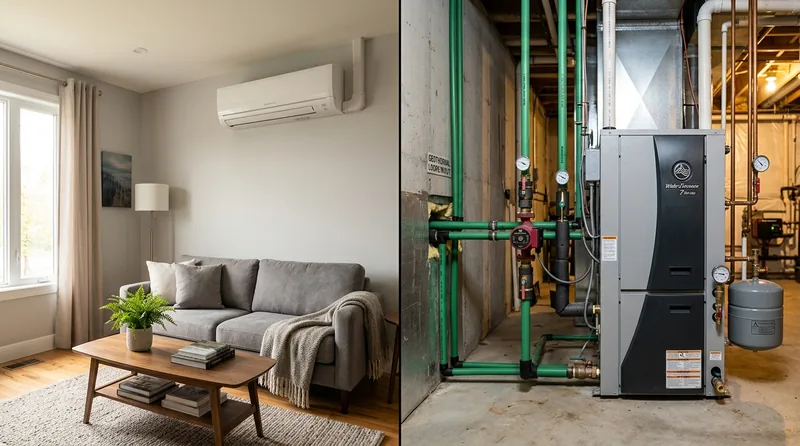
A geothermal system moves heat between your home and the ground through a buried loop of HDPE pipe filled with water and antifreeze. The ground stays 45–65°F year-round regardless of air temperature, giving the heat pump a stable, efficient heat source in winter and heat sink in summer.
The indoor unit connects to your home's ductwork (or a hydronic distribution system for radiant floors). There's no outdoor unit — everything is either underground or inside your mechanical room.
Key advantage: The ground temperature doesn't change. When it's -20°F outside, your geothermal system still pulls heat from 50°F ground. There's no efficiency drop.
Ductless Mini-Splits
A mini-split moves heat between your home and the outdoor air using refrigerant. An outdoor compressor connects to one or more indoor air handlers (wall-mounted, ceiling cassette, or floor-standing) through a small refrigerant line that passes through your wall.
Mini-splits don't need ductwork. Each indoor unit heats and cools a specific zone — a room, an addition, a converted garage.
Key advantage: No ductwork means no 25–30% duct losses, fast installation, and the ability to target specific rooms instead of conditioning the whole house.
Is There a Ductless or Mini-Split Geothermal Heat Pump?
Short answer: yes, and it's a common point of confusion, so let's be precise about it. When people search for a "geothermal mini split" or a "ductless geothermal heat pump," they're usually asking one of two different questions — and the answers aren't the same.
Can a geothermal system heat and cool without ducts? Yes. A geothermal (ground-source) heat pump doesn't have to feed a central duct system. A water-to-water geothermal unit can supply radiant floors, panel radiators, or fan coils, and a water-to-air unit can run compact, zoned air handlers instead of one big central plenum. So "ductless geothermal" — geothermal that reaches your rooms without whole-house ductwork — is real and installed every day.
Is there a wall-mounted "mini-split" that also uses a ground loop? This is where the terms collide. A classic mini-split is an air-source machine: its outdoor unit trades heat with the outdoor air. A geothermal system trades heat with a buried ground loop instead. There are ground-source "console" and multi-zone units that deliver room-by-room comfort much like a mini-split does, but they still need the buried loop — you don't get geothermal's ground-loop efficiency from a standard air-source mini-split hanging on the wall. So a true "mini-split geothermal heat pump" means ground-source equipment configured for zoned, ductless-style distribution, not an air-source mini-split rebranded.
The practical takeaway: if a contractor offers you a "ductless geothermal" option, they mean a ground-source system delivering comfort through hydronic or compact zoned distribution — you keep the buried-loop efficiency and skip the central ductwork. What you can't do is get geothermal's underground heat source out of a wall-mounted air-source mini-split. For the underlying mechanics, see what a ground source heat pump is; for the ductwork question in general, does geothermal work without ductwork.
The Efficiency Gap
This is where the conversation gets interesting — and where most online comparisons get it wrong.
In Mild Weather (30–50°F): Mini-Splits Are Competitive
Modern mini-splits deliver impressive efficiency numbers. A top-tier Mitsubishi or Daikin unit might hit COP 4.0 at 47°F — meaning it produces 4 units of heat for every 1 unit of electricity consumed. That's competitive with geothermal's typical COP of 4.0–4.5 in the same conditions.
At these temperatures, mini-splits and geothermal perform similarly. If you live in a mild climate — think the Pacific Northwest, coastal Carolinas, or the southern Sun Belt — a mini-split might deliver comparable efficiency at a fraction of the installation cost.
In Cold Weather (Below 20°F): Geothermal Pulls Away
Here's where physics works against mini-splits. As outdoor air temperature drops, a mini-split's efficiency drops with it. At 0°F, even the best cold-climate mini-splits (Mitsubishi Hyper-Heat, Fujitsu XLTH) operate at roughly COP 2.0–2.5. Below -10°F, they struggle to maintain capacity and some models switch to electric resistance backup heating at COP 1.0.
Geothermal doesn't care what the air temperature is. The ground loop sits in 45–55°F earth regardless of whether it's a pleasant 50°F day or a brutal -30°F night. COP stays at 3.5–5.0 all winter.
The math matters: In a northern climate where you need 80 million BTU of heating per season, the difference between COP 4.0 (geothermal) and COP 2.0 (mini-split at average winter temps) means the geothermal system uses roughly half the electricity during winter. At 15¢/kWh, that's $1,200–$2,000 per year in energy savings — which adds up fast over a 25-year system life.
In Cooling: Mini-Splits Have an Edge
For cooling-only efficiency, modern mini-splits are hard to beat. Top models achieve SEER2 ratings of 28–42, compared to geothermal's equivalent of 16–25 EER. In cooling-dominant climates (Arizona, Florida, southern Texas), a mini-split will use less electricity for air conditioning.
However, geothermal systems can produce nearly free hot water through a desuperheater — capturing waste heat from the cooling cycle to heat your domestic water. This offsets 60–80% of your water heating bill during cooling season, partially closing the efficiency gap.
Cost Comparison: The Real Numbers
Installation Costs
Mini-split (single zone): $3,000–$5,000 installed. A single outdoor unit with one indoor head. Perfect for a room addition, home office, or supplemental heating.
Mini-split (whole-house, 3–4 zones): $10,000–$25,000 installed. Multiple indoor heads connected to one or two outdoor units. Covers the whole home but requires careful zone planning.
Geothermal: $18,000–$35,000 installed. Includes drilling or trenching for the ground loop, indoor unit, and ductwork connections. The ground loop is the expensive part — vertical drilling typically runs $15–$20 per foot of bore.
After the Federal Tax Credit
This is the part of the comparison that changed, and it changed against geothermal.
- Geothermal: the 30% credit with no cap under IRC §25D applied only to property placed in service through December 31, 2025. It is not available after that date (One Big Beautiful Bill Act, P.L. 119-21). A $30,000 system placed in service in 2025 got a $9,000 credit; the same system finished in 2026 gets nothing federally. Budget the full installed price.
- Air-source heat pumps (including mini-splits): these fall under a separate provision — the §25C Energy Efficient Home Improvement Credit, published at 30% of cost with a $2,000 annual cap. That is a different section of the code from the geothermal credit, and this page does not verify its current status. A $15,000 whole-house mini-split system would top out at $2,000 back under those published terms. Confirm what §25C actually allows for your tax year with a tax professional before counting on it.
The tax credit difference used to favor geothermal heavily on larger installations. With §25D repealed for post-2025 installs, the federal incentive picture no longer works in geothermal's favor at all — geothermal's case now rests on operating cost, equipment life, and whatever your state and utility offer.
15-Year Operating Cost Comparison
Let's model a 2,400 sq ft home in Indianapolis (climate zone 5, ~6,000 HDD, electricity at 14¢/kWh):
| Cost Category | Geothermal | Mini-Split (Whole-House) |
|---|---|---|
| Installation | $28,000 | $18,000 |
| Federal tax credit | $0 — §25D expired for installs placed in service after Dec 31, 2025 | -$2,000 (§25C as published; verify current terms) |
| 2026 out-of-pocket | $28,000 | $16,000 |
| Annual heating cost | $680 | $1,150 |
| Annual cooling cost | $320 | $280 |
| Annual maintenance | $150 | $200 |
| 15-year operating cost | $17,250 | $24,450 |
| 15-year total cost | $45,250 | $40,450 |
| Replacement at year 15 | None (25+ year lifespan) | $18,000 new system |
Note what the repeal does to this comparison. At 2026 out-of-pocket pricing, the geothermal system's 15-year total ($45,250) is roughly $4,800 higher than the whole-house mini-split ($40,450) — the reverse of the old result. For reference, this same job under the expired 30% credit netted $19,600 installed and $36,850 over 15 years, about $3,600 ahead of the mini-split. That version of the math is no longer available.
Geothermal's remaining edge in this scenario is what happens after year 15: the mini-split needs an $18,000 replacement while the geothermal loop has another 35+ years of life and the indoor unit swap costs a fraction of a full system. Push the horizon to 20–25 years and geothermal pulls back ahead — it just no longer wins inside 15.
In a cold climate with expensive electricity (New England, Alaska) or high fuel costs (propane, oil): The geothermal advantage widens. Annual savings of $2,000–$3,000 against propane or oil bring simple payback on the full $28,000 out-of-pocket to roughly 10–14 years — longer than the 7–10 years published under the credit.
In a mild climate with cheap electricity (Southeast, Pacific NW): The mini-split's lower upfront cost wins, and wins more decisively than before. The efficiency gap is small, payback periods for geothermal stretch well past 20 years without the credit, and the mini-split makes better financial sense.
When Geothermal Is the Better Choice
Go geothermal if:
- You're building a new home (ground loop installation during construction cuts costs by 30–50%)
- You're replacing an oil, propane, or electric resistance heating system (high fuel costs = fast payback)
- You live in a cold climate (USDA zones 3–5 with 6,000+ HDD)
- You plan to stay in the home for 10+ years
- Your property has adequate land for trenching or is suitable for vertical drilling
- You want one system for heating, cooling, AND hot water
- You already have ductwork in the home
- You hate the look and sound of outdoor equipment
- Your area has state or utility incentives — with the federal §25D credit repealed for post-2025 installs, these are the only incentives left to work with, and they vary widely by state and utility
The ideal geothermal candidate: A homeowner in Minnesota replacing a propane furnace in a home they plan to own for 15+ years, with existing ductwork and half an acre of yard. At 2026 out-of-pocket pricing with no federal credit, simple payback on that job runs roughly 9–14 years against $2,000–$3,000 in annual propane savings — longer than the 5–8 years published under the credit. Lifetime savings over the system's life still land in the tens of thousands, and state or utility incentives shorten the payback where they exist.
When Mini-Splits Are the Better Choice
Go mini-split if:
- You're adding heating/cooling to a specific room or zone (garage, addition, bonus room)
- Your home doesn't have ductwork and you don't want to install it
- You're on a tight budget and need efficient heating/cooling now
- You live in a mild climate (USDA zones 7–9, under 4,000 HDD)
- You're a renter or might move within 5 years
- You want to supplement an existing system (keep the furnace, add a mini-split for shoulder seasons)
- Your property can't accommodate a ground loop (small urban lot, rocky ground, no yard)
- You're in a cooling-dominant climate where SEER efficiency matters most
The ideal mini-split candidate: A homeowner in Charlotte, NC with a 15-year-old gas furnace who wants to reduce energy bills. A 3-zone mini-split system for $14,000 — $12,000 if the §25C credit applies at its published $2,000 cap, which you should confirm with a tax professional — cuts heating costs by 40% and adds efficient cooling. Payback: 6–8 years against the old system.
The Hybrid Approach: Best of Both Worlds?
Some homeowners install both — and it's not as crazy as it sounds.
Geothermal for base load + mini-split for problem rooms. If your home has ductwork to most rooms but one area (a sunroom, finished attic, or converted garage) doesn't connect to the duct system, a geothermal system handles 90% of the home while a single-zone mini-split covers the outlier.
Mini-split now, geothermal later. If you can't afford geothermal today, install a mini-split system to replace your fossil fuel heating immediately. When it's time for a major renovation or the mini-split reaches end-of-life in 15 years, transition to geothermal with the ground loop as a long-term investment.
This phased approach works especially well for new homeowners who plan to stay put but need to manage cash flow.
Common Misconceptions
"Mini-splits are more efficient than geothermal"
This is true only in mild weather and only for cooling. In heating mode — which is where most of your energy dollars go in cold climates — geothermal is significantly more efficient because it pulls heat from stable ground temperatures rather than cold outdoor air.
"Geothermal is overkill for most homes"
It depends entirely on your fuel costs and climate. In a mild-climate home with cheap natural gas, yes — geothermal is probably more system than you need. But if you're heating with propane at $3.50/gallon, oil at $4.00/gallon, or electric resistance, geothermal's economics are compelling.
"Mini-splits can't handle cold climates"
Modern cold-climate mini-splits (Mitsubishi Hyper-Heat, Fujitsu XLTH, Bosch Climate 5000) can operate down to -13°F to -22°F. They absolutely work in cold climates — they just work less efficiently than in mild weather. Whether that efficiency penalty matters depends on how many hours you spend below 10°F and what electricity costs in your area.
"Geothermal requires a huge yard"
With vertical vs. horizontal loop options, vertical loop systems need as little as a 10x10 foot area per bore. Even urban homes with small yards can accommodate geothermal if vertical drilling is feasible. Horizontal loops do need more space — typically 1,500–3,000 sq ft of open ground per ton of capacity.
Environmental Comparison
Both systems reduce carbon emissions compared to fossil fuel heating, but the degree depends on your local electricity grid.
| Factor | Geothermal | Mini-Split |
|---|---|---|
| Direct emissions | Zero | Zero |
| Electricity use (heating) | Lower (COP 3.5–5.0) | Higher in cold (COP 1.5–4.0 depending on temp) |
| Refrigerant | Water-based loop (R-410A in indoor unit) | R-410A or R-32 in exposed outdoor lines |
| Refrigerant leak risk | Low (mostly sealed indoor) | Higher (outdoor unit + long line sets) |
| Land impact | Buried loop (invisible after install) | Outdoor unit on pad |
| Lifespan waste | Less frequent replacement | Unit replacement every 15–20 years |
For grid-connected homes, the carbon footprint difference comes down to how much electricity each system uses. In cold climates, geothermal's consistent COP advantage means 30–50% less electricity consumption for heating — which translates directly to lower emissions regardless of your grid mix.
Frequently Asked Questions
Can I use a mini-split as my only heating system?
Yes, if you choose a cold-climate rated model and size it correctly. Whole-house mini-split systems with 3–5 indoor heads can handle entire homes. However, in climates with sustained temperatures below 0°F, you may want a backup heating source for the coldest days when mini-split capacity drops significantly.
Does geothermal work without ductwork?
Yes. Geothermal heat pumps can connect to hydronic distribution systems (radiant floor heating, fan coil units) or even dedicated mini-split-style air handlers. However, the most cost-effective installation uses existing ductwork. Adding ductwork to a home that doesn't have it can add $5,000–$15,000 (see our new construction guide for planning ahead) to the project.
Which system qualifies for better tax credits?
Geothermal used to win here, and no longer does. The 30% uncapped credit for geothermal under IRC §25D applied only to property placed in service through December 31, 2025 and is not available after that date (One Big Beautiful Bill Act, P.L. 119-21) — a $30,000 geothermal system placed in service in 2026 gets no federal credit at all. Mini-splits fall under a separate provision, §25C, published at 30% of cost up to a $2,000 annual cap; that is a different section of the code and you should confirm its current terms with a tax professional. State and utility programs are now the main incentives available for geothermal — see your state guide.
How loud are mini-splits compared to geothermal?
Indoor noise levels are similar — both are very quiet (20–35 dB). The difference is outdoors: mini-splits have a compressor unit that produces 40–60 dB of noise (similar to a quiet conversation), while geothermal has no outdoor unit at all. If outdoor noise matters — near a bedroom window, on a small lot with close neighbors — geothermal has a clear advantage.
Can I install a mini-split myself?
Some mini-split brands (e.g., MrCool DIY) offer pre-charged line sets designed for DIY installation. Geothermal always requires professional installation due to the ground loop drilling and system complexity. However, DIY mini-split installations may void warranties and may not qualify for the §25C credit, which carries its own installation and certification requirements — check the current rules with a tax professional before assuming a self-install qualifies.
Which system adds more home value?
Geothermal typically adds more resale value because it's a permanent infrastructure improvement. The ground loop lasts 50+ years and represents a significant investment. Studies suggest geothermal systems add $10,000–$25,000 to home value. Mini-splits add modest value but are not typically appraised as a major home improvement.
What about maintenance costs?
Geothermal systems require less maintenance — primarily annual filter changes and periodic loop pressure checks. The sealed ground loop has no moving parts. Mini-splits need annual filter cleaning, periodic coil cleaning, and refrigerant level checks. Outdoor units are exposed to weather, debris, and potential damage. Over 25 years, geothermal maintenance costs run roughly $3,000–$4,000 total versus $5,000–$7,000 for mini-splits.
Do either system work with solar panels?
Both pair excellently with solar. Since both run on electricity, solar panels directly offset their operating costs. Geothermal uses more electricity during winter heating (when solar production is lowest), while mini-splits' variable efficiency means they might need more electricity during winter than their ratings suggest. In either case, a properly sized solar array can offset 60–100% of the heat pump's electricity consumption.
Which system is better for allergies?
Geothermal connected to ductwork can use high-MERV filters (MERV 13+) that capture allergens, dust, and fine particles. Mini-splits typically use basic washable filters (MERV 1–4) that catch large particles but not fine allergens. Some mini-split models offer optional plasma or ionizer filtration, but they generally can't match the filtration capability of a ducted system.
What happens during a power outage?
Neither system works without electricity. Both require a generator or battery backup for heating/cooling during outages. Mini-splits have an advantage here — a single zone can run on a small portable generator (1,500–2,000 watts), while a geothermal system with its loop pump needs a larger generator (3,000–5,000 watts). For homes with battery storage (Tesla Powerwall, etc.), a mini-split's lower draw makes it easier to keep running.
Ready to explore costs for your state? Check our state-by-state geothermal guides for local incentives, installer info, and payback estimates.
The Bottom Line
Don't let anyone tell you one system is universally "better" than the other. They solve different problems at different price points.
Choose geothermal when you want the lowest possible long-term heating and cooling costs, plan to stay in your home well past a decade, and can absorb the higher upfront investment — which in 2026 means the full sticker price, since the 30% federal §25D credit expired for property placed in service after December 31, 2025. It's still the better choice for cold climates, homes with existing ductwork, and anyone replacing expensive fuel (oil, propane, electric resistance); the payback is simply longer than it was.
Choose mini-splits when you need flexible, efficient heating and cooling without ductwork, want a lower entry price, or are conditioning specific zones rather than the whole house. They're the better choice for mild climates, room additions, retrofit situations, and budget-conscious homeowners.
Choose both when your home has a mix of ducted and non-ducted spaces, or when you want to phase your investment over time.
Either way, you're moving away from fossil fuels and toward lower energy bills. That's a win regardless of which heat pump technology you pick.
The one thing to take away
There is no ductless geothermal mini-split. A mini-split exchanges heat with outdoor air through a wall-mounted head; a geothermal heat pump exchanges heat with the ground through a buried loop. Once §25D expired, the 15-year cost comparison in the modelled case above flipped to the mini-split by about $4,800 — geothermal's remaining argument is what happens after year 15, when the mini-split needs replacing and the ground loop does not.
Sources
- U.S. Department of Energy — Geothermal Heat Pumps. Verbatim: "Temperatures at about 30 feet below the surface remain relatively constant year-round—between about 50°F (10°C) and 59°F (15°C)", and geothermal systems "have been shown to be quieter, last longer, and require less maintenance" than air-source systems. Verified September 2, 2026 (HTTP 200).
- ENERGY STAR — Ductless Heating & Cooling. Verbatim: "ENERGY STAR certified mini splits use up to 60% less energy than standard home electric radiators." Verified September 2, 2026 (HTTP 200).
- Internal Revenue Service — Residential Clean Energy Credit (§25D), the provision that covered geothermal. Verified September 2, 2026 (HTTP 200).
- Internal Revenue Service — Energy Efficient Home Improvement Credit (§25C), the separate provision under which air-source heat pumps and mini-splits are claimed. Verified September 2, 2026 (HTTP 200).
- Public Law 119-21 (One Big Beautiful Bill Act, 2025) — termination of §25D for property placed in service after December 31, 2025. See our federal geothermal tax credit guide.
- AHRI Directory of Certified Product Performance — where a specific model's rated efficiency can be looked up. Verified September 2, 2026 (HTTP 200).
Two citations withdrawn. This page previously cited two U.S. Department of Energy Energy Saver pages, on ductless mini-splits and on geothermal heat pumps. Both now return HTTP 404, as does every other energy.gov/energysaver/ address tested on September 2, 2026 — the section appears to have been retired rather than individual pages moved. The geothermal document has an equivalent live at energy.gov/hgeo/, cited above. No live replacement for the mini-split page was located, so it has been removed rather than swapped for a guess.
What is and is not sourced here. The ground temperature range, the ENERGY STAR savings figure and the tax-credit provisions are sourced above. The COP, SEER2 and EER ranges, the dollar figures for equipment and installation, and the modelled 15-year scenario are market estimates and worked examples built from the stated assumptions — the arithmetic in the 15-year table is internally consistent at 14¢/kWh, but the inputs are estimates, not government figures. Check them against your own quotes and your own electricity rate.