
In This Guide
- Who Should (and Shouldn't) Go Geothermal
- Costs by Region
- Iowa at a Glance
- Incentives and Tax Credits
- Case Studies
- Month-by-Month Energy Profile
- The Honest Economics: Four Markets
- The Farm REAP Opportunity
- Iowa's Geology: The Flattest Loop Terrain in America
- Open-Loop System Assessment by Region
- Loop Type Cost Comparison
- Solar + Geothermal Stacking
- Vacation Rental and Tourism Properties
- How to Claim the Federal Tax Credit
- Iowa vs. Neighboring States
- Finding an Iowa Geothermal Installer
- Frequently Asked Questions
- Sources
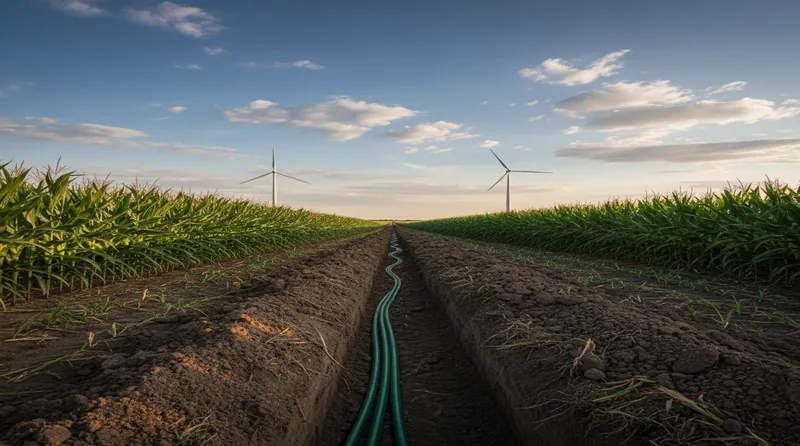
Most states in the country run geothermal heat pumps on a grid still heavily weighted toward fossil fuels. Coal, natural gas, and sometimes oil — the electricity powering those systems carries a real carbon cost. Iowa is different. Profoundly different.
Iowa generates more than 60% of its electricity from wind — the highest share of any state in the nation, surpassing even Texas in percentage terms. A geothermal heat pump running on Iowa's grid is one of the lowest-carbon heating systems you can install anywhere in America. And that wind share keeps growing, which means a system installed today gets progressively cleaner every year without any modifications.
Then there's the terrain. Iowa may have the easiest horizontal loop installation conditions in the entire country. Deep glacial till — 50 to 200+ feet of soft, workable soil — with virtually no rock, spread across the flattest landscape this side of Kansas. An excavator that would struggle for days in granite country can finish an entire loop field in a day here. That translates directly to installation costs 15–25% below the national average.
But here's where Iowa's story gets complicated, and where this guide diverges from every other Iowa geothermal article you'll find. Iowa's electricity rate is 9.34¢/kWh — the 6th cheapest in the nation. Cheap electricity is great for running a heat pump. But cheap electricity also means cheap conventional heating, which compresses the savings gap between geothermal and gas. For existing gas homes, the payback now stretches past 35 years — and with the 30% federal §25D credit unavailable for property placed in service after December 31, 2025 (One Big Beautiful Bill Act, P.L. 119-21), well past 50. That's not an investment; that's a loss. We'll say that plainly.
The real Iowa geothermal story has three chapters, and the federal repeal changed the numbers in all three: farm operations using REAP grants, which still land in the 4–8 year range; rural propane homes making a solid but not spectacular case at 10–17 years; and the honest acknowledgment that existing gas homes in Des Moines don't pencil out at all. This guide covers all three with real 2026 numbers.
Who Should (and Shouldn't) Go Geothermal in Iowa
| Situation | Typical Payback | Verdict |
|---|---|---|
| Farm operation (REAP 50%; federal 25D credit expired) | 4–8 years | ✅ Still the best case in the state — REAP was not repealed |
| Rural propane home + horizontal loop | 10–17 years | ✅ Solid — propane volatility adds value |
| New construction (any fuel area) | Longer than the 6–10 years incremental published under the credit | ✅ Good — specify at design stage |
| Electric resistance heat (rural/older home) | 11–17 years | ✅ Good — 60–65% energy reduction |
| Vacation rental (Iowa Great Lakes, Amana) | Longer than the 6–10 years published under the credit | ✅ Good — 12-month revenue, premium positioning |
| Aging heat pump replacement | Longer than the 10–14 years published under the credit | ⚠️ Moderate — compare incremental cost carefully |
| Des Moines / Cedar Rapids gas (existing) | Well over 50 years | ❌ Not financially viable — carbon benefit only |
| Iowa City gas (existing, academic market) | Well over 45 years | ❌ Same math — new construction is the path |
Payback figures reflect 2026 conditions with no federal tax credit. The 30% credit under IRC §25D applied to systems placed in service through December 31, 2025 and is not available for property placed in service after that date (One Big Beautiful Bill Act, P.L. 119-21). Earlier versions of this table showed shorter paybacks because they netted out that credit — and Iowa has no state geothermal credit to substitute. USDA REAP was not repealed. Rows carried over from the credit era are noted as such.
The pattern is stark: Iowa's cheap electricity makes geothermal operations inexpensive, but it also makes the alternatives inexpensive. The cases that work are the ones where you're replacing something expensive (propane, electric resistance), getting massive incentives (REAP), or avoiding the full system cost (new construction). Gas retrofits don't work here. That's not pessimism; that's arithmetic.
Installation Costs by Region
Iowa's flat terrain and deep glacial till create a cost advantage across the entire state. Horizontal loops are practical on 95%+ of Iowa properties, and they cost 30–40% less than vertical boreholes. Regional variation is smaller here than in most states — there's no mountainous region driving up costs — but metro vs. rural differences and installer availability still create meaningful price gaps.
| Region | Horizontal (3-ton) | Vertical (3-ton) | 2026 Out-of-Pocket (horizontal) | Key Factor |
|---|---|---|---|---|
| Des Moines Metro (Polk, Dallas, Warren) | $20,000–$28,000 | $30,000–$42,000 | $20,000–$28,000 | Most competitive bidding; suburban lot constraints may push toward vertical |
| Cedar Rapids / Iowa City (Linn, Johnson) | $19,000–$26,000 | $28,000–$38,000 | $19,000–$26,000 | Active market; university-driven demand supports installer base |
| Northern Iowa (Dubuque, Mason City, Waterloo) | $18,000–$25,000 | $27,000–$36,000 | $18,000–$25,000 | Colder climate (7,500 HDD) may size system larger; excellent glacial till |
| Western Iowa / Sioux City (Woodbury, Plymouth) | $18,000–$24,000 | $27,000–$35,000 | $18,000–$24,000 | Loess Hills silty deposits; fewer installers = less competition |
| Rural Central / Southern Iowa (farm country) | $16,000–$22,000 | $25,000–$34,000 | $16,000–$22,000 | Lowest costs in state — flat land, easy access, minimal site prep |
Out-of-pocket equals gross cost in 2026: Iowa has no state geothermal credit, and the 30% federal §25D credit applied only to property placed in service through December 31, 2025 (One Big Beautiful Bill Act, P.L. 119-21). For reference, these same horizontal jobs netted $11,200–$19,600 under the old credit. USDA REAP still applies to eligible farms and rural businesses.
The standout: rural central Iowa sees some of the lowest installed geothermal costs in the entire Midwest. Flat fields, deep soft soil, easy equipment access, and no rock at any reasonable depth. A 3-ton horizontal system at $16,000 — that's hard to beat anywhere east of the Rockies, and with no federal credit anywhere in the country now, that low gross cost matters more than it used to.
Iowa at a Glance
| Metric | Iowa Figure | Context |
|---|---|---|
| Residential electricity rate | 9.34¢/kWh | Rank 45 — among cheapest in the US |
| Grid carbon intensity | 699 lbs CO₂/MWh | Rank 29 — declining rapidly with wind buildout |
| Wind generation share | >60% | #1 in the US by percentage |
| Des Moines HDD | ~6,800 | Meaningful heating load |
| Cedar Rapids HDD | ~7,100 | Above-average heating demand |
| Dubuque HDD | ~7,500 | One of the colder Iowa markets |
| Cooling degree days (Des Moines) | ~800 CDD | Moderate but real cooling load |
| Ground temperature | 50–54°F | Stable, suitable for heat exchange year-round |
| Primary utilities | MidAmerican Energy, Alliant Energy/IPL | Plus 38 rural electric co-ops |
| State geothermal credit | None | Federal §25D credit expired Dec 31, 2025; USDA REAP for ag still applies |
What 9.34¢/kWh Means — In Both Directions
Iowa's electricity rate of 9.34¢/kWh is one of the cheapest in the country. This is primarily a function of the state's massive wind fleet — inexpensive fuel (wind is free) producing inexpensive power. For consumers and businesses, this is largely good news. But for the financial case for geothermal, it cuts both ways.
The good news: Running a geothermal heat pump in Iowa is cheap. Operating costs per unit of heat are low. For large systems — farm operations, commercial buildings, manufacturing facilities — this means geothermal can deliver meaningful cost savings even in a low-energy-cost environment.
The honest news: Cheap electricity also means cheaper resistance heating, cheaper heat pumps of all types, and — most critically — it shrinks the operating cost advantage of geothermal over natural gas. Iowa's natural gas prices are also competitive. A gas furnace running on cheap Iowa gas doesn't cost nearly as much to operate as a gas furnace in, say, New England or the Pacific Northwest. That compresses the annual savings from switching to geothermal, which directly lengthens the payback period.
This is not a reason to dismiss geothermal. It's a reason to be precise about who the right candidates are — and Iowa has some very strong candidates, as we'll see. But it does mean this guide will not sugarcoat scenarios where the math doesn't work.
Utilities and Service Territory
MidAmerican Energy serves central and eastern Iowa, including Des Moines and Cedar Rapids. It is one of the largest utilities in the state and operates substantial efficiency incentive programs. Geothermal-specific rebates were not confirmed at time of publication — contact MidAmerican directly or check DSIRE Iowa for current offerings.
Alliant Energy / Iowa Power and Light (IPL) serves southern and eastern Iowa. Similarly, the utility operates efficiency programs; specific geothermal rebate amounts should be verified before relying on them in financial projections.
Rural electric cooperatives — 38 of them statewide — serve the bulk of Iowa's rural geography. Co-op rates vary, and some offer their own efficiency incentive programs separate from the investor-owned utilities. If you're in co-op territory, contact your co-op directly; they often have more flexibility than large utilities and sometimes offer favorable financing for efficiency upgrades.
Iowa Geothermal Incentives and Rebates
Federal Section 25D Tax Credit — Expired ❌
The federal residential clean energy credit under Section 25D of the Internal Revenue Code was, until recently, the largest financial incentive available to most Iowa homeowners. It covered 30% of the total installed cost of a qualified geothermal heat pump system, with no dollar cap, applied to the full system cost including equipment, labor, and ground loop installation.
It applied to systems placed in service through December 31, 2025 and is not available for property placed in service after that date (One Big Beautiful Bill Act, P.L. 119-21). The Inflation Reduction Act had scheduled 30% through 2032 with step-downs in 2033 and 2034; that schedule was repealed before it ever took effect.
Key details for anyone with a pre-2026 installation:
- The credit applies to systems placed in service on or before December 31, 2025 — a $40,000 system generated a $12,000 credit
- Credit is non-refundable but carries forward if your tax liability was insufficient to absorb it in year one; that carryforward is unaffected by the repeal
- System had to meet ENERGY STAR requirements — virtually all modern geothermal heat pumps qualified
- Applied to primary residences and second homes (not rental properties under 25D; commercial entities use the separate Section 48 credit, which is a different provision)
For a 2026 Iowa installation, there is no federal credit and no state geothermal credit — the quoted price is the price, unless you qualify for USDA REAP. Verified July 2026 against IRS.gov. For full details, see our federal geothermal tax credit guide.
USDA REAP — For Agricultural Producers and Rural Businesses
As detailed in the Farm REAP section below, USDA REAP is now the geothermal incentive in Iowa — it is the only substantial one left. Grants up to 50% of eligible costs for qualifying agricultural and rural business applicants. REAP was not affected by the federal 25D repeal, but the 30% credit it used to stack with is not available for property placed in service after December 31, 2025, so a qualifying operation now reduces its out-of-pocket cost to roughly 50–75% of gross rather than the 20–35% the combined stack produced.
Contact the USDA Iowa Rural Development office to begin the pre-application process. Deadlines vary; apply well in advance of project timelines.
Iowa Property Tax Exemption
Iowa offers a property tax exemption for renewable energy installations, which can include geothermal systems. The assessed value added by the geothermal system may be exempt from property taxes for a period of years. Verify current terms with your county assessor, as application requirements and exemption periods can vary by county.
MidAmerican Energy — Rebates (unverified)
MidAmerican Energy operates energy efficiency programs and has historically offered rebates for high-efficiency HVAC equipment. Specific geothermal heat pump rebate amounts were not confirmed at time of publication. Contact MidAmerican Energy directly at 1-888-427-5632 or visit midamericanenergy.com/savings for current program details.
Alliant Energy / IPL — Rebates (unverified)
Alliant Energy/Iowa Power and Light similarly operates efficiency incentive programs for Iowa customers. Specific geothermal figures were not confirmed at time of publication. Contact Alliant Energy at 1-800-255-4268 or visit alliantenergy.com/save for current rebate availability. Rural electric co-op customers should contact their specific co-op.
DSIRE Iowa — The Authoritative Incentive Database
For a comprehensive, current listing of all state and utility incentives available in Iowa, the Database of State Incentives for Renewables & Efficiency (DSIRE) at dsireusa.org is the authoritative source. Filter by Iowa and by technology type (geothermal).
See What Incentives Apply to Your Project
Iowa installers can run incentive calculations specific to your situation — utility territory, property type, system size — so you know your actual net cost before signing anything.
Get 3 Free QuotesFree · No obligation · Takes 2 minutes
About the examples below
The homes in these examples are representative scenarios, not real customers. We do not install geothermal systems and we have not visited these properties. Each scenario models a typical home for the area using real equipment pricing, local fuel and electricity rates, and the incentive programs described above — but the house, the owner and the invoice are constructed to show how the arithmetic works. Treat them as worked examples, and get quotes for your own home before budgeting.
Case Studies
Case Study 1: Decorah Propane Farmhouse — 11.5-Year Payback in 2026
The property: A 2,400 sq ft two-story farmhouse in Winneshiek County, built 1987. Previously heated with a propane furnace (88% AFUE) consuming approximately 1,100 gallons per year at $2.85/gallon average. Window AC units for cooling. Annual heating cost: ~$3,135. Annual cooling: ~$320 (window units). Total HVAC: ~$3,455.
The system: 4-ton WaterFurnace 7 Series (COP 4.0 heating / EER 20.1 cooling), horizontal slinky loop in 6-foot trenches. Total installed: $24,800. Iowa's deep glacial till meant the excavation crew finished the entire loop field in a single day — no rock, no complications, no surprises.
| Gross installed cost | $24,800 |
| Federal 30% tax credit (Section 25D) | $0 — expired for installs placed in service after Dec 31, 2025 (it was worth $7,440 on this job through 2025) |
| 2026 out-of-pocket | $24,800 (this same job netted $17,360 under the old credit) |
| Annual geothermal operating cost (heating + cooling) | $1,290 |
| Annual savings vs. propane + window AC | $2,165 |
| Simple payback (out-of-pocket ÷ annual savings) | 11.5 years (was 8.0 years when the 30% federal credit applied) |
The math: Heating load ~55 million BTU/yr. At COP 4.0 and 9.34¢/kWh: 55M BTU ÷ 3,412 BTU/kWh ÷ 4.0 COP × $0.0934 = ~$376/month heating season (5 months heavy, 2 shoulder). Annual heating electricity: ~$970. Cooling at EER 20.1 runs roughly $320/yr. Total geo operating: $1,290 vs. old $3,455. Net savings: $2,165/yr.
What the numbers miss: Propane hit $3.60/gallon during the January 2024 cold snap. At that price, annual heating alone exceeds $3,960 — pushing payback to roughly 8.3 years. Propane price volatility is the hidden variable that payback calculations based on averages don't capture. Over a 25-year system life, even one or two severe price spikes dramatically improve the actual return.
Case Study 2: Ames New Construction — 12.6-Year Incremental Payback in 2026
The property: A 2,100 sq ft new-construction ranch in Story County, part of a 2025 subdivision near Iowa State University. Builder offered geothermal as an upgrade option over the standard 96% AFUE gas furnace + 16 SEER2 AC system.
The system: 3-ton ClimateMaster Tranquility 30 (COP 3.8 / EER 19.5), horizontal closed loop. Total installed cost including loop: $22,500. Standard HVAC package the builder would have installed: $12,800. Incremental cost of choosing geothermal: $9,700.
| Geothermal installed cost | $22,500 |
| Standard HVAC alternative | $12,800 |
| Incremental cost | $9,700 |
| Federal 30% credit (Section 25D) | $0 — expired for installs placed in service after Dec 31, 2025 (it was worth $6,750 on this job through 2025) |
| 2026 incremental cost | $9,700 (the credit brought this to $2,950 through 2025) |
| Annual gas furnace + AC cost (estimated) | $1,680 |
| Annual geothermal operating cost | $910 |
| Annual savings | $770 |
| Incremental payback | 12.6 years (was 3.8 years when the 30% federal credit applied) |
Why new construction still matters — and what the repeal cost it: Through 2025, the 30% federal credit applied to the full geothermal system cost ($22,500), not just the incremental amount. That returned $6,750 on a $9,700 upcharge, cutting the real upgrade cost to under $3,000 and producing a sub-4-year break-even. The credit is not available for property placed in service after December 31, 2025 (One Big Beautiful Bill Act, P.L. 119-21), so the upcharge is now the full $9,700 and break-even runs about 12.6 years on a system that lasts 25. New construction is still Iowa's best non-farm case, because the incremental cost is the only cost that matters — but the leverage that made it exceptional came from the credit, and that leverage is gone.
The catch: This only works when the builder offers it as a true upgrade at construction time. Retrofitting geothermal into a finished home — even a new one — costs the full installed price, not the incremental amount. If you're planning to build in Iowa, specify geothermal before the foundation is poured.
Month-by-Month Energy Profile
This table shows estimated monthly geothermal operating costs for a typical 2,200 sq ft Iowa home with a 3.5-ton system (COP 3.8 heating, EER 19 cooling), compared against the gas furnace + AC system it replaces. Based on Des Moines climate data (6,800 HDD / 800 CDD).
| Month | Mode | Geo kWh | Geo Cost | Gas + AC Cost | Monthly Savings |
|---|---|---|---|---|---|
| January | Heat | 1,580 | $148 | $235 | $87 |
| February | Heat | 1,380 | $129 | $205 | $76 |
| March | Heat | 1,050 | $98 | $155 | $57 |
| April | Shoulder | 520 | $49 | $72 | $23 |
| May | Cool | 380 | $36 | $58 | $22 |
| June | Cool | 650 | $61 | $95 | $34 |
| July | Cool | 820 | $77 | $118 | $41 |
| August | Cool | 750 | $70 | $108 | $38 |
| September | Shoulder | 340 | $32 | $52 | $20 |
| October | Heat | 680 | $64 | $98 | $34 |
| November | Heat | 1,120 | $105 | $162 | $57 |
| December | Heat | 1,480 | $138 | $210 | $72 |
| Annual | 10,750 | $1,004 | $1,568 | $564 |
Annual savings of $564 against a gas system — this is the honest number for an existing Des Moines gas home. At a 2026 out-of-pocket cost of $24,000–$28,000 (the full gross price, since the 30% federal §25D credit is not available for property placed in service after December 31, 2025), you're looking at a 43–50 year payback. It was 30–35 years when the credit applied. The monthly profile makes it clear: the savings exist, but they're modest month by month because Iowa gas is cheap and Iowa electricity, while cheap, still costs something to run a heat pump.
Compare this to a propane home in northern Iowa where annual heating alone runs $2,800–$3,500. The monthly savings table would show $150–$200/month savings in winter — a completely different financial picture.
The Honest Economics: Who Should (and Shouldn't) Go Geothermal in Iowa
There are four primary market segments in Iowa, and they have dramatically different economics. The right answer for a 500-acre corn operation is very different from the right answer for a Des Moines homeowner with a working furnace.
| Scenario | Gross System Cost | 2026 Out-of-Pocket | Annual Savings | Payback Period | Verdict |
|---|---|---|---|---|---|
| Farm operation (REAP only — federal 25D expired) | $60,000+ | ~50% of installed cost | $3,000–$8,000/yr | 4–8 years | ✅ Still the strongest case in Iowa |
| Rural home replacing propane | $18,000–$28,000 | $18,000–$28,000 | $1,200–$2,200/yr | 10–17 years | ✅ Reasonable case |
| New construction (incremental cost) | $8,000–$12,000 incremental | $8,500–$12,500 | $700–$1,200/yr | 11–16 years | ✅ Good fit |
| Existing home on natural gas | $24,000–$40,000 | $24,000–$40,000 | $400–$800/yr | 43–70+ years | ⚠️ Not financially viable |
Scenario 1: Farm Operations — Iowa's Best Case
Iowa farms are still the highest-value geothermal opportunity in the state. If you operate a grain farm, hog or dairy confinement, or rural agribusiness, read the Farm REAP section carefully. A USDA REAP grant alone can cut your out-of-pocket cost to roughly 50 cents on the dollar, which makes even large systems pay back in 4–8 years. Through 2025 the federal §25D credit stacked on top and took that to about 35 cents on the dollar with a 2–5 year payback; that credit is not available for property placed in service after December 31, 2025 (One Big Beautiful Bill Act, P.L. 119-21). REAP was not repealed.
Scenario 2: Rural Propane Replacement
For Iowa homeowners heating with propane — most common in rural areas not served by natural gas pipelines — geothermal makes a solid financial case. Propane is expensive relative to electricity, especially in a low-electricity-rate state like Iowa. The math is meaningful but not dramatic: you're looking at a 10–17 year payback in 2026. That's longer than some states where propane is the norm, primarily because Iowa's electricity rate is so low that even propane doesn't look terrible in comparison — and because the 30% federal §25D credit that used to bring this to 7–12 years is not available for property placed in service after December 31, 2025. But factor in propane price volatility — $2.50 one winter, $3.60 the next — and geothermal's fixed operating cost becomes increasingly attractive over the system's 25-year life.
For a detailed side-by-side analysis, see our geothermal vs. propane comparison.
Scenario 3: New Construction
Building new in Des Moines, Iowa City, Ames, or anywhere in the state? Geothermal is still one of the stronger choices you can make at the design stage, because the incremental cost — geothermal over a standard gas or electric system — is substantially lower than the full replacement cost in a retrofit. That incremental cost now runs roughly $8,500–$12,500 rather than the $2,600–$5,400 net figure that applied through 2025, because the 30% federal §25D credit is not available for property placed in service after December 31, 2025. Expect a payback in the 11–16 year range on a system with a 25-year lifespan.
The college markets (Iowa City, Ames) and Des Moines metro are all seeing strong new construction activity. Geothermal contractors in these markets are experienced and competitive.
Scenario 4: Existing Natural Gas Home — Be Honest
This is where many Iowa residents need to hear something they won't find in most guides: replacing a working gas furnace with geothermal in Iowa is not a financially sound decision for most households.
Here's the arithmetic. Iowa's average residential natural gas price is roughly $8–$10 per MMBtu. A 2,000 sq ft home with a 90% AFUE gas furnace in Des Moines might spend $900–$1,400/year on heating. Switch to geothermal at a COP of 3.5–4.5 running on 9.34¢/kWh electricity, and you might spend $600–$900/year — a savings of $400–$800 annually. Against a 2026 out-of-pocket cost of $24,000–$40,000 (the full gross price — the 30% federal §25D credit is not available for property placed in service after December 31, 2025), that implies a payback of 43–70+ years. A geothermal system has a 25-year lifespan. It was 25–40 years when the credit applied, which was already longer than the equipment lasts.
I'm not going to pretend that's an investment. Under the old credit it was roughly cost-neutral over the life of the equipment; without it, you now lose money on the swap in pure operating-cost terms. If your motivation is carbon reduction, that's a different conversation and a valid one (Iowa's grid is genuinely clean). But if you're expecting geothermal to save you money on an existing gas home in Iowa, the numbers don't support it.
For a full analysis of this comparison, see geothermal vs. natural gas.
Find Iowa Geothermal Installers
Connect with certified Iowa geothermal installers. Compare estimates side-by-side and understand your actual payback before committing.
Get 3 Free QuotesFree · No obligation · Takes 2 minutes
The Farm REAP Opportunity: Dollar-by-Dollar Math
Iowa is the #1 corn-producing state in the nation. It leads the country in pork production. Its rural economy is defined by energy-intensive agricultural operations: grain drying facilities, hog confinement buildings, dairy operations, food processing plants, grain elevators. These facilities run on significant energy loads — and that's precisely what makes them extraordinary candidates for USDA REAP funding.
What Is REAP?
The USDA Rural Energy for America Program (REAP) provides grants and loan guarantees to agricultural producers and rural small businesses for renewable energy systems and energy efficiency improvements. For geothermal heat pumps specifically, REAP grants can cover up to 50% of eligible project costs, with no requirement to repay the grant portion.
Iowa consistently ranks as one of the top REAP-recipient states in the country, for the obvious reason that its farm economy is massive. The program is funded through the Farm Bill and has been reauthorized with increased funding under the Inflation Reduction Act. Applications are reviewed on a competitive basis — working with an experienced grant writer familiar with REAP applications is highly recommended.
The REAP Strategy — and What the Federal Repeal Took Off the Table
Iowa farm geothermal is still the strongest case in the state, but it is no longer exceptional in the way it was. Agricultural producers and rural small businesses used to stack REAP grants with the federal Section 25D credit. That credit is not available for property placed in service after December 31, 2025 (One Big Beautiful Bill Act, P.L. 119-21). REAP itself was not repealed and still does the bulk of the work. A farm operating as a business may separately qualify for the Section 48 commercial credit — a different provision — so consult a tax professional about which applies to which structure on your operation.
Representative Farm System: Line-Item Calculation
| Installed system cost (commercial grain/hog facility) | $60,000 |
| USDA REAP grant (50% of eligible costs) | − $30,000 |
| Federal Section 25D credit | $0 — expired for property placed in service after Dec 31, 2025 |
| 2026 out-of-pocket cost | $30,000 |
| Effective subsidy rate | 50% of installed cost (grant only — a REAP loan guarantee is repayable financing, not a subsidy, and is not counted here) |
| Out-of-pocket as % of gross | ~50% |
Under the pre-2026 rules the federal credit added $9,000 on top of the REAP grant — calculated on the full $60,000 installed cost, not the post-REAP remainder — bringing net out-of-pocket to $21,000, a 65% effective subsidy. That federal component is gone for property placed in service after December 31, 2025. Consult a tax professional about whether the separate Section 48 commercial credit applies to your entity type.
Annual Savings and Payback
| Annual heating/cooling cost savings (grain drying, confinement climate control) | $3,000–$8,000/year |
| 2026 investment | $30,000 |
| Simple payback (conservative end) | ~10 years ($3,000 savings) |
| Simple payback (favorable end) | ~3.8 years ($8,000 savings) |
| Typical payback range | 4–8 years (it was 2–5 years when the federal credit stacked on top) |
A 4–8 year payback on a 25-year system is still strong by any standard — Iowa solar installations typically run 8–12 years. The combination of a large energy load, a REAP grant that survived the federal repeal, and Iowa's flat terrain driving low installation costs keeps farm geothermal among the best capital investments available to Iowa agricultural operators. It is simply no longer the 2–5 year outlier it was through 2025.
Who Qualifies for REAP?
To qualify as an agricultural producer under REAP, at least 50% of your gross income must come from agricultural operations. Rural small businesses — defined as businesses in areas with populations under 50,000 — also qualify, which includes many Iowa agribusinesses, rural contractors, and processing operations.
Key requirements:
- Project must be located in an eligible rural area (most of Iowa qualifies)
- System must meet USDA technical requirements and efficiency standards
- Applications are competitive and reviewed quarterly — apply early
- Projects must be complete within the award period
- Prevailing wage and apprenticeship requirements may apply for larger projects under IRA provisions
The USDA Iowa Rural Development office in Des Moines administers REAP applications for the state. Working with an energy consultant familiar with REAP documentation requirements can significantly improve your application's competitiveness.
Beyond the Numbers: Energy Security for Iowa Farms
There's an argument beyond the financial one. Iowa farms face propane price spikes every winter. Hog confinement operations that lose heat during a propane delivery disruption face serious animal welfare consequences. Geothermal systems running on grid electricity have none of these supply chain vulnerabilities — the fuel is delivered by wire, 24/7, at a fixed rate. For operations where temperature control is critical, this reliability has real value that doesn't show up in a payback calculation.
Iowa's Geology: The Flattest Loop Terrain in America
If you want to understand why Iowa is a particularly favorable state for geothermal installation — independent of the incentive environment — you need to understand the geology. Iowa's subsurface was profoundly shaped by the Pleistocene glaciations, and what the glaciers left behind is a geothermal contractor's dream.
Glacial Till: Deep, Soft, Workable
The Des Moines Lobe, the Iowa Lobe, and other glacial advances covered essentially the entire state with thick deposits of glacial till — a mixture of clay, silt, sand, and gravel carried and deposited by the ice sheets. In much of central and northern Iowa, this till is 50 to 200+ feet deep before you hit bedrock. In some areas, the deposits are even thicker.
For horizontal closed-loop geothermal installations, this is about as favorable as geology gets. There is no rock to blast through. There is no bedrock that limits trench depth. Trenching equipment moves through Iowa's till efficiently and predictably. An excavator that would struggle for days in granite country — New Hampshire, Vermont, much of the Northeast — can complete an entire horizontal loop field in a day or two in central Iowa.
Combine this with Iowa's flat topography — the result of glacially-leveled terrain across most of the state — and you have conditions where:
- Equipment can access virtually any part of a property without grades or obstacles
- Loop fields can be laid out optimally rather than contorting around terrain features
- Larger properties (farms, rural lots) provide ample space for full horizontal systems
- Installation time is reduced, directly lowering labor costs
The practical result: horizontal loop installation in Iowa typically costs 15–25% less than comparable systems in states with challenging geology. This makes total installed costs lower, which improves payback periods across all scenarios.
Ground Temperatures: 50–54°F Statewide
Iowa's ground temperature at the relevant loop depth (6–8 feet for horizontal systems, deeper for vertical) ranges from 50°F in the northern parts to 54°F in the south. This range is well-suited for heat pump operation year-round. In winter, you're extracting heat from 50–54°F ground when the outdoor air might be 0°F or below. In summer, you're rejecting heat into that same 50–54°F ground when outdoor air is 85–95°F.
Southeastern Iowa: Karst Caution
One area of the state deserves specific geological attention. Southeastern Iowa — roughly the counties south of I-80 and east of I-35 — overlies Mississippian and Devonian limestone that has been dissolved by groundwater to form karst topography: sinkholes, caves, and unpredictable subsurface voids.
In karst terrain, open-loop systems can be unpredictable or inappropriate — water injected into the ground may disappear into cave systems rather than being properly dispersed. The practical recommendation for SE Iowa: conduct a geological site assessment before finalizing loop design, and favor closed-loop systems over open-loop. A qualified installer familiar with the specific county's geology should evaluate each site individually.
Outside of this southeastern karst zone, Iowa's geology presents essentially no unusual complications for standard horizontal loop installation. It is among the most installer-friendly states in the country.
Open-Loop System Assessment by Region
Iowa's glacial aquifer system is productive enough that open-loop geothermal systems — which draw groundwater from a well, exchange heat, and discharge the water — are viable across much of the state. But viability varies significantly by region.
| Region | Aquifer Quality | Typical Well Yield | Open-Loop Viability | Key Consideration |
|---|---|---|---|---|
| North-Central Iowa (Mason City, Ames) | Excellent — deep glacial sand/gravel | 8–25 GPM | ✅ Highly viable | Iowa DNR permit required; excellent water quality |
| Des Moines Metro | Good — alluvial deposits along Des Moines River | 5–15 GPM | ✅ Viable with site assessment | Urban lots may lack space for discharge; check city ordinances |
| Cedar Rapids / Iowa City | Good — Cedar River alluvium + glacial aquifer | 5–20 GPM | ✅ Viable | Iron content can be high — test water chemistry before committing |
| Western Iowa / Sioux City | Moderate — Missouri River alluvium, loess | 3–12 GPM | ⚠️ Site-dependent | Loess deposits are silty; well yield testing critical |
| Southeast Iowa (Burlington, Ottumwa) | Poor to risky — karst limestone | Variable, unpredictable | ❌ Not recommended | Karst geology creates groundwater contamination risk; use closed-loop |
| Southwest Iowa (Council Bluffs area) | Moderate — Missouri River alluvium | 5–15 GPM | ⚠️ Site-dependent | Near river: good yields. Upland: limited. Always test. |
Iowa DNR Well Permit Requirement
Any well drilled in Iowa for geothermal purposes requires a permit from the Iowa Department of Natural Resources (Iowa DNR) under Iowa Code Chapter 135. This applies to both source wells and discharge wells. The permitting process involves:
- Well construction permit application
- Licensed well contractor (must be Iowa-certified)
- Well completion report filed with the Iowa DNR after drilling
- Discharge plan approval for return-well systems
For a comprehensive comparison of loop system types, see our open-loop vs. closed-loop guide. In Iowa's context: if you have the water yield and chemistry, open-loop can offer a 10–20% efficiency advantage over horizontal closed-loop — meaningful over a 25-year system life. But given Iowa's exceptionally favorable horizontal loop conditions, closed-loop horizontal is often the more practical and cost-effective choice.
Loop Type Cost Comparison for Iowa
| Loop Type | Typical Cost (3-ton) | Best For | Iowa Suitability |
|---|---|---|---|
| Horizontal slinky | $3,500–$6,000 | Large lots, rural properties, farms | ⭐ Excellent — #1 choice for most Iowa installations |
| Horizontal straight | $4,000–$7,000 | Long narrow lots, moderate acreage | ⭐ Excellent — flat terrain ideal |
| Vertical borehole | $8,000–$14,000 | Small suburban lots, urban | ✅ Good — usually not needed due to flat terrain |
| Open-loop (well) | $5,000–$9,000 | Properties with good aquifer access | ✅ Good — viable in glacial aquifer zones (not SE Iowa) |
| Pond/lake loop | $3,000–$5,000 | Properties with 1/2+ acre pond | ⚠️ Limited — fewer natural ponds than southern states |
The standout: Iowa's geology makes horizontal slinky loops the dominant choice. At $3,500–$6,000 for the loop field alone, it's the cheapest loop type available — and Iowa's deep glacial till makes it viable on nearly every property with adequate yard space. This is a significant cost advantage over states where vertical boreholes are the default.
Solar + Geothermal Stacking
Iowa's wind-dominated grid already provides clean electricity for geothermal systems, but pairing rooftop solar with a geothermal heat pump creates a particularly compelling combination — especially for homeowners who want to minimize or eliminate their utility bill entirely.
The Iowa Solar + Geo Math
A typical 3.5-ton geothermal system in Iowa consumes roughly 10,000–12,000 kWh annually. At 9.34¢/kWh, that's $934–$1,121/year in electricity. A 6–8 kW solar array in Iowa produces approximately 7,200–9,600 kWh per year (Iowa averages 4.2–4.5 peak sun hours). That covers 65–85% of the geothermal system's electricity demand.
Combined incentive math:
- Geothermal 3.5-ton system: $23,000 installed → $23,000 out of pocket in 2026
- 7 kW solar array: $18,200 installed → $18,200 out of pocket in 2026
- Federal 30% credit (§25D): $0 — expired for property placed in service after Dec 31, 2025
- Combined 2026 out-of-pocket: $41,200
- Combined annual savings (vs. gas furnace + AC + grid electricity): $1,800–$2,400
- Combined payback: 17–23 years
Under the pre-2026 rules §25D covered both systems at 30%, netting the pair to $28,840 for a 12–16 year payback. Neither qualifies for property placed in service after December 31, 2025 (One Big Beautiful Bill Act, P.L. 119-21).
That payback is longer than either system alone. The 25+ year combined savings are still substantial, and Iowa's net metering policies (which vary by utility — check with MidAmerican or Alliant) can further improve the economics if your solar array overproduces during summer months. What changed is the entry price: through 2025 both systems qualified independently for the 30% federal credit.
The best case: New construction where both solar and geothermal are specified at design time. The incremental cost of adding geothermal at build (vs. the full retrofit price) combined with optimally-oriented solar panels makes the combined system significantly more economical. Builders in Ames and Iowa City are increasingly offering "net-zero ready" packages that include both.
For homes already on geothermal, adding solar later is straightforward — the systems are independent. The geothermal loop doesn't care where its electricity comes from.
Vacation Rental and Tourism Properties
Iowa's tourism market is smaller than coastal states, but several regions support meaningful vacation rental revenue — and geothermal can be a differentiator in these markets.
Iowa Great Lakes (Okoboji / Spirit Lake)
The Iowa Great Lakes region in Dickinson County is Iowa's premier vacation destination. Lake Okoboji — one of only three blue-water glacial lakes in the world — draws heavy summer traffic and increasingly year-round visitors. Vacation rental properties here face both cooling loads in summer and heating loads during ice-fishing and winter recreation season. Geothermal provides year-round climate control at lower operating cost than dual gas/AC systems, and "geothermal-heated" is a legitimate premium positioning point for environmentally conscious renters.
Amana Colonies
The Amana Colonies in Iowa County — seven historic German villages with a distinctive cultural tourism draw — support bed-and-breakfast and vacation rental operations year-round. Heritage properties with modern geothermal retrofits can market the sustainability angle while maintaining the historic character. The Iowa City installer market serves this area well.
Northeast Iowa / Driftless Area
The Driftless Area of northeast Iowa (Decorah, Effigy Mounds, Yellow River State Forest) is Iowa's most scenic region — the only part of the state the glaciers missed, creating dramatic bluffs and valleys. This area supports growing agritourism and outdoor recreation rental markets. Note: the Driftless Area's more varied terrain may require vertical loops in some locations, unlike the flat rest of the state.
Vacation Rental Payback Advantage
Vacation rentals benefit from geothermal differently than primary residences:
- 12-month revenue: Unlike seasonal cabins, well-marketed Iowa vacation rentals operate year-round (summer tourism + fall football + winter recreation)
- Higher HVAC usage: Guests don't conserve energy like homeowners do — systems run harder, making efficiency improvements worth more
- Premium nightly rates: "Geothermal-heated" and "eco-friendly" are increasingly valued search filters on Airbnb and VRBO, supporting $15–$30/night premiums in the right markets
- Tax advantages: Commercial rental properties may qualify for ITC (Section 48) rather than residential 25D, and can depreciate the geothermal system as a business asset (MACRS 5-year accelerated depreciation)
For an Iowa Great Lakes property generating $25,000–$40,000 in annual rental income, the geothermal operating cost savings ($1,500–$2,500/year) plus the rate premium ($2,000–$4,000/year) can produce payback periods of 6–10 years. Worth modeling for any serious rental property investment.
The Federal Tax Credit: What Changed for 2026
The Section 25D Residential Clean Energy Credit is not available for any property placed in service after December 31, 2025 (One Big Beautiful Bill Act, P.L. 119-21). For a 2026 Iowa installation there is nothing to claim, and Iowa has no state geothermal credit to fall back on — see Step 8. The steps below apply if your system was placed in service on or before December 31, 2025 and you are still filing or amending for that year.
-
Step 1: Confirm the Placed-in-Service Date and System Eligibility
The credit applies only to systems placed in service on or before December 31, 2025. For those, verify the geothermal heat pump met ENERGY STAR requirements — your installer should provide the AHRI certificate with the system's rated COP and EER. Virtually all modern residential geothermal systems qualified.
-
Step 2: Keep All Receipts and Documentation
Save the installer's itemized invoice showing total system cost (equipment + labor + loop installation), the AHRI certificate number, any manufacturer documentation, and proof of payment. You'll need the total amount paid during the tax year.
-
Step 3: Determine Your Tax Year
The credit is claimed in the tax year the system is placed in service (operational), not when the contract is signed or deposit is paid. This is now the decisive question rather than a scheduling detail: a system commissioned on December 31, 2025 qualifies; the same system commissioned on January 1, 2026 does not.
-
Step 4: Complete IRS Form 5695
Download IRS Form 5695 (Residential Energy Credits). Enter your total geothermal system cost on Line 3. The form calculates 30% automatically. The result carries to your Form 1040 as a direct reduction in tax owed.
-
Step 5: File with Your Tax Return
Attach Form 5695 to your federal tax return (Form 1040). The credit reduces your tax liability dollar-for-dollar — a $7,500 credit means $7,500 less in taxes owed.
-
Step 6: Handle Carryforward if Needed
If the credit exceeds your total tax liability for the year, the unused portion carries forward to the next tax year. You won't lose it — but it may take 2–3 years to fully absorb a large credit if your annual tax bill is modest. A tax professional can help optimize timing.
-
Step 7: If You Received REAP (Farm/Business)
Agricultural producers should consult a tax professional or CPA experienced with agricultural energy credits. The REAP grant is reported as income. For a pre-2026 installation, the §25D credit was calculated on the full installed cost, not the post-grant amount. For a 2026 installation there is no §25D credit, though a genuinely commercial farm structure may qualify for the separate Section 48 credit. The interaction between grant income, depreciation, and any applicable credit requires careful tax planning — especially for partnerships and S-corps common in Iowa farming.
-
Step 8: If You're Installing in 2026, Budget the Full Gross Cost
Form 5695 no longer applies to geothermal placed in service after December 31, 2025, and Iowa has no state geothermal tax credit. What remains: the Iowa property tax exemption for renewable energy installations (verify terms with your county assessor), any current MidAmerican, Alliant, or rural co-op efficiency rebate [both unverified — call them], and USDA REAP for qualifying agricultural producers and rural small businesses. REAP is by far the largest of these and was not repealed.
For full details, see our federal geothermal tax credit guide.
Iowa vs. Neighboring States
| Factor | Iowa | Illinois | Minnesota | Wisconsin | Missouri | Nebraska |
|---|---|---|---|---|---|---|
| Electricity rate | 9.34¢ | 11.21¢ | 11.95¢ | 13.22¢ | 9.70¢ | 9.83¢ |
| Grid CO₂ (lbs/MWh) | 699 | 510 | 682 | 862 | 1,456 | 1,123 |
| Primary grid source | Wind (60%+) | Nuclear (54%) | Wind + nuclear | Natural gas | Coal (60%+) | Coal + wind |
| State geo credit | None | None | None | None | None | None |
| Best case payback (published under the old 30% credit) | 2–5 yr (REAP) | 5–8 yr (propane) | 5–8 yr (propane) | 5–9 yr (propane) | 6–10 yr (propane) | 2–5 yr (REAP) |
| Gas retrofit payback (published under the old 30% credit) | 25–40 yr | 20–30 yr | 16–24 yr | 14–22 yr | 18–26 yr | 22–35 yr |
| Payback in 2026 (no federal credit) | 4–8 yr (REAP); gas retrofit 43–70+ yr | Longer than the credit-era ranges above in every state — §25D is not available for property placed in service after Dec 31, 2025. State programs differ; see each state guide. | ||||
| Horizontal loop ease | ⭐⭐⭐⭐⭐ | ⭐⭐⭐⭐ | ⭐⭐⭐⭐ | ⭐⭐⭐ | ⭐⭐⭐ | ⭐⭐⭐⭐⭐ |
| REAP opportunity | ⭐⭐⭐⭐⭐ | ⭐⭐⭐ | ⭐⭐⭐⭐ | ⭐⭐⭐⭐ | ⭐⭐⭐ | ⭐⭐⭐⭐⭐ |
Key takeaways:
- Iowa has the cheapest electricity in the region — great for operating costs, but it weakens the gas-retrofit case because gas alternatives are also cheap to run
- Iowa's grid is among the cleanest — only Illinois (nuclear-heavy) has lower carbon intensity. Missouri and Nebraska are coal-heavy grids where the carbon argument for geothermal is even stronger
- Wisconsin and Minnesota have better gas-retrofit economics — their higher electricity rates paradoxically help the payback math because gas is also more expensive there, creating a wider savings gap
- Iowa and Nebraska are tied for best REAP opportunity — both are top-5 agricultural states with massive farm energy loads. If you're a farmer in either state, a REAP grant is the best geothermal deal left in America. The §25D credit that used to stack on top of it is not available for property placed in service after Dec 31, 2025
- Iowa's horizontal loop advantage is unmatched — only Nebraska's Great Plains terrain is comparable. Wisconsin and Missouri have karst zones and varied terrain that push more installations to expensive vertical boreholes
For neighboring state details: Illinois · Minnesota · Wisconsin · Missouri
Finding an Iowa Geothermal Installer
Iowa has a mature geothermal installation market, particularly in the farm and agricultural sector where REAP-funded projects have driven consistent demand for decades.
What to Look For
IGSHPA certification — The International Ground Source Heat Pump Association (IGSHPA) certifies geothermal installers at multiple levels. An Accredited Installer (AI) credential indicates formal training in ground-source heat pump design and installation. IGSHPA is retiring the AI training course, though existing credentials can be renewed and maintained (see the note below).
REAP experience — If you're a farm operation pursuing REAP funding, specifically ask whether the installer has completed REAP-funded projects. The documentation requirements for REAP are specific, and installers with REAP experience will know how to properly document the project for grant compliance.
References in Iowa — Ask for references from completed projects in your specific application type (residential, farm, commercial). Iowa's climate and soil conditions are consistent enough that local experience matters primarily for REAP familiarity and utility rebate program knowledge.
Manual J load calculation — Any reputable installer will perform a Manual J heating and cooling load calculation for your specific building before sizing the system. This is not optional. Oversizing or undersizing are both costly mistakes.
Getting Multiple Bids
Iowa's installed geothermal costs are among the lowest in the country due to favorable geology, but prices still vary meaningfully between installers — sometimes by 20–30% for equivalent systems. Getting three or more competitive bids is strongly recommended.
For detailed guidance on evaluating installation proposals, see our geothermal installation cost guide.
Iowa Markets: Where the Activity Is
Des Moines metro: The largest market in the state, with multiple established contractors and the most competitive bidding environment.
Cedar Rapids / Iowa City / Ames: Active markets driven partly by University of Iowa and Iowa State University institutional demand, with strong residential spillover.
Rural farm market: Contractors specializing in agricultural geothermal operate statewide. Some of the most experienced REAP-funded geothermal installers in the country are Iowa-based.
Connect With Iowa Geothermal Installers
Get competitive quotes from certified installers in your area. Whether you're replacing propane, building new, or sizing up a farm system, matching with the right contractor makes a significant difference.
Get 3 Free QuotesFree · No obligation · Takes 2 minutes
Frequently Asked Questions
Does Iowa have a state geothermal tax credit?
No — and as of 2026 there is no federal one either. Iowa does not offer a state-level tax credit specifically for geothermal heat pumps, and the federal Section 25D credit applied only to systems placed in service through December 31, 2025 (One Big Beautiful Bill Act, P.L. 119-21). What remains: the USDA REAP grant program for agricultural operations, which was not repealed, and Iowa's property tax exemption for renewable energy installations — check with your county assessor for current terms.
Does geothermal make financial sense for Iowa homeowners on natural gas?
Honestly, not for most existing homes on natural gas. Iowa's gas prices are among the lower in the Midwest, and with electricity at 9.34¢/kWh, the annual operating cost savings from switching to geothermal are typically only $400–$800/year. With the 30% federal §25D credit unavailable for property placed in service after December 31, 2025, you're looking at a payback of 43–70+ years — up from the 25–40 years that applied under the credit, which was already longer than the system's 25-year lifespan. If your motivation is carbon reduction, it's worth considering given Iowa's wind-powered grid. But go in with eyes open about the economics.
How does Iowa's wind-powered grid affect geothermal's carbon footprint?
Significantly. Iowa generates more than 60% of its electricity from wind — the highest share of any state. The grid's carbon intensity is 699 lbs CO₂ per MWh and falling fast. A geothermal heat pump running on Iowa's electricity produces far less CO₂ per unit of heat than any combustion system. And because Iowa's wind fleet keeps expanding, a system installed today will get cleaner every year without any modifications.
What makes Iowa farms such a strong REAP opportunity?
Iowa is the #1 corn and #1 pork-producing state, which means massive farm energy loads for grain drying, hog confinement climate control, and processing. USDA REAP grants cover up to 50% of installed costs and were not repealed. On a $60,000 commercial system that's roughly $30,000 out of pocket — with $3,000–$8,000 in annual savings and a 4–8 year payback. Through 2025 the 30% federal §25D credit stacked on top, taking net cost to about 35% of installed price ($21,000) and payback to 2–5 years; it is not available for property placed in service after December 31, 2025.
Do MidAmerican Energy or Alliant Energy offer geothermal rebates?
Both utilities operate energy efficiency programs and have historically offered rebates for high-efficiency equipment. Specific geothermal rebate amounts were not confirmed at time of publication. Contact MidAmerican Energy (1-888-427-5632) or Alliant Energy (1-800-255-4268) directly, or check DSIRE Iowa at dsireusa.org for current listings.
Why is Iowa's horizontal loop installation so easy compared to other states?
Iowa sits on some of the deepest glacial till deposits in North America — 50 to 200+ feet of soft, workable soil with virtually no rock. The flat terrain lets trenching equipment work efficiently across wide areas. Installers can complete an entire horizontal loop field in a day or two — compared to days or weeks in rocky states. This directly translates to 15–25% lower installation costs than the national average.
What about open-loop systems in Iowa?
Open-loop systems are viable across much of Iowa, particularly in glacial aquifer zones of central and northern Iowa. They offer 10–20% higher efficiency than horizontal closed loops but require an Iowa DNR well permit, adequate water yield testing, and proper discharge planning. Avoid open-loop in southeastern Iowa where karst limestone creates unpredictable aquifer conditions. Given Iowa's excellent horizontal loop conditions, closed-loop is often the more practical choice.
Is geothermal good for new construction in Des Moines or Iowa City?
Yes — new construction is still the best non-farm economic case for geothermal in Iowa, because the true incremental cost over conventional HVAC is much lower than a full retrofit. That incremental cost now runs roughly $8,500–$12,500 with an 11–16 year payback on a 25-year system. Through 2025 the 30% federal §25D credit applied to the full system cost, bringing the net increment to $2,600–$5,400 and payback to 3–8 years; it is not available for property placed in service after December 31, 2025. Des Moines, Ames, and Iowa City are all active new construction markets with experienced geothermal contractors.
Can I combine solar panels with a geothermal system in Iowa?
Yes. A typical 3.5-ton geothermal system consumes 10,000–12,000 kWh annually, and a 7 kW solar array in Iowa produces roughly 8,400 kWh/year, covering 70–80% of that demand. The combined payback is longer than either system alone — roughly 17–23 years in 2026, up from the 12–16 years that applied when the 30% federal §25D credit covered both systems independently. That credit is not available for property placed in service after December 31, 2025. The 25-year savings are still substantial and you're effectively eliminating most of your heating, cooling, and electricity costs. New construction is the best time to specify both.
How cold is too cold for geothermal in Iowa?
There is no "too cold" for geothermal in Iowa. Ground temperatures at loop depth remain 50–54°F year-round regardless of surface weather. When it's −15°F outside, you're still extracting heat from 50°F ground. Geothermal systems in Iowa, Minnesota, and even Alaska operate reliably through the coldest winters. The system is sized based on your home's heating load at design temperature (typically −5°F to −10°F for Iowa) — a properly sized system handles the worst Iowa throws at it.
Sources
- U.S. Energy Information Administration — Iowa State Electricity Profile (electricity rates, generation mix, carbon intensity, 2024 data)
- USDA Rural Development — Rural Energy for America Program (REAP)
- Iowa Department of Natural Resources — Geothermal Well Permits
- Internal Revenue Service — Section 25D Residential Clean Energy Credit — 30% GSHP credit applied to property placed in service through Dec 31, 2025; not available after that date (One Big Beautiful Bill Act, P.L. 119-21). Verified July 2026.
- IRS Form 5695 — Residential Energy Credits
- DSIRE Iowa — Database of State Incentives for Renewables & Efficiency
- International Ground Source Heat Pump Association (IGSHPA) — Installer certification standards and ground loop design guidelines
- Iowa State University Extension — Iowa climate data, heating and cooling degree days, agricultural energy assessments
- MidAmerican Energy — Efficiency program information [rebate amounts not verified at time of publication]
- Alliant Energy / Iowa Power and Light — Efficiency program information [rebate amounts not verified at time of publication]
- Iowa Geological Survey — Glacial geology, karst mapping, and aquifer characterization data
- ASHRAE — Climate design temperatures and Manual J load calculation standards for Iowa
- U.S. Department of Energy — Geothermal heat pump technology fact sheets and efficiency ratings
- ENERGY STAR — Geothermal heat pump qualification criteria and certified product listings
- Iowa Association of Electric Cooperatives — Rural co-op service territory and rate information
Data current as of March 2026. Incentive programs, utility rebates, and energy rates change frequently. Verify all figures with the relevant agency or utility before making financial decisions.
Figures marked (unverified) are our best reading of program documentation that we were not able to confirm independently. Rebate and incentive terms change often — confirm current amounts with the utility or program administrator before you budget against them.