
In This Guide
- Why Nebraska's Public Power Changes the Math
- Quick Verdict: Should You Go Geothermal?
- The 100% Public Power Advantage
- Climate & Geology: Glacial Till to Sandhills
- Geology & Drilling Conditions by Region
- Regional Costs & ROI
- Case Study: Seward County Propane Farmhouse
- Case Study: Papillion New Construction
- Case Study: Holt County Ranch — Stock Pond Loop + REAP
- Month-by-Month Energy Profile
- Open-Loop System Assessment by Region
- Loop Type Cost Comparison
- Incentive Stacking: Federal ITC, REAP & Public Power
- Solar + Geothermal: The Prairie Combo
- The Honest Gas Assessment
- Permits & Licensing Requirements
- Finding & Vetting a Qualified Installer
- Maintenance & System Longevity
- Vacation Rental & Tourism Property Economics
- How to Claim the Federal Tax Credit (IRS Form 5695)
- Nebraska vs. Neighboring States
- Frequently Asked Questions
- Bottom Line
- Sources
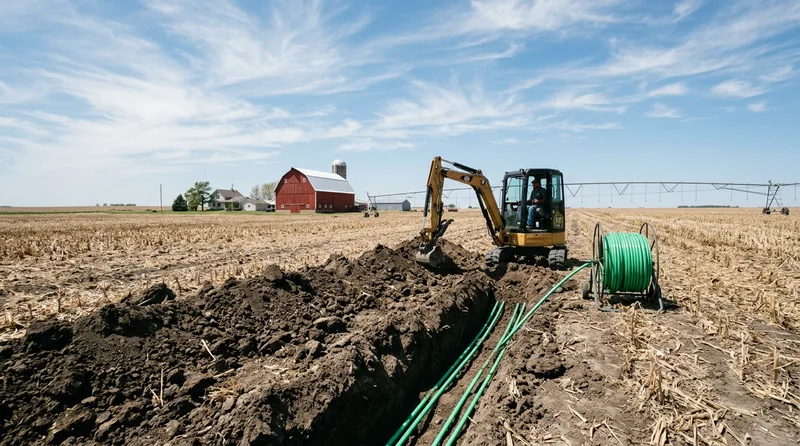
Why Nebraska's Public Power Changes the Math
Nebraska is the only state in America where every single kilowatt comes from a public power utility. No investor-owned shareholders taking a cut. No deregulated market volatility. Just NPPD, OPPD, LES, and about 160 smaller public power districts serving 1.9 million people at some of the cheapest electricity rates in the country.
At 9.07¢/kWh — rank 49 out of 50 states — Nebraska's cheap power is both the best friend and worst enemy of a geothermal heat pump installation. Best friend because your operating costs will be rock-bottom. Worst enemy because it makes the payback math against natural gas brutally honest.
But step off the gas grid — and in Nebraska, that happens fast once you leave Omaha, Lincoln, and a handful of gas-served towns — and the picture transforms. An estimated 85,000+ Nebraska homes heat with propane, concentrated in the Sandhills, the northeast, and across western Nebraska. For those households, the combination of 9¢ electricity and a COP-4 geothermal system creates operating costs so low they're almost hard to believe: $60–$90/month to heat and cool a 2,500 sq ft home, year-round.
Three things make Nebraska's geothermal market unique:
- 78,000+ stock ponds. Nebraska ranches are dotted with stock tanks and ponds built for cattle water. A qualifying pond (½ acre, 8 feet deep) can serve as the heat exchange medium for a residential geothermal system at roughly 40% the cost of vertical loops. This is the cheapest geothermal installation option in America, and Nebraska has more of them than almost any state.
- 45,000 farms and ranches covering 91% of the state's land. Nearly every one qualifies for USDA REAP grants covering up to 50% of a geothermal system's cost — and REAP survived the federal repeal. The 55–80% coverage we published previously required stacking REAP with the 30% federal §25D credit, which applied only to property placed in service through December 31, 2025. REAP now carries the load on its own at 25–50%, which is still the best incentive in the state by a wide margin.
- The Ogallala Aquifer. The largest aquifer in North America underlies most of western and central Nebraska, with an estimated 2.1 billion acre-feet of stored water. In areas where the aquifer is accessible at reasonable depth and NRD permits allow, open-loop geothermal is a viable option that most states simply can't offer.
Quick Verdict: Should You Go Geothermal in Nebraska?
| Your Situation | Verdict | Estimated Payback |
|---|---|---|
| Rural propane home | 🟢 Strong yes | 9–14 years |
| Electric resistance heating | 🟢 Yes | Longer than the 5–8 years published under the credit |
| Farm/ranch (USDA REAP eligible) | 🟢 Excellent — REAP still available | 4–8 years |
| New construction (any fuel) | 🟢 Best opportunity | Roughly 7 years incremental (see Sarpy County case study) |
| Sandhills/western NE propane | 🟢 Yes, with caveats | Longer than the 7–12 years published under the credit |
| Aging heat pump replacement | 🟢 Good upgrade | Longer than the 5–9 years published under the credit |
| Natural gas (Omaha/Lincoln metro) | 🔴 Probably not | 50–150 years |
| Natural gas (outstate) | 🟡 Long payback | Well over 30 years |
Payback figures reflect 2026 conditions with no federal tax credit. The 30% credit under IRC §25D applied to systems placed in service through December 31, 2025 and is not available for property placed in service after that date (One Big Beautiful Bill Act, P.L. 119-21). Earlier versions of this table showed shorter paybacks because they netted out that credit. USDA REAP and public power rates were not affected. Rows carried over from the credit era are noted as such.
The honest truth: if you heat with natural gas in the Omaha or Lincoln metro — which is about half the state's population — geothermal rarely makes financial sense. Nebraska's natural gas rates through public utilities are among the cheapest in the nation. But if you're one of the estimated 85,000+ Nebraska homes heating with propane, or if you're building new, the math swings hard in geothermal's favor.
The 100% Public Power Advantage
Nebraska is the only state where every electric customer is served by a public power entity — no investor-owned utilities. This matters for geothermal in several ways:
Lower rates, sustainably. Public power districts operate at cost. There's no shareholder return built into your rate. Nebraska's 9.07¢/kWh average has been stable relative to the national average for decades. This means your geothermal operating costs are predictable and low.
But also: fewer incentive programs. Investor-owned utilities like Xcel (Colorado) and Consumers Energy (Michigan) run aggressive heat pump rebate programs partly because regulators push them to and partly because efficiency investments improve their regulated rate of return. Public power districts have less financial incentive to subsidize your heat pump. Nebraska's utility rebates, where they exist, tend to be modest ($200–$500/ton).
The three big districts:
- OPPD (Omaha Public Power District): Serves 400,000+ customers in eastern Nebraska. Has historically promoted heat pumps and offered energy-saving loans.
- NPPD (Nebraska Public Power District): Serves most of outstate Nebraska through 80+ local distribution utilities. EnergyWise program offers efficiency incentives through your local utility.
- LES (Lincoln Electric System): Serves 150,000+ customers in Lincoln. Has offered HVAC efficiency rebates.
Contact your specific utility district — the person who answers the phone can tell you what's currently available. Nebraska has over 160 public power entities, each with their own programs.
Climate & Geology: Glacial Till to Sandhills
Eastern Nebraska (Omaha to Norfolk)
Glacial till and loess deposits — 20–100+ feet of unconsolidated sediment over limestone bedrock. This is ideal horizontal loop territory. The soil has decent thermal conductivity (1.0–1.4 BTU/hr·ft·°F), retains moisture well, and excavation is straightforward. Most eastern Nebraska homes can go horizontal slinky for $4,000–$6,000 less than vertical. Ground temperatures: 51–53°F.
Central Nebraska (Grand Island to North Platte)
Transition zone. Eastern portions still have glacial deposits; western portions hit the Ogallala Formation — ancient sand, gravel, and silt deposited by Rocky Mountain erosion millions of years ago. The Ogallala Aquifer beneath makes this one of the few regions where open-loop geothermal could work, though water rights and drawdown concerns apply. Ground temperatures: 50–52°F.
Western Nebraska / Sandhills
The Sandhills cover about 19,600 square miles — the largest sand dune formation in the Western Hemisphere, stabilized by grass. Beneath the sand sits the Ogallala Aquifer. The sand has poor thermal conductivity for closed loops (0.6–0.9 BTU/hr·ft·°F), which means vertical bores need to be deeper. But the aquifer's enormous water volume (an estimated 2.1 billion acre-feet under Nebraska alone) creates open-loop potential in some areas. Ground temperatures: 49–51°F.
Panhandle
Pierre Shale and Brule Formation dominate — similar challenges to western South Dakota. Drilling through shale is harder and more expensive. Vertical loop installations cost 15–25% more here than in eastern Nebraska. The panhandle is also the most remote for installer access — expect travel surcharges. Ground temperatures: 48–50°F.
| City | Ground Temp (50 ft) | Heating Degree Days | Cooling Degree Days |
|---|---|---|---|
| Omaha | 52°F | 6,200 | 1,150 |
| Lincoln | 52°F | 6,100 | 1,200 |
| Grand Island | 51°F | 6,500 | 1,050 |
| North Platte | 50°F | 6,900 | 850 |
| Scottsbluff | 49°F | 7,100 | 700 |
| Norfolk | 51°F | 6,800 | 950 |
Geology & Drilling Conditions by Region
Nebraska's geology — glacial deposits in the east, Ogallala sand in the west, shale in the panhandle — creates dramatically different drilling conditions and costs across the state. Here's what your contractor will encounter by region:
| Region | Dominant Geology | Thermal Conductivity (BTU/hr·ft·°F) | Typical Bore/Trench Depth | Drilling Cost/ft | Key Challenges |
|---|---|---|---|---|---|
| Omaha Metro / Eastern NE (Missouri River valley) | Glacial till (clay/silt/gravel), loess, over Pennsylvanian limestone at 50–100 ft | 1.0–1.4 | Vertical: 150–200 ft; Horizontal: 6–8 ft | Vertical: $11–$15/ft; Horizontal: $2.50–$4.50/ft | Easy drilling in glacial fill. Some cobble layers near rivers slow progress. Suburban lots may require vertical. Best contractor availability. |
| Lincoln / SE Nebraska | Deep loess (10–50 ft) over Dakota sandstone and Niobrara chalk | 0.9–1.3 | Vertical: 150–225 ft; Horizontal: 6–7 ft | Vertical: $11–$15/ft; Horizontal: $2.50–$4.50/ft | Loess is easy to trench but lower conductivity when dry. Dakota sandstone drills well. Good conditions overall. |
| Northeast NE (Norfolk / Columbus / Wayne) | Thick glacial deposits (50–200 ft) — clay, sand, gravel, till | 1.0–1.4 | Vertical: 150–200 ft; Horizontal: 6–8 ft | Vertical: $10–$14/ft; Horizontal: $2–$4/ft | Excellent glacial conditions — among the cheapest drilling in the state. Deep soft soil. Water table can be shallow (15–40 ft) near Elkhorn River — monitor during excavation. |
| Central NE / Platte Valley (Grand Island / Kearney / Hastings) | Platte River alluvium (sand/gravel, 20–80 ft) over Ogallala Formation sand/gravel | 0.9–1.2 (dry) / 1.1–1.4 (saturated) | Vertical: 175–225 ft; Horizontal: 6–7 ft | Vertical: $11–$15/ft; Horizontal: $3–$5/ft | Open-loop viable in Platte Valley alluvium (high yield, clean water). Dry conditions away from river reduce closed-loop conductivity — oversized loops recommended. |
| Sandhills (Valentine / Thedford / Mullen) | Unconsolidated fine-to-medium sand (Ogallala Formation), 50–300+ ft | 0.6–0.9 (dry sand) / 1.0–1.3 (saturated at depth) | Vertical: 200–300 ft (need depth to reach saturated zone); Horizontal: 7–8 ft | Vertical: $12–$17/ft; Horizontal: $3–$5/ft | Dry sand near surface has very poor conductivity — worst in the state for closed-loop. Deeper bores needed to reach saturated Ogallala. Open-loop may be more cost-effective where NRD permits allow. |
| Panhandle (Scottsbluff / Sidney / Chadron) | Pierre Shale, Brule Formation (siltstone/sandstone), Arikaree Group at surface | 0.8–1.2 | Vertical: 200–275 ft; Horizontal: 7–8 ft | Vertical: $13–$18/ft; Horizontal: $3–$5/ft | Shale and cemented formations are harder to drill — 15–25% premium over eastern NE. Remote location adds $2,000–$4,000 installer mobilization. Thinner Ogallala here limits open-loop potential. |
| Republican River Valley (McCook / Cambridge / Imperial) | Alluvial sand/gravel over Ogallala, some loess uplands | 0.9–1.2 | Vertical: 175–250 ft; Horizontal: 6–7 ft | Vertical: $11–$15/ft; Horizontal: $3–$5/ft | Valley floors have decent alluvium. Ogallala declining in SW Nebraska (Republican NRD restrictions). Upland areas have lower conductivity loess. |
Pre-Drill Intelligence: CSD Well Log Database
Before committing to a loop design, check the Nebraska Conservation and Survey Division (CSD) well log database at the University of Nebraska–Lincoln. The CSD maintains records from thousands of water wells across the state — formation types, water-bearing zones, and drilling rates at various depths. This data is publicly accessible at snr.unl.edu through the Nebraska Test Hole Database.
Nebraska's test hole program is actually one of the most comprehensive in the country — the CSD has logged over 12,000 test holes across all 93 counties. This gives your installer unusually good pre-drill intelligence compared to states with sparse well records. Ask your installer if they've reviewed the test hole data for your township and section — any experienced Nebraska driller should do this routinely.
For the Sandhills specifically, the key question is depth to the saturated zone. Dry sand above the water table has terrible thermal conductivity (0.6–0.9). Below the water table, the same sand saturated with groundwater performs much better (1.0–1.3). A bore that reaches the saturated Ogallala will outperform one that stays in dry sand — your installer's loop design should account for this critical transition.
Regional Costs & ROI
| Region | Avg. System Cost (3–4 ton) | Best Loop Type | Typical Annual Savings | 2026 Payback (no federal credit) | Payback When the 30% Credit Applied (2022–2025) |
|---|---|---|---|---|---|
| Omaha Metro (OPPD) | $22,000–$42,000 | Vertical (smaller lots) or horizontal | $600–$1,000 (vs. gas); $1,800–$2,300 (vs. propane) | 37–70 yr (gas); 10–16 yr (propane) | 26–49 yr (gas); 7–11 yr (propane) |
| Lincoln Metro (LES) | $20,000–$38,000 | Horizontal or vertical | $600–$1,000 (vs. gas); $1,600–$2,200 (vs. propane) | 33–63 yr (gas); 9–17 yr (propane) | 23–44 yr (gas); 6–12 yr (propane) |
| NE Nebraska (Norfolk/Wayne) | $18,000–$34,000 | Horizontal (deep glacial soil) | $1,600–$2,200 (vs. propane) | 8–15 yr (propane) | 6–11 yr (propane) |
| Central NE (Grand Island/Kearney) | $19,000–$36,000 | Horizontal, open-loop, or vertical | $1,400–$2,000 (vs. propane) | 10–18 yr (propane) | 7–13 yr (propane) |
| Sandhills (Valentine/Thedford) | $22,000–$40,000 | Open-loop (where permitted) or deep vertical | $1,800–$2,800 (vs. propane) | 8–15 yr (propane) | 6–11 yr (propane) |
| Panhandle (Scottsbluff/Sidney) | $24,000–$42,000 | Vertical (shale drilling) | $1,600–$2,400 (vs. propane) | 10–18 yr (propane) | 7–13 yr (propane) |
The 2026 column is what a Nebraska homeowner actually faces today: full system cost divided by annual savings, with no federal offset. The right-hand column is the after-credit math that applied to property placed in service through December 31, 2025 — shown for historical reference only. The 30% credit under IRC §25D is not available after that date (One Big Beautiful Bill Act, P.L. 119-21). USDA REAP, where you qualify, still reduces the 2026 figures substantially.
Why Nebraska costs trend lower than national averages: Flat terrain means horizontal loop installation is feasible on most properties outside urban cores. Land is cheap and lots are big. A horizontal loop system at $18,000–$24,000 for a 2,000 sq ft home is common in outstate Nebraska — try finding that price in New England.
About the examples below
The homes in these examples are representative scenarios, not real customers. We do not install geothermal systems and we have not visited these properties. Each scenario models a typical home for the area using real equipment pricing, local fuel and electricity rates, and the incentive programs described above — but the house, the owner and the invoice are constructed to show how the arithmetic works. Treat them as worked examples, and get quotes for your own home before budgeting.
Case Study: Seward County Propane Farmhouse
The Setup
A 2,200 sq ft ranch home on 5 acres near Seward, built 1985. Heating with a 500-gallon propane tank, central AC supplemented by a 2.5-ton unit at 10 SEER. Elevation: 1,450 ft.
The Old System Costs
- Annual propane: 850 gallons × $2.80/gallon = $2,380/year heating
- Annual cooling: $480/year (inefficient 10 SEER AC)
- Total HVAC: $2,860/year
The Geothermal System
- Equipment: 3-ton WaterFurnace 7 Series, variable speed + desuperheater
- Loop: Horizontal slinky (5 acres = plenty of room), trenched at 7 ft in glacial till
- Installed cost: $24,500
- Federal ITC (Section 25D): $0 — expired for installs placed in service after Dec 31, 2025
- 2026 out-of-pocket: $24,500
The Math
- Annual geothermal electricity: ~$810/year (at 9.07¢/kWh, COP 3.8 heating / EER 20 cooling)
- Annual savings: $2,860 − $810 = $2,050/year
- Simple payback: $24,500 ÷ $2,050 = 12.0 years
- At $3.20/gallon propane (recent winter peak): payback drops to about 10.1 years
- 20-year net savings: ($2,050 × 20) − $24,500 = $16,500
Verdict: Classic Nebraska propane conversion, and the numbers moved. This same job netted $17,150 and paid back in 8.4 years under the 30% federal §25D credit, which applied only to systems placed in service through December 31, 2025 (One Big Beautiful Bill Act, P.L. 119-21) — the repeal added about three and a half years. The family eliminated the propane tank, gained even heating and dramatically better cooling (the old 10 SEER AC couldn't keep up with July heat), and locked in operating costs at $68/month year-round. The 5-acre lot made horizontal installation straightforward — trenched in one day. Note this household was not REAP-eligible; a working farm in the same situation would do considerably better.
Case Study: Papillion New Construction
The Setup
A 2,800 sq ft two-story in a new Sarpy County subdivision near Papillion. Builder originally spec'd a 96% AFUE gas furnace + 16 SEER AC. The buyers chose geothermal during the design phase. Lot: 0.25 acres — too small for horizontal, so vertical closed-loop.
Conventional HVAC Quote
- 96% gas furnace + 16 SEER AC + ductwork: $14,500 installed (builder bid)
- Estimated annual gas + electric (conventional): $2,150/year
The Geothermal System
- Equipment: 4-ton ClimateMaster Tranquility 30, two-stage + desuperheater
- Loop: Vertical — 3 bores × 200 ft in glacial till, drilled during foundation work
- Total installed cost: $32,000
- Incremental over conventional: $32,000 − $14,500 = $17,500
- Federal ITC (Section 25D): $0 — expired for installs placed in service after Dec 31, 2025
- 2026 net incremental cost: $17,500
The Math
- Annual geothermal electricity: ~$1,060/year
- Annual savings vs. conventional: $2,150 − $1,060 = $1,090/year
- Incremental payback: $17,500 ÷ $1,090 = 16.1 years
- Eliminate gas line connection ($2,500–$4,000): payback drops to 12.4–13.8 years
- 20-year net savings on incremental: ($1,090 × 20) − $17,500 = $4,300
Verdict: New construction is still the best framing in gas-served Sarpy County — you're only paying the premium over HVAC you'd buy anyway — but the federal repeal more than doubled that premium. With the 30% §25D credit the net incremental cost was $7,900 and payback ran 7.2 years, or about 5 years after skipping the gas line. That credit applied only to property placed in service through December 31, 2025; for a 2026 build the full $17,500 increment lands on the buyer. The builder reported that the geothermal option attracted buyers specifically — it was a market differentiator in a competitive subdivision, and against cheap Nebraska gas that resale premium now matters more than the energy math.
Case Study: Holt County Ranch — Stock Pond Loop + REAP
The Setup
A fourth-generation cattle ranch outside Atkinson in Holt County. The 2,400 sq ft ranch home, built 1972, heats with propane ($3,100/year including DHW) and cools with window units ($420/year — no central air). The property has a 0.8-acre stock pond, 9 feet deep, located 180 feet from the house. The family earns 85%+ of gross income from cattle operations — solidly REAP-eligible.
The Old System Costs
- Annual propane (heating + DHW): 1,050 gallons × $2.95/gallon = $3,098/year
- Annual cooling (window units): $420/year
- Total HVAC: $3,518/year
The Geothermal System
- Equipment: 4-ton WaterFurnace 5 Series, two-stage + desuperheater
- Loop: Pond loop — 8 slinky coils sunk in the stock pond, 180 ft header pipe to house
- New ductwork: First central air system for this home
- Pond loop installation: $3,600 (coils fabricated, sunk with weighted anchors, header trenched)
- Equipment + installation + ductwork: $18,400
- Total system cost: $22,000
REAP Stack (2026 — No Federal Credit)
| Line Item | Amount |
|---|---|
| Total geothermal system cost | $22,000 |
| USDA REAP grant (25%) | −$5,500 |
| Federal ITC (Section 25D) | $0 — expired for property placed in service after Dec 31, 2025 |
| 2026 out-of-pocket | $16,500 (25% covered) |
| Annual savings (vs. propane + window AC) | $2,698 |
| Simple payback | 6.1 years |
Under the pre-2026 rules this same stack netted to $11,550 (47.5% covered) and paid back in 4.3 years, because the 30% federal credit applied to the $16,500 remaining after REAP. REAP itself was not repealed — only the federal §25D component came out.
The Math
- Annual geothermal electricity (heating + central AC + partial DHW): ~$820/year (9,035 kWh at 9.07¢)
- Annual savings: $3,518 − $820 = $2,698/year
- At 50% REAP (competitive round): out-of-pocket drops to $11,000 → payback 4.1 years
- 20-year net savings (25% REAP): ($2,698 × 20) − $16,500 = $37,460
Verdict: This is the Nebraska geothermal grand slam. The family's stock pond — infrastructure they were already maintaining for cattle — became the cheapest possible heat exchange medium. The REAP grant rewarded their established agricultural operation. They now have central air for the first time in the home's 50+ year history, eliminated propane delivery to a remote ranch (delivery surcharges add $0.20–$0.40/gallon in Holt County), and are saving $2,700/year. The stock pond continues to function normally for cattle water — the slinky coils sit on the bottom and don't interfere with livestock access.
REAP application was submitted through the USDA Nebraska State Office in Lincoln. Timeline: 5 months from application to award notification. The local Holt County extension office assisted with application preparation. Key tip: apply before you break ground — REAP reviews are competitive, and a pending installation timeline strengthens your application.
Month-by-Month Energy Profile
This profile models the Seward County propane farmhouse (2,200 sq ft, 3-ton system) after the geothermal conversion.
| Month | Old Propane Cost | Old Electric (AC) | Geo Electric Cost | Monthly Savings |
|---|---|---|---|---|
| January | $485 | $0 | $125 | $360 |
| February | $420 | $0 | $110 | $310 |
| March | $310 | $0 | $85 | $225 |
| April | $120 | $0 | $45 | $75 |
| May | $0 | $35 | $30 | $5 |
| June | $0 | $85 | $55 | $30 |
| July | $0 | $120 | $75 | $45 |
| August | $0 | $110 | $70 | $40 |
| September | $0 | $60 | $40 | $20 |
| October | $95 | $0 | $35 | $60 |
| November | $280 | $0 | $70 | $210 |
| December | $440 | $0 | $115 | $325 |
| Annual Total | $2,150 | $410 | $855 | $1,705 |
Propane at $2.80/gallon. Electric at 9.07¢/kWh (EIA 2024 Nebraska average). Nebraska is heating-dominant (~85% of geothermal energy use) but has a meaningful cooling season — July averages 77–88°F depending on region.
Open-Loop System Assessment by Region
Nebraska's position atop the Ogallala Aquifer — the largest aquifer in North America — creates unique open-loop opportunities that most states can't match. But "possible" and "advisable" aren't the same thing.
| Region | Open-Loop Viability | Water Temp | Key Considerations |
|---|---|---|---|
| Eastern NE (Missouri River valley) | 🟡 Site-specific | 51–53°F | Alluvial aquifers; adequate yield likely; NRD permit required; check nitrate levels from ag runoff. |
| Omaha Metro | 🔴 Not recommended | 52°F | Urban wells restricted; city water supply protection zones; lot sizes insufficient for discharge. |
| Lincoln Metro | 🔴 Not recommended | 52°F | Municipal wellhead protection areas; LES territory has no open-loop incentive. |
| Central Platte Valley | 🟢 Generally viable | 50–52°F | Ogallala shallow access; high yields (500+ GPM irrigation wells common); NRD water allocation may limit. Check with Central Platte NRD. |
| Sandhills | 🟡 Possible, complex | 49–51°F | Enormous aquifer volume but remote locations; discharge into Sandhills lakes/streams requires NDEQ review. |
| Panhandle | 🟡 Limited | 48–50°F | Aquifer thinner and declining in some areas; Groundwater Management Area restrictions; North Platte NRD may limit. |
| Republican River Valley | 🔴 Restricted | 50–52°F | Compact compliance area — Republican NRD has strict allocation limits. New non-agricultural wells may be denied. |
Critical: Nebraska's Natural Resources Districts (NRDs) govern groundwater use at the local level. There are 23 NRDs across the state, each with their own rules. Before planning an open-loop system, contact your local NRD. Some have moratoriums on new high-capacity wells. Others require metering and annual reporting. A geothermal system typically uses 5–10 GPM — modest compared to irrigation — but the permit is still required.
Loop Type Cost Comparison
| Loop Type | Typical Cost (3-ton) | Best For | Nebraska Notes |
|---|---|---|---|
| Horizontal slinky | $12,000–$18,000 | Large rural lots | The Nebraska default. Eastern NE glacial till is ideal. Needs 2,500+ sq ft per ton. |
| Horizontal straight | $14,000–$20,000 | Very large properties | Farms/ranches; 400–600 ft trench per ton. Easy excavation in most NE soil. |
| Vertical closed-loop | $18,000–$28,000 | Urban/suburban lots | Omaha/Lincoln subdivisions; 150–200 ft per bore. Required where lots are small. |
| Open-loop | $10,000–$16,000 | Central NE with well access | Cheapest per ton where viable. NRD permit + water quality testing required. |
| Pond/stock tank loop | $8,000–$14,000 | Ranches with ponds | Nebraska has 78,000+ stock ponds. Min ½ acre, 8 ft deep. The cheapest option in the country. |
The Nebraska ranch advantage: With 78,000+ stock ponds and tanks across the state, pond-loop systems are uniquely accessible. A properly sized stock pond (minimum ½ acre surface area, 8 feet deep) can serve as the heat exchange medium for a residential system at roughly 40% the cost of vertical loops. This is an underutilized option that works particularly well for ranch homes already maintaining stock water. If your property has a qualifying pond within 200 feet of the house, this should be the first option explored.
Incentive Stacking: Federal ITC, REAP & Public Power
Federal Investment Tax Credit (IRC §25D) — Expired ❌
The federal residential clean energy credit under IRC §25D provided 30% back on total installed cost — equipment, loops, drilling, trenching, ductwork, desuperheater, and all labor, with no cap. It applied to property placed in service through December 31, 2025 and is not available for property placed in service after that date (One Big Beautiful Bill Act, P.L. 119-21). The Inflation Reduction Act had set 30% through 2032 with step-downs in 2033 and 2034; that schedule was repealed before it ever took effect.
Nebraska has no state geothermal tax credit either. For a 2026 install, that leaves USDA REAP and whatever public power rebate you can confirm. Verified July 2026 against IRS.gov.
USDA REAP — Nebraska's Secret Weapon (and Now Its Main One)
Nebraska has over 45,000 farms and ranches covering 44.8 million acres — 91% of the state's total land area. REAP grants cover up to 50%; loan guarantees up to 75%. REAP was not affected by the federal §25D repeal, which makes it the largest incentive left in the state by a wide margin.
A note on that 75% figure: it combines the grant with a loan guarantee. The loan portion is repayable, not free money — only the grant share actually reduces what the project costs you. Treat 50% as the realistic ceiling on cost reduction.
REAP Best-Case Stack (2026)
| Line Item | Amount |
|---|---|
| 3-ton horizontal slinky system (installed) | $24,000 |
| USDA REAP grant (25%) | −$6,000 |
| Federal ITC (Section 25D) | $0 — expired for property placed in service after Dec 31, 2025 |
| Local utility rebate (estimated) | −$750 (unverified) |
| 2026 out-of-pocket | $17,250 (28% covered) |
| Annual propane savings | $2,050 |
| Payback | 8.4 years |
At 50% REAP (competitive round, strong application): out-of-pocket drops to $11,250 → payback 5.5 years. That's a 53% cost reduction for qualifying agricultural producers.
Under the pre-2026 rules this same 25% REAP stack netted $11,850 and paid back in 5.8 years, and the 50% version reached 77% coverage with a 2.6-year payback — both because the 30% federal credit applied on top of REAP. Only the federal component came out.
REAP applications are submitted to the USDA Nebraska State Office in Lincoln. Deadlines are typically March 31 and October 31. Application requires energy audit, technical feasibility report, and financial documentation. Start 4–6 months before your planned installation.
Public Power Utility Programs
| Utility | Geothermal Incentive | Status | Notes |
|---|---|---|---|
| OPPD (Omaha) | Energy efficiency programs; has promoted heat pumps | (unverified) | Contact OPPD at (402) 536-4131. |
| NPPD (outstate) | EnergyWise — incentives through local utilities | (unverified) | Contact your local public power district. Programs vary by district. |
| LES (Lincoln) | HVAC efficiency rebates | (unverified) | Contact LES at (402) 475-4211. |
| Rural electric cooperatives | Varies by co-op | (unverified) | Some co-ops offer heat pump incentives. Call your co-op's energy advisor. |
Solar + Geothermal: The Prairie Combo
Nebraska gets 4.5–6.0 peak sun hours per day (higher in the west). Net metering policies vary by utility district — OPPD and LES allow up to 25 kW. Smaller rural co-ops may differ.
| Component | Gross Cost | 2026 Out-of-Pocket |
|---|---|---|
| 4-ton geothermal system | $32,000 | $32,000 |
| 8 kW solar array | $22,000 | $22,000 |
| Total | $54,000 | $54,000 |
| Annual energy savings (vs. propane + grid) | ~$3,200/year | |
| Combined payback | ~16.9 years | |
Section 25D covered both geothermal and solar at 30% for property placed in service through December 31, 2025, which brought this stack to $37,800 net and a ~11.8-year payback. It is not available after that date (One Big Beautiful Bill Act, P.L. 119-21), so the 2026 out-of-pocket is the full $54,000. A REAP-eligible farm can still take 25–50% off the geothermal side.
In western Nebraska where propane is common AND solar irradiance peaks at 5.5–6.0 hours, the combined payback is meaningfully shorter — though the 7–10 year figure we published previously assumed the federal credit on both systems. After payback, you're living in a home with near-zero energy costs for heating, cooling, and hot water.
The Honest Gas Assessment
Let's be direct: if you heat with natural gas in Omaha or Lincoln, geothermal almost certainly doesn't make financial sense right now.
- Average Nebraska natural gas heating cost: ~$800–$1,100/year for a 2,000 sq ft home
- Geothermal operating cost for the same home: ~$600–$850/year
- Annual savings: $200–$400
- 2026 out-of-pocket system cost: $20,000–$30,000 (the full gross — no federal credit)
- Payback: 50–150 years
That's not a typo, and it got worse in 2026. The 35–75 year range we published previously assumed a net cost of $14,000–$21,000 after the 30% federal §25D credit, which is not available for property placed in service after December 31, 2025 (One Big Beautiful Bill Act, P.L. 119-21). When gas is cheap and electricity is cheap, the gap between them is tiny — and a $25,000 investment to save $300/year doesn't compute at any credit level.
When Gas Homes SHOULD Consider Geothermal
- New construction — avoid the gas line connection ($2,500–$4,000 savings), and the incremental cost drops dramatically
- Your furnace is dying — compare incremental cost of replacement furnace vs. geothermal upgrade
- You're adding AC to a home that doesn't have it — geothermal provides both in one system
- Environmental priority — though Nebraska's coal-heavy grid (1,082 lbs CO2/MWh) makes this less impactful than in Iowa (676) or South Dakota (318)
- You expect gas prices to rise significantly — possible, but Nebraska's public gas utilities have historically maintained stable, low rates
Permits & Licensing Requirements
Nebraska's permitting is relatively straightforward, with the NRD groundwater permit being the key variable for open-loop systems.
Mechanical / Building Permit (All Installations)
- Omaha (OPPD territory): City of Omaha Planning Department. Standard mechanical permit: $75–$200. Turnaround: 5–10 business days.
- Lincoln (LES territory): City of Lincoln Building and Safety. Standard HVAC permit. Similar fees and timeline.
- Sarpy County (Papillion/Bellevue/La Vista): City-specific building departments. Standard process.
- Outstate Nebraska: Many rural Nebraska counties have minimal permitting requirements for residential HVAC. Some counties don't require mechanical permits for single-family homes. Confirm with your county clerk's office.
Groundwater Permits — Natural Resources Districts
- Closed-loop vertical bores: Generally do not require an NRD water appropriation permit since no groundwater is withdrawn. However, well construction standards still apply — bores must be properly grouted to prevent aquifer contamination. Some NRDs require notification before drilling.
- Open-loop systems: Require a water well permit from your NRD. Processing time varies: 2–8 weeks in non-restricted areas, potentially months in Groundwater Management Areas. Contact your NRD early. The 23 NRDs each have different rules — what's permitted in the Central Platte NRD may be denied in the Republican NRD.
- Existing agricultural wells: If you want to convert an existing irrigation or livestock well to dual-use (geothermal + original purpose), you'll need a modified permit from your NRD. Generally faster than a new well permit.
Contractor Licensing
Nebraska regulates HVAC contractors through the Nebraska State Electrical Board and local licensing requirements:
- Omaha and Lincoln: Both cities require HVAC contractors to hold a local mechanical contractor license. Verify with the city licensing division before hiring.
- Outstate Nebraska: No statewide HVAC contractor licensing requirement. In rural areas, verify that your installer carries adequate liability insurance ($1M+ general liability), workers' compensation coverage, and manufacturer training credentials.
- Well driller: Nebraska requires all water well drillers to be licensed by the Nebraska Department of Health and Human Services (DHHS). Verify at the DHHS Licensed Well Driller Registry. Required for both water wells (open-loop) and geothermal boreholes (closed-loop vertical).
- Electrical work: Nebraska requires licensed electricians for electrical connections. The State Electrical Board governs licensing statewide.
Typical Permit Timeline
| Step | Timeframe | Notes |
|---|---|---|
| Mechanical permit (metro) | 5–10 business days | Omaha/Lincoln; outstate may be faster or unnecessary |
| NRD notification (closed-loop) | 1–5 business days | Not always required — check your NRD |
| NRD water well permit (open-loop) | 2–8 weeks | Non-restricted areas. GMA areas: potentially months. |
| Trenching/drilling | 1–3 days | Horizontal in eastern NE: often 1 day. Panhandle shale: 2–3 days. |
| Equipment installation | 2–4 days | Includes piping, ductwork (if new), controls, commissioning |
| Final inspection | 1–3 business days | Schedule proactively |
| Total (closed-loop) | 2–5 weeks | Straightforward in most of Nebraska |
| Total (open-loop) | 4–10 weeks | NRD permit is the variable |
Finding & Vetting a Qualified Installer
Nebraska has a low-moderate installer base concentrated in Omaha and Lincoln, with coverage thinning significantly as you move west. The state's proximity to IGSHPA's influence zone (headquartered in Stillwater, Oklahoma) helps, and some Iowa and Colorado contractors serve Nebraska's borders.
Where to Find Installers
- IGSHPA installer directory: igshpa.org business directory — search Nebraska AND neighboring states (IA, KS, CO, SD).
- WaterFurnace Dealer Locator: waterfurnace.com/dealer-locator
- ClimateMaster Dealer Network: climatemaster.com/residential/find-a-dealer
- Bosch Geothermal: bosch-thermotechnology.us
- GeoExchange Directory: geoexchange.org
- Nebraska public power districts: Some districts maintain referral lists. Call your local utility's energy advisor.
- UNL Extension offices: Nebraska Extension may have contractor referrals for REAP-eligible energy projects.
Regional Installer Availability
| Region | Estimated Qualified Installers | Wait Time (Typical) | Notes |
|---|---|---|---|
| Omaha Metro (OPPD) | 6–10 | 4–8 weeks | Best availability. Several firms with 10+ years experience. Some IA-based firms also serve this area. |
| Lincoln Metro (LES) | 3–5 | 4–8 weeks | Good availability. Some Omaha firms serve Lincoln regularly. |
| NE Nebraska (Norfolk/Columbus/Wayne) | 2–4 | 6–10 weeks | Some Omaha firms travel here. Iowa contractors serve the eastern edge. |
| Central NE (Grand Island/Kearney/Hastings) | 2–3 | 6–12 weeks | Limited local options. Omaha or Lincoln firms travel. Some from Denver serve the I-80 corridor. |
| Sandhills (Valentine/Thedford) | 1–2 | 10–16 weeks | Very limited. May need Omaha or SD-based contractor. Mobilization surcharge ($2,000–$4,000). |
| Panhandle (Scottsbluff/Sidney/Chadron) | 1–2 | 10–16 weeks | Denver/Fort Collins contractors may be closest. Mobilization surcharge ($2,500–$4,500). |
8-Point Vetting Checklist
- IGSHPA accreditation or manufacturer certification — proves geothermal-specific training.
- Local HVAC license (Omaha/Lincoln) — verify with city licensing division. Required in metro areas.
- Nebraska DHHS licensed well driller on staff or under contract — required for all bore drilling.
- At least 5 completed Nebraska installations — ask for references. Nebraska soil/climate conditions are specific enough that experience matters.
- Manual J load calculation in the proposal — any contractor who sizes equipment without a load calc is guessing. Nebraska's 6,200 HDD + 1,150 CDD requires careful sizing.
- Soil moisture/conductivity addressed in loop design — western Nebraska's dry conditions require loop oversizing. If the installer uses the same loop length for Douglas County clay and Cherry County sand, they're not designing for Nebraska conditions.
- Written warranty: equipment (10 yr), labor (1–2 yr), loop (25–50 yr) — verify loop warranty is from the pipe manufacturer.
- Itemized bid with trenching/drilling, equipment, labor, permits separated — bundled bids hide markup.
Maintenance & System Longevity
Nebraska's continental climate — genuine four-season demand with both heating and cooling loads — actually creates favorable conditions for geothermal longevity. The balanced load keeps ground temperature stable, and the indoor equipment is protected from Nebraska's severe weather.
Maintenance Schedule
| Task | Frequency | DIY or Pro? | Nebraska-Specific Notes |
|---|---|---|---|
| Check/replace air filter | Every 1–3 months | DIY | Monthly during heating season (Oct–Apr) and harvest season. Nebraska's agricultural dust (corn harvest, field work) loads filters faster than urban states. |
| Inspect condensate drain | Twice yearly (spring/fall) | DIY | Nebraska's summer humidity is moderate but sufficient to generate condensate during cooling. Check before summer. |
| Check loop pressure/antifreeze | Annually (fall) | Pro | Nebraska design temps: -15°F to -20°F. Propylene glycol at 20–25% is standard. Sandhills/panhandle may need 25–30% for deeper cold events. |
| Desuperheater inspection | Annually | Pro | Nebraska water is moderately hard in many areas (150–400 ppm). Annual inspection; descale if needed. |
| Compressor and electrical check | Every 2–3 years | Pro | Nebraska's year-round usage means steady compressor hours. Check refrigerant, electrical connections, thermostat calibration. |
| Ductwork inspection/sealing | Every 5–7 years | Pro | Nebraska's temperature swings (-15°F to 100°F annually) stress duct seals. Basement and crawl space ducts in older homes are prone to leaks. |
| Full system commissioning | Every 5 years | Pro | Flow rates, entering/leaving water temps, COP verification. The "geothermal physical." |
| Pond loop inspection (if applicable) | Annually (spring) | DIY/Pro | After ice-out, visually inspect pond loop headers for any cattle or ice damage. Check that coils remain sunk and weighted. |
System Lifespan
| Component | Expected Lifespan | Replacement Cost | Notes |
|---|---|---|---|
| Heat pump unit (indoor) | 20–25 years | $5,000–$9,000 | Protected indoors from Nebraska's severe weather (tornadoes, hail, ice storms, -20°F cold). No outdoor exposure. |
| Ground loop (HDPE pipe) | 50–75+ years | $0 (doesn't need replacing) | Buried below frost line. Protected from everything. Nebraska's ground loop installations from the 1990s are still operational. |
| Circulating pump | 10–15 years | $500–$1,200 | Variable-speed pumps last longer. For remote ranches, stock a spare — delivery time matters when it's January. |
| Compressor | 15–20 years | $2,000–$4,000 | Nebraska's balanced year-round usage avoids the thermal shock of heating-only operation. |
| Antifreeze solution | 10–15 years | $250–$500 | Test annually. Nebraska's design temps are moderate (-15°F to -20°F) compared to Wyoming or Montana — glycol stress is lower. |
| Thermostat/controls | 10–15 years | $200–$500 | Smart thermostats with remote monitoring recommended for ranch properties — check status during winter field work. |
Nebraska-Specific Longevity Advantages
- No outdoor unit in storm country: Nebraska averages 57 tornadoes per year plus frequent severe hail. Conventional AC condensers are exposed to all of this. Your geothermal heat pump sits indoors — basement, utility room, or mechanical closet.
- Balanced thermal cycling: Nebraska's roughly 85/15 heating/cooling split keeps the ground around your loop at stable temperature. States that are heavily heating-dominant (Minnesota) or cooling-dominant (Arizona) can develop thermal drift. Nebraska's balance prevents this naturally.
- Continental climate is predictable: Nebraska's weather is extreme but consistent year over year. Your geothermal system experiences the same annual temperature cycle every year — no surprises that stress equipment beyond design parameters.
Vacation Rental & Tourism Property Economics
Nebraska National Forest / Sandhills (Halsey/Valentine)
Sandhills hunting lodges and cabin rentals — propane costs are the highest in the state ($3.00–$3.50/gallon with remote delivery surcharges). Geothermal saves $3,500–$5,000/year in propane. Year-round climate control is a marketing advantage for shoulder-season bookings. REAP-eligible if operated as a rural small business.
Lake McConaughy (Ogallala/Keith County)
Nebraska's largest reservoir draws 900,000+ visitors annually. Lakefront vacation rentals are growing. A pond-loop system using a nearby stock pond or (theoretically) a lake-adjacent loop could dramatically reduce costs while adding an "eco-lodge" booking premium.
Lewis & Clark Lake / Niobrara River Valley
Emerging vacation rental market with mostly propane-heated cabins. The Niobrara is one of America's most popular canoeing rivers. Same REAP stacking applies if the property qualifies as a rural small business. The "heated by Nebraska earth" angle complements the nature-tourism brand.
Vacation Rental Tax Treatment
The residential credit under IRC §25D is not available for property placed in service after December 31, 2025 (One Big Beautiful Bill Act, P.L. 119-21), so a rental owner cannot count on it. Business-use property has historically been treated under the separate Section 48 commercial credit rather than §25D, alongside MACRS 5-year depreciation — (unverified — the current status and rate of the Section 48 credit for geothermal is outside what we have verified here. Confirm with a tax professional before budgeting for it) The 60–70% first-five-years recovery figure we published previously depended on the pre-repeal credit stack and should not be relied on.
The Federal Tax Credit: Expired December 31, 2025
The 30% federal credit under IRC §25D applied to geothermal heat pump property placed in service through December 31, 2025. It is not available for property placed in service after that date (One Big Beautiful Bill Act, P.L. 119-21). The Inflation Reduction Act had scheduled 30% through 2032 with step-downs in 2033 and 2034; that schedule was repealed before it ever took effect. Verified July 2026 against IRS.gov.
Nebraska has no state geothermal credit to fall back on, so for a 2026 install there is no tax-filing action to take — IRS Form 5695 does not apply to your system. Here's what to do instead:
- Do not budget for a federal credit. On a $24,000 Nebraska system, the $7,200 offset that existed through 2025 is gone. Build your financing around the gross number.
- Apply for USDA REAP if you qualify. Not repealed. 25–50% for agricultural producers and rural small businesses — and with 45,000 farms covering 91% of the state's land, most rural Nebraska properties do. Deadlines are typically March 31 and October 31 through the USDA Nebraska State Office in Lincoln.
- Check your public power district. OPPD, LES, NPPD and local districts may offer efficiency incentives or favorable heat pump rates. Verify directly — none are confirmed here.
- Keep all documentation. Itemized invoices, ENERGY STAR certification, proof of payment, REAP award letter if applicable.
- If your system was placed in service in 2022–2025 and you never claimed the credit, ask a tax professional whether an amended return is still open to you. Carry-forward from a qualifying pre-2026 install also still runs.
- Verify before you sign. A contractor quoting a "net after 30% federal credit" price in 2026 is quoting a number that no longer exists.
Nebraska vs. Neighboring States
| Factor | Nebraska | Iowa | South Dakota | Kansas | Colorado | Wyoming | Missouri |
|---|---|---|---|---|---|---|---|
| Avg. Electricity Rate | 9.07¢ | 13.28¢ | 12.68¢ | 11.21¢ | 14.30¢ | 9.14¢ | 11.98¢ |
| Grid CO2 (lbs/MWh) | 1,082 (coal) | 685 (wind) | 318 (wind+hydro) | 680 (wind) | 752 (gas) | 980 (coal) | 1,305 (coal) |
| State Incentive | Utility varies | None confirmed | None | None | Xcel rebate (unverified) | None (no income tax) | None |
| Propane Payback | 9–14 yr | 7–12 yr* | 6–12 yr* | 6–10 yr* | 7–12 yr* | 5–9 yr* | 6–10 yr* |
| Gas Payback | 50–150 yr | 20–35 yr* | 25–45 yr* | 30–50 yr* | 15–25 yr* | 14–200+ yr* | 18–26 yr* |
| Horizontal Loop Potential | Excellent (east) | Excellent | Good | Excellent | Good (rural) | Excellent (ranch) | Good |
| Installer Density | Low-Moderate | Low-Moderate | Low | Low-Moderate | Moderate | Very low | Moderate |
| REAP Eligibility | Nearly statewide | Nearly statewide | Nearly statewide | Nearly statewide | Rural only | Nearly statewide | Most areas |
| Permitting Complexity | Low (NRD for open-loop) | Low | Low | Low | Moderate | Low-Moderate | Low-Moderate |
| Unique Advantage | 100% public power + 78K stock ponds + Ogallala | Wind-clean grid + REAP | Cleanest grid (318) + REAP | Wind grid + 180K ponds | Mountain propane market | Cheapest electricity + ranch land | Highest gas payback delta |
*Nebraska's payback rows are recomputed for 2026 with no federal §25D credit. Neighbor-state figures marked with an asterisk carry over from ranges published when the 30% credit applied — expect them to run longer now, and check each state's own guide for its updated math.
Nebraska's unique position: cheapest electricity of any bordering state (tied with Wyoming), 100% public power stability, and the combination of 78,000 stock ponds + 45,000 REAP-eligible farms creates the largest untapped pond-loop market in the Great Plains. The coal-heavy grid is the weakness — Iowa's wind-powered grid (685 lbs/MWh) and South Dakota's remarkably clean 318 lbs/MWh make the environmental argument stronger across the border. But for pure economics, Nebraska's 9.07¢ electricity with geothermal's COP 4.0 creates the cheapest operating costs in the region.
Frequently Asked Questions
How much does geothermal cost in Nebraska?
$18,000–$42,000 out of pocket. That's the full number — the 30% federal §25D credit applied only to property placed in service through December 31, 2025 and is not available after that date, so there is no net-after-credit figure to quote. (For reference, the same job netted roughly $12,600–$29,400 under the old credit.) Rural horizontal: $18,000–$24,000. Urban vertical: $28,000–$42,000. Pond loops on qualifying ranches: $14,000–$18,000 total system. Nebraska trends below national averages due to flat terrain and deep soft soil — and USDA REAP takes 25–50% off for qualifying farms.
Is cheap electricity good or bad for geothermal?
Both. At 9.07¢/kWh, your operating costs are rock-bottom ($60–$90/month). But cheap electricity = cheap gas, compressing the savings gap for gas homes. Propane and electric resistance homes see the biggest benefit.
Can I use the Ogallala Aquifer for open-loop?
Potentially, in central and western Nebraska. You need an NRD well permit, water quality testing, and a return-water plan. Residential geothermal uses modest flow (5–10 GPM) but permits are still required. Some NRDs restrict new wells in Groundwater Management Areas.
What's the best loop type?
Rural: horizontal slinky ($12K–$18K). Urban Omaha/Lincoln: vertical ($18K–$28K). Ranch with stock pond: pond loop ($8K–$14K — cheapest option in the country). Nebraska's 78,000+ stock ponds are an unmatched advantage.
Do utilities offer rebates?
Some public power districts offer efficiency incentives. NPPD EnergyWise and OPPD have promoted heat pumps. Programs vary — contact your specific utility among Nebraska's 160+ public power entities.
How dirty is the grid?
1,082 lbs CO2/MWh — 12th dirtiest (coal-heavy). Environmental case is strongest replacing propane or electric resistance. Grid is getting cleaner as wind capacity grows. A system installed today becomes greener over its 25–50 year lifespan.
Is it worth it for farms/ranches?
Absolutely — the strongest candidates in Nebraska. Large lots (cheap loops), stock ponds (cheapest loops), propane heating (highest savings), REAP eligibility (25–50% grants). REAP alone now gets you 25–53% coverage and a 4–8 year payback. The 55–80% coverage and 3–5 year payback we published previously required stacking REAP with the 30% federal §25D credit, which is not available for property placed in service after December 31, 2025.
Can it handle Nebraska winters?
Yes. Ground stays 49–52°F year-round at depth regardless of surface temperature. The system extracts heat from 50°F ground, not -10°F air. Supplemental resistance strips provide backup for extreme events.
How long does it last?
Indoor unit: 20–25 years. Ground loop: 50–75+ years. Nebraska's balanced heating/cooling demand keeps the loop thermally stable. Systems from the 1990s are still operational. Second-generation replacement reuses existing loop.
How do I find an installer?
IGSHPA directory + manufacturer locators. Omaha: 6–10 firms (best availability). Lincoln: 3–5 firms. Western NE/Panhandle: may need Omaha or Denver contractors ($2K–$4.5K mobilization). Get 3+ quotes.
What permits are needed?
Mechanical permit (metro areas). Closed-loop: no NRD water permit needed. Open-loop: NRD well permit required (2–8 weeks; longer in restricted areas). Well driller must be DHHS-licensed. Rural areas may have minimal requirements.
Can I use my stock pond?
Yes, if ½+ acre and 8+ feet deep. Nebraska has 78,000+ qualifying ponds. Pond loops are the cheapest option ($8K–$14K for loop portion). Coils sit on bottom; pond still works for cattle, fishing, recreation. Explore this first if you have a qualifying pond.
Bottom Line
Nebraska is a tale of two geothermal markets — and understanding which one you're in determines whether the investment makes sense.
If you heat with natural gas in Omaha, Lincoln, or another gas-served community, geothermal doesn't pencil out financially. Keep your gas furnace until it dies, then evaluate geothermal as a replacement — especially in new construction where the incremental cost is much smaller and you can skip the gas line hookup.
If you're among Nebraska's 85,000+ propane-heated households, or if you operate one of the state's 45,000 farms and ranches, the picture is completely different:
- 78,000+ stock ponds make Nebraska a pond-loop paradise — the cheapest geothermal installation option in America, and the state has more qualifying ponds than almost anywhere.
- USDA REAP eligibility covers 91% of the state's land. A 25–50% REAP grant brings a typical system to roughly $11,000–$18,000 out of pocket, with payback in 4–8 years. REAP was not repealed. The $5,000–$12,000 net and 2–5 year payback we published previously required stacking REAP with the 30% federal §25D credit, which is not available for property placed in service after December 31, 2025 (One Big Beautiful Bill Act, P.L. 119-21).
- 9.07¢ electricity from 100% public power means the lowest operating costs in the Great Plains. Your entire home's heating, cooling, and partial hot water for $60–$90/month.
- Flat terrain, deep soil, big lots mean horizontal loops at below-national-average prices. $18,000–$24,000 for a complete system in outstate Nebraska.
Nebraska's public power system gives you something no other state can match: predictable, low-cost electricity backed by a system that operates at cost with no shareholder markup. Pair that with a ground-source heat pump's COP multiplier, and you're heating and cooling your home for less than your neighbor's cable bill. The loop lasts 50+ years. The savings last a lifetime. And that stock pond you've been maintaining for your cattle? It might just be the best HVAC investment on the property.
Sources
- U.S. Energy Information Administration — Nebraska Electricity Profile 2024. Average residential rate: 9.07¢/kWh, rank 49 (2nd cheapest).
- U.S. Energy Information Administration — Nebraska Natural Gas Prices.
- Internal Revenue Service — Residential Clean Energy Credit (IRC §25D). 30% credit applied to property placed in service through Dec 31, 2025; not available after that date (OBBBA, P.L. 119-21). Verified July 2026.
- USDA Rural Development — Rural Energy for America Program (REAP).
- USDA National Agricultural Statistics Service — Nebraska Agricultural Statistics. 45,000 farms, 44.8 million acres, 91% of state land.
- University of Nebraska–Lincoln Conservation and Survey Division — Nebraska Test Hole Database. 12,000+ test holes across 93 counties.
- Nebraska Department of Natural Resources — Natural Resources Districts and Groundwater Management.
- Nebraska DHHS — Licensed Well Driller Registry. All water well and geothermal bore drillers must be state-licensed.
- OPPD (Omaha Public Power District) — Energy Efficiency Programs.
- NPPD (Nebraska Public Power District) — EnergyWise Incentive Programs.
- LES (Lincoln Electric System) — Energy Efficiency Rebates.
- Database of State Incentives for Renewables & Efficiency (DSIRE) — Nebraska Incentives.
- International Ground Source Heat Pump Association (IGSHPA) — IGSHPA business directory.
- WaterFurnace International — Dealer Locator.
- GeoExchange — Geothermal Heat Pump Industry Directory.
- EPA eGRID — Emissions & Generation Resource Integrated Database. Nebraska grid: 1,082 lbs CO2/MWh.
- National Laboratory of the Rockies — National Solar Radiation Database. Nebraska: 4.5–6.0 peak sun hours/day.
- U.S. Department of Energy — Geothermal Heat Pumps Overview.
- UNL Extension — Agricultural Energy and REAP Resources.
Figures marked (unverified) are our best reading of program documentation that we were not able to confirm independently. Rebate and incentive terms change often — confirm current amounts with the utility or program administrator before you budget against them.