
In This Guide
- Why Nevada Is Two States for Geothermal
- Quick Verdict: Should You Go Geothermal?
- Does Geothermal Work in the Desert?
- The Water Scarcity Reality
- Caliche & Hardpan: Drilling in Las Vegas
- Regional Costs & ROI
- Case Study: Reno Propane Home Conversion
- Case Study: Las Vegas Cooling-Dominant Home
- Month-by-Month Energy Profile
- Open-Loop System Assessment by Region
- Loop Type Cost Comparison
- Incentive Stacking: Federal ITC & Nevada Programs
- Solar + Geothermal: Nevada's Killer Combo
- How to Claim the Federal Tax Credit (IRS Form 5695)
- Nevada vs. Neighboring States
- Frequently Asked Questions
- Bottom Line
- Sources
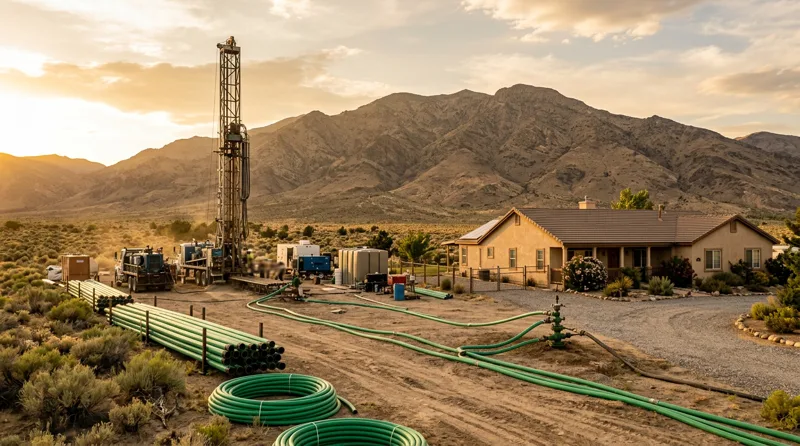
Why Nevada Is Two States for Geothermal
Here's the thing most people don't realize about Nevada: it's really two different states when it comes to heating and cooling. Las Vegas sits at 2,000 feet in the Mojave Desert, where summer highs regularly hit 115°F and your AC runs eight months a year. Reno perches at 4,500 feet in the high desert of the Sierra Nevada rain shadow, where winter lows drop below 10°F and heating is actually the dominant load.
This split personality creates two completely different geothermal conversations — and both of them are interesting.
In Las Vegas, the case for geothermal is all about cooling. When it's 112°F outside, your conventional air conditioner is trying to reject heat into air that's already brutally hot. A ground-source heat pump dumps that heat into 72°F ground instead — roughly 40°F cooler than ambient air. That temperature difference translates directly into efficiency. Your compressor doesn't have to work nearly as hard, and your COP jumps from around 2.0 (a typical air-source unit struggling in extreme heat) to 4.0 or higher. That's essentially twice the cooling for the same electricity.
In Reno, the conversation flips. With over 6,000 heating degree days per year, Reno has a legitimate cold-climate heating need. Many homes outside the city limits heat with propane — and at $3.00+ per gallon, propane is brutally expensive per BTU. A geothermal system heating from 55°F ground instead of 15°F air makes an enormous difference in efficiency and operating cost.
Three things define the Nevada geothermal equation:
- Moderate electricity rates. Nevada's average residential electricity rate is 11.47¢/kWh (EIA 2024), which is below the national average of 16.63¢. This is overwhelmingly positive for geothermal — cheap electricity plus high COP means very low operating costs. NV Energy serves roughly 95% of the state's residential customers.
- Water scarcity that eliminates open-loop. Nevada is the driest state in the nation, averaging just 9.5 inches of rainfall annually. The Colorado River is over-allocated, Lake Mead has been in crisis-level decline, and groundwater rights are fiercely regulated. In practical terms, open-loop geothermal systems are essentially impossible for most Nevada homeowners. Closed-loop is the only game in town.
- Nation-leading solar synergy. Nevada ranks #1 in solar energy per capita and receives 294+ sunny days per year. Pairing a geothermal heat pump with rooftop solar creates the ultimate self-consumption loop — your panels power your ground-source system directly, slashing grid dependence to near zero.
Let's be direct about what doesn't work: if you heat with natural gas in a Las Vegas tract home and your cooling bills are manageable, geothermal payback will likely stretch past 15 years. Las Vegas gas rates are among the cheapest in the nation thanks to Southwest Gas's proximity to pipeline infrastructure. The economics only get compelling when you're replacing propane, electric resistance, or have monster cooling loads in a larger home.
Quick Verdict: Should You Go Geothermal in Nevada?
| Your Situation | Verdict | Typical Payback |
|---|---|---|
| Reno/rural — propane heating | ✅ Best NV scenario | 6–9 years |
| Any region — electric resistance heating | ✅ Strong savings immediately | 5–8 years |
| New construction — anywhere in Nevada | ✅ Incremental cost is manageable | 5–9 years |
| USDA REAP eligible — rural property | ✅ Up to 50% cost coverage | 3–6 years |
| Las Vegas — extreme cooling load (3,500+ sq ft) | ✅ Ground is 40°F cooler than air in summer | 9–14 years |
| Las Vegas — gas heating, moderate cooling | ⚠️ Honest: long payback | 15–22 years |
| Reno — gas heating, moderate home | ⚠️ Possible but marginal | 12–18 years |
| Vacation rental — Tahoe-adjacent or Lake Las Vegas | ✅ High usage + marketing value | 8–13 years |
Does Geothermal Work in the Desert?
This is the first question everyone asks, and the short answer is: absolutely yes, and arguably better than in most other states — at least for cooling.
Here's why. The desert surface gets insanely hot. Las Vegas pavement can reach 160°F in July. But dig down just 10 feet and the temperature drops to a remarkably stable 72–75°F. Go to 200 feet — a typical vertical bore depth — and you're looking at around 72°F year-round, regardless of what's happening on the surface.
That temperature stability is the entire magic of geothermal. When your air conditioner has to reject heat into 112°F air, it's fighting an uphill battle. The temperature differential between your desired indoor temp (say 76°F) and the outdoor heat sink is only about 36°F — but the compressor is working against that hot-side air. When a geothermal system rejects heat into 72°F ground, the math changes completely. The compressor barely has to work.
The numbers bear this out. A conventional air-source heat pump in Las Vegas summer might achieve a COP of 1.8–2.2. That same tonnage of geothermal capacity can deliver COP 4.0–5.0. You're getting roughly twice as much cooling per kilowatt-hour. On a 5-ton residential system running 10+ hours a day during summer, that efficiency gain adds up fast.
Reno's story is different but equally compelling. Ground temperatures at depth in the Reno-Sparks area average around 55–58°F. In January, when outside air is 25°F and an air-source heat pump is struggling (or giving up entirely and switching to auxiliary heat strips), a ground-source unit is pulling heat from relatively warm earth. The COP stays at 3.5–4.0 even during the coldest nights. That's the kind of consistency that makes a real difference in your heating bills.
The desert actually offers one underappreciated advantage for geothermal: dry soil has lower thermal conductivity than saturated soil, which means the ground doesn't absorb and hold summer surface heat as effectively. The stable deep-ground temperatures in Nevada are remarkably consistent even compared to humid-climate states where soil moisture can create seasonal temperature swings at moderate depths.
The Water Scarcity Reality: Why Open-Loop Is Dead in Nevada
Let's talk about the elephant in the room. Nevada is the driest state in America. The Colorado River — which supplies Las Vegas — is in the middle of a multi-decade megadrought. Lake Mead hit its lowest level since being filled in the 1930s. The Southern Nevada Water Authority has been in conservation crisis mode for years, banning decorative grass, paying residents to rip out lawns, and imposing strict watering schedules.
Against that backdrop, the idea of pumping groundwater through an HVAC system and discharging it seems... tone-deaf at best, impossible at worst. And practically speaking, it is.
Open-loop geothermal systems, which pump groundwater through the heat exchanger and then discharge it (either back into the ground or into a surface water body), face multiple barriers in Nevada:
- Water rights. Nevada operates under the prior appropriation doctrine — "first in time, first in right." New groundwater appropriation permits are extraordinarily difficult to obtain in most basins, particularly in Clark County (Las Vegas) and Washoe County (Reno). The Nevada Division of Water Resources has designated many basins as "over-allocated."
- Discharge permits. Even if you secure water rights, discharging used water requires permits from the Nevada Division of Environmental Protection (NDEP). For residential systems, the permitting burden is typically not worth the effort.
- Public perception. In a state where water conservation is a civic religion, installing a system that uses groundwater for HVAC is a tough sell — even if the water is returned to the aquifer.
- Depth to water table. In Las Vegas Valley, the water table is 100–300+ feet below surface in many areas. That's far deeper than the 20–50 foot range that makes open-loop cost-effective. In Reno, depth is more variable (30–150 feet) but still presents challenges.
The practical conclusion is straightforward: if you're building a geothermal system in Nevada, you're building a closed-loop system. Period. The rare exceptions might be agricultural properties in northern Nevada with existing water rights and high-flow wells, but for residential applications in Las Vegas or Reno, don't even consider open-loop. Your installer shouldn't either.
Caliche & Hardpan: The Drilling Challenge Nobody Tells You About
Now for the genuinely bad news — and I want to be honest about this because it affects your bottom line.
The Las Vegas Valley is underlain by a geological formation called caliche — a hardened layer of calcium carbonate-ceite-cemented soil that's essentially natural concrete. This layer, which can range from a few feet to dozens of feet thick, sits between the surface and the deeper sedimentary rock. And it's a nightmare to drill through.
Caliche dramatically increases drilling costs for vertical bore geothermal systems. Where a typical vertical bore in soft sedimentary soil might cost $15–20 per foot, drilling through caliche in Las Vegas can push costs to $20–30+ per foot. For a residential system needing 600–800 feet of total bore depth (typically 3–4 bores at 200 feet each), that premium adds $3,000–8,000 to your installation cost.
There are workarounds:
- Experienced local drillers. Las Vegas-area geothermal drillers who know the local geology can often identify the caliche layer depth from existing well logs and plan accordingly. Some use air rotary drilling methods specifically designed for caliche.
- Horizontal loops. For properties with sufficient yard space — which is increasingly rare in new Las Vegas subdivisions — horizontal slinky loops avoid the deep drilling entirely. They require more land area but stay in the upper 6–8 feet where caliche may be less consolidated.
- Bore spacing. Proper bore spacing (15–20 feet minimum in Nevada's dry soil) prevents thermal interference and ensures the ground can handle the concentrated cooling rejection that Las Vegas summer loads demand.
Reno has different geology — largely alluvial deposits from the Truckee River and ancient Lake Lahontan — that's generally easier to drill through. Costs in the Reno-Sparks area tend to be more in line with national averages.
Bottom line: get at least three drilling quotes in the Las Vegas area, and make sure your installer has drilled in your specific neighborhood before. Geology can vary block to block.
Nevada Geology & Drilling Conditions by Region
The cost and complexity of a geothermal installation in Nevada depends heavily on what's underground. Nevada's basin-and-range geology creates dramatically different drilling conditions across the state — from Las Vegas's notorious caliche hardpan to Reno's favorable Lahontan alluvium to the dense crystalline rock of the Sierra Nevada foothills. Understanding your regional geology helps you evaluate installer bids, set realistic cost expectations, and ask the right questions before signing a contract.
| Region | Primary Geology | Typical Bore Depth | Drilling Cost/Ft | Thermal Conductivity | Key Notes |
|---|---|---|---|---|---|
| Las Vegas Valley (core) | Desert alluvium + caliche hardpan | 200–250 ft | $22–$30/ft | 0.8–1.2 W/m·K (dry) | Caliche requires air rotary drilling; adds $3,000–$8,000 per job; pull county well logs to verify caliche depth in your specific neighborhood |
| Henderson / Boulder City | Alluvial deposits + scattered limestone | 200–240 ft | $20–$27/ft | 0.9–1.4 W/m·K | More consistent than LV core; fewer caliche surprises; standard vertical bore equipment typically sufficient |
| Pahrump Valley | Alluvial fan deposits, desert playa | 180–230 ft | $17–$23/ft | 0.9–1.3 W/m·K | Ample lot size enables horizontal loops; propane-dependent homes create the best NV ROI; less caliche than LV metro |
| Reno / Sparks | Lake Lahontan alluvium, Truckee River deposits | 150–200 ft | $15–$20/ft | 1.2–1.8 W/m·K | Most favorable drilling conditions in populated NV; standard rotary equipment; moisture-enhanced conductivity near river corridors |
| Carson Valley / Minden | Alluvial fans, glacial outwash, valley fill | 150–220 ft | $15–$20/ft | 1.3–1.9 W/m·K | Good conditions overall; some clay layers that improve thermal conductivity; horizontal loops viable on larger rural parcels |
| Elko / Spring Creek | Basin-range sediments, volcanic tuff | 150–200 ft | $13–$18/ft | 1.4–2.1 W/m·K | Best drilling economics in the state; propane-dependent region maximizes ROI; most properties qualify for USDA REAP |
| Lake Tahoe / Incline Village | Decomposed granite, volcanic basalt, Sierra crystalline rock | 200–300 ft | $20–$28/ft | 2.0–3.2 W/m·K | Higher drilling cost but exceptional thermal conductivity in hard rock; vacation property economics justify the premium; elevation adds meaningful heating load |
Why thermal conductivity matters: Higher thermal conductivity means the ground exchanges heat more efficiently with your loop pipes. Crystalline rock around Lake Tahoe conducts heat so well that you can get maximum exchange from fewer bore feet. Dry desert sediments in Las Vegas have lower conductivity — which is why bores run deeper and bore spacing must be wider to prevent thermal interference. Your installer should conduct a thermal conductivity test on-site before finalizing the loop design. This 48-hour test costs $500–$1,500 but prevents costly undersizing — especially critical for Las Vegas's high cooling loads.
Using Nevada's well log database: The Nevada Division of Water Resources maintains a searchable well log database at water.nv.gov. Any experienced geothermal installer should pull logs from nearby wells before drilling to understand the subsurface profile — especially caliche layer depth in the Las Vegas Valley, which can vary significantly from block to block. Be cautious with any Las Vegas installer who doesn't ask about your address to check well logs before quoting.
Regional Costs & ROI
Geothermal system costs in Nevada vary significantly by region, primarily driven by drilling conditions, system size (cooling-dominant vs. heating-dominant), and installer availability. Here's what you can expect as of 2026:
| Region | Typical Home | System Cost (Before Incentives) | After 30% Federal ITC | Annual Savings vs. Conventional | Simple Payback |
|---|---|---|---|---|---|
| Las Vegas Metro | 2,200 sq ft, 4-ton | $28,000–$38,000 | $19,600–$26,600 | $1,400–$2,200 | 10–16 years |
| Henderson / Boulder City | 2,500 sq ft, 5-ton | $32,000–$42,000 | $22,400–$29,400 | $1,600–$2,500 | 10–15 years |
| Reno / Sparks | 2,000 sq ft, 3.5-ton | $24,000–$32,000 | $16,800–$22,400 | $1,800–$3,200 | 6–11 years |
| Carson City / Minden | 2,200 sq ft, 4-ton | $25,000–$34,000 | $17,500–$23,800 | $1,600–$2,800 | 7–12 years |
| Rural / Pahrump | 1,800 sq ft, 3-ton | $22,000–$30,000 | $15,400–$21,000 | $2,000–$3,500 | 5–8 years |
A few things jump out from this table:
- Las Vegas costs more. Caliche drilling, larger cooling loads (requiring bigger systems), and the sheer demand for cooling capacity in summer push both equipment and installation costs higher. A 4-ton system in Las Vegas often has supplemental capacity that a 3.5-ton system in Reno doesn't need.
- Reno and rural areas have better payback. Lower drilling costs, propane displacement (for rural homes), and meaningful heating savings make the math work faster in northern Nevada.
- Rural properties are the sweet spot. Pahrump, Tonopah, Elko, Ely — these communities often rely on propane or electric resistance heating, have larger lots for easier loop installation, and may qualify for USDA REAP grants. If you're in rural Nevada on propane, geothermal is a no-brainer.
The savings estimates above assume you're replacing a combination of natural gas furnace + central AC (for Las Vegas) or propane furnace + electric AC (for rural). If you're replacing electric resistance baseboard heating, your savings will be substantially higher — potentially $3,000–5,000 per year in Reno's climate.
Case Study: Reno-Area Propane Home Conversion
Let's walk through a real-numbers scenario for the best case in Nevada — a Reno-area home converting from propane.
The Property
- Location: Cold Springs (northwest of Reno), elevation 4,800 feet
- Home: 2,400 sq ft, built 2005, reasonably well-insulated (R-30 attic, R-13 walls, dual-pane windows)
- Current heating: Propane furnace (92% AFUE), 1,000-gallon tank
- Current cooling: 3.5-ton central AC (14 SEER)
- Annual propane consumption: 900 gallons at $3.15/gallon = $2,835/year for heating
- Annual electricity for cooling: ~$480 (Reno has modest cooling loads — maybe 800 CDD)
- Total annual HVAC cost: $3,315
The Geothermal System
- System: 4-ton, two-stage ground-source heat pump (COP 4.2 heating / EER 18 cooling)
- Loop: Vertical closed-loop, 3 bores × 200 feet = 600 linear feet
- Drilling cost: $10,800 (at $18/ft — Reno-area alluvial soil)
- Equipment + indoor unit: $9,500
- Ductwork modifications: $1,800
- Piping, grout, antifreeze: $3,200
- Electrical upgrades: $1,200
- Permits + commissioning: $1,500
- Total installed cost: $28,000
The Math
- Federal ITC (30%): −$8,400
- Net cost after tax credit: $19,600
- New annual heating electricity: ~$820 (COP 4.2 vs. propane at 92% efficiency, at 11.47¢/kWh)
- New annual cooling electricity: ~$290 (EER 18 vs. SEER 14)
- New total annual HVAC cost: $1,110
- Annual savings: $3,315 − $1,110 = $2,205/year
- Simple payback: $19,600 ÷ $2,205 = 8.9 years
Additional Factors
Propane prices have been volatile — ranging from $2.50 to $4.00+ per gallon in the Reno area over the past five years. If propane hits $3.50/gallon (which it has during cold winters), the annual savings jump to $2,700+ and payback drops to 7.3 years. There's also the value of eliminating propane delivery logistics, tank rental fees ($50–100/year from most providers), and the stress of watching propane prices spike during polar vortex events.
For a detailed comparison of these two fuel types, see our geothermal vs. propane analysis.
Case Study: Las Vegas Cooling-Dominant Home
Now let's look at the tougher case — a Las Vegas home where the primary value proposition is cooling efficiency. I want to be honest about this one because it's not as clear-cut.
The Property
- Location: Summerlin (west Las Vegas), elevation 3,200 feet
- Home: 2,800 sq ft, built 2012, good insulation (meets 2009 IECC), two-story
- Current heating: Natural gas furnace (96% AFUE) — Southwest Gas service
- Current cooling: 5-ton central AC (16 SEER), runs April through October
- Annual gas bill (heating + water heater + cooking): $720 ($480 attributed to heating)
- Annual electricity for cooling: ~$1,950 (this is a big number — Las Vegas has 4,000+ CDD)
- Total annual HVAC cost: $2,430
The Geothermal System
- System: 5-ton, variable-speed ground-source heat pump (COP 3.8 heating / EER 20 cooling)
- Loop: Vertical closed-loop, 4 bores × 225 feet = 900 linear feet
- Drilling cost: $22,500 (at $25/ft — caliche-affected Las Vegas soil)
- Equipment + indoor unit: $11,000
- Ductwork modifications: $2,200
- Piping, grout, antifreeze: $4,100
- Electrical upgrades: $1,400
- Permits + commissioning: $1,800
- Total installed cost: $43,000
The Math
- Federal ITC (30%): −$12,900
- Net cost after tax credit: $30,100
- New annual cooling electricity: ~$1,170 (EER 20 vs. SEER 16 — ~40% reduction)
- New annual heating electricity: ~$350 (replacing gas furnace — cheaper per BTU at COP 3.8 and NV electricity rates)
- Lost gas savings from keeping gas range/water heater: Still paying ~$240/year gas base charges
- New total annual HVAC cost: $1,760
- Annual savings: $2,430 − $1,760 = $670/year
- Simple payback: $30,100 ÷ $670 = 44.9 years
The Honest Assessment
Yeah, 45 years. That's not a typo, and I'm not going to sugarcoat it. For a Las Vegas home on cheap natural gas with a modern, reasonably efficient AC system, the raw payback math is brutal. Here's why:
- Gas heating is cheap. Southwest Gas rates in Las Vegas are among the lowest in the nation. You just can't save much by replacing a 96% AFUE gas furnace with a geothermal system at Nevada electricity rates.
- The cooling savings are real but not enormous. Going from SEER 16 to geothermal's EER 20 equivalent saves $780/year — meaningful but not transformative against a $43,000 system cost.
- Caliche drilling is expensive. That $22,500 drilling bill is the killer. If this home were in Reno with $18/ft drilling, the installed cost drops to $35,500 (net $24,850 after ITC).
When the Vegas math DOES work:
- Homes over 4,000 sq ft with $3,000+ annual cooling bills
- Homes replacing aging equipment (AC already needs replacement — then you're comparing incremental cost, not full system cost)
- Homes going all-electric and adding solar (eliminating the gas connection entirely saves $15–25/month in gas base charges)
- New construction (where the geothermal premium over conventional is $15,000–20,000, not the full $43,000)
Case Study: Henderson New Construction — All-Electric + Solar Stack
The most financially compelling geothermal scenario in Nevada isn't replacing an existing system — it's building a new home without a gas line from day one. Here's how the math plays out for a Henderson new construction going fully electric with geothermal and solar.
The Property
- Location: Henderson, Nevada (Green Valley area, elevation 1,800 ft)
- Home: New construction, 2,800 sq ft, two-story, built to 2021 IECC energy code
- Comparison baseline: Standard spec: 5-ton 18 SEER AC + 96% AFUE gas furnace + gas water heater
- Upgrade path: 4.5-ton variable-speed GSHP + desuperheater + heat pump water heater + 9 kW rooftop solar
Cost Comparison: Standard vs. All-Electric + Geo + Solar
- Standard HVAC (5-ton 18 SEER + gas furnace): $14,500
- Gas line stub-out + meter connection: $3,200 (required for gas option)
- Standard build total for HVAC + gas: $17,700
- —
- Geothermal system (4.5-ton variable-speed): $33,500 (vertical bore, Henderson alluvial + shallow caliche zone, ~$23/ft)
- Heat pump water heater: $1,300
- 9 kW solar array (31 panels): $22,000
- Geothermal + solar + HPWH combined: $56,800
- Incremental premium over standard: $56,800 − $17,700 = $39,100
Incentives on the Premium
- Federal ITC on geothermal + HPWH (30% of $34,800): −$10,440
- Federal ITC on solar (30% of $22,000): −$6,600
- Total combined ITC: −$17,040
- Net incremental cost after incentives: $39,100 − $17,040 = $22,060
- Monthly payment (20-year, 6.75% rolled into construction loan): ~$167/month
Annual Operating Cost Comparison
- Standard HVAC + gas (Year 1 estimate): $2,780/year (cooling $1,920 + gas heating $500 + gas water heater $360)
- Geo + solar + HPWH (Year 1 net): ~$310/year (electricity net of solar self-consumption)
- Annual savings: $2,780 − $310 = $2,470/year
- Monthly savings: ~$206/month
The Bottom Line
The monthly savings ($206) exceed the incremental loan payment ($167) from month one — this combination is cash-flow positive immediately, even before the tax credits hit your April return. Simple payback on the net premium: $22,060 ÷ $2,470 = 8.9 years. After payback, the home generates $2,500+ per year in net savings for the remaining 15–20 year life of the solar array and the 20–25 year life of the geothermal equipment.
The new construction angle eliminates the biggest barrier to geothermal adoption: avoiding the cost of ripping out a functional existing system. You're paying the incremental premium between what the builder was going to spend anyway and what the higher-spec system costs. That's a fundamentally different — and much more favorable — economic equation than a full retrofit.
For a deep dive on the new construction timing advantage, see our complete guide to geothermal in new construction and our solar + geothermal combination guide.
Month-by-Month Energy Profile
Understanding how geothermal performance varies throughout the year helps set realistic expectations. Here's a typical 2,200 sq ft home in each of Nevada's two main climate zones:
| Month | Las Vegas Avg High/Low | LV Geothermal kWh | LV Conventional kWh + Gas | Reno Avg High/Low | Reno Geothermal kWh | Reno Conventional kWh + Propane |
|---|---|---|---|---|---|---|
| January | 58°/37°F | 380 | 210 kWh + 85 therms | 45°/23°F | 520 | 110 kWh + 130 gal |
| February | 63°/41°F | 310 | 170 kWh + 65 therms | 50°/27°F | 440 | 95 kWh + 105 gal |
| March | 70°/47°F | 220 | 110 kWh + 30 therms | 57°/31°F | 350 | 80 kWh + 75 gal |
| April | 79°/55°F | 290 | 380 kWh | 63°/35°F | 210 | 60 kWh + 40 gal |
| May | 90°/64°F | 480 | 680 kWh | 72°/42°F | 140 | 95 kWh |
| June | 100°/74°F | 680 | 1,020 kWh | 82°/50°F | 180 | 210 kWh |
| July | 106°/81°F | 820 | 1,280 kWh | 92°/57°F | 280 | 380 kWh |
| August | 104°/79°F | 790 | 1,220 kWh | 90°/55°F | 260 | 350 kWh |
| September | 96°/70°F | 560 | 840 kWh | 82°/47°F | 170 | 220 kWh |
| October | 81°/57°F | 280 | 360 kWh | 67°/36°F | 250 | 55 kWh + 35 gal |
| November | 66°/44°F | 290 | 130 kWh + 50 therms | 52°/28°F | 410 | 75 kWh + 90 gal |
| December | 56°/36°F | 400 | 190 kWh + 90 therms | 43°/22°F | 540 | 105 kWh + 135 gal |
Key patterns to notice:
- Las Vegas peak (July): Geothermal uses 820 kWh vs. conventional's 1,280 kWh — a 36% reduction during the most expensive electricity month. NV Energy's tiered rate structure means those peak kWh cost more, so the dollar savings are even larger than the percentage suggests.
- Reno winter: The geothermal system uses more electricity than the conventional setup, but eliminates 130 gallons of propane in January alone. At $3.15/gallon, that's $410 worth of propane replaced by roughly $60 in electricity. That's the kind of math that makes geothermal compelling.
- Shoulder seasons: Both Las Vegas and Reno have lovely spring and fall weather where HVAC loads are minimal. These months drag down annual savings somewhat — you can't save much when you're barely running the system.
Open-Loop System Assessment by Region
Despite our earlier discussion about water scarcity, I want to give a thorough, region-by-region assessment. Some northern Nevada locations might technically support open-loop, but the barriers are formidable everywhere.
| Region | Water Table Depth | Groundwater Availability | Permitting Difficulty | Open-Loop Feasibility |
|---|---|---|---|---|
| Las Vegas Valley | 100–300+ feet | Critically over-allocated | Essentially impossible for new residential permits | ❌ Not feasible |
| Henderson / Boulder City | 150–400 feet | Severely limited (Lake Mead watershed) | Extremely difficult | ❌ Not feasible |
| Pahrump Valley | 80–200 feet | Declining aquifer, designated basin | Very difficult — basin is over-appropriated | ❌ Not feasible |
| Reno / Sparks | 30–150 feet | Limited — Truckee River adjudication | Difficult — most basins fully appropriated | ⚠️ Rarely feasible — existing rights only |
| Carson Valley / Minden | 20–80 feet | Moderate — Carson River system | Difficult but possible in some areas | ⚠️ Possible with existing water rights |
| Elko / Spring Creek | 20–100 feet | Better than southern NV | Moderate — check basin designation | ⚠️ Best chance in state — still challenging |
| Fallon / Churchill County | 10–50 feet | Irrigation district water available | Moderate | ⚠️ Possible — agricultural properties |
The takeaway: unless you're in rural northern Nevada with existing water rights and a high-producing well, plan for closed-loop. Your installer should recommend this by default. If someone tries to sell you an open-loop system in Las Vegas, find a different installer.
Loop Type Cost Comparison
For the vast majority of Nevada installations, you're choosing between vertical closed-loop and horizontal closed-loop. Here's how they compare in Nevada's specific conditions:
| Loop Type | Cost per Ton | Land Required | Best For | Nevada-Specific Notes |
|---|---|---|---|---|
| Vertical Closed-Loop | $6,000–$9,500 | Minimal (10' × 10' per bore) | Small lots, Las Vegas subdivisions | Caliche increases drilling cost in LV Valley; standard choice for most NV installations |
| Horizontal Closed-Loop | $4,000–$6,500 | Large (400–600 sq ft per ton) | Rural properties, Pahrump, ranch land | Desert soil is dry — may need longer loops for equivalent heat exchange; trench depth 6–8 feet |
| Horizontal Slinky | $4,500–$7,000 | Moderate (200–400 sq ft per ton) | Medium lots with yard space | Coiled design reduces land needs; still requires more space than typical Las Vegas lot offers |
| Pond/Lake Loop | $3,500–$5,500 | Body of water (0.5+ acres) | Properties adjacent to irrigation ponds | Extremely rare in NV — virtually no natural ponds; some ranch properties in northern NV may qualify |
| Open-Loop (Standing Column) | $5,000–$8,000 | Minimal | Not applicable in most of NV | Water rights + permits make this effectively impossible for residential in most of the state |
For most Las Vegas homeowners, vertical closed-loop is the only practical choice. Lots in subdivisions like Summerlin, Green Valley, and North Las Vegas are typically 6,000–8,000 square feet — enough for vertical bores but not enough for horizontal loops. Rural properties in Pahrump, Mesquite, or northern Nevada have the space for horizontal installations, which can save $5,000–15,000 over vertical.
Incentive Stacking: Federal ITC & Nevada Programs
Let's talk about every dollar you can capture to offset your geothermal investment. The incentive landscape for Nevada is straightforward but lacks the state-level programs that some neighboring states offer.
Federal Investment Tax Credit (ITC) — 30%
This is the big one, and it applies to every geothermal installation in America. Under the Inflation Reduction Act (IRC §25D), ground-source heat pumps qualify for a 30% tax credit through 2032, stepping down to 26% in 2033 and 22% in 2034.
- Covers: Equipment, installation labor, drilling, piping, ductwork modifications, desuperheater — essentially the full installed cost
- Type: Non-refundable tax credit (reduces your tax liability dollar-for-dollar, but doesn't generate a refund beyond what you owe)
- Carryforward: Unused credit can roll forward to future tax years — so even if your tax liability is lower than the credit in the installation year, you won't lose it
- No cap: Unlike some energy credits, there's no maximum dollar amount on the geothermal ITC
Nevada State Incentives
Here's where Nevada falls short compared to states like California or Arizona. Nevada does not currently have a state-level tax credit, rebate, or incentive program specifically for geothermal heat pumps. Let me break down what does and doesn't exist:
- NV Energy rebates: NV Energy offers rebates for energy-efficient HVAC equipment, but their current program focuses on air-source heat pumps and does not include ground-source/geothermal systems. [NEEDS VERIFICATION — NV Energy's rebate page requires JavaScript and couldn't be fully confirmed. Check nvenergy.com/save-with-nv-energy/rebates for current offerings.]
- Nevada Property Tax Exemption for Renewable Energy: Nevada offers a partial property tax abatement for qualifying renewable energy systems (NRS 701A.110). However, this program is primarily designed for solar and wind installations. Whether ground-source heat pumps qualify is ambiguous and may depend on your county assessor's interpretation. [NEEDS VERIFICATION]
- No state tax credit: Nevada has no state income tax, so there's no state-level income tax credit possible.
- Net metering (for solar + geothermal): Nevada's net metering program (NRS 704.766) applies to solar installations that power your geothermal system, though NEM rates have been restructured. More on this in the solar stacking section.
USDA REAP Grant (Rural Properties)
The Rural Energy for America Program (REAP) is potentially the most powerful incentive for rural Nevada property owners. REAP provides grants covering up to 50% of project costs (with a combined grant + loan guarantee of up to 75%) for agricultural producers and rural small businesses.
- Grant amount: Up to 50% of total project costs
- Eligible applicants: Agricultural producers and rural small businesses (rural areas generally exclude Las Vegas metro and Reno city limits)
- Stackable with ITC: Yes — you can claim the USDA REAP grant AND the federal 30% ITC, though the ITC basis is reduced by the grant amount
- Nevada USDA office: Contact the USDA Rural Development Nevada State Office in Carson City for application details
Example stack for a rural Nevada agricultural property:
- System cost: $28,000
- USDA REAP grant (40%): −$11,200
- Adjusted basis: $16,800
- Federal ITC (30% of adjusted basis): −$5,040
- Net cost: $11,760 (58% total reduction)
IRA Home Energy Rebates (HER / HOMES)
The Inflation Reduction Act created two additional rebate programs administered by states: the Home Efficiency Rebates (HOMES) and the Home Electrification and Appliance Rebates (HEAR). Nevada's implementation of these programs through the Governor's Office of Energy is still being finalized as of early 2026. Heat pump systems (including ground-source) are eligible under both programs, with income-based rebate tiers:
- Low-income households (<80% AMI): Up to 100% of costs, capped at $8,000 for heat pump systems
- Moderate-income (80–150% AMI): Up to 50% of costs, capped at $8,000
- Market rate (>150% AMI): Rebate based on measured energy savings (HOMES program)
[NEEDS VERIFICATION — Nevada's specific HOMES/HEAR program launch dates and application process should be confirmed through the Nevada Governor's Office of Energy at energy.nv.gov]
Solar + Geothermal: Nevada's Killer Combo
Now for the section that should genuinely excite anyone considering geothermal in Nevada. This state is arguably the best place in America to pair solar panels with a ground-source heat pump — and it's not even close.
Why Nevada Solar Is Elite
Nevada receives an average of 5.8–6.4 peak sun hours per day (Las Vegas area), making it one of the top 3 solar resources in the nation. A typical 8 kW residential solar array in Las Vegas produces 13,000–14,500 kWh per year. In Reno, you're looking at 5.2–5.6 peak sun hours and about 11,500–12,500 kWh from the same array.
Nevada ranked #1 in solar energy per capita as recently as 2023, and rooftop solar penetration in Las Vegas suburbs is among the highest in the country. The infrastructure, installer competition, and permitting pathways are all mature.
The Self-Consumption Advantage
Here's why solar + geothermal is better than solar alone: net metering in Nevada has been restructured. Under the current NEM program, excess solar energy exported to the grid is credited at a rate well below the retail rate you pay for electricity consumed. The exact credit rate depends on when you interconnected and your rate class, but the trend is clear — exporting solar electricity is worth less than consuming it on-site.
A geothermal heat pump is the ultimate "solar sponge." It converts your excess solar production into heating and cooling instead of exporting it for reduced credit. During a Las Vegas summer day, your solar panels are producing at peak capacity at the exact same time your geothermal system is running at peak cooling load. The alignment is nearly perfect.
Combined System Economics
Let's model a combined solar + geothermal system for a Las Vegas home:
- 8 kW solar array: $18,400 installed (before incentives)
- 4-ton geothermal system: $33,000 installed
- Combined cost: $51,400
- Combined ITC (30%): −$15,420
- Net combined cost: $35,980
- Annual electricity offset by solar: ~$1,600 (at 11.47¢/kWh retail, self-consumed)
- Annual HVAC savings from geothermal: ~$900
- Eliminated gas bill (going all-electric): ~$720
- Total annual savings: ~$3,220
- Combined payback: $35,980 ÷ $3,220 = 11.2 years
Compare that to the geothermal-only payback of 45 years for that same Las Vegas home. The solar transforms the economics because it addresses the core problem — geothermal saves a percentage of your electricity bill, but solar slashes the entire bill. Together, they create savings that neither system achieves alone.
Battery Storage Consideration
Adding a battery (like the Tesla Powerwall or Enphase IQ Battery) to a solar + geothermal system makes less economic sense in Nevada than in California. NV Energy's time-of-use rates have a smaller peak-to-off-peak differential than California's, so the arbitrage value is lower. However, if grid resilience matters to you (Las Vegas does experience summer brownouts during heat waves), a battery provides insurance. The ITC covers batteries too.
Permits, Licenses & Regulatory Requirements
Nevada has a clear but multi-agency regulatory framework for geothermal heat pump installations. The primary complexity isn't the permit count — it's knowing which agency governs what, because HVAC licensing, well drilling authorization, and environmental review each fall under different state bodies. Understanding this before hiring a contractor helps you verify credentials and avoid the small but real risk of unlicensed operators in a state with limited installer competition.
Nevada Contractor Licensing (NSCB)
The Nevada State Contractors Board (NSCB) at nscb.nv.gov issues licenses for all construction trades. A geothermal installation typically requires two separately licensed trades:
- HVAC Contractor — Classification C-21 (Air Conditioning and Refrigeration): Covers indoor unit installation, ductwork, refrigerant handling, and associated electrical work up to the disconnect. Verify at nscb.nv.gov — the license lookup is free and takes under a minute. Confirm the license is active and has no disciplinary history.
- Well/Loop Driller — NV Division of Water Resources (NDWR): Under NRS Chapter 534, all well drillers in Nevada must be licensed through NDWR. This license covers drilling the vertical bores and installing the loop piping within them. Some integrated geothermal contractors hold both C-21 and NDWR driller licenses; others subcontract the drilling to a licensed specialist. Either structure is acceptable — verify both licenses.
- Electrical — C-2 Electrical Contractor: If your installation requires panel upgrades or new dedicated circuits beyond what the C-21 contractor handles, a separate C-2 licensed electrician may be needed. Many geothermal contractors have both C-21 and C-2 classifications.
- EPA Section 608 Certification: Any technician handling refrigerant must hold EPA 608 certification. Ask for it — any reputable contractor will have it and won't hesitate to show you.
Required Permits by Installation Type
| Permit Type | Issuing Agency | Approximate Cost | Processing Time | Required For |
|---|---|---|---|---|
| Mechanical Permit | Local building dept. (Clark County, City of Reno, etc.) | $150–$500 | 3–10 business days | All geothermal installations — indoor unit, ductwork, refrigerant system |
| Well Drilling Permit | NV Division of Water Resources (NDWR) | $100–$250 + $1/ft | 3–15 business days | All vertical bore closed-loop installations |
| Well Completion Report | NV Division of Water Resources | $0 (required filing) | Filed within 30 days of completion | All bored wells — driller's legal responsibility to file |
| Electrical Permit | Local building dept. | $75–$250 | 2–5 business days | New circuits for compressor; panel upgrades |
| Open-Loop Water Rights | NV Division of Water Resources | $1,000–$5,000+ (legal) | Months to years | Open-loop systems only — essentially unavailable in most NV basins |
| NDEP Discharge Authorization | Nevada Division of Environmental Protection | $500–$2,000 | 4–12 weeks | Open-loop systems with surface water discharge — very rare residential scenario |
County-Specific Notes
Clark County (Las Vegas metro): The Clark County Building Department processes most residential mechanical permits online through the Citizen Access Portal (citizenaccess.clarkcountynv.gov). For a standard residential geothermal installation (closed-loop vertical bore, no gas line disconnection), you typically need a mechanical permit and an NDWR well drilling permit. Expect 5–10 business days for mechanical permit review.
Washoe County / City of Reno: Permits go through Washoe County Community Services (for unincorporated areas) or the City of Reno Building and Safety Division. Processing times run 3–7 business days — somewhat faster than Clark County. No unique geothermal-specific requirements beyond state standards.
HOA Approval: Nevada's common interest community law (NRS Chapter 116) restricts HOA authority over certain renewable energy installations. While geothermal heat pumps aren't explicitly named in the same statute as solar, vertical bore installations leave essentially nothing visible on your property — just small flush-mounted well caps. Most Las Vegas and Reno HOAs approve these with minimal friction. Get written HOA approval before contract signing. Your installer should provide a site plan showing bore locations.
Permit Timeline: What to Expect
- Standard closed-loop, Las Vegas metro: 4–6 weeks start to finish (permits 2 weeks + installation 3–7 days + inspection)
- Standard closed-loop, Reno area: 3–5 weeks (slightly faster permitting)
- New construction integration: 2–3 weeks (permits often pulled with the home build package)
- Open-loop (rare rural case): 3–12+ months (NDWR water rights process is the bottleneck)
How to Find and Vet a Nevada Geothermal Installer
Nevada's geothermal contractor market is thin — Las Vegas has perhaps four to six established residential geothermal operators, Reno has a similar number. This isn't a saturated market like Minnesota or Massachusetts where a dozen qualified installers compete aggressively for every job. The limited competition makes due diligence more important, not less. A qualified installer who understands caliche geology, Nevada water law, and the cooling-dominant load profile of a Las Vegas home is genuinely hard to find. Here's how to find them — and how to verify you're not getting someone who installed three systems and hung out a shingle.
Where to Find Qualified Nevada Geothermal Installers
- IGSHPA Member Directory: igshpa.org/member-directory — filter by Nevada. IGSHPA (International Ground Source Heat Pump Association) accreditation means the installer has completed geothermal-specific training and passed an industry exam. This is the gold-standard credential beyond basic HVAC licensing.
- WaterFurnace Dealer Locator: waterfurnace.com/find-a-dealer — WaterFurnace is the dominant residential geothermal brand in the western U.S. Authorized dealers receive factory training on product installation and design.
- ClimateMaster Dealer Locator: climatemaster.com/find-a-dealer — factory-trained Nevada dealers.
- Bosch Geothermal (FHP): bosch-heat-pump.com/dealer-locator
- Nevada State Contractors Board: nscb.nv.gov — use the license lookup to verify any C-21 contractor's active status and check for complaints or disciplinary actions.
- USDA REAP-Experienced Installers: If you're pursuing REAP grants, ask directly whether the installer has completed REAP-funded projects before. The grant application requires a project description and cost documentation that experienced installers know how to structure.
8-Point Installer Vetting Checklist
- Verify NSCB C-21 license — active status, no disciplinary history. Takes 60 seconds at nscb.nv.gov. Non-negotiable first step before any other conversation.
- Confirm well driller license. Ask for the NDWR driller license number — either the contractor's own or their drilling subcontractor. Verify it's active at water.nv.gov.
- Ask about IGSHPA accreditation. Not legally required, but a strong signal of geothermal-specific competence beyond basic HVAC training.
- Ask for local references in your specific area. "Have you drilled in my neighborhood before?" is the critical Las Vegas question. Caliche depth varies by block. Ask for permit numbers or prior customer contacts you can call.
- Insist on a site assessment + Manual J load calculation. Any quote without a Manual J is guesswork. Proper sizing determines system performance for 25 years. An oversized system short-cycles; an undersized one can't meet peak Las Vegas cooling loads.
- Ask if they'll pull county well logs for your address. Good installers check the NDWR well log database before quoting. In Las Vegas, this is how they estimate caliche depth and plan the drilling approach. If they haven't done this, their bid may be based on optimistic assumptions.
- Request the equipment manufacturer's ENERGY STAR certification. You need this at tax time for the federal ITC. If they can't produce it, ask why — and verify independently before paying.
- Get three quotes — minimum. Nevada's thin market means some installers know they have limited competition. Three bids create price tension and give you data points to identify outliers in either direction.
Regional Installer Availability
| Region | Availability | Typical Lead Time | Notes |
|---|---|---|---|
| Las Vegas / Henderson metro | Limited (4–6 established contractors) | 4–10 weeks | Caliche expertise is the key differentiator; get at least 3 quotes; ask who does the actual drilling |
| North Las Vegas / Summerlin | Limited (same Las Vegas installer pool) | 4–10 weeks | No availability advantage over core LV; geography is all within the same metro |
| Reno / Sparks | Moderate (4–7 established contractors) | 3–8 weeks | More competitive than Las Vegas; Reno's favorable drilling conditions attract more entrants |
| Carson City / Minden | Limited (served by Reno contractors) | 4–10 weeks | May carry travel premium; ask upfront about travel charges |
| Pahrump / Rural Southern NV | Very limited | 6–14 weeks | May need Las Vegas contractor to travel; worth it for propane homes with strong ROI |
| Elko / Northern Rural NV | Sparse | 6–16 weeks | Idaho and Utah contractors sometimes work this territory; IGSHPA directory is your best source; REAP-experienced installers worth waiting for |
Red flags to walk away from: Any installer who can't produce their NSCB C-21 license number on request. A Las Vegas quote that doesn't acknowledge caliche. Any suggestion that open-loop is a realistic residential option (immediate knowledge gap). Unusually low bids that don't account for Nevada's drilling cost realities.
Maintenance & System Longevity in Nevada
Geothermal heat pumps have the lowest routine maintenance burden of any residential HVAC system — no outdoor unit to protect from weather, no combustion components, no flue to inspect. But Nevada's extreme conditions create a few specific maintenance priorities, particularly for Las Vegas systems running 10+ hours of cooling daily for six months straight.
Annual Maintenance Schedule
| Task | Frequency | Who | Approximate Cost | Nevada-Specific Notes |
|---|---|---|---|---|
| Air filter replacement | Every 4–8 weeks (LV); every 2–3 months (Reno) | Homeowner | $5–$25/filter | Las Vegas dust is relentless — check filters monthly May through September; use MERV 8–11 (not higher, which restricts airflow) |
| Annual system inspection + tune-up | Once per year (spring) | Licensed C-21 technician | $150–$350 | Schedule in March–April before LV cooling season; finding a technician in July during a heat wave is difficult and more expensive |
| Condensate drain cleaning | Annually or as needed | Technician or homeowner | $0–$75 | Las Vegas's high cooling hours produce heavy condensate; algae can grow in drain pans — check during summer if you notice musty odors |
| Loop fluid antifreeze concentration check | Every 5 years or after any loop repair | Geothermal technician | $75–$200 | NV's dry conditions are gentle on loop piping; no additional checks needed between scheduled intervals under normal operation |
| Loop pressure verification | Annually (during tune-up) | Technician | Included in tune-up | Target 50–75 psi in closed loop. Pressure loss indicates a leak — diagnose immediately; don't let it sit |
| Circulation pump inspection | Every 3 years | Technician | $50–$100 or included | The loop pump is statistically the most common mechanical failure point; specify ECM (variable-speed) pumps for longer service life |
| Ductwork leak check | Every 3–5 years | Technician | $100–$300 | Las Vegas attic temperatures exceed 140–150°F in summer; leaky supply ducts routed through unconditioned attic lose significant cooling capacity |
| Refrigerant level verification | Every 5 years or if cooling drops | EPA 608 certified tech | $100–$300 | Geothermal refrigerant circuits rarely leak; investigate immediately if summer cooling performance drops noticeably — don't assume it's the loop |
Component Lifespan in Nevada's Climate
| Component | Expected Lifespan | NV Factors | Replacement Cost (Installed) |
|---|---|---|---|
| Indoor heat pump unit (compressor + heat exchanger) | 20–25 years | High cooling-hours in LV means the compressor works hard all summer; variable-speed inverter compressors last longer than single-stage; proper sizing prevents short-cycling that accelerates wear | $6,500–$14,000 |
| Ground loop (HDPE piping) | 50+ years | Nevada's dry, low-acid soils are actually ideal for HDPE loop longevity; no corrosion, no freeze-thaw pipe stress in loop zone; essentially permanent infrastructure | Not typically replaced — loop outlasts the home's mortgage multiple times |
| Circulation pump (ECM) | 15–25 years | ECM variable-speed pumps significantly outlast older single-speed models; cooling-dominant operation in LV means higher annual run hours than heating-climate states | $600–$1,800 |
| Desuperheater (if equipped) | 15–25 years | Excellent ROI in LV — heavy cooling = substantial "free" water heating production summer through fall; clean heat exchanger every 5 years if water quality is hard (common in LV) | $1,200–$2,800 |
| Controls / smart thermostat | 10–15 years | Smart thermostat that understands NV Energy time-of-use rate schedules is particularly valuable; upgrade when replacing to capture TOU savings | $150–$500 |
| Ductwork | 25–40 years | Duct insulation in LV attics is critical — add R-8 minimum duct wrap if not already present; seal all joints with mastic (not tape, which fails at 150°F attic temps) | $3,500–$14,000 full replacement |
Nevada-Specific Maintenance Notes
- Las Vegas dust storms (haboobs) are real. After any significant dust storm, check your return air filter. A single haboob can clog a filter that was clean the day before. A clogged filter during a 110°F heat wave is a comfort and efficiency emergency.
- Pre-cool with off-peak electricity. NV Energy's time-of-use plans have lower rates late at night and early morning. Program your thermostat to cool the house slightly lower (say, 72°F) between midnight and 6 AM during summer, then allow it to float up to 76–78°F during the 3–8 PM peak window. Geothermal's high efficiency makes this pre-cooling strategy unusually cost-effective.
- Leverage the desuperheater during cooling season. If your system includes a desuperheater, your water heater should be the secondary source (not primary) from May through October. The geothermal system will preheat your water storage to near-setpoint using waste heat that would otherwise go into the ground — at zero additional electricity cost.
- Schedule service before tourist season peaks. HVAC technicians in Las Vegas get extremely busy starting in late April. Book your annual inspection in February or March to avoid wait times and to catch any issues before peak demand.
How to Claim the Federal Tax Credit (IRS Form 5695)
The 30% federal tax credit is claimed on IRS Form 5695 (Residential Clean Energy Credits). Here's how to do it:
-
Confirm your system qualifies
Your geothermal heat pump must meet ENERGY STAR requirements at the time of installation. All major residential ground-source systems from manufacturers like WaterFurnace, ClimateMaster, and Bosch currently qualify. Keep the manufacturer's certification statement — your installer should provide this.
-
Gather your documentation
Collect your final invoice showing total installed cost (equipment, drilling, labor, piping — everything), the ENERGY STAR certification, and proof of installation date. If you financed the system, you still claim the credit on the full cost in the year the installation was completed.
-
Download IRS Form 5695
Get Form 5695 from irs.gov. You want Part I — Residential Clean Energy Credits. This is where geothermal heat pumps are reported.
-
Enter your costs on Line 4
Line 4 of Form 5695 is specifically for geothermal heat pump property. Enter the total installed cost here. This includes equipment, drilling, loop installation, ductwork modifications, and all labor. Do NOT subtract any utility rebates — those don't reduce your ITC basis (USDA REAP grants DO reduce basis, however).
-
Calculate your credit
Add up all eligible clean energy costs (Lines 1–5), enter the total on Line 6a, and multiply by 30% on Line 6b. This is your total Residential Clean Energy Credit amount.
-
Transfer to Form 1040
The credit from Form 5695 flows to Schedule 3 (Form 1040), Line 5. It reduces your tax liability dollar-for-dollar. Note: this is non-refundable, so it can only reduce your tax to zero, not generate a refund. Any excess carries forward to next year.
-
Keep records for your files
Retain your installer invoices, ENERGY STAR certification, and a copy of your filed Form 5695 for at least 6 years. The IRS can audit returns for up to 3 years (6 years in some cases), and you'll want documentation readily available. Nevada has no state income tax, so there's no state form to file — the federal credit is your only tax-based incentive.
Nevada vs. Neighboring States
How does Nevada compare to its neighbors for geothermal feasibility? The Silver State has some distinct advantages and disadvantages depending on which border you're looking across.
| Factor | Nevada | California | Arizona | Utah | Oregon | Idaho |
|---|---|---|---|---|---|---|
| Avg. Electricity Rate (¢/kWh) | 11.47 | 27.04 | 13.16 | 11.35 | 12.27 | 10.58 |
| State Geothermal Incentive | None specific | TECH Clean CA, SGIP | Energy Equipment Property Tax Exemption | Renewable Energy Tax Credit (expires) | Energy Trust of Oregon rebate | None specific |
| Open-Loop Feasibility | Very limited (water scarcity) | Regional (Central Valley yes, SoCal limited) | Very limited (water scarcity) | Good in many areas | Excellent in many areas | Excellent — aquifer access |
| Drilling Conditions | Caliche in LV; alluvial in Reno | Highly variable by region | Caliche in Phoenix metro | Generally favorable | Generally favorable | Basalt challenges in some areas |
| Cooling Load | Extreme (Las Vegas) | Extreme (inland valleys) | Extreme (Phoenix) | Moderate | Low | Low–Moderate |
| Heating Load | Moderate (Reno) to Low (LV) | Low (coast) to High (mountains) | Low | High | High | Very High |
| Solar Synergy Potential | ★★★★★ (Top 3 U.S.) | ★★★★★ | ★★★★★ | ★★★★ | ★★★ | ★★★ |
| Geothermal Payback (Typical) | 6–16 years | 5–25 years | 8–18 years | 6–12 years | 7–14 years | 5–10 years |
| Permitting Complexity | Moderate (NSCB C-21 + NDWR well permit) | Complex (CSLB C-20/C-57 + county + coastal zones) | Moderate (ROC license + county permits) | Moderate (DOPL license + county + DWRi) | Moderate (CCB license + OWRD if open-loop) | Moderate (IPUC + DEQ if open-loop) |
| Installer Availability | Limited (4–6 in LV, 4–7 in Reno) | Good (robust CA market) | Limited (Phoenix-centered, thin elsewhere) | Moderate | Good (Energy Trust program drives demand) | Good (strong geothermal culture) |
Key takeaways from this comparison:
- Nevada's low electricity rate is a double-edged sword. It makes geothermal cheaper to operate (11.47¢ vs. California's 27.04¢ — less than half), but it also means the savings over conventional systems are proportionally smaller. Paradoxically, geothermal often has a shorter payback in expensive-electricity states because the savings per kWh are larger.
- Water scarcity puts Nevada and Arizona in the same boat. Both states are essentially closed-loop-only, which increases costs compared to Idaho and Oregon where open-loop is often the most cost-effective option.
- Nevada and Arizona share caliche challenges. The Las Vegas Valley and Phoenix metro both deal with cemented desert soils that increase drilling costs. If you've read our Arizona guide, many of the same drilling considerations apply.
- Solar synergy is Nevada's ace. Only Arizona and California match Nevada's solar resources, and Nevada's lower electricity rates actually make the solar self-consumption math interesting because the system you're powering costs less to run in the first place.
- Idaho and Utah are the payback champions. High heating loads, reasonable drilling conditions, and available groundwater make our northern neighbors the best geothermal markets in the region. If you're on the Nevada-Idaho border near Jackpot or Owyhee, the economics look more like Idaho than Las Vegas.
Frequently Asked Questions
Does geothermal work in the Las Vegas desert heat?
Yes — and it actually works better for cooling than conventional systems in extreme heat. The ground temperature 200 feet below Las Vegas is a constant 72°F, regardless of whether it's 115°F on the surface. A geothermal heat pump rejects heat into this cool ground instead of fighting against hot desert air, which means it maintains COP of 4.0+ even when conventional AC efficiency drops to COP 1.8–2.2 on the hottest days. The challenge isn't performance — it's cost, primarily due to caliche drilling conditions.
Can I install an open-loop geothermal system in Nevada?
In most of Nevada, no. The state's water scarcity and strict groundwater rights (prior appropriation doctrine) make open-loop systems impractical for residential use. Las Vegas Valley, Henderson, and Pahrump are all in over-allocated basins where new groundwater appropriation permits are essentially unavailable. Some rural northern Nevada locations (Elko, Fallon) may have options if you hold existing water rights, but closed-loop is the standard for 95%+ of Nevada installations.
What is caliche and how does it affect geothermal installation costs?
Caliche is a layer of calcium carbonate-cemented soil found throughout the Las Vegas Valley. It's essentially natural concrete and can be several feet to dozens of feet thick. Drilling through caliche requires specialized equipment (often air rotary rigs) and takes longer than standard sedimentary drilling. This typically adds $3,000–$8,000 to a geothermal installation in Las Vegas compared to what the same system would cost in Reno, where alluvial soils are softer. The Reno-Sparks area generally doesn't have significant caliche issues.
Is geothermal worth it in Reno with the different climate?
Reno is actually one of the better geothermal markets in Nevada, especially for homes heating with propane. With 6,000+ heating degree days per year, Reno has substantial heating needs that geothermal addresses efficiently. The ground temperature at depth (55–58°F) provides a warm heat source during cold winters when air-source heat pumps struggle. Drilling costs are lower than Las Vegas due to softer alluvial soil. For propane homes, payback periods of 6–9 years are realistic after the federal tax credit.
Does Nevada offer any state rebates or tax credits for geothermal?
Nevada does not currently have a state-level tax credit or dedicated rebate for geothermal heat pumps. Since Nevada has no state income tax, an income-based tax credit isn't possible. NV Energy offers some HVAC rebates but these have historically focused on air-source equipment. The primary incentives are the federal 30% ITC, potential USDA REAP grants for rural properties, and the IRA-funded HOMES/HEAR rebate programs (which Nevada is still implementing as of 2026). The federal ITC alone typically covers $6,000–$13,000 of your installation cost.
How does solar + geothermal work together in Nevada?
Nevada is one of the best states in the country for this combination. Solar panels produce peak electricity during summer days — exactly when your geothermal system's cooling load is highest. Instead of exporting excess solar to the grid at reduced NEM rates, the geothermal system consumes that electricity on-site at full retail value. A typical 8 kW solar array paired with geothermal can reduce a Las Vegas home's grid electricity purchases by 70–85%. Both systems qualify for the 30% federal ITC. The combined payback period is often 10–13 years — dramatically better than either system alone.
How deep do geothermal bore holes need to be in Nevada?
Typical vertical bore depths in Nevada range from 150–250 feet per bore, with most residential systems requiring 3–5 bores. In Las Vegas, deeper bores (200–250 feet) are common to ensure adequate heat exchange in dry desert soil and to account for the significant cooling-season heat rejection. In Reno, 150–200 foot bores are typical. Bore spacing should be 15–20 feet minimum in Nevada's dry soils to prevent thermal interference between loops. Your installer will design the loop field based on a soil conductivity test and your home's specific heating/cooling loads.
What about the dry soil in Nevada — does it affect geothermal performance?
Dry soil does have lower thermal conductivity than saturated soil, which means heat transfer between the loop and surrounding earth is somewhat less efficient. This is why Nevada installations typically require slightly more bore footage per ton than systems in humid Midwest states. However, thermally enhanced grout (used to fill the bore around the loop piping) significantly improves heat transfer and compensates for dry conditions. A proper soil conductivity test before installation ensures the loop field is sized correctly. Performance in Nevada's dry soils is well-documented and reliable — it just requires proper design.
How long do geothermal systems last in Nevada's conditions?
The indoor heat pump unit typically lasts 20–25 years — similar to any quality HVAC equipment. The underground loop field, which is the expensive part, lasts 50+ years because HDPE pipe is impervious to corrosion, soil chemistry, and temperature cycling. Nevada's dry conditions are actually easier on loop piping than acidic or high-moisture soils found in other states. You'll likely replace the indoor unit once during the loop's lifetime, but the loop itself is essentially permanent. This long equipment life is a major factor in the lifetime ROI calculation.
Can I install geothermal in a Las Vegas HOA community?
Yes, and this is more straightforward than you might think. Vertical bore installations require minimal surface disruption — the drill rig needs about a 10' × 10' access area per bore, and after installation, the only visible change is small flush-mounted well caps in your yard. Nevada law (NRS 116.2109) prohibits HOAs from banning solar energy systems, and while geothermal isn't explicitly covered by the same statute, many HOAs approve vertical bore installations because there's nothing visible to object to. Get written HOA approval before signing a contract, and ask your installer for photos of completed installations to share with your HOA board.
What licenses should my Nevada geothermal installer have?
At minimum, your installer should hold an active Nevada State Contractors Board (NSCB) C-21 license (Air Conditioning and Refrigeration) and either hold or subcontract to someone with an NV Division of Water Resources (NDWR) well driller license. Verify both at nscb.nv.gov and water.nv.gov respectively — the lookups are free. If the installation requires panel upgrades, a C-2 electrical contractor license is also needed. IGSHPA accreditation (igshpa.org) is not legally required but indicates geothermal-specific training beyond basic HVAC certification, and is strongly preferred. Any technician handling refrigerant must also hold EPA Section 608 certification.
How often does a geothermal system need maintenance in Nevada?
Plan on one professional tune-up per year (schedule it in March or April, before Las Vegas cooling season), plus homeowner air filter changes every 4–8 weeks during the summer in Las Vegas (monthly minimum), or every 2–3 months in Reno. Every 5 years, have a technician verify loop fluid antifreeze concentration and check loop pressure. The underground loop itself requires essentially no maintenance — HDPE pipe in Nevada's dry, non-corrosive soils is good for 50+ years. Annual maintenance costs run $150–$350 for the professional visit plus filters. Total annual maintenance cost is typically $250–$500, compared to $400–$800 for a conventional gas + AC system with two services (heating and cooling tune-ups) plus filter changes.
Bottom Line
Nevada is a state of extremes — extreme heat in the south, extreme cold in the mountains, extreme water scarcity everywhere, and extreme solar potential across the board. Geothermal heat pumps aren't the right answer for every Nevada home, but for the right situations, they're transformative.
The best candidates in Nevada:
- Rural and semi-rural homes heating with propane (anywhere in the state)
- Reno-area homes with significant heating loads, especially on propane or electric resistance
- New construction anywhere — where the incremental cost over conventional is manageable
- Homes pairing geothermal with solar for maximum self-consumption
- Larger Las Vegas homes (3,500+ sq ft) with monster cooling bills
- USDA REAP-eligible agricultural properties in rural Nevada
The honest "maybe not" list:
- Existing Las Vegas homes under 2,500 sq ft on natural gas — the payback is just too long
- Anyone expecting open-loop system pricing — water scarcity makes that impossible
- Rental properties where you can't recoup the investment through higher rent
If you're in the "best candidate" column, start by getting three quotes from installers who have drilled in your specific area. Ask about soil conductivity testing, caliche depth (if you're in Las Vegas), and whether they've worked with the federal ITC process before. Check whether your property qualifies for USDA REAP. And seriously consider adding solar if you haven't already — in a state with 294 sunny days per year and restructured net metering, the solar + geothermal combination is hard to beat.
For the fundamentals on how these systems work, check our complete guide to geothermal heat pumps. For loop type options, see our open-loop vs. closed-loop comparison. And for homeowners on propane, our geothermal vs. propane analysis breaks down the fuel cost math in detail.
Sources
- U.S. Energy Information Administration. "Nevada Electricity Profile 2024." eia.gov/electricity/state/nevada. Average retail electricity price: 11.47¢/kWh.
- U.S. Department of Energy. "Geothermal Heat Pumps." energy.gov/energysaver/geothermal-heat-pumps.
- Internal Revenue Service. "Form 5695: Residential Clean Energy Credits." irs.gov/forms-pubs/about-form-5695.
- Database of State Incentives for Renewables & Efficiency (DSIRE). "Nevada Programs." dsireusa.org.
- Nevada Division of Water Resources. "Groundwater Basin Designations." water.nv.gov.
- Southern Nevada Water Authority. "Water Conservation Programs." snwa.com/conservation.
- NV Energy. "Rebates and Savings Programs." nvenergy.com. [NEEDS VERIFICATION for current geothermal-specific rebates]
- U.S. Department of Agriculture. "Rural Energy for America Program (REAP)." rd.usda.gov.
- NOAA National Weather Service. "Las Vegas Climate Data." weather.gov/vef.
- NOAA National Weather Service. "Reno Climate Data." weather.gov/rev.
- U.S. Bureau of Reclamation. "Lake Mead Water Levels." usbr.gov.
- Nevada Governor's Office of Energy. "Energy Programs." energy.nv.gov.
- Solar Energy Industries Association. "Nevada Solar Factsheet." seia.org.
- International Ground Source Heat Pump Association (IGSHPA). "Residential Geothermal Installation Standards." igshpa.org.
- Nevada State Contractors Board (NSCB). "Contractor License Search." nscb.nv.gov. Verified March 2026.
- Nevada Division of Water Resources (NDWR). "Well Driller Licensing and Well Log Database." water.nv.gov. NRS Chapter 534.
- Nevada Division of Environmental Protection (NDEP). "Water Pollution Control Permits." ndep.nv.gov.
- WaterFurnace International. "Series 7 Ground Source Heat Pump — ENERGY STAR Certification." waterfurnace.com. EER 41.9 / COP 5.3 rated unit.
- ClimateMaster. "Tranquility 30 Digital (THW) Product Data." climatemaster.com. Residential ground-source specifications.