
In This Guide
- Is geothermal right for NH homes?
- Does geothermal work in granite bedrock?
- New Hampshire geothermal costs
- NH geothermal incentives, rebates, and tax credits
- Utility and policy landscape
- Permitting and installer questions
- Geothermal vs. air-source heat pumps in NH
- Bottom line for NH homeowners
- Sources
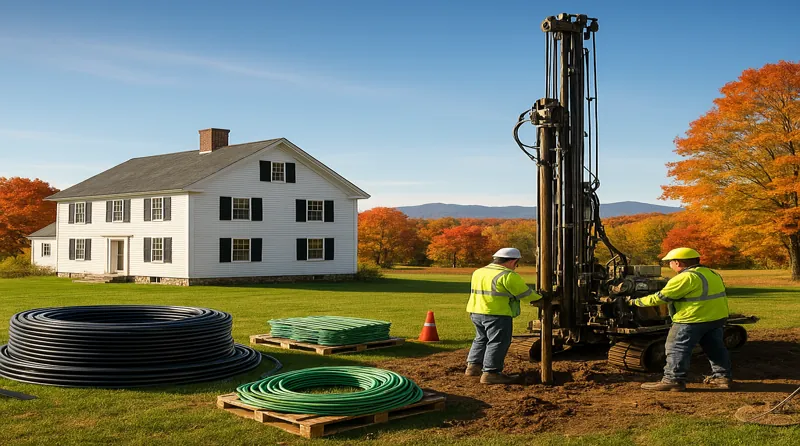
New Hampshire homeowners have a problem that doesn't get talked about enough: roughly 59% of households rely on petroleum products as their primary heating fuel, and more than 40% burn straight fuel oil. As of mid-February 2026, that oil is priced at $3.901 per gallon — and it has averaged well above $3.50 for the past three consecutive winters.
That dependency is expensive, volatile, and largely invisible to state energy policy. While neighboring Maine and Vermont have built out meaningful geothermal incentive programs, New Hampshire's residential geothermal support infrastructure is thinner. But the underlying economics still favor a switch for many homeowners — particularly those heating larger homes with oil, who have the land for a vertical loop system, and who can structure the federal tax credit correctly.
This guide works through the real numbers: what geothermal installation costs on granite bedrock, what incentives actually exist (versus what people assume exists), how the utility landscape affects operating costs, and what questions to ask before signing a drilling contract. We'll be direct about where New Hampshire's program falls short compared to neighboring states — because understanding the gap helps you make a better decision.
Is Geothermal Right for NH Homes?
The short answer: geothermal makes economic sense for a significant portion of New Hampshire homeowners, but it's not a slam-dunk for everyone the way it might be in states with larger rebate programs. The case is strongest when several factors align:
- You're currently heating with fuel oil or propane. Displacing $3,120+ in annual oil spend (see the cost comparison below) is the engine that drives payback. If you're already on natural gas — and NH has limited natural gas infrastructure, so this applies to fewer homeowners than you might expect — the economics tighten considerably.
- Your home is well-insulated or you plan to improve it. Geothermal delivers heat efficiently through ductwork or in-floor radiant systems. If your 1970s colonial is losing heat through single-pane windows and under-insulated walls, fix the envelope first. The NHSaves Home Energy Performance program (more on this below) can help fund those improvements at 0% interest.
- You have the outdoor footprint for drilling. NH's rocky terrain almost always means vertical closed-loop systems, which require less horizontal land than horizontal loops — but they require clear truck access for drilling equipment. Corner lots, steep grades, and large trees near the drilling zone all complicate installation.
- You can use the federal tax credit. A 30% federal tax credit on the full installed cost is a significant reduction — but only if you have enough federal tax liability to absorb it. Retirees with limited income, or homeowners with many deductions, sometimes can't fully utilize the credit in a single year. (Note: verify the current federal credit status with a tax professional, as federal energy tax law changed in 2025.)
- You're planning to stay in the home 7–12+ years. Geothermal payback in NH, accounting for the higher drilling costs that granite imposes, typically runs 8–13 years before incentives, and 6–9 years after a full federal credit. If you're selling in three years, the math doesn't work.
If three or more of these boxes check out for your situation, keep reading. If you're on the fence, the cost comparison in the section below will help you run the actual numbers for your home.
Does Geothermal Work in Granite Bedrock?
This is the question New Hampshire homeowners ask more than any other — and it deserves a direct answer: yes, geothermal works in granite bedrock. It just works differently than it does in sedimentary soil states, and it costs more to install.
Here's the geology. The Granite State's name isn't just branding. Much of New Hampshire sits on Precambrian and early Paleozoic granite and metamorphic bedrock, often with shallow depth to ledge — sometimes 12 to 24 inches below the surface. This creates two realities for geothermal installation:
Vertical Closed Loops Are Standard (and Necessary)
In states with deep, workable soil — think the Midwest or mid-Atlantic — horizontal closed-loop systems are often the cheaper choice. Trenches are dug 4–6 feet deep, pipes are laid, and the loop circulates fluid through stable soil. In New Hampshire, shallow ledge makes horizontal loops impractical or outright impossible on most properties. You hit rock before you hit adequate depth for effective heat exchange.
The result: vertical closed loops are the default in NH. Drillers bore holes 150 to 400 feet deep through the bedrock, insert U-bend pipe, grout the hole, and connect the loop to your heat pump. The drilling itself is the most expensive line item in a New Hampshire geothermal project — and it's more expensive than in soft-soil states.
Granite's thermal conductivity, however, is actually a favorable property. Dense igneous rock conducts heat from deeper strata more efficiently than loose clay or sandy soils. This means you can extract meaningful BTUs from fewer or shallower holes than you might need in lower-conductivity soil, partially offsetting the higher drilling cost. Experienced NH installers know this and design loop fields accordingly.
Open-Loop Systems: Possible, but Complex
Open-loop systems — which use groundwater directly from a well, circulate it through the heat pump, and return it to a discharge point — can work in parts of New Hampshire where aquifer yields are sufficient. Some NH homeowners with high-yield drilled wells have successfully installed open-loop systems at lower cost than vertical closed loops.
However, open-loop systems in New Hampshire come with regulatory complexity. The New Hampshire Department of Environmental Services (NHDES) governs groundwater withdrawals and requires review of any open-loop system design. Water quality matters too — high iron or mineral content can foul heat pump components over time. The conservative approach: ask your installer specifically about open-loop feasibility for your property, get NHDES guidance, and don't assume it's the cheaper path until you've done the full engineering assessment.
What Depth Means for Your Project
A typical 2,000 square foot NH home with a 4-ton geothermal system (a common sizing for that home size in NH's climate zone) might require two to three vertical boreholes at 250–350 feet each. At current NH drilling rates of roughly $18–$25 per foot for consolidated granite, that's $9,000–$26,000 in drilling costs alone — before the heat pump unit, distribution system, header connections, or labor for the interior installation.
Don't let that number startle you out of the math. The drilling cost is a one-time capital expense. The fuel oil bill is an annual recurring one. Do the 20-year math, and the drilling cost looks different. To understand how the full ground-source system works, including loop design and heat pump operation, our primer covers the mechanics in depth.
New Hampshire Geothermal Costs
Let's build out a realistic cost picture for a representative New Hampshire home, and compare it directly against what that same home is currently spending on heat.
Installation Cost Range
For a 2,000 square foot New Hampshire home requiring a 3–4 ton geothermal system with vertical closed loops:
| Cost Component | Typical Range (NH) |
|---|---|
| Drilling (2–3 boreholes at 250–350 ft) | $12,000–$26,000 |
| Ground loop piping and grouting | $2,000–$4,000 |
| Geothermal heat pump unit (3–4 ton) | $4,500–$8,500 |
| Interior installation (air handler, ductwork, controls) | $4,000–$9,000 |
| Electrical upgrades (if needed) | $0–$3,000 |
| Total installed (before incentives) | $22,500–$50,500 |
The wide range reflects real variability: depth to ledge, system complexity, existing ductwork condition, and proximity to the drilling zone all shift the number significantly. A property with difficult site access, shallow ledge requiring extensive drilling, and no existing ductwork will land at the high end. A property with good access, relatively soft overburden before hitting consistent granite, and existing forced-air ductwork will land closer to the middle.
Our full geothermal installation cost guide breaks down every line item in detail, including what questions to ask to understand where your project will land in this range before you commit.
Annual Operating Cost: Geothermal vs. Fuel Oil
Here's the comparison that drives the decision for most NH homeowners:
Current fuel oil cost: A well-maintained 2,000 sq ft New Hampshire home in a Climate Zone 6 location (most of the state) burns roughly 800 gallons of heating oil per year. At the current EIA price of $3.901/gallon (as of February 16, 2026), that's $3,121 per year in heating fuel alone — not counting domestic hot water or any cooling costs.
Estimated geothermal operating cost: A 4-ton ground-source heat pump operating at a COP (coefficient of performance) of 3.5 delivers 3.5 units of heat energy for every 1 unit of electricity it consumes. To deliver the same heat load that 800 gallons of oil provides:
- 800 gallons × 138,500 BTU/gallon × 80% furnace efficiency = ~88.6 million BTUs of useful heat
- At COP 3.5: 88.6M BTU ÷ 3.5 = 25.3M BTU of electricity needed = ~7,420 kWh
- At NH's residential electricity rate of 24.56¢/kWh (EIA 2025 YTD): 7,420 × $0.2456 = ~$1,822/year
Annual savings: approximately $1,299/year — just on space heating, before accounting for any domestic hot water savings from a desuperheater, and before any utility time-of-use rates that could improve the calculation.
Note that NH's electricity rate of 24.56¢/kWh is higher than the national average, which does eat into geothermal's operating advantage compared to lower-electricity-cost states. The fuel oil side of the equation, however, is brutal enough that the math still works. Oil is a commodity subject to significant price swings; electricity rates, while high in NH, are more stable and increasingly driven by fixed infrastructure costs rather than fuel price volatility.
After-Incentive Cost and Simple Payback
Using the midpoint installed cost of $36,500 and the current federal tax credit:
- Federal 30% tax credit (verify current status with a tax professional — federal energy law changed in 2025): −$10,950
- NHSaves heat pump rebate at $250/ton for a 4-ton system: −$1,000
- Net out-of-pocket after incentives: ~$24,550
- Annual savings: $1,299
- Simple payback: approximately 18.9 years at current energy prices
That's longer than the 10–12 year payback you see in states like Maine with stronger rebate programs. But three factors can compress it: higher oil prices (which have been the norm, not the exception, since 2021), a project that comes in at the lower end of the cost range, and the addition of geothermal domestic hot water production via desuperheater, which eliminates or reduces electric water heating costs. If oil rises to $4.50/gallon — which it has done repeatedly — annual savings climb to approximately $1,790, bringing payback to about 14 years.
For NH homeowners replacing an aging oil boiler who would otherwise spend $6,000–$12,000 on a new boiler plus oil tank, the capital comparison also shifts. You're not comparing geothermal against free heat — you're comparing it against another significant equipment investment with ongoing fuel exposure.
NH Geothermal Incentives, Rebates, and Tax Credits
Let's be direct about where New Hampshire stands: the state's residential geothermal incentive picture is notably weaker than Maine or Vermont. There is no dedicated state-level residential geothermal rebate program comparable to Efficiency Maine's $3,000 rebate or Vermont's Heat Pump Incentive Program. NH homeowners working through the economics should understand exactly what is and isn't available.
Federal Investment Tax Credit (ITC) — Verify Current Status
Geothermal heat pumps have been eligible for a federal tax credit since the Energy Policy Act of 2005, and the Inflation Reduction Act of 2022 extended and expanded that credit to 30% of installed costs through 2032. However, federal energy tax law changed in 2025, and the status of the residential clean energy credit for geothermal heat pumps should be verified with a qualified tax professional before you count on it in your financial projections.
If the 30% credit is fully available to you, it's the largest single incentive in play for most NH homeowners — potentially $7,000–$15,000 off a typical project. The credit applies to the full installed cost, including drilling, the heat pump unit, and installation labor. It is a non-refundable credit, meaning it reduces your tax liability but does not generate a refund beyond what you owe. Homeowners with limited tax liability in a given year should ask their tax advisor about multi-year carry-forward provisions. See our federal geothermal tax credit guide for a detailed breakdown of how to claim it.
NHSaves: Heat Pump Rebates
NHSaves is the umbrella program administered by New Hampshire's electric and gas utilities — including Eversource, Liberty Utilities, and Unitil — to fund energy efficiency and electrification incentives. The program does offer heat pump rebates, but the structure matters:
- Standard heat pump rebate: $250 per ton of capacity. A 3-ton geothermal system earns $750; a 4-ton system earns $1,000. This is meaningful but not transformative relative to total project cost.
- Electric-resistance replacement rebate: $2,000 per ton. This higher rebate tier applies when replacing electric resistance heating (baseboard electric or electric furnace) with a heat pump. If you're coming from electric resistance, this significantly changes the incentive math — a 4-ton replacement would earn $8,000 in rebates.
- Geothermal system eligibility: Ground-source heat pumps qualify for NHSaves heat pump rebates. Confirm with your specific utility that ground-source systems qualify under current program rules, as incentive programs can update their equipment lists and terms.
NHSaves Home Energy Performance Program
While not a geothermal-specific incentive, this program is worth integrating into your project planning. The Home Energy Performance program provides:
- Up to $6,000 in incentives for weatherization improvements (insulation, air sealing, window upgrades)
- 0% interest loans up to $15,000 for qualifying energy improvements
The strategic play: use the Home Energy Performance program to fund envelope improvements before or alongside your geothermal installation. A tighter building envelope reduces the heat load your geothermal system needs to meet, which can allow you to size down the system (and cut drilling costs) or improve your COP performance in the coldest NH winters. Better insulation and geothermal are genuinely synergistic investments.
What NH Doesn't Have (And Why It Matters)
To set expectations clearly: New Hampshire does not currently offer a state-funded residential geothermal rebate in the range of $2,000–$3,000 that Maine's Efficiency Maine program provides. There is no state geothermal tax credit. The New Hampshire Housing Finance Authority does offer some green energy financing programs, but they are not geothermal-specific.
This gap compared to Maine's geothermal incentive landscape is real, and it means NH homeowners need to work harder to make the numbers pencil out — typically by getting multiple quotes to control project costs, maximizing use of the federal credit, and combining geothermal with envelope improvements funded through NHSaves.
Property Tax Exemption
New Hampshire law (RSA 72:61-72:72) authorizes municipalities to grant property tax exemptions for qualifying renewable energy systems, including geothermal heat pumps. However, this is permissive — each municipality decides whether to adopt the exemption. Some NH towns participate; others do not. Check with your local assessor's office before assuming the exemption applies to your property. For municipalities that do grant it, the exemption prevents your geothermal installation from raising your assessed property value (and thus your property tax bill) — a meaningful secondary benefit over the life of the system.
Utility and Policy Landscape
Understanding New Hampshire's utility structure matters for geothermal economics, both for the electricity rate you'll pay and for any special rate programs that could reduce operating costs.
NH Electricity Rates and Why They're High
At 24.56¢/kWh (EIA 2025 YTD average), New Hampshire has one of the higher residential electricity rates in the country. The reasons are structural: NH is part of the ISO New England grid, which faces high capacity costs, significant transmission infrastructure costs, and limited in-state generation relative to demand. The state also deregulated electricity supply in the late 1990s, meaning consumers pay competitive supply rates that can fluctuate.
This rate reality is the primary argument geothermal skeptics make about NH: electricity is expensive here, so the operating advantage of geothermal over oil is narrower than in lower-electricity-cost states. That argument is valid — it's one reason the payback period in NH is longer than in Maine or Vermont. It's not, however, a reason to dismiss geothermal entirely, because the alternative (oil) is also expensive, increasingly subject to supply-chain volatility, and generates ongoing maintenance and tank replacement costs that don't appear in simple price-per-BTU comparisons.
Unitil Heat Pump Rate
Unitil, which serves customers in southeastern New Hampshire (primarily Concord, Exeter, and surrounding areas), has introduced a heat pump time-of-use rate that can benefit geothermal system owners. Under this structure, electricity for heat pump loads during off-peak hours is priced below the standard residential rate. Geothermal systems — unlike air-source heat pumps, which must run when it's coldest outside — can, in some configurations with thermal storage, shift heating load to off-peak hours.
If you're in Unitil's service territory, ask specifically about their heat pump rate and whether your geothermal system would qualify. The incremental savings can improve annual operating economics by $100–$300/year, which meaningfully shortens payback over a 20-year system life.
Eversource and Liberty Utilities customers should similarly ask their utility about any heat pump-specific rates or electric vehicle time-of-use tariffs that might be adapted for controlled geothermal loads. Rate structures evolve, and what wasn't available in 2023 may be on the menu today.
NH PUC Class I Thermal: Geothermal Recognition
The New Hampshire Public Utilities Commission's Renewable Portfolio Standard includes a Class I Thermal category that formally recognizes geothermal heat pumps as qualifying renewable thermal energy. This classification is significant for a few reasons:
First, it signals that New Hampshire's regulatory framework treats geothermal as a legitimate renewable energy resource — not merely an efficiency measure. This matters for future policy development; states that have classified geothermal under their RPS structures tend to build more targeted incentives over time.
Second, thermal renewable energy certificates (TRECs) associated with Class I Thermal generation have, in some New England states, created a secondary revenue stream for geothermal system owners. The TREC market in NH is not currently developed enough to provide meaningful homeowner revenue, but the regulatory foundation exists. Monitor this space — it could become economically relevant over the 20-year life of a system installed today.
Permitting and Installer Questions
New Hampshire's permitting framework for geothermal systems involves multiple agencies and local authorities. Understanding the landscape upfront prevents delays that can add cost to your project.
What Permits You'll Need
Local building permit: Required in virtually all NH municipalities for HVAC system replacement or installation. Your installer should handle this, but confirm who is responsible for pulling the permit and scheduling inspections before signing a contract.
Well construction permit (for vertical loops): In New Hampshire, vertical borehole drilling for geothermal falls under the state's well construction statute. The driller must be licensed by NHDES, and the completed borehole must be registered with NHDES. Your installer or drilling contractor handles this — but you should verify they are NHDES-licensed before work begins. This isn't bureaucratic formality; unlicensed drilling has led to groundwater contamination incidents in other states, and you don't want that liability on your property.
Open-loop system review: If your project involves an open-loop system drawing from or discharging to groundwater, NHDES review and approval is required. This adds time (typically 30–90 days for review) and may require hydrogeological assessment. Frame open-loop permitting conservatively in your timeline — defer to your installer and NHDES guidance on whether your site qualifies.
Shoreland protection: Properties within 250 feet of a public water body, river, or wetland are subject to NH's Shoreland Water Quality Protection Act, administered by NHDES. Vertical drilling within the shoreland zone requires NHDES approval. If your property is anywhere near a lake, pond, river, or significant wetland — common in rural NH — check this before finalizing your loop field design.
Finding a Qualified NH Installer
New Hampshire has a smaller installer ecosystem than more geothermal-active states, which means getting multiple qualified quotes requires more effort. Here are two established NH-based geothermal contractors:
- Ultra Geothermal (Barrington, NH) — Specializes in residential and light commercial ground-source systems in the seacoast and Lakes Region area. IGSHPA-certified installers.
- AGB Geothermal (Bethlehem, NH) — Serves the North Country and White Mountains region; experience with high-altitude and challenging terrain installations.
Beyond these examples, look for installers who carry IGSHPA (International Ground Source Heat Pump Association) certification — it's the industry standard credential for ground-source installers. Ask any installer for references from NH projects specifically, and ask to speak with homeowners who had vertical loops drilled through granite. Experience with local geology is the single most important qualification, because a loop field designed for southern soil conditions won't perform optimally in NH's rock profile.
Get a minimum of three quotes. Drilling costs are the most variable element, and driller relationships vary significantly between installers. Some NH HVAC contractors subcontract drilling to a single well driller without shopping price; others have competitive drilling relationships that result in meaningfully lower costs. Ask each bidder who they use for drilling and whether they have multiple drilling options.
Financing Options
Beyond the federal tax credit and NHSaves incentives, several financing paths are available to NH homeowners:
- NHSaves 0% financing (through the Home Energy Performance program) up to $15,000 for energy improvements — useful for covering envelope upgrades alongside geothermal installation
- USDA Rural Energy for America Program (REAP) — for rural NH properties, REAP grants and loans have funded geothermal commercial installations; some homeowners in qualifying rural areas may also be eligible for USDA rural development energy programs
- Home equity financing — the most straightforward path for most homeowners; geothermal's impact on home value (studies consistently show positive effects) makes this a reasonable use of home equity
- Manufacturer and distributor financing — some geothermal equipment manufacturers (Bosch, ClimateMaster, WaterFurnace) offer financing through their dealer networks; ask your installer what's available
Geothermal vs. Air-Source Heat Pumps in NH
Every NH homeowner evaluating heat pumps will face this question: why not just install cold-climate air-source heat pumps (mini-splits or ducted air-source systems), which cost a fraction of geothermal?
It's a fair and important question. Modern cold-climate air-source heat pumps — like the Mitsubishi Hyper Heat, Bosch IDS, and Daikin Aurora lines — can operate at outdoor temperatures as low as -13°F to -22°F, which covers virtually everything NH's winters throw at them. They've gotten dramatically better in the past decade. And their installed cost ($8,000–$18,000 for a whole-home system) is well below geothermal's range.
So why would anyone choose geothermal in New Hampshire? Several reasons, depending on your situation:
Efficiency at Peak Load
Air-source heat pump efficiency (COP) drops as outdoor temperatures fall. A unit rated at COP 3.5 at 47°F might operate at COP 1.5–2.0 at 5°F — exactly when you need the most heat. Geothermal heat pumps pull from ground temperature, which in NH stays at approximately 48–50°F year-round regardless of what's happening above ground. A geothermal system that delivers COP 3.5 in October delivers COP 3.5 in January. This consistency matters during NH's coldest snaps, which can run -10°F to -20°F in the North Country.
Longevity and Maintenance
Air-source heat pump equipment — particularly the outdoor compressor unit — takes weather abuse. NH homeowners deal with ice storms, heavy snow loading, and temperature swings that stress equipment. Expected equipment life for air-source heat pumps is 15–20 years. Geothermal ground loops, once installed, carry 50-year warranties on the pipe. The heat pump unit itself is indoor equipment, protected from weathering, with typical longevity of 20–25 years. The higher upfront cost of geothermal buys you a longer, more consistent performing system.
Operating Cost at NH Electricity Rates
At 24.56¢/kWh, even a small COP difference between geothermal and air-source generates meaningful annual savings. If your air-source system averages COP 2.5 during a full NH heating season (reasonable given cold snaps), and your geothermal system maintains COP 3.5, the operating cost difference on a 2,000 sq ft home can run $400–$700/year. Over 20 years, that's $8,000–$14,000 in operating cost difference that partially offsets the higher geothermal capital cost.
When Air-Source Makes More Sense
Air-source wins on upfront economics for homeowners who can't fully use the federal tax credit, who have shorter planning horizons, or whose properties present exceptional drilling challenges (cliff-face sites, town water service areas with permitting restrictions, very limited outdoor access). For a complete side-by-side analysis, see our ground-source vs. air-source heat pump comparison.
If you're also considering the comparison against remaining on propane rather than oil, our geothermal vs. propane cost analysis runs those numbers in detail — relevant for the 15–20% of NH homeowners heating with propane rather than fuel oil.
Bottom Line for NH Homeowners
New Hampshire is not the easiest state to make geothermal pencil out, and this guide hasn't pretended otherwise. Granite bedrock drives up drilling costs. A 24.56¢/kWh electricity rate narrows the operating advantage. And the state's incentive structure — while improving — still lags neighboring Maine and Vermont.
But the economic case is real for a meaningful subset of NH homeowners, and the fuel-switching argument is compelling. Oil at $3.90/gallon, on a 800-gallon-per-year home, is a $3,120 annual recurring expense with no ceiling. Electricity-powered geothermal cuts that to roughly $1,800 — with a system that should still be running efficiently in 2045.
Here's a practical checklist for NH homeowners who want to take the next step:
- Get a home energy audit through NHSaves. Understanding your home's actual heat load — not a rule-of-thumb estimate — is the foundation of an accurate geothermal quote. The audit also flags envelope improvements you should address before or alongside installation.
- Talk to your tax advisor before getting quotes. Confirm whether the federal residential clean energy credit is currently available for geothermal heat pumps under 2025 federal law, and whether your tax situation allows you to fully utilize it. This single number changes the economics significantly.
- Get three quotes from IGSHPA-certified installers. Insist on site visits, not phone estimates. Any installer who quotes a geothermal system without visiting your property to assess depth to ledge, site access, and lot constraints is not giving you a reliable number.
- Ask specifically about drilling costs and the driller they use. This is the most variable cost in your project and the most negotiable. Installers with multiple driller relationships will generally give you a better price.
- Run the 20-year math, not the sticker price comparison. The capital cost of geothermal is real; so is the annual fuel savings. Twenty years of $1,299/year savings is $25,980 — more than the net post-incentive project cost at the midpoint of our range. Factor in oil price escalation and the equation tilts further.
- Check with your municipal assessor about the property tax exemption. If your town participates in NH's optional renewable energy exemption program, your geothermal installation won't raise your property tax bill — a small but real secondary benefit.
New Hampshire's geothermal market is smaller than it should be given the state's oil dependence, and the incentive programs reflect that. But the underlying technology is sound, the geology — while challenging — is workable, and the fuel-switching economics are legitimate. For homeowners who are serious about ending their oil exposure, geothermal is the most durable solution available.
Sources
- U.S. Energy Information Administration — 2020 Residential Energy Consumption Survey (RECS): New Hampshire State Fact Sheet
- EIA — Weekly Retail Heating Oil Prices, New England (including New Hampshire), as of February 16, 2026
- EIA — Electric Power Monthly, Table 5.6.A: Average Retail Price of Electricity, Residential Sector (2025 YTD)
- NHSaves — Heat Pump Rebate Program and Home Energy Performance Program
- New Hampshire Public Utilities Commission — Renewable Portfolio Standard: Class I Thermal
- NH Department of Environmental Services — Well Construction and Registration Requirements
- NH Department of Environmental Services — Shoreland Water Quality Protection Act
- International Ground Source Heat Pump Association (IGSHPA) — Installer Certification
- IRS — Residential Clean Energy Credit (Form 5695)
- Unitil — Current Rates and Tariffs, including Heat Pump Rate
- New Hampshire Housing Finance Authority — Energy and Home Improvement Financing Programs
- U.S. GSA — Geothermal Heat Pump Technology Overview and Performance Benchmarks