
New Jersey at a Glance
New Jersey's Energy Situation
New Jersey has a home energy problem that's easy to summarize: it's the most densely populated state in the country, its electricity costs rank 12th highest nationally at 16.29¢/kWh according to EIA 2024 data, and roughly 15–18% of its housing stock — mostly pre-1980s homes in the north and central regions — still runs on heating oil that's been hovering between $3.50 and $4.00 per gallon.
That context matters a lot when you're evaluating geothermal. Whether it makes financial sense for you depends almost entirely on what you're replacing.
If you heat with natural gas, the math is honest but not exciting. Gas in New Jersey currently runs around $1.25–1.45/therm, which means your annual heating bill likely lands around $800–$850 for a typical home. Geothermal can trim that, but the savings won't be dramatic enough to produce a short payback period. You're looking at 18–22 years after the federal tax credit. That's a real number, and you should know it before you sign anything.
If you heat with oil, the story flips completely. Seven hundred gallons at $3.80 is a $2,660 annual heating bill. Geothermal can cut that to $430–$500 in electricity — annual savings of $2,360–$2,560. After the federal 30% tax credit, payback lands at 7–9 years. That's genuinely compelling, especially in a state where home values give you a long ownership horizon.
There's also a cooling angle that doesn't get talked about enough. New Jersey summers are legitimately hot and humid — Newark racks up roughly 1,000 cooling degree days annually, and southern New Jersey pushes 1,100. A geothermal system replaces your AC too, and it does it more efficiently than a conventional central air system. For shore properties that sit empty in winter but see heavy summer use, that cooling value becomes a significant part of the economic case.
Across the border, neighboring states are dealing with similar dynamics. Our Connecticut geothermal guide and New York geothermal guide cover related terrain if you want comparison context.
Does Geothermal Actually Work in NJ?
Short answer: yes, well. The ground conditions in New Jersey are favorable, and the climate produces enough heating and cooling demand to make a geothermal system earn its keep year-round.
Ground Temperature
The single most important factor in geothermal performance is ground temperature at loop depth — and New Jersey sits in a favorable spot. USGS data for the mid-Atlantic region puts undisturbed ground temperatures at 55–57°F across most of the state. That number doesn't change with the seasons. In January, when outdoor air might hit 20°F, your ground loop is still pulling heat from 55°F earth. In August, when it's 92°F outside, you're rejecting heat into that same 55°F sink. That thermal stability is what makes geothermal so much more efficient than air-source systems.
To understand the mechanics of how that temperature exchange gets turned into space conditioning, see our explainer on how geothermal heat pumps work.
Heating Demand
New Jersey's heating demand is meaningful but not extreme. According to NOAA data, Newark logs around 4,900 heating degree days annually, Trenton around 4,700, and Cape May drops to roughly 3,900 as you move south toward the shore. For comparison, Chicago runs about 6,500 HDD and Atlanta around 2,800. New Jersey sits comfortably in the mid-range where a properly sized geothermal system delivers strong efficiency gains without being undersized.
Cooling Demand
Don't underestimate the cooling side. Newark's ~1,000 annual cooling degree days and southern New Jersey's ~1,100 CDD reflect genuine heat and humidity load — not just a few warm weeks. A geothermal system operating in cooling mode moves heat into the ground efficiently, typically achieving EER ratings of 20–30 (compare that to 12–16 for a good conventional central air system). For families running AC heavily June through September, that efficiency difference shows up in the electric bill.
Geology by Region
New Jersey's geology divides the state into three distinct drilling environments:
- Northern NJ (Highlands and Piedmont): Bedrock sits at 50–150 feet below the surface. Vertical loop drilling through competent rock is straightforward, and thermal conductivity tends to be good. Loop depths typically run 300–500 feet per ton, meaning a 3-ton system requires 900–1,500 total bore-feet.
- Central NJ (Inner Coastal Plain): Sedimentary geology with clay and sand layers. Drilling is moderately easy, costs are in the middle range, and vertical loops remain the standard approach.
- Southern NJ (Outer Coastal Plain): Sandy, unconsolidated material makes drilling faster and often cheaper. Open-loop systems are technically feasible where groundwater is sufficient, but Pinelands and aquifer sensitivities constrain many properties — more on that in the permitting section.
Which System Type Fits NJ?
New Jersey's suburban density shapes system selection more than geology does. The state averages more than 1,200 people per square mile — and most residential lots run 0.25–0.35 acres. That's not enough land for a horizontal closed-loop system, which typically needs 1,500–3,000 square feet of trench per ton of capacity. A 3-ton horizontal system would consume your entire backyard and then some.
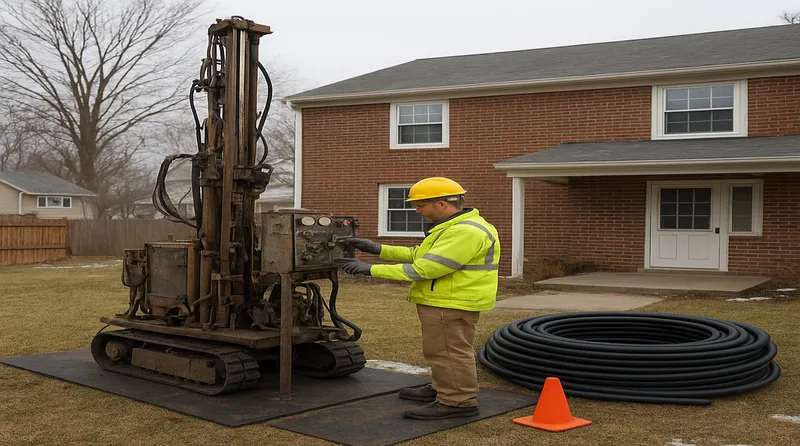
Vertical closed-loop systems dominate in New Jersey for that reason. Boreholes go straight down — two per ton at 150–250 feet each, depending on rock type and thermal conductivity. The footprint at the surface is just a few drill pad locations that get capped and grassed over. For a typical NJ suburban lot, this is the only workable option.
Vertical Closed-Loop: The NJ Standard
A vertical closed-loop system circulates food-grade antifreeze solution through high-density polyethylene (HDPE) pipes installed in the boreholes. The fluid absorbs ground heat in winter, rejects it in summer, and never mixes with groundwater. It's a closed system — nothing gets consumed, nothing gets discharged. From a regulatory standpoint, this is the cleanest installation type.
Total bore-feet for a 3-ton system typically runs 900–1,500 feet in NJ geology. Northern NJ rock generally allows shorter bores with fewer holes; southern coastal plain soils may need more total footage for equivalent heat exchange.
Open-Loop Systems: Possible in Parts of South NJ
Open-loop systems draw groundwater directly, extract or reject heat through the system, and discharge it back to a pond, drain field, or return well. They're more efficient than closed-loop but require sufficient well yield (typically 3+ gallons per minute per ton) and appropriate aquifer conditions.
In southern New Jersey, the sandy Outer Coastal Plain aquifer systems can support open-loop installations — but properties in the Pinelands National Reserve face additional review due to sensitivity around the Kirkwood-Cohansey Aquifer, which supplies drinking water for millions of residents. Most south NJ properties default to closed-loop to avoid the regulatory complexity, and that's usually the right call unless you've confirmed open-loop suitability with both the NJ DEP and your installer.
Horizontal Closed-Loop: Rarely Practical
Horizontal systems are cheaper to install (trenching beats drilling in most cases) but demand substantial land. A handful of rural properties in Sussex, Warren, or Salem Counties with large lots might qualify, but horizontal loops are the exception rather than the rule in New Jersey's suburban landscape. Don't plan around horizontal unless your installer has surveyed your specific lot and confirmed you have the acreage.
Cost and ROI: Gas Homes vs. Oil Homes
The numbers below are real, and they tell two very different stories depending on what's heating your house today. Read both scenarios carefully before deciding whether geothermal makes sense for your situation. For a deeper look at the variables that affect these calculations, our geothermal installation cost guide covers the full range of factors.
System Cost
A 3-ton vertical closed-loop geothermal system in New Jersey runs $20,000–$30,000 gross before incentives. That range reflects real variation: northern NJ rock drilling costs more than south Jersey sandy soils; a well-insulated newer home might need 2.5 tons while an older leaky colonial needs 4; equipment brands and installer overhead vary. Get multiple quotes. The federal 30% tax credit (more on that in the incentives section) brings the net cost to $14,000–$21,000 for most installations.
That's a significant investment, and the honest answer is that it doesn't pencil the same way for everyone.
| Gas-Heated Home | Oil-Heated Home | |
|---|---|---|
| Current annual heating cost | ~$810/yr 600 therms × $1.35 |
~$2,660/yr 700 gal × $3.80 |
| Geothermal electricity (heating) | $380–$430/yr | $430–$500/yr |
| Cooling savings vs. central AC | $200–$350/yr | $200–$350/yr |
| Total annual savings | $600–$780/yr | $2,360–$2,560/yr |
| Net cost after 30% federal credit | $14,000–$21,000 | $14,000–$21,000 |
| Simple payback period | 18–22 years | 7–9 years |
The Gas Home Reality
If you heat with gas, geothermal isn't a slam-dunk. That 18–22 year payback is longer than most home improvement projects, longer than most HVAC equipment lifespans, and longer than the average homeownership tenure in New Jersey. You need to be honest with yourself about whether you'll stay in your home long enough to see the savings accumulate.
That said, there are reasons gas-heated NJ homeowners still choose geothermal. It's the only upgrade that simultaneously eliminates both your gas heating and your electric cooling costs. It adds to home resale value. It protects against future gas price spikes. And for homeowners making a HVAC replacement anyway — when the furnace is 20 years old and needs to go — the marginal cost of going geothermal versus installing another conventional system narrows considerably.
See our full analysis of geothermal vs. natural gas if you want to walk through the 25-year total cost of ownership side by side. Over a 25-year period, even at current gas prices, geothermal comes out ahead on lifetime operating costs for most NJ homes — the question is whether the upfront investment works for your situation right now.
The Oil Home Case
Oil-heated homes are where geothermal really earns its reputation. The numbers above aren't optimistic projections — they reflect what happens when you replace $2,660/year in oil costs with $430–$500/year in electricity. At that savings rate, a $17,500 net investment (midpoint after the 30% credit) pays back in roughly 7–8 years. After that, you're banking $2,300–$2,500 in annual savings for the remaining life of the system.
Most geothermal systems carry 25-year warranties on the ground loop and 10-year warranties on the heat pump unit. A 3-ton system installed today in a north or central NJ oil home could realistically save $40,000–$60,000 over its lifetime, even at today's energy prices — and oil prices have historically trended upward.
If you're in an older pre-1980s home in Bergen, Essex, Morris, or Union County — exactly the profile of NJ's oil-heavy housing stock — this deserves a serious quote and analysis, not just a passing look.
Understanding Payback vs. Total Value
Payback period is a useful shorthand but it's not the whole story. Our geothermal payback period guide breaks down why total cost of ownership over 20–25 years often tells a different story than simple payback — particularly when you account for system longevity, equipment replacement costs for conventional alternatives, and energy price inflation. Worth reading before you make a final call.
Incentives and Tax Credits
Federal 30% Investment Tax Credit (Solid)
The most important incentive — and the most reliable — is the federal residential clean energy credit under IRS Section 25D. It covers 30% of the total installed cost of a qualified geothermal heat pump system, including equipment, labor, and ground loop work. No cap. The credit runs through 2034, steps down to 26% in 2033, then 22% in 2034, and expires unless Congress renews it.
This is a tax credit, not a deduction — it reduces your federal tax liability dollar for dollar. If the full credit exceeds your tax liability in year one, the unused portion carries forward to future tax years. Most homeowners can absorb the full credit over 1–2 years.
Our federal geothermal tax credit guide walks through eligibility requirements, how to claim it on IRS Form 5695, and how carryforward works if you can't use the full amount in year one.
NJ Clean Energy Program (NJCEP)
The NJ Clean Energy Program, administered by the NJ Board of Public Utilities, has historically offered residential incentives for geothermal heat pump installations. [NEEDS VERIFICATION — confirm current rebate amounts and program status at njcleanenergy.com before filing. Programs change, and this guide may not reflect the most current offering.]
Check njcleanenergy.com directly for current program details and eligibility requirements.
Utility Rebate Programs
Several New Jersey utilities have offered geothermal-specific rebates through their energy efficiency programs, though amounts and program status vary:
- PSE&G (Public Service Electric and Gas): [NEEDS VERIFICATION — PSE&G has run Clean Energy programs; confirm current geothermal rebate availability at pseg.com/cleanenergy]
- JCP&L (Jersey Central Power & Light / FirstEnergy): [NEEDS VERIFICATION — confirm current program status at firstenergyhome.com or jcpl.com]
- Atlantic City Electric (south NJ): [NEEDS VERIFICATION — confirm current geothermal incentives at atlanticcityelectric.com]
Call your utility directly and ask specifically about geothermal heat pump rebates — not just "heat pump" rebates, which sometimes apply only to air-source systems. Get the current program documentation in writing before starting your installation.
Financing Options
New Jersey doesn't currently have a statewide residential PACE (Property Assessed Clean Energy) program, which is a gap compared to some neighboring states. However, green home improvement loans, credit union financing, and manufacturer financing through equipment brands like Bosch, WaterFurnace, and Carrier are available. Our geothermal financing options guide covers the main paths and how to evaluate them.
Permitting in New Jersey
New Jersey's permitting environment adds real time and cost to geothermal installations, but it's manageable if you understand what's required upfront. A good local installer handles most of this — but you should know what you're getting into.
NJ DEP Well Permit
Vertical closed-loop boreholes are classified as wells under New Jersey law, which means they require a permit from the NJ Department of Environmental Protection. The application fee typically runs $150–200 per borehole (though confirm current fees with the DEP). Your drilling contractor submits the permit application; it's not something the homeowner files directly. Processing times vary but generally run 2–6 weeks.
This is standard across the state and not a barrier — just a step that adds time to the project schedule. Plan for it.
CAFRA Zone (Jersey Shore and Tidal Areas)
If your property is within 150 feet of a tidal waterway — which covers a significant portion of the Jersey Shore, Barnegat Bay, Delaware Bay shoreline, and tidal rivers — you're in the Coastal Area Facility Review Act (CAFRA) zone. Any subsurface work, including geothermal borehole drilling, triggers a CAFRA review from the NJ DEP's Land Resource Protection program.
CAFRA approval is not impossible to get for geothermal work, but it adds a review layer that can extend permitting timelines by weeks to months. Shore properties considering geothermal should engage an installer with specific CAFRA experience, and should build additional time into the project schedule.
Pinelands Commission
Properties within the Pinelands National Reserve — covering roughly 22% of New Jersey's land area across seven south Jersey counties — face additional review from the Pinelands Commission. The Pinelands sits atop the Kirkwood-Cohansey Aquifer, a massive shallow unconfined aquifer that supplies drinking water to millions and supports the region's unique ecology.
Vertical closed-loop systems, because they don't withdraw or discharge groundwater, are generally viewed more favorably than open-loop systems in Pinelands permitting. Most Pinelands geothermal installations default to closed-loop specifically to avoid open-loop aquifer concerns. Work with an installer who knows the Pinelands permitting process — it's different from standard NJ DEP work, and getting the application right the first time saves significant time.
Municipal Mechanical and Electrical Permits
Like any HVAC installation, geothermal requires local building department permits for the mechanical work (the heat pump and distribution system) and electrical work (system wiring, controls, dedicated circuit). These are standard and handled by your installer. Costs are typically $200–$600 depending on municipality.
HOA Restrictions
New Jersey's dense suburbs mean a significant share of homes sit in communities with homeowner associations. HOA rules vary widely — some prohibit any equipment that disturbs the ground without board approval; others have no relevant restrictions. Check your HOA documents and get written approval before contracting for installation. An installer who arrives to drill and then discovers an HOA prohibition is a problem for everyone. Handle this upfront.
Finding a Qualified Installer
Geothermal isn't a typical HVAC job. The ground loop design, borehole drilling, and system integration require genuine expertise that not every heating contractor has. The wrong installer can result in an undersized loop field, poor heat pump selection, or permitting problems that take months to resolve.
Start With IGSHPA
The International Ground Source Heat Pump Association (IGSHPA) maintains a directory of accredited contractors at igshpa.org/find-a-contractor. IGSHPA accreditation means the installer has completed formal training in ground loop design, heat pump installation, and system commissioning. It's not a guarantee of quality, but it filters out contractors who've done a few geothermal jobs as a side project.
Questions to Ask Any NJ Installer
- How many vertical closed-loop installations have you completed in NJ specifically? Local geology experience matters. Northern NJ bedrock drilling is different from south Jersey sandy soils.
- Have you worked in the Pinelands / CAFRA zone? If your property is in either regulated area, you want an installer who's navigated that permitting before.
- Do you handle the NJ DEP well permits, or do you subcontract drilling? Either is fine — you just want to know who's responsible for what, and whether the driller has their own DEP relationships.
- What ground loop design software do you use? A serious installer uses GLHEPro, LOOPLINK, or similar engineering software to size the loop field — not a back-of-envelope calculation.
- What's the equipment brand and what warranties apply? Major geothermal brands (WaterFurnace, Bosch/Florida Heat Pump, Carrier, ClimateMaster) carry different equipment and labor warranty terms. Understand what's covered and for how long.
- Can you provide references from NJ installations completed in the last 3 years? Call them. Ask about the permitting timeline, whether the system performed as promised, and how any post-installation issues were handled.
Get at least three written quotes. The lowest bid often reflects corners cut on loop design or equipment quality. The highest bid doesn't guarantee better work. Look for the installer who gives you the most thorough assessment of your specific lot, soil conditions, and load requirements — that detail reflects genuine expertise.
After installation, maintenance is minimal but not zero. Our geothermal maintenance guide covers what to expect year-to-year and how to keep your system performing at its rated efficiency.
Frequently Asked Questions
My lot is small — does geothermal even work on a quarter-acre suburban lot?
Yes, for vertical closed-loop systems. This is exactly why vertical dominates in New Jersey — the surface footprint of a borehole is roughly 8–12 inches in diameter. A 3-ton system with four 300-foot boreholes occupies four small points in your yard, typically spaced 15–20 feet apart. The total disturbed area during drilling might be 10×40 feet while equipment is on site, but once the crew is done, the yard goes back to normal. Quarter-acre lots are not a problem for vertical geothermal.
We have a shore property we only use summers — does geothermal make sense?
The economics are different for seasonal properties but the efficiency case is strong for cooling. If your shore house runs AC heavily from June through Labor Day, a geothermal system will cut that cooling cost significantly compared to conventional central air. The heating savings are less meaningful if you're not there in winter. The financial case depends on your specific usage pattern, what you're replacing, and whether you're dealing with CAFRA permitting complexity. Many Jersey Shore geothermal installations make the decision primarily on cooling cost reduction and the elimination of a separate HVAC system that needs servicing. Get a detailed quote that accounts for your actual usage profile.
I have gas heat and it's working fine — should I switch to geothermal?
Not necessarily, and definitely not just because it's the environmental choice. The 18–22 year payback for NJ gas homes is real. If your furnace has 10+ years of life left, the economics of switching right now are weak. The best time to evaluate geothermal seriously is when you're already facing a major HVAC replacement — when the furnace or AC is at end of life, the comparison isn't "geothermal vs. working gas system" but "geothermal vs. new conventional equipment." That's a much closer call, and in many cases geothermal wins on 20-year TCO even from a gas baseline. If you're curious, our geothermal vs. natural gas comparison walks through this scenario in detail.
Can apartment or condo residents get geothermal?
Residential geothermal requires ground loop installation, which means you need land rights — typically meaning you own the property and its lot. Apartment and condo residents generally can't install individual geothermal systems. The exception is a growing category of geothermal district systems where a shared ground loop serves a whole building or development; Princeton University's campus is a large-scale example of this approach. Some new condo and townhome developments are being designed with shared geothermal loop fields from the ground up. But for existing apartment dwellers, individual geothermal isn't typically an option.
How long does NJ geothermal permitting actually take?
For a standard suburban installation outside of CAFRA and Pinelands zones, plan on 4–8 weeks from permit application to approval. The NJ DEP well permit is typically the longest item on the critical path. Municipal permits are usually faster — a week or two. If you're in a CAFRA zone or the Pinelands, add 4–12 weeks depending on the complexity of the application and current DEP review volumes. Total project timelines from first contractor contact to a running system commonly run 3–6 months for straightforward installations, longer for regulated areas.
Does geothermal work with radiant floor heating?
Yes, and it's actually one of the best combinations. Hydronic geothermal heat pumps can deliver low-temperature water (90–110°F) that's ideal for radiant floor systems — far more efficient than the 140–160°F water a boiler needs. If you have an existing radiant system or are building new, a water-to-water geothermal heat pump is worth evaluating seriously. Many older NJ oil-heated homes with hot water baseboard heat are natural candidates for this configuration, since the distribution system only needs a new heat source, not a full replacement.
The Bottom Line
Geothermal in New Jersey doesn't have a single answer — it has two, and which one applies to you depends on what's in your utility room right now.
If you heat with oil: This is one of the stronger geothermal cases in the Northeast. A 7–9 year payback after the federal tax credit, on a system that should last 25+ years, is a genuinely good investment in a state with high home values and long ownership horizons. The case gets even stronger if oil prices rise (historically, they do over long periods) or if you're also replacing aging AC equipment. Get quotes now, especially if your boiler or oil furnace is more than 15 years old.
If you heat with gas: Be honest about your timeline and your alternatives. An 18–22 year payback isn't compelling as a standalone investment, but it looks different if you're already facing furnace replacement, if you value the long-term operating cost hedge, or if you're planning to stay in your home for decades. The math improves meaningfully if gas prices rise, if you can capture additional utility rebates, or if your installer finds a path to a lower-cost installation. Worth getting a quote and running the 25-year numbers — just don't go in expecting solar-level payback times.
For everyone: New Jersey's ground conditions are favorable, the federal 30% credit is real and reliable through 2034, and the state's four-season climate means you'll use both the heating and cooling capacity of the system year-round. The permitting is manageable if you work with an experienced local installer. Princeton University built a major geothermal district system for a reason — the physics work well here.
Use the geothermal savings calculator to run numbers on your specific home, then reach out to an IGSHPA-accredited NJ installer for a site assessment. And if you want to see how New Jersey compares to neighboring states, our guides for New York, Connecticut, and Pennsylvania cover similar terrain — PA is especially useful if you're comparing the oil-belt economics on either side of the Delaware.
The ground beneath New Jersey is 55–57°F, twelve months a year. Whether that's your best path to lower energy bills depends on what's above it.