
In This Guide
- Ohio's Geothermal Landscape
- Incentives and Tax Credits
- Southeast Ohio: Appalachian Propane Belt
- Northwest Ohio: The Horizontal Loop Advantage
- Columbus, Cleveland, Cincinnati: The Honest Gas Math
- Farm Operations and Rural REAP Grants
- Ohio Geology and Ground Conditions
- Installation Costs and Payback Summary
- Permitting in Ohio
- Frequently Asked Questions
- Sources
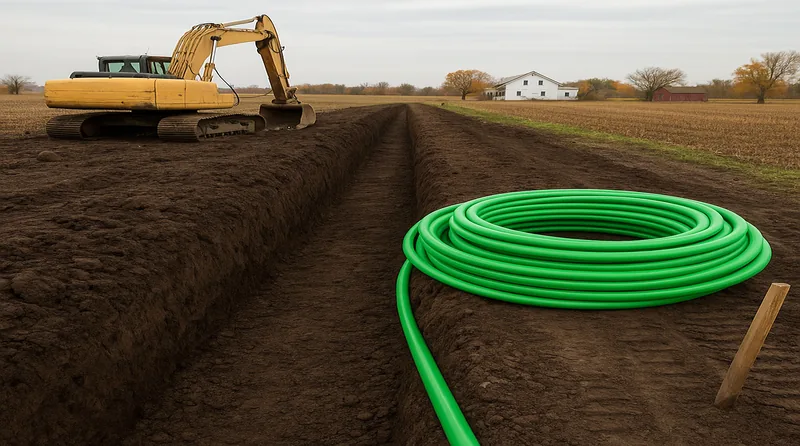
Ohio sits at an interesting crossroads for geothermal energy. The state doesn't have the eye-popping electricity rates that make New England math automatic. Its natural gas supply — fed partly by Ohio's own Utica shale production — keeps gas prices low in the major metros. And unlike its Appalachian neighbors to the southeast, Ohio doesn't have a single dominant market segment that makes the answer obvious statewide.
What Ohio has, instead, is variety. A sharp geographic and economic split between the rural southeast — where propane heating and Appalachian foothills define the landscape — and the flat, gas-served industrial Midwest. A northwest corner with geology uniquely suited to cost-effective horizontal loop installation. High heating loads in northern Ohio that make geothermal's winter output actually matter. And one of the largest farm sectors in the country, opening the door to federal REAP grant funding that most homeowners never hear about.
This guide maps those differences and gives you the honest math for each one.
Ohio's Geothermal Landscape
Ohio's residential electricity rate is 11.29¢/kWh (EIA 2024, rank 28) — slightly below the national average. The state's primary generation source is natural gas, reflecting its position at the heart of Utica and Marcellus shale production territory. That cheap-gas reality shapes geothermal economics for urban Ohio homes significantly.
Climate varies more than you'd expect for a single state. Cleveland and northern Ohio sit on Lake Erie, with heating loads of 6,000–6,500 heating degree days annually — comparable to New England. Columbus runs around 5,500 HDD. Cincinnati, pushed south and moderated by the Ohio River valley, sees closer to 4,500 HDD. These aren't trivial differences. A geothermal system in Cleveland runs heating mode for more hours every year than the same system in Cincinnati, producing meaningfully more annual savings.
Ground temperatures in Ohio run 50–53°F at loop depth — cooler than the Southeast but fully within the operating range for geothermal heat pumps. Heating mode minimum EWT is typically 25°F; Ohio's 50°F ground is well above that, allowing efficient heating operation throughout even the coldest Ohio winters.
Four major utilities serve the state. AEP Ohio covers south and central Ohio. FirstEnergy (Ohio Edison, Cleveland Electric Illuminating, Toledo Edison) covers northeast Ohio. Duke Energy Ohio serves the southwest. AES Ohio (formerly DP&L) covers the Dayton area. None of these utilities have confirmed geothermal-specific residential rebate programs as of March 2026, though their general energy efficiency programs may offer partial incentives — verify with your utility before finalizing your budget.
Incentives and Tax Credits
Federal 30% Section 25D Credit — Confirmed
The federal residential clean energy credit applies to all Ohio geothermal installations through 2032 at 30%, stepping down to 26% in 2033 and 22% in 2034. It's a direct credit against your federal tax liability — not a deduction. On a $32,000 installation, that's $9,600 back. The credit carries forward if your tax liability in year one doesn't absorb it all.
No Ohio State Geothermal Credit
Ohio has no state-level income tax credit for residential geothermal heat pumps as of March 2026. The Alternative Energy Portfolio Standard (AEPS) targets utility-scale generation and doesn't translate to homeowner incentives. The federal credit is the only confirmed incentive stack for Ohio residential installations.
Utility Rebates — Unconfirmed
AEP Ohio, FirstEnergy, Duke Energy Ohio, and AES Ohio have energy efficiency programs, but none have confirmed geothermal heat pump rebates in their published residential materials. [NEEDS VERIFICATION — contact your utility before project planning.] AEP Ohio's Home Energy Savings program and FirstEnergy's Efficiency Smart program may offer incentives for qualifying high-efficiency heat pumps — it's worth a direct inquiry to see if ground-source systems are eligible.
USDA REAP — For Farm and Rural Business Operations
Ohio's substantial agricultural sector makes the USDA Rural Energy for America Program highly relevant. REAP provides grants covering up to 25% of installation costs (up to $500,000) for agricultural businesses and rural small businesses. For an Ohio farm installing a geothermal system in a barn, grain facility, or main farmhouse, REAP stacks on top of the 30% federal credit. Contact the USDA Ohio Rural Development state office for current funding availability.
Southeast Ohio: The Appalachian Propane Belt
The southeast corner of Ohio — Athens, Meigs, Gallia, Lawrence, Jackson, Vinton, Perry, Morgan, and Muskingum counties, extending northwest through Knox and Holmes — is Ohio's version of the Appalachian propane corridor that runs through West Virginia, Kentucky, Tennessee, and North Carolina.
These are rural, hilly counties without natural gas distribution in many areas. Homes heat with propane, delivered by tanker truck. At $2.50–$3.00 per gallon and typical consumption of 1,000–1,400 gallons per Ohio winter heating season, that's $2,500 to $4,200 per year in heating fuel alone.
Holmes County deserves particular mention. With one of the largest Amish communities in the world, Holmes County has tens of thousands of rural homes, many of which use propane for heating. The Amish community's practical, long-term thinking about energy costs makes geothermal an interesting fit — the economics align well, and the 25-year system lifespan maps well to traditional land stewardship values. IGSHPA-certified contractors in the region have noted that geothermal is increasingly common in Holmes and neighboring Knox County.
Geothermal replaces $2,500–$4,200/year in propane with approximately $700–$900/year in electricity at Ohio's 11.29¢/kWh rate. Annual savings of $1,800–$3,300. After the 30% federal credit, payback runs 8–13 years — competitive with any market in the state.
The geology in SE Ohio is Appalachian foothills — shale, sandstone, and some limestone, with more rugged terrain than the western half of the state. Vertical boreholes are standard; horizontal loops are impractical on hillside lots. Drilling contractors in this area are generally experienced with Appalachian geology from the Ohio-West Virginia market.
Northwest Ohio: The Horizontal Loop Advantage
Flip to the opposite corner of the state — Wood, Fulton, Defiance, Paulding, Van Wert, Seneca, and Putnam counties in northwest Ohio — and the terrain could not be more different. This is the Lake Erie plain: flat as a table, largely agricultural, and sitting on deep deposits of glacial till left behind by the Wisconsin ice sheet.
That glacial till is significant for geothermal installation. It's a consistent, excavatable material — clay and silt with predictable thermal conductivity. No ledge rock to drill through, no unstable karst, no boulders every few feet. Horizontal trench installation is entirely practical here, and it costs significantly less than vertical boreholes.
A horizontal closed-loop system in northwest Ohio farmland runs approximately $5,000–$8,000 per ton installed versus $7,000–$12,000 per ton for vertical drilling. A 3-ton residential system might cost $15,000–$24,000 gross installed horizontally versus $21,000–$36,000 for a vertical system — a difference of $6,000–$12,000 before the federal credit applies. After the 30% credit, that horizontal system might net out at $10,500–$16,800, making the payback period notably shorter.
Northwest Ohio's heating load is moderate — Toledo sees about 6,200 HDD annually, significant but not extreme. Natural gas is available in most towns, but rural areas outside municipal service territory often rely on propane. The combination of low horizontal loop cost and propane replacement savings in rural NW Ohio produces some of the best geothermal economics in the state.
A note on groundwater: northwest Ohio has a relatively shallow water table in many areas, particularly near the Maumee River and its tributaries. Open-loop systems are feasible where well water quality is adequate, but many homeowners prefer closed-loop to avoid water rights complexity and mineral scaling. Consult with a licensed Ohio well driller about site conditions before committing to loop configuration.
The flat glaciated terrain advantage doesn't stop at the Ohio border. Northern Indiana shares the same horizontal loop geology — deep glacial till, flat farmland, and some of the best rural geothermal economics in the Midwest. If you're near the Indiana line, installers licensed in both states can often quote both locations.
Columbus, Cleveland, Cincinnati: The Honest Gas Math
Most of urban Ohio runs on natural gas. Columbia Gas of Ohio (NiSource), Dominion Energy Ohio, and Vectren serve the major population centers with gas at roughly $1.10–$1.40 per therm — competitive pricing partly supported by Ohio's own shale production.
For existing gas-heated homes in Columbus, Cleveland, and Cincinnati, the energy-cost case for switching to geothermal is honest but not dramatic:
| City | Annual HDD | Gas Heating Cost (est.) | Geo Heating Cost (est.) | Annual Heating Savings |
|---|---|---|---|---|
| Cleveland | ~6,350 | ~$800–$1,100/yr | ~$550–$750/yr | ~$250–$400/yr (heating only) |
| Columbus | ~5,500 | ~$650–$900/yr | ~$450–$650/yr | ~$200–$350/yr (heating only) |
| Cincinnati | ~4,500 | ~$550–$750/yr | ~$400–$550/yr | ~$150–$250/yr (heating only) |
Add cooling savings — geothermal's EER advantage over conventional central air conditioning produces $300–$600/year in additional savings — and total annual savings for an urban Ohio gas home typically runs $500–$1,000. On a net installation cost of $21,000–$31,500, payback is 22–35 years. That's a long time.
Cleveland's high heating load does create the best gas-to-geo case among Ohio's major cities — more heating hours means more annual savings. But it's still not a short payback.
Where the math works better for urban Ohio:
- New construction: The incremental cost of specifying geothermal versus a standard furnace + central AC at build time is often $8,000–$12,000 gross, or $5,600–$8,400 after the 30% credit. Payback on the incremental cost: 5–8 years. Builders targeting energy-efficient certification (ENERGY STAR, Net Zero, Passive House) find geothermal simplifies the compliance path.
- Electric resistance replacement: Less common in Ohio's cities than in rural areas, but older homes and multi-family buildings with electric baseboard heat do exist. The 65–75% heating electricity reduction produces 10–14 year payback — much more compelling.
- Full system replacement at end of life: When the furnace dies and the AC needs replacement anyway, the net incremental decision is smaller. At replacement time, the comparison is geothermal vs. a new furnace + new AC — not geothermal vs. a perfectly functioning existing system.
Farm Operations and USDA REAP Grants
Ohio is one of the top agricultural states in the country by farm revenue — corn, soybeans, dairy, poultry, and specialty crops across most of the state. Farm operations have a path to geothermal incentives that residential homeowners don't: the USDA Rural Energy for America Program.
REAP provides grants of up to 25% of project costs (maximum $500,000) for agricultural businesses and rural small businesses investing in renewable energy systems, including geothermal heat pumps used for farm buildings, grain storage facilities, livestock operations, or the primary farmhouse. The grant is not taxable income, and it stacks with the 30% federal ITC:
- $40,000 geothermal installation
- Federal 30% credit: −$12,000
- USDA REAP 25% grant: −$10,000
- Net cost: $18,000 (55% of gross cost recovered)
The combined federal + REAP incentive stack can make geothermal highly competitive even against cheap natural gas for farm operations. Contact the Ohio USDA Rural Development state office in Columbus to check current grant funding availability — REAP is a competitive program that opens and closes funding windows throughout the year.
Farm pond loops are another opportunity specific to rural Ohio. A pond loop uses HDPE coil sunk to the bottom of a farm pond, using the water body as the thermal exchange medium. Installation cost is roughly $3,000–$5,000 per ton — among the lowest of any geothermal configuration. Ohio's rural areas have abundant private ponds and farm reservoirs. The pond needs to be at least 8 feet deep at the loop placement and large enough for the coil footprint (roughly 200–400 square feet per ton). No well permit is required for a closed pond loop on private property — just a standard mechanical permit.
Ohio Geology and Ground Conditions
Northwest and Central Ohio — Glacial Till
Most of western and central Ohio was glaciated during the last ice age, leaving deep deposits of glacial till — primarily clay and silt with embedded stones and gravel. Thermal conductivity is moderate (~1.2–1.5 W/m·K). This material is ideal for horizontal trenching and accepts vertical drilling well. No significant karst or void risk.
Northeast Ohio — Lake Plain and Till
The Lake Erie shoreline counties (Cuyahoga, Lorain, Erie, Ottawa) have lake plain deposits — fine-grained sediments from glacial Lake Erie. Excellent for horizontal loops on larger lots. Urban Cleveland lots are typically too small for horizontal; vertical boreholes are standard in the metro area. Ground temps here are 50–52°F.
Southeast Ohio — Appalachian Foothills
The unglaciated Appalachian plateau of SE Ohio has bedrock at relatively shallow depth — shale, sandstone, and some limestone. Hilly terrain limits horizontal loop options. Vertical boreholes are the standard approach. Drilling costs may run slightly higher due to harder rock encounters at depth. Ground temps in the foothills: ~51–53°F.
Southwest Ohio — Mixed Geology
Hamilton County (Cincinnati) and surrounding counties have glacial till over limestone and shale. Vertical boreholes are standard. Some open-loop potential in areas with adequate well water, but closed-loop is more common for residential applications.
Installation Costs and Payback Summary
| Home Size | Vertical System (gross) | Horizontal System (gross, if feasible) | After 30% Credit (vertical) |
|---|---|---|---|
| 1,500 sq ft | $22,000–$28,000 | $14,000–$18,000 | $15,400–$19,600 |
| 2,000 sq ft | $28,000–$36,000 | $18,000–$24,000 | $19,600–$25,200 |
| 2,500 sq ft | $33,000–$42,000 | $21,000–$29,000 | $23,100–$29,400 |
| Scenario | Current Fuel | Annual Savings | Net Cost (30% credit) | Payback |
|---|---|---|---|---|
| SE Ohio rural, propane | Propane ~$2.75/gal | $1,800–$3,300/yr | $21,000–$28,000 | 8–13 years |
| Rural OH, electric resistance | Electric strip heat | $1,500–$2,200/yr | $19,600–$25,200 | 10–14 years |
| NW OH, horizontal, propane rural | Propane (horizontal loop) | $1,800–$2,800/yr | $10,500–$16,800 (horizontal) | 6–10 years |
| Columbus/Cleveland, natural gas | Natural gas | $500–$1,000/yr | $21,000–$31,500 | 22–35 years (existing home) |
| New construction (incremental) | N/A | $1,200–$1,800/yr | $5,600–$8,400 (incremental) | 5–8 years |
| Farm operation + REAP grant | Propane/gas | $1,500–$3,000/yr | $18,000–$25,000 (post-REAP+ITC) | 8–14 years |
Permitting in Ohio
Closed-loop vertical systems: Local mechanical and building permits. Ohio requires a licensed well driller for vertical borehole installations. The Ohio Department of Natural Resources (ODNR) Division of Water Resources oversees water well regulations. Verify your contractor holds a valid Ohio well driller's license.
Open-loop systems: ODNR Division of Water Resources permit required. Open-loop design requires adequate groundwater quantity and quality testing. Discharge water management must comply with OEPA (Ohio Environmental Protection Agency) rules.
Horizontal closed-loop: Standard mechanical permits. No water well permit required for closed horizontal systems. Some townships in NW Ohio may have agricultural land disturbance rules — verify with your township zoning office.
Pond/lake loops on private property: Standard mechanical permit. No water well permit for closed-loop pond systems. If the pond connects to a navigable waterway, OEPA review may apply.
Find IGSHPA-certified installers at the IGSHPA contractor finder. Ohio has a reasonable number of certified geothermal installers, particularly concentrated in the Columbus and Cincinnati metros and in SE Ohio near the West Virginia market. Get at least three quotes.
Frequently Asked Questions
Does Ohio have a state geothermal tax credit?
No. Ohio has no state income tax credit for geothermal heat pumps as of March 2026. The federal 30% Section 25D credit is the primary incentive. USDA REAP grants are available for qualifying agricultural and rural business operations.
Do AEP Ohio or FirstEnergy offer geothermal rebates?
No confirmed geothermal-specific rebates as of March 2026. Contact your utility to verify current program eligibility for ground-source heat pumps — programs change annually. [NEEDS VERIFICATION]
Is geothermal worth it in Columbus or Cleveland with natural gas?
The energy-cost payback for existing gas homes runs 22–35 years. Not compelling as a pure fuel-cost play. New construction incremental economics are much better (5–8 years). Cleveland's high heating load creates larger absolute annual savings than comparable conversions in warmer states.
What are the best geothermal opportunities in Ohio?
SE Ohio propane homes (8–13 year payback) and new construction anywhere in Ohio (5–8 year incremental payback). Northwest Ohio propane homes with horizontal loops can be even stronger (6–10 years) due to lower installation cost on flat glaciated terrain.
Why is northwest Ohio good for horizontal loops?
Flat glaciated terrain with deep clay-silt glacial till — no ledge rock, consistent excavation, lower install cost ($5,000–$8,000/ton vs. $7,000–$12,000 for vertical). Wood, Fulton, Defiance, Seneca, and Paulding counties are prime horizontal loop territory.
Can Ohio farms get grants for geothermal?
Yes. USDA REAP provides up to 25% of installation costs (max $500,000) for agricultural businesses and rural small businesses. Stacks with the 30% federal ITC for a combined 55% cost recovery. Contact Ohio USDA Rural Development in Columbus for current funding availability.
What ground temperatures should I expect in Ohio?
About 50–53°F at loop depth — well within geothermal operating range (minimum EWT is ~25°F for most units). Heating COP at 50°F EWT typically runs 3.0–3.8 for residential units. Cooler than SE states, but Ohio's higher HDD means more annual heating runtime and more savings.
Sources
- EIA Ohio Electricity Profile 2024 — U.S. Energy Information Administration
- DSIRE Ohio Programs — Database of State Incentives for Renewables & Efficiency
- IRS Section 25D Home Energy Tax Credits — Internal Revenue Service
- USDA REAP Program — Rural Development
- Ohio DNR Division of Water Resources — Well Driller Licensing
- IGSHPA Certified Geothermal Contractor Finder
- Kentucky Geothermal Guide — Geothermal Insider
- West Virginia Geothermal Guide — Geothermal Insider
- Indiana Geothermal Guide — Geothermal Insider