
In This Guide
- The Rhode Island Paradox
- Rhode Island by the Numbers
- Geothermal vs. Oil: The Math for RI
- Federal 30% Tax Credit
- Rhode Island Incentives & Utility Programs
- Rhode Island's Geology
- Small Lots: Is Your Property Suitable?
- What Installation Costs in Rhode Island
- Permitting in Rhode Island
- Finding a Qualified Installer
- Bottom Line
Rhode Island has a problem that won't go away: its residential electricity is priced at roughly 29 cents per kilowatt-hour, among the highest rates in the country, essentially tied with Connecticut. That number shows up in conversations about clean energy and heat pumps constantly — as a reason to be cautious, to wait, or to stick with natural gas if you have it.
But for the roughly 40% of Rhode Island households still using heating oil as their primary fuel source, that argument doesn't hold. The math runs the other way. When you account for what a geothermal heat pump actually does — extract three to four units of heat from the ground for every one unit of electricity consumed — 29¢/kWh electricity beating $4.00/gallon oil isn't a paradox. It's just arithmetic.
Rhode Island also has a geological advantage that most people don't know about: the state's ground temperature averages around 53°F year-round. That's warmer than most of New England — Maine sits at 45°F, New Hampshire around 48°F — and that extra warmth translates directly into higher heat pump efficiency. The ground is doing more of the work.
The Rhode Island Paradox
Connecticut framed this same question first — and we wrote about it extensively in our Connecticut Geothermal Guide. Rhode Island sits in the same position: you look at 29 cents per kilowatt-hour and immediately think that's hostile territory for an electric heat pump. The instinct is understandable.
Here's what the instinct misses: oil furnaces and boilers are thermally inefficient in a way that electricity isn't. Burning a gallon of oil at 87% furnace efficiency means 13% of that fuel goes up the flue as waste heat. You paid for it; you didn't get it. A geothermal heat pump converts electricity into heat with a COP of 3.5 or better — meaning 100% of the electricity input becomes useful thermal energy for your home, plus the additional heat harvested free from the ground.
The per-unit cost of electricity is high. The per-unit cost of heat delivered by electricity through a ground-source heat pump is not. Those are different numbers, and confusing them is where the "expensive electricity = bad heat pumps" argument falls apart.
Rhode Island by the Numbers
Rhode Island Energy Profile
- Average residential electricity rate: 29.06¢/kWh (2025, EIA) — among the highest in the US
- Annual heating degree days (Providence): ~5,836 HDD
- Annual cooling degree days: ~545 CDD (meaningful cooling load)
- Average ground temperature (4–6 ft depth): ~53°F year-round
- IECC climate zone: 5A (Cold, moist)
- Homes heating with fuel oil: ~38–42% (EIA; estimate, varies by town)
- Primary utility: Rhode Island Energy (formerly National Grid)
- State renewable energy target: 100% clean electricity by 2033
A few things worth calling out. The 53°F average ground temperature is exceptional for New England. For context: Maine is ~45°F, Vermont is ~47°F, New Hampshire ~48°F. Rhode Island's coastal maritime climate and southerly latitude push ground temps up relative to its inland neighbors. Every degree of additional ground warmth means slightly better heat pump efficiency — a ground-source system in Rhode Island will consistently outperform the same unit installed in northern Maine, all else equal.
The 545 cooling degree days is also notable. Rhode Island has real summers. A heat pump that handles both heating and cooling is more valuable here than in, say, Vermont or Maine, where cooling is an afterthought. If you're currently running window units or a central AC system and a separate oil furnace, geothermal replaces both with a single installation. That changes the value calculus significantly.
Geothermal vs. Oil: The Math for Rhode Island
Let's run the numbers with RI-specific inputs:
Heating Oil Cost
At 138,500 BTU/gallon, 87% boiler efficiency, and a delivered price of $4.00/gallon, heating oil delivers useful heat at $33.22 per million BTU. At $4.50/gallon, that's $37.37/MMBtu. Given where oil prices have been in 2024–2026, $4.00 is a reasonable baseline and $4.50 is a realistic planning scenario.
Geothermal Cost
Rhode Island's 53°F ground temperature supports a seasonal COP of approximately 3.5–3.8. Using 3.6 as our baseline:
29.06¢/kWh ÷ 3,412 BTU/kWh × 1,000,000 ÷ 3.6 = $23.68 per million BTU of delivered heat
Annual Comparison
Annual Heating Cost: 65 MMBtu/year (typical RI home, ~1,800 sq ft)
- Heating oil at $4.00/gal: $2,159/year
- Geothermal at 29.06¢/kWh, COP 3.6: $1,539/year
- Annual heating savings: ~$620/year
- If oil rises to $4.50/gal: savings grow to ~$900/year
- Add cooling credit: Replace $400–$700/year central AC or window units with geothermal cooling at ~$200–$300/year — additional $200–$400 savings
- Combined heating + cooling savings: $820–$1,300/year depending on your baseline
The combined heating and cooling savings make the RI case stronger than the heating-only number suggests. Rhode Island isn't Maine — it's not purely a heating story. Homeowners replacing both an oil furnace and central AC system with geothermal are capturing value on both ends of the thermostat.
Federal 30% Tax Credit
The Residential Clean Energy Credit (Section 25D) applies to geothermal heat pump installations everywhere in the US, Rhode Island included. It's 30% of total installed cost, with no dollar cap, through 2032.
On a $22,000 RI installation: $6,600 back on your federal taxes. No cap. No repayment. Dollar-for-dollar reduction in what you owe the IRS, with carryforward if the credit exceeds your tax liability in year one.
See our Federal Geothermal Tax Credit Guide for the full breakdown, and our Geothermal Financing Options Guide for how to structure financing around the credit timing.
Rhode Island Incentives & Utility Programs
Rhode Island Energy (Formerly National Grid)
Rhode Island Energy — the state's primary electric and gas utility, which completed its rebranding from National Grid RI in 2022 — offers energy efficiency rebates through its RI Energy Efficiency programs. Ground-source heat pumps are eligible for rebates under the utility's heating and cooling programs.
Current rebate amounts require verification directly with Rhode Island Energy — their programs and amounts update periodically. As of early 2026, heat pump rebates in the $300–$1,500 range have been available for qualifying equipment, with higher amounts for fuel-displacing installations (replacing oil or propane). Check rienergy.com for the most current figures. [NEEDS VERIFICATION: confirm current geothermal-specific rebate amounts and eligibility criteria]
Rhode Island Commerce Corporation — Clean Energy Finance
The RI Commerce Corporation administers several clean energy financing programs, including the Qualified Energy Conservation Bond (QECB) program and support for Commercial PACE financing. Residential PACE is not available in Rhode Island (currently limited to California, Florida, and Missouri nationally).
For residential geothermal specifically, inquire with RI Commerce about any current residential clean energy loan programs. The landscape changes as state funding rounds open and close. Contact them at commerceri.com or through the RI Office of Energy Resources (energy.ri.gov).
Rhode Island Office of Energy Resources (OER)
The OER coordinates state energy policy and maintains a current list of programs and incentives. Their website at energy.ri.gov is the most reliable source for what's actively available at any point in time. Check their residential energy programs section when planning your project.
Property Tax Exemption for Renewable Energy
Rhode Island law provides a property tax exemption for the added value of residential renewable energy systems. A geothermal system that increases your home's appraised value won't increase your property tax bill as a result. Confirm with your municipality, as implementation varies. [NEEDS VERIFICATION: confirm this exemption applies to ground-source heat pumps specifically in RI]
Rhode Island's Geology
Rhode Island sits at the southeastern edge of the New England crystalline bedrock province, but with a coastal coastal plain overlay that changes the drilling picture considerably by region.
Providence Metro & Blackstone Valley
Much of central Rhode Island — Providence, Cranston, Pawtucket, Woonsocket — sits on glacial till, sand, and gravel deposits over bedrock. These conditions are generally favorable for vertical drilling: soil is drillable, bedrock (typically granite or schist) is encountered at moderate depths of 50–100 feet in many locations. Typical borehole depths run 200–350 feet in this zone.
Newport & Aquidneck Island
Newport and surrounding communities sit on a narrow island with bedrock close to the surface. Drilling costs can be higher here, and lot sizes in the historic districts are very small. Vertical closed-loop systems are the standard approach; horizontal loops are generally impractical given lot constraints. Worth getting a site assessment before assuming infeasibility — vertical loops can fit in surprisingly tight spaces.
South County & Coastal Plain
Washington County (South County) features sandy coastal plain soils and, in some areas, peaty wetland deposits. Horizontal loops may be viable on larger lots in this region, particularly in areas with good soil depths. The sandy soil has good thermal properties for horizontal loop heat exchange. Wetland proximity requires checking with the RI DEM for setback requirements.
Block Island
Block Island presents unique conditions: the island is largely glacial moraine with sandy soils and no bedrock at drillable depths in most locations. Horizontal loops are often the preferred installation method. The island's older housing stock (many seasonal homes) and limited contractor access add project complexity and cost. If you're on Block Island, expect to pay a premium and plan well in advance.
Small Lots: Is Your Property Suitable?
Rhode Island is the smallest state by area, and its residential lots — particularly in the Providence metro corridor — are often small by national standards. This is a common concern for homeowners exploring geothermal.
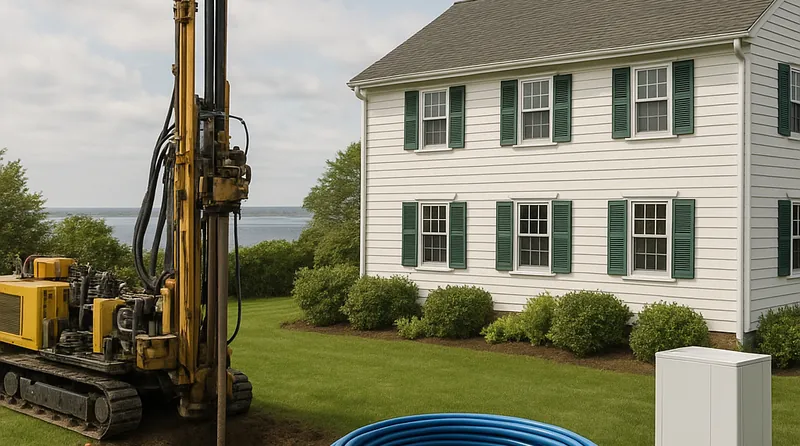
The good news: vertical closed-loop systems require far less surface area than horizontal systems. A standard residential installation using three boreholes at 300 feet deep each occupies only about 75 square feet of surface area (the boreholes can be as close as 15–20 feet apart). The drill rig itself needs a footprint of roughly 25 by 40 feet during installation — a temporary staging area that can often be accommodated in a standard suburban backyard or side yard.
What actually matters for vertical loops isn't total lot size — it's clearances. Most municipalities require boreholes to be setback 10–15 feet from property lines and structures, and further from wells and septic systems. An experienced RI installer will assess your lot and tell you honestly whether vertical loops fit before you spend any money.
Practically speaking: a 6,000 sq ft lot in Cranston or Warwick with a typical setback configuration can almost always accommodate a residential geothermal system. A 3,000 sq ft lot in Providence may require a creative layout but is often feasible. Lots under 2,500 sq ft with a close neighbor on every side may present genuine constraints — an honest site assessment will tell you.
What Installation Costs in Rhode Island
Rhode Island Geothermal Installation Cost Ranges (2025–2026)
- Small home (1,200–1,500 sq ft): $17,000–$23,000 installed
- Medium home (1,500–2,500 sq ft): $21,000–$30,000 installed
- Large home (2,500+ sq ft): $28,000–$42,000 installed
- Vertical drilling (most RI sites): $20–$35/linear foot
- With existing ductwork: Lower install cost; without ductwork, add $5,000–$12,000
- Block Island premium: Add 15–25% for logistics and access
RI drilling costs are somewhat lower than Maine because the soil-to-bedrock ratio is more favorable — less granite hardrock drilling overall. That said, Providence's urban density means mobilization can be more complex than a rural New Hampshire installation. Get at least three quotes from IGSHPA-certified installers. Ask each to itemize drilling vs. equipment vs. labor.
Rhode Island's mix of older colonial-era homes (many in Providence, Bristol, Newport) presents a common complication: inadequate ductwork. Many of these homes were originally heated with hot-water baseboard radiators and have no forced-air system at all. Converting to geothermal with a duct installation adds $8,000–$15,000 to the project, but is frequently done. Alternatively, a hydronic heat pump can interface directly with existing radiator loops in homes with hot-water systems — ask your installer about this option. See our geothermal installation cost guide for a detailed breakdown.
Permitting in Rhode Island
Rhode Island geothermal installations involve permits at multiple levels:
State Permits
- Well Permit (DEM): Geothermal boreholes are classified as wells under Rhode Island law and require a permit from the RI Department of Environmental Management (DEM). Your licensed well driller files this; confirm they do so before any work starts.
- ISDS/Wetlands: If your lot is near wetlands, ponds, or coastal features, additional DEM review is required. Rhode Island's Freshwater Wetlands Act and Coastal Resources Management Council (CRMC) regulations impose setback requirements. South County and coastal installations require extra due diligence.
- CRMC Assent: For properties in the CRMC jurisdiction (roughly within 200 feet of tidal water), a CRMC Assent may be required. Coastal RI homeowners should ask their installer about this specifically.
Local Permits
- Building permit: Required in essentially all RI municipalities. Fees vary but are typically $100–$350.
- Electrical permit: Required for heat pump unit connection.
- Plumbing permit: Required in most municipalities for the loop piping.
Permitting timelines in RI vary by municipality. Providence and larger cities typically process permits within 2–4 weeks; smaller towns may be faster. Ask your installer about their experience with your specific town's permitting office — local knowledge matters here.
Finding a Qualified Installer
Rhode Island has a smaller installer market than Massachusetts or New York, but a functional one — particularly for the Providence and greater metro area. A few guidelines:
IGSHPA Certification
Look for installers certified by the International Ground Source Heat Pump Association (IGSHPA). Certified installers have completed training specific to ground-source system design and loop installation. This is the primary professional credential for geothermal work in the US. See our geothermal installer certification guide for what these credentials mean in practice.
Rhode Island Energy Qualified Contractors
Rhode Island Energy maintains a list of qualified contractors for their rebate programs. Using a listed contractor may be required to access utility rebates. Check rienergy.com for their contractor directory.
Look Beyond Rhode Island for Quotes
Because RI is a small state, don't limit yourself to contractors headquartered in Rhode Island. Many installers based in Connecticut, Massachusetts, and even southern New Hampshire regularly serve the RI market. A Connecticut-based installer with a strong IGSHPA-certified team and experience with similar geology may give you a better quote and a better installation than a RI-based generalist who does occasional geothermal work. What matters is the installer's specific geothermal experience and certifications, not their mailing address.
Questions to Ask
- How many ground-source systems have you installed in Rhode Island specifically? (Local geology knowledge, DEM permit experience, CRMC familiarity)
- Do you design the loop in-house or sub-contract it?
- Are you familiar with my municipality's permitting requirements?
- Have you worked near coastal or wetland properties in RI? (If applicable)
- What's your warranty on the ground loop vs. the heat pump unit?
Bottom Line: Rhode Island's Case for Geothermal
Rhode Island occupies a sweet spot for geothermal that isn't obvious at first glance. The electricity rate looks scary until you do the COP math. The lot sizes look limiting until a vertical loop specialist explains what's actually feasible. The state incentive picture is less developed than Maine or Connecticut, but the federal 30% credit still removes a third of the cost, and Rhode Island Energy's utility programs add something on top.
The strongest case is this: you're replacing heating oil in a home you plan to stay in, and you have real cooling costs too. That combination — dual seasonal savings, volatile oil replaced by stable electricity costs, federal credit available, warmer-than-average ground temps helping efficiency — makes geothermal viable for a large share of RI homeowners today.
The weakest case: you're a natural gas customer in Providence who doesn't have strong cooling needs. Gas to geothermal economics are tighter everywhere, and RI is no different. Worth running the numbers, but don't expect the slam-dunk return that oil-to-geothermal provides.
For everyone else — oil heat, modest lot, planning to stay 10+ years — get a site assessment. The "my lot is too small" assumption fails more often than it holds in this state.
Get Started in Rhode Island
Check the Rhode Island Energy contractor directory for qualified heat pump installers. Look specifically for IGSHPA-certified contractors and ask for itemized quotes that separate drilling, equipment, and labor. The federal 30% credit is available right now — the window to maximize it runs through 2032 at the full rate.
Rhode Island Energy Programs →Related Reading
- How Geothermal Heat Pumps Work — the technology explained simply
- Federal Geothermal Tax Credit Guide (2026) — how to claim your 30%
- How to Finance a Geothermal System — all options ranked by cost
- Connecticut Geothermal Guide — same high-rate paradox, detailed breakdown
- Massachusetts Geothermal Guide — Mass Save programs, similar market
- Is My Property Suitable for Geothermal? — lot size, soil, and geology factors
- Geothermal Installation Cost Guide — what drives costs, how to compare quotes