
In This Guide
- Why Vermont Is One of the Strongest Geothermal Markets in America
- Vermont Geothermal Incentives: The Full Stack
- Can You Stack Vermont Incentives?
- Vermont Electricity Prices and Heating Fuel Economics
- Vermont Ground Conditions and Installation Reality
- Vermont Energy Policy Context
- Vermont Geothermal Case Studies
- Geothermal vs. Air-Source Heat Pumps in Vermont
- How Vermont Homeowners Should Get Started
- Sources
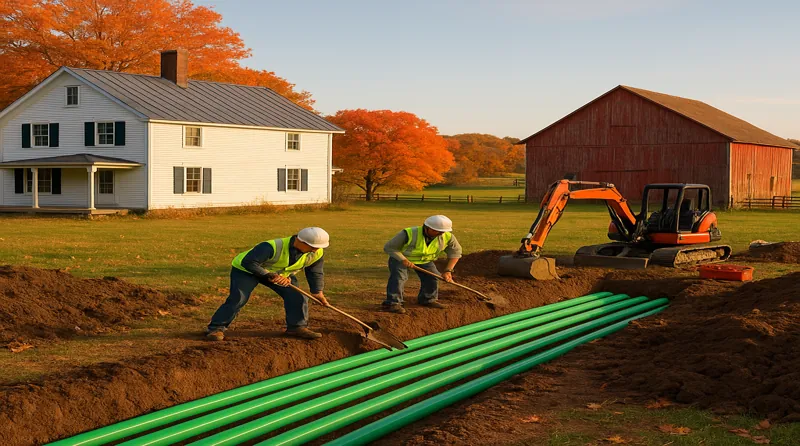
If you live in Vermont and heat your home with oil or propane — and roughly 56% of Vermont households do — you are probably spending more money on heat every winter than almost anyone else in the country. Heating oil is a commodity priced by global crude markets, delivered by truck, and subject to the kind of price swings that make household budgeting a contact sport. Propane isn't far behind.
Geothermal heat pumps don't solve every problem, but in Vermont, they solve a big one. They move heat from the earth into your home in winter and reverse the process in summer, at efficiencies three to four times higher than any combustion system. And because Vermont has assembled the most aggressive geothermal incentive package in New England — and arguably one of the strongest in the country — the economics of making that switch have never looked better.
This guide covers everything a Vermont homeowner needs to know: the complete incentive stack, the real installation costs, how Vermont's geology affects your options, and what a realistic payback timeline looks like for a home replacing heating oil or propane. We've also included case studies from Vermont institutions that have already made the leap, and a frank comparison with air-source heat pumps for homeowners weighing both options.
Let's start with why Vermont has become such a compelling geothermal market.
Why Vermont Is One of the Strongest Geothermal Markets in America
Three factors combine to make Vermont an exceptional geothermal market: cold winters that demand high-efficiency heating, an unusually high dependence on expensive delivered fuels, and a state policy environment that has made eliminating fossil-fuel heat a genuine priority — backed by real money.
Vermont is a small state with a big energy problem. The EIA's most recent residential energy data puts Vermont's heating fuel mix at roughly 36.5% fuel oil, 19.6% propane, and 17.2% natural gas — meaning more than half of Vermont households heat with oil or propane rather than the relatively cheaper natural gas that dominates in other parts of the country. Natural gas infrastructure barely reaches Vermont at all outside of Burlington and a few larger communities.
This is not a minor inconvenience. Heating oil and propane prices are volatile, and Vermont winters are long. A typical 2,000 square foot Vermont home burns roughly 850 gallons of heating oil per year. At $3.80 per gallon — a conservative estimate for recent seasons — that's $3,230 spent annually just on heat, before you've turned on a light or cooked a meal. In colder-than-average years, or when oil prices spike, that number climbs significantly.
Geothermal heat pumps change this equation dramatically. A properly sized ground-source heat pump with a coefficient of performance (COP) of 3.5 delivers 3.5 units of heat for every unit of electricity consumed. That same 2,000 square foot home, electrified for heat at Vermont's average residential electricity rate of 18.41 cents per kilowatt-hour (EIA, 2024), would typically cut annual heating costs by 50–65% compared to oil — and do it while also providing central air conditioning at near-zero marginal cost.
Then there's the incentive side. Vermont has built a layered system of rebates, utility programs, and low-interest financing that can reduce the upfront cost of a geothermal installation by $6,000 to $10,000 or more before any federal tax credit is applied. No other New England state comes close to this level of support. New Hampshire has the same cold winters but a much weaker incentive stack. Maine offers a strong $3,000 rebate from Efficiency Maine, but Vermont's per-ton rebate structure — combined with 0% financing and utility program integration — often produces a larger total benefit for systems of typical residential size.
Vermont has also embedded geothermal into its long-term energy planning in a way that few states have matched. The 2022 Comprehensive Energy Plan sets targets of 30% renewable thermal by 2025, 45% by 2032, and 70% by 2042. Geothermal heat pumps are explicitly central to achieving those targets. That means the policy infrastructure supporting these incentives is not a temporary promotion — it is baked into Vermont's energy law.
Vermont Geothermal Incentives: The Full Stack
Vermont's geothermal incentive landscape is layered across the statewide efficiency utility, individual electric utilities, and federal programs. Here is each program in detail.
Efficiency Vermont Ground-Source Heat Pump Rebate
Efficiency Vermont — the nation's first statewide efficiency utility — is the anchor program. As of March 2026, Efficiency Vermont offers rebates of up to $2,100 per ton of heating capacity for qualifying ground-source heat pump installations. Verify current 2026 amounts at efficiencyvermont.com before applying, as program amounts are subject to periodic adjustment.
A "ton" of heating capacity in this context refers to 12,000 BTUs per hour of heating output — the same unit used in air conditioning. A typical 2,000 square foot Vermont home will require a 3-ton system. At $2,100 per ton, that's a $6,300 rebate from Efficiency Vermont alone.
Income-eligible households qualify for an additional $500 bonus on top of the standard rebate. If your household income falls below the program's threshold (check the current limits at efficiencyvermont.com), this bonus stacks directly on top of the per-ton rebate.
Efficiency Vermont also offers rebates for heat pump water heaters — an important add-on, because most oil-heated Vermont homes also heat their domestic hot water with oil. Adding a heat pump water heater at the time of a geothermal installation can yield an additional rebate and meaningfully extends the financial case for the full conversion.
Green Mountain Power Integrated Path
Green Mountain Power (GMP), Vermont's largest electric utility, has developed an integrated geothermal incentive pathway that works alongside Efficiency Vermont's program. Under this structure, GMP contributes $1,800 per ton toward qualified ground-source installations, with the remaining $300 per ton coming from Efficiency Vermont — for a combined total of $2,100 per ton through the integrated path.
This is functionally the same total rebate amount as the standard Efficiency Vermont path, but the funding source structure differs. GMP customers should ask their installer which pathway they're enrolled in, and confirm the current program terms directly with GMP. The integrated path also may include additional program benefits, such as equipment procurement support or expanded contractor networks.
0% Home Energy Loan
Efficiency Vermont administers a 0% interest Home Energy Loan program that can finance up to $25,000 over terms of up to 15 years. This is not a rebate — you will repay the principal — but at 0% interest, it dramatically changes the cash-flow math for homeowners who want to go geothermal but face a significant upfront cost after rebates are applied.
On a $25,000 loan over 15 years, your monthly payment would be approximately $139. If your geothermal system is saving you $150 to $200 per month in heating costs compared to oil, the 0% loan can make the transition cash-flow positive from day one — you pay less each month in total (loan payment + electricity) than you were spending on oil. That's a genuinely compelling financial structure that doesn't exist in most states.
Washington Electric Co-op
Washington Electric Co-op (WEC) serves portions of central Vermont and has historically offered among the most aggressive utility geothermal incentives in the state. As of the time of this writing, WEC's program offers $2,100 per ton for the first 10 tons of installed ground-source capacity, stepping down to $1,500 per ton for tons 11 through 20. Note: 2026 rates are pending regulatory approval — contact WEC directly to confirm current amounts before making installation decisions.
For a residential customer in WEC territory with a 3-ton system, this represents a $6,300 rebate — the same headline number as the standard Efficiency Vermont program, but through a different funding mechanism. It's worth clarifying with your installer which utility program applies to your address and whether WEC and Efficiency Vermont amounts can be combined.
Vermont Electric Co-op
Vermont Electric Co-op (VEC) serves customers across much of the central and northern parts of the state. VEC has offered a $150 per unit thermal efficiency credit for qualifying heat pump installations. Verify 2026 status directly with VEC, as program terms may have been updated. The per-unit credit is structured differently from the per-ton rebates offered by GMP and WEC, so it may apply differently depending on your system configuration.
Burlington Electric Department
Burlington Electric Department (BED) serves Vermont's largest city. Note that BED's specific 2026 ground-source heat pump incentive program was not available for detailed review at time of publication. Burlington Electric customers should contact BED directly for current program details before beginning an installation project.
Federal Tax Credit
The federal residential clean energy credit has historically provided a 30% tax credit for qualifying geothermal heat pump installations. However, federal law changed in 2025, and the current status of this credit — including the applicable percentage, any income limits, and which equipment qualifies — should be verified with a qualified tax professional before making installation decisions. See our federal geothermal tax credit guide for background on how these credits have historically worked and what to ask your accountant.
If a 30% federal credit remains available for your installation, it would apply to the net cost after rebates on eligible equipment and installation costs. On a $22,000 net installation cost, that's an additional $6,600 — though the exact calculation depends on your tax situation, and a tax professional should be consulted.
Can You Stack Vermont Incentives?
Yes — but the stacking rules depend on which programs apply to your address and which path your installer uses. Here's how the math can look for a typical Vermont homeowner.
Example: 3-Ton System, GMP Customer
| Incentive | Amount | Notes |
|---|---|---|
| Gross installed cost (3-ton system) | $24,000 | Typical mid-range estimate; see cost section |
| Efficiency Vermont / GMP combined rebate | −$6,300 | $2,100/ton × 3 tons |
| Income-eligible bonus (if applicable) | −$500 | Additional Efficiency Vermont bonus |
| Net cost after rebates | $17,200 | Before federal credit |
| Federal tax credit (30% — verify current status) | −$5,160 | Consult tax professional; law changed in 2025 |
| Effective cost after rebates + credit | $12,040 | Does not include 0% loan savings |
| 0% loan available (if needed) | Up to $25,000 | 15-year term, $139/month on full $25K |
The key insight: the statewide rebate, utility rebate, and federal credit can all apply to the same installation. The 0% loan covers the portion you finance rather than pay upfront. When fully stacked for an eligible homeowner, Vermont's incentive environment can reduce the effective out-of-pocket cost of a geothermal system to roughly half of its gross price — sometimes less.
Compare that to a neighboring state without Vermont's programs. The same $24,000 installation in a state with only the federal credit available would leave a homeowner with an effective cost of $16,800 — nearly $5,000 more than the Vermont income-eligible scenario above, with no 0% financing option on top of it.
To understand the full cost structure of geothermal installation before you start applying for incentives, read our complete installation cost guide. It breaks down what drives price variation and how to get competitive bids.
Vermont Electricity Prices and Heating Fuel Economics
Vermont's electricity is not cheap by national standards — the EIA puts the residential rate at 18.41 cents per kilowatt-hour as of 2024 — but the economics of geothermal still work strongly in Vermont's favor when you're replacing oil or propane. Here's why.
The Efficiency Multiplier
Geothermal heat pumps don't generate heat the way a furnace does. They move heat from the ground into your home using a refrigerant cycle, and the earth stays at a constant 45–55°F year-round at drilling depth regardless of how cold the air gets. This allows modern ground-source heat pumps to achieve COPs of 3.0 to 4.5 in real-world Vermont conditions — meaning for every dollar of electricity you spend, you get $3 to $4.50 worth of heat delivered.
An oil furnace, by contrast, operates at roughly 80–95% efficiency. If it's 90% efficient, you get 90 cents of heat per dollar of fuel. At a COP of 3.5, geothermal is delivering roughly 3.9 times the useful heat per energy dollar compared to a 90%-efficient oil furnace.
The Numbers for a Typical Vermont Home
Let's run the comparison for a 2,000 square foot Vermont home heating with oil:
- Annual oil consumption: ~850 gallons
- Oil price (conservative 2024–2026 estimate): $3.80/gallon
- Annual heating cost with oil: ~$3,230
Now with geothermal (COP 3.5, replacing the same heating load):
- Oil equivalent in BTUs: 850 gal × 138,500 BTU/gal = 117.7 million BTUs
- At COP 3.5: Requires 117.7M BTU ÷ 3.5 ÷ 3,412 BTU/kWh = ~9,850 kWh of electricity
- At 18.41¢/kWh: ~$1,813 per year
- Annual savings: ~$1,417 — or about 44% less per year
If your oil price spikes — which it has repeatedly in recent years — the savings widen further. And if you add solar panels (Vermont has good net metering policy), you can drive the electricity cost down further still, potentially reaching near-zero net heating costs.
For propane users, the comparison is even more dramatic. Propane contains fewer BTUs per gallon than oil (91,500 vs. 138,500), costs comparable per gallon, and therefore costs more per unit of heat delivered. Propane-to-geothermal conversions in Vermont typically yield annual savings of $1,800 to $2,500 depending on home size and usage patterns.
What About Natural Gas?
The 17.2% of Vermont homes on natural gas are in a different position. Natural gas is cheaper per BTU than oil or propane, so the operating cost savings from switching to geothermal are smaller — though still real. For natural gas customers, the financial case for geothermal rests more heavily on the upfront incentive offset and the long-term bet on stable electricity prices versus volatile gas prices. It's worth running the numbers, but the payback periods are typically longer for gas-to-geothermal conversions than for oil or propane.
Vermont Ground Conditions and Installation Reality
Vermont's geology is varied, beautiful, and — for geothermal installers — a source of both opportunity and occasional challenge. Understanding what's under your property before you sign a contract is important, and any honest installer will tell you the same.
What Geothermal Installation Actually Involves
If you're new to how geothermal heat pumps work, the short version: a ground loop — typically a series of vertical boreholes drilled 150 to 400 feet deep, or horizontal trenches laid 6 to 10 feet deep — circulates fluid that absorbs heat from the earth. That heat is transferred to a refrigerant cycle inside the heat pump unit, which concentrates and delivers it to your home's distribution system (forced air, radiant, or fan coil).
The ground loop is the most expensive and site-specific part of the installation, and Vermont's geology shapes what's possible at your address.
Glacial Till and Surface Soils
Much of Vermont was covered by glaciers during the last ice age, and the retreating ice left behind a landscape of glacial till — a jumbled mix of clay, sand, gravel, and boulders. Till soils are common across Vermont's valleys and hillsides and generally support both vertical and horizontal ground loop installations. The moisture retention of clay-heavy till soils actually improves thermal conductivity, which is good for heat exchange efficiency.
However, till soils can contain boulders that slow drilling or require relocating a borehole. An experienced Vermont driller will be familiar with this and factor it into their bid. Boulder-heavy sites may increase drilling costs — something to discuss explicitly with your contractor before finalizing a quote.
Hardpan
Hardpan — a dense, cemented layer of glacial sediment — appears in some Vermont locations and can significantly slow drilling progress. If your soil borings or your driller's local knowledge suggests hardpan at your site, get an explicit discussion about how it affects the drilling estimate. Reputable drillers will either give you a fixed-price quote or clearly explain what conditions might trigger change orders.
Fractured Bedrock
Vermont's bedrock — schist, quartzite, marble, and granite across different regions — is generally excellent for vertical geothermal boreholes once you're through the overburden. Fractured bedrock often has higher thermal conductivity than soil, which means you may need fewer or shallower boreholes per ton of capacity compared to clay-dominated soil sites. Vermont's Green Mountains and their flanking ridges tend to offer good bedrock drilling conditions.
The exception is any site with highly fractured rock that has high groundwater flow. In these cases, open-loop systems (which circulate groundwater directly rather than a closed refrigerant loop) can be extremely efficient — but they require water rights, permits, and careful hydrogeological assessment. Most Vermont residential installations use closed-loop vertical systems.
Horizontal vs. Vertical Loops
Horizontal ground loops — trenches rather than boreholes — are less expensive to install than vertical systems but require significantly more land area. In Vermont's landscape of hillside farms, village lots, and densely wooded rural properties, many homeowners simply don't have the right combination of flat, open land and soil depth for a horizontal system. Vertical boreholes are the dominant approach for Vermont residential geothermal, especially in hilly terrain.
Permitting in Vermont
Vermont requires a Well Driller's License for anyone drilling geothermal boreholes, and the Vermont Agency of Natural Resources oversees well construction standards. Most experienced Vermont geothermal installers handle the necessary permitting as part of their standard process. In municipalities with specific local requirements — some Vermont towns have additional zoning or groundwater protection rules — there may be additional steps. Ask your installer what permits they'll be pulling and what the expected timeline is.
The permitting process in Vermont is generally not a major obstacle for residential vertical closed-loop systems in most locations, but it is a real step that affects project scheduling. Budget 2–6 weeks for permitting in most cases.
Vermont Energy Policy Context
Vermont's geothermal incentive programs don't exist in a vacuum. They are embedded in a long-term policy framework that makes this an unusually stable environment for homeowners making a 20+ year heating decision.
The 2022 Comprehensive Energy Plan
Vermont's 2022 Comprehensive Energy Plan (CEP) sets binding targets for the state's energy transformation, including specific milestones for renewable thermal energy. The targets are:
- 30% renewable thermal by 2025
- 45% renewable thermal by 2032
- 70% renewable thermal by 2042
Geothermal heat pumps qualify as renewable thermal under Vermont's framework when powered by the state's electricity grid, which is already predominantly hydroelectric and wind-sourced. This means that geothermal installations actively count toward Vermont's statutory goals — which creates a powerful political incentive for the state to maintain and expand the programs that support them.
In practical terms: Vermont's geothermal rebates are not a one-time pilot program that might disappear next year. They are tied to legislatively mandated emissions and renewable energy targets. That doesn't mean the specific dollar amounts won't change — they may increase or decrease as the programs are refined — but the underlying policy commitment is durable.
Vermont's Greenhouse Gas Emissions Standards
Vermont has adopted greenhouse gas emissions reduction targets of 40% below 1990 levels by 2030, and 80–95% by 2050. The residential heating sector — dominated by oil and propane combustion — is one of the largest sources of emissions that Vermont is working to address. This creates strong legislative motivation to keep geothermal incentives funded and accessible.
The Global Warming Solutions Act
Vermont's Global Warming Solutions Act (2020) made the state's emissions reduction targets legally enforceable — Vermonters can sue the state government if it fails to meet them. This is an unusual backstop that most states lack. It means that even if political winds shift, there is legal pressure to maintain progress on decarbonization, including the thermal sector that geothermal serves.
Efficiency Vermont's Statutory Role
Efficiency Vermont operates under a mandate from the Vermont Legislature and is funded through a small charge on all electric utility bills. It is not a voluntary program that survives only at the discretion of individual utilities — it is a statutory entity with a defined mission. This matters for homeowners who are wondering whether the rebate they're counting on will still exist by the time their installation is complete. Efficiency Vermont has been operating continuously since 2000 and has a long track record of program stability.
Vermont Geothermal Case Studies
Vermont has become a proving ground for geothermal energy across multiple scales, from residential projects to institutional retrofits. These real-world examples illustrate both the potential and the practical realities of geothermal in this climate and geology.
Green Mountain Power + Dandelion Energy Partnership (2021)
In 2021, Green Mountain Power partnered with Dandelion Energy — a geothermal installation company spun out of Google's X moonshot lab — to bring streamlined ground-source heat pump installations to Vermont homeowners. The partnership was designed to lower the barrier to entry by combining GMP's utility rebate structure with Dandelion's standardized installation process and financing options.
The GMP-Dandelion program targeted Vermont homeowners heating with oil or propane and emphasized the combination of utility rebates, Efficiency Vermont incentives, and lease-to-own financing structures that allowed qualified customers to go geothermal with little or no upfront cost. The program demonstrated that when the financial complexity of geothermal is managed at the utility level — with pre-negotiated rebates, standardized contractor processes, and integrated financing — adoption rates increase substantially. It also served as a proof-of-concept for the integrated utility rebate path that GMP has continued to develop.
Champlain College's Fossil-Fuel-Free Retrofit
Champlain College in Burlington undertook a landmark geothermal retrofit project as part of its commitment to becoming 100% fossil-fuel-free for campus heating and cooling. The college replaced oil-fired heating systems across multiple campus buildings with a ground-source geothermal district system, drilling a field of vertical boreholes on and near campus in Burlington's dense urban environment.
The project demonstrated that vertical closed-loop geothermal is viable even in densely developed urban settings — a point worth noting for Vermont homeowners with smaller lots or urban/suburban parcels where horizontal loops aren't feasible. It also illustrated how geothermal economics improve at larger scale, where shared drilling and distribution infrastructure reduces per-unit costs and allows sophisticated load-balancing between buildings.
Middlebury College LEED Platinum President's Residence
Middlebury College has been a national leader in campus sustainability for two decades, and its president's residence — a historic property on the Middlebury campus — was retrofitted to achieve LEED Platinum certification with geothermal heating and cooling as the centerpiece energy system. The project balanced historic preservation constraints with high-performance energy goals, demonstrating that geothermal retrofits can be designed sensitively around existing structures and landscapes.
For Vermont homeowners in older homes — Vermont has a high proportion of pre-1980 housing stock — the Middlebury project is particularly instructive. It shows that geothermal is not just for new construction or energy-efficient modern homes; with proper design, it can integrate effectively into older buildings, including those with historic character.
University of Vermont 510-Foot Geothermal Test Well (2024)
In 2024, the University of Vermont drilled a 510-foot geothermal research test well on its Burlington campus as part of a broader effort to assess the geothermal potential of Vermont's subsurface geology and to develop deeper geothermal resources for campus use. The project is part of UVM's long-term commitment to carbon neutrality and reflects growing institutional interest in geothermal energy as a scalable, renewable thermal resource.
The test well data helps characterize the thermal properties of Burlington-area bedrock at depth — information that is valuable not just for UVM's future projects but for the broader understanding of Vermont's geothermal resource potential. As deeper geothermal technologies mature and costs come down, data from projects like UVM's will inform whether Vermont can access deeper, higher-temperature geothermal resources beyond the shallow ground-source systems that are the current standard for residential use.
Geothermal vs. Air-Source Heat Pumps in Vermont
Vermont's incentive programs include support for both ground-source (geothermal) and air-source heat pumps, and many Vermont homeowners are weighing both options. The right choice depends on your specific situation. Here's an honest comparison. For a deeper dive, see our ground-source vs. air-source heat pump comparison guide.
Cold-Climate Performance
Modern cold-climate air-source heat pumps (ccASHPs) have dramatically improved their low-temperature performance over the past decade. Models from Mitsubishi, Bosch, and others can operate efficiently down to -13°F or colder, making them viable in Vermont's climate in a way that older air-source technology was not.
However, there is a fundamental physics difference: air-source heat pumps draw heat from outdoor air, which gets colder in winter. As outdoor temperatures drop, the available heat decreases and the heat pump works harder — COP drops from perhaps 3.5 at 40°F outdoor temperature to 1.5–2.0 at -10°F. Geothermal heat pumps draw heat from the earth at a constant 45–55°F year-round, which means their COP remains stable across Vermont's entire winter range. In Vermont's coldest weeks — when heating loads are highest and you most need your system to perform — geothermal maintains its efficiency advantage.
Installation Cost Difference
Air-source heat pumps cost significantly less to install than geothermal systems. A typical Vermont cold-climate air-source heat pump installation runs $3,000 to $7,000 per zone, depending on whether you're installing ductless mini-splits or a ducted central system. Geothermal installations typically run $18,000 to $30,000 gross for a whole-home system before incentives — though Vermont's rebates and financing close much of that gap.
For homeowners who cannot absorb even the post-rebate geothermal cost, or who are not eligible for the 0% loan, air-source heat pumps can make excellent partial-fossil-fuel-displacement systems. Many Vermont homeowners use mini-split air-source units to heat and cool their most-used rooms while maintaining their oil or gas system as a backup for extreme cold snaps. This "hybrid" approach can cut annual fuel consumption by 40–60% at far lower upfront cost.
Where Geothermal Wins
- Whole-home replacement of a high-fuel-cost system: For an oil or propane customer doing a complete system replacement, geothermal's higher upfront cost is justified by deeper operating savings and Vermont's per-ton rebate structure.
- Properties without outdoor unit placement options: Condominiums, village properties with narrow lots, or homes in HOAs that prohibit outdoor equipment may be better suited to vertical geothermal systems with all mechanical components installed indoors or in mechanical rooms.
- Cooling-heavy use cases: Geothermal provides central air conditioning at near-zero marginal cost (the earth acts as a heat sink in summer), which adds value in Vermont's increasingly warm summers.
- Long time horizons: A geothermal system properly installed in Vermont will last 20–25 years for the heat pump equipment and 50+ years for the ground loop. Over that horizon, the economics strongly favor geothermal.
Where Air-Source Wins
- Budget-constrained situations: If the post-rebate geothermal cost remains out of reach and you don't want to take on loan payments, air-source heat pumps deliver real savings at much lower entry cost.
- Site constraints that prevent drilling: Some Vermont properties have bedrock at or near the surface, limited water rights, or permit complications that make geothermal drilling impractical or unaffordable. Air-source is the practical alternative.
- Supplemental/zone heating: For adding heating and cooling to a room addition, garage apartment, or poorly-served zone without a full system replacement, mini-split air-source units are the right tool.
- Natural gas customers with shorter payback expectations: If you're on natural gas and want a 5-year payback, air-source is typically the easier choice. Geothermal's advantage is most powerful when displacing expensive delivered fuels.
How Vermont Homeowners Should Get Started
If you've read this far and you're heating with oil or propane, you've probably done the mental math and you're ready to take a next step. Here's the practical path forward.
Step 1: Check Your Utility Territory
The incentive programs available to you depend on which electric utility serves your address. Vermont has several utilities — Green Mountain Power, Vermont Electric Co-op, Washington Electric Co-op, Burlington Electric Department, and smaller municipal utilities. Look at your electric bill to confirm your utility, then visit that utility's website to understand what programs they're running in 2026. Start with Efficiency Vermont (efficiencyvermont.com) regardless of your utility — they administer the statewide rebate and 0% loan and are the best starting point for any Vermont homeowner.
Step 2: Schedule an Energy Audit
Before sizing a geothermal system, you want to know how much heating load your home actually has — not what the old oil furnace was rated for. Many Vermont homes have been poorly insulated for decades, and air-sealing and insulation improvements can significantly reduce the size (and therefore cost) of the geothermal system you need. Efficiency Vermont can connect you with auditors, and the audit itself may be subsidized.
The audit will produce a Manual J heat load calculation — the industry standard method for sizing heating and cooling systems. Don't let any contractor size your geothermal system without one. Oversizing wastes money on excess drilling and equipment; undersizing leaves you cold in a Vermont winter.
Step 3: Get Multiple Quotes from Vermont-Experienced Installers
Geothermal installation is specialized work. Not every HVAC contractor has the drilling equipment, the design experience, or the utility program relationships to execute a Vermont residential geothermal project well. Get at least three quotes from contractors who have completed multiple projects in your region and can provide references from Vermont homeowners with similar properties.
Ask each contractor specifically:
- What's their experience with Vermont's geology in your area?
- Which incentive programs will they enroll you in, and how do they handle the rebate paperwork?
- What does the ground loop design look like, and why?
- How do they handle unexpected subsurface conditions — boulders, hardpan, unexpected bedrock depth?
- What is included in the warranty, and who services the equipment?
For background on what drives cost variation in geothermal installations, our geothermal installation cost guide walks through each cost component and how to evaluate contractor bids.
Step 4: Understand the Incentive Application Process Before You Start
This is critical: incentive programs typically require that you apply — or at minimum register your project — before installation begins, not after. Efficiency Vermont's rebate process and the utility programs have specific sequencing requirements. If you install first and apply second, you may find yourself ineligible. Your installer should guide you through this, but verify it yourself with Efficiency Vermont's customer service team before breaking ground.
Step 5: Confirm Federal Tax Credit Status
Before you finalize your project budget, speak with a tax professional about the current status of the federal residential clean energy credit for geothermal heat pumps. Federal law changed in 2025, and the credit may have been modified, extended with new conditions, or structured differently from prior years. The federal credit — if it applies to your installation — can represent $4,000 to $7,000 in additional offset for a typical Vermont system, so it's worth getting a definitive answer from your accountant before you sign a contract. Our federal tax credit guide provides background context, but it is not tax advice.
Step 6: Plan Your Distribution System
Geothermal heat pumps work best with distribution systems that operate at lower water or air temperatures — radiant floor heating, low-temperature fan coils, or well-designed forced-air systems with good ductwork. If your existing distribution system is a high-temperature baseboard hot water system designed for an oil boiler (which runs at 180°F), you may need to resize radiators or modify the system to work effectively with geothermal's lower operating temperatures (typically 100–130°F supply water).
This is not always required — some geothermal systems can be configured to produce higher temperatures — but it affects both efficiency and cost. Get clarity on your distribution system design as part of the installation quote process. Modifying the distribution system is often the piece that creates unexpected cost, and it should be on the table from the beginning.
Vermont Is Ready — Are You?
Vermont has done the hard work of building the infrastructure for geothermal adoption: the statewide efficiency utility, the utility rebate programs, the 0% financing, and the long-term policy framework that makes these investments make sense. If you're spending $3,000 or more per year on heating oil or propane, Vermont's incentive stack means that a geothermal system — with a properly structured financial package — can begin saving you money in year one and continue doing so for decades.
The next step is yours: visit efficiencyvermont.com, check your utility's program page, schedule an energy audit, and start talking to qualified installers. Vermont's geothermal opportunity is real, and the window to take advantage of the current incentive stack is open now.
Sources
- Efficiency Vermont — Ground-Source Heat Pump Rebates (efficiencyvermont.com)
- Efficiency Vermont — Home Energy Loan Program (efficiencyvermont.com)
- Green Mountain Power — Heat Pump Rebates and Programs (greenmountainpower.com)
- Washington Electric Cooperative — Efficiency Rebates (washingtonelectric.coop)
- Vermont Electric Cooperative — Efficiency Programs (vermontelectric.coop)
- U.S. Energy Information Administration — Vermont State Energy Profile (eia.gov)
- U.S. Energy Information Administration — Electric Power Monthly, Residential Rates (eia.gov)
- Vermont Department of Public Service — 2022 Comprehensive Energy Plan (publicservice.vermont.gov)
- Vermont General Assembly — Global Warming Solutions Act (H.688, 2020)
- University of Vermont — Geothermal Research Well Project (uvm.edu)
- Champlain College — Sustainability and Energy Initiatives (champlain.edu)
- Middlebury College — Campus Energy and Geothermal Systems (middlebury.edu)
- Dandelion Energy — Vermont Geothermal Program (dandelionenergy.com)
- Vermont Agency of Natural Resources — Groundwater and Well Drilling Standards (anr.vermont.gov)