
In This Guide
- New Hampshire's Heating Reality
- Quick Verdict: Should You Go Geothermal?
- Does Geothermal Work in Granite?
- Five Distinct NH Markets
- Cost & ROI by Fuel Type
- Case Studies
- Month-by-Month Energy Profile
- Open-Loop System Assessment
- Loop Type Cost Comparison
- Incentives: NHSaves (Federal Credit Expired)
- Solar + Geothermal Stacking
- Vacation Rental & Second Home Analysis
- USDA REAP for Agricultural Properties
- The Federal Tax Credit (Expired Dec 31, 2025)
- Geothermal vs. Air-Source Heat Pumps in NH
- Permits & Regulations
- Finding a Qualified NH Installer
- New Hampshire vs. Neighboring States
- Frequently Asked Questions
- Bottom Line
- Sources
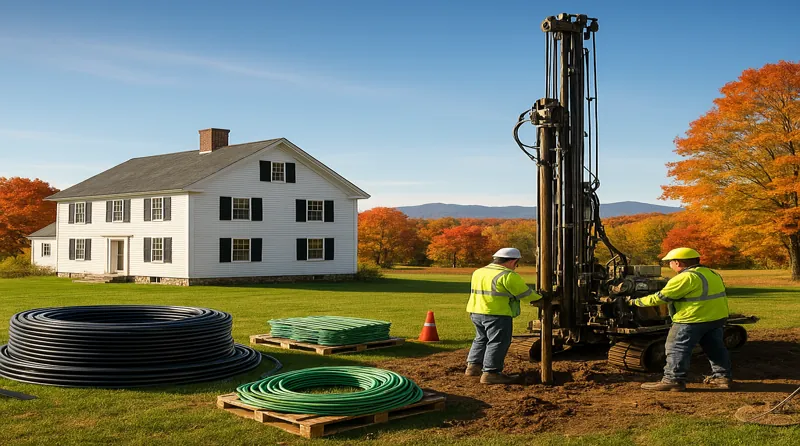
New Hampshire's Heating Reality
Roughly 59% of New Hampshire households rely on petroleum products for heat. More than 40% burn straight fuel oil. At $3.90/gallon, a typical 800-gallon-per-year home spends $3,120 just on heating — and that number has averaged above $3.50 for three consecutive winters.
Meanwhile, NH's electricity costs 24.56¢/kWh (EIA 2025) — among the highest in the country. That rate scares people away from electric heating of any kind. But ground-source heat pumps don't use electricity 1:1 — they use it at COP 3.5, extracting 3.5 units of heat for every unit of electricity consumed. At 24.56¢/kWh and COP 3.5, geothermal delivers heat at roughly $20.60/MMBTU. Oil at $3.90/gal delivers at $32.50/MMBTU. The electricity is expensive per kWh; the heat is not expensive per BTU.
The other elephant: granite. New Hampshire sits on some of the hardest bedrock in the eastern U.S. Drilling costs more here — $25–$40/linear foot compared to $15–$25 in soft-soil states. But granite has excellent thermal conductivity (1.4–2.5 BTU/hr·ft·°F), meaning you need fewer total bore-feet per ton. The rock that makes installation harder also makes the system more efficient.
Quick Verdict: Should You Go Geothermal in New Hampshire?
| Your Situation | Verdict | Typical Payback |
|---|---|---|
| Oil heat — seacoast, Merrimack Valley, Lakes Region | ✅ Yes | 16–18 years full / 9–10 incremental |
| Electric resistance + NHSaves $2K/ton rebate | ✅ Strong yes | 6–8 years |
| New construction — anywhere in NH | ✅ Strong yes | Longer than the 4–6 incremental years published under the credit |
| Propane heat — rural NH | ✅ Yes | Longer than the 8–11 years published under the credit |
| USDA REAP eligible farm/rural business | ✅ Excellent — REAP still available | 7–8 years |
| Vacation rental — White Mountains, Lakes Region | ✅ Yes — enhanced ROI | ~11 years incremental (see case study) |
| Aging oil boiler replacement (comparing incremental) | ✅ Yes — incremental math is the strongest case | 9–10 years (incremental) |
| Natural gas — limited areas with gas service | ❌ Not on payback alone | No payback — see the arithmetic below the table |
Payback figures reflect 2026 conditions with no federal tax credit. The 30% credit under IRC §25D applied to systems placed in service through December 31, 2025 and is not available for property placed in service after that date (One Big Beautiful Bill Act, P.L. 119-21). Earlier versions of this table showed shorter paybacks because they netted out that credit. NHSaves rebates and USDA REAP were not repealed and are reflected above. Rows carried over from the credit era are noted as such.
Why the gas row says no payback. Work it in the open. At 24.56¢/kWh and COP 3.5, geothermal delivers heat at about $20.60/MMBTU (that figure is derived above). EIA's 2025 residential gas price for New Hampshire is $18.61 per thousand cubic feet, which is roughly $18.06/MMBTU at the burner after a 95% efficient furnace. Gas heat is therefore cheaper per BTU than geothermal in this state — the annual savings figure is negative, and a payback period only exists when savings are positive. This is a consequence of New Hampshire having among the highest electricity rates in the country, not a knock on the technology; in a state with cheaper power the same comparison flips. If your gas rate is materially above the state average, or you are replacing an old low-efficiency furnace, run your own numbers rather than relying on this row.
Find New Hampshire Geothermal Installers
NH's installer market is smaller than neighboring states — cast your net into MA and ME. Granite drilling experience is non-negotiable.
Find NH Installers → Opens IGSHPA’s certified-member directory · we don’t collect your detailsDoes Geothermal Work in Granite Bedrock?
Yes. The Granite State's name isn't just branding — most of NH sits on Precambrian and early Paleozoic granite and metamorphic bedrock, often with ledge 12–24 inches below the surface. This means vertical closed-loop is essentially the only option (horizontal loops are impractical when you hit rock at 2 feet).
| City / Region | HDD | CDD | Ground Temp (°F) | Primary Heating Fuel |
|---|---|---|---|---|
| Portsmouth / Seacoast | 6,200 | 400 | 49–51 | Oil / Gas |
| Manchester / Nashua | 6,600 | 400 | 48–50 | Oil / Gas |
| Concord | 7,100 | 350 | 48–50 | Oil / Gas / Propane |
| Laconia / Lakes Region | 7,200 | 350 | 47–49 | Oil / Propane |
| North Conway / White Mtns | 7,800 | 250 | 46–48 | Oil / Propane |
| Littleton / North Country | 8,400 | 200 | 45–47 | Oil / Propane |
Ground temps of 45–51°F support COP of 3.2–3.8 in heating mode — lower than warmer states but still delivering 3+ units of heat per unit of electricity. The cooler ground temps in the North Country reduce efficiency slightly but are offset by higher HDDs (more heating hours = more savings hours). NH's minimal cooling season (200–400 CDD) means summer savings are modest — $50–$150/year in most areas.
The Granite Paradox
Granite is expensive to drill through — but has excellent thermal conductivity. A driller boring through NH granite at $30/foot needs fewer total feet than a driller in sandy soil at $18/foot. A typical 3-ton system in NH might need 3 × 250ft = 750 bore-feet in granite vs. 3 × 350ft = 1,050 bore-feet in sandy sediment. The cost difference narrows when you account for footage — though NH drilling is still more expensive net.
Five Distinct NH Markets
1. Seacoast (Portsmouth, Exeter, Hampton)
Mildest climate in NH. Mix of oil and gas. Higher property values support the investment. MA contractors serve this area. Good installer access.
2. Merrimack Valley (Manchester, Nashua, Concord)
NH's population center. Good mix of oil and gas homes. Unitil customers in Concord area have access to heat pump TOU rate. Best contractor availability in the state.
3. Lakes Region (Laconia, Wolfeboro, Meredith)
Vacation home market with significant propane/oil. Higher HDDs. Lake Winnipesaukee properties are strong candidates — large lots, propane heat, year-round rental potential.
4. White Mountains (North Conway, Lincoln, Franconia)
Vacation and rental market. Propane dominant. 7,800+ HDDs. Geothermal's stable operating cost vs. propane delivery volatility is a genuine selling point for short-term rental properties.
5. North Country (Littleton, Berlin, Colebrook)
Highest HDDs in NH (8,400+). Almost entirely oil/propane. Thin contractor market — travel premiums from Manchester/Concord. The savings per year are highest here, but installation logistics are hardest.
Regional Costs & ROI by Fuel Type
| Region | 3-Ton Vertical (Gross) | 2026 Out-of-Pocket (before NHSaves) | Granite Premium | Contractor Access |
|---|---|---|---|---|
| Seacoast | $24,000–$35,000 | $24,000–$35,000 | Moderate — mixed soil/ledge | Good — MA firms serve |
| Merrimack Valley | $25,000–$36,000 | $25,000–$36,000 | Moderate to high | Best in NH |
| Lakes Region | $26,000–$38,000 | $26,000–$38,000 | High — deep granite | Moderate |
| White Mountains | $27,000–$40,000 | $27,000–$40,000 | High — hard metamorphic | Thin — travel premium |
| North Country | $28,000–$42,000 | $28,000–$42,000 | Highest — remote + hard rock | Very thin |
Out-of-pocket equals gross in 2026 before NHSaves. The 30% federal §25D credit applied only to systems placed in service through December 31, 2025 and is not available after that date (One Big Beautiful Bill Act, P.L. 119-21). For reference, the after-credit column previously showed roughly 70% of gross — $16,800–$24,500 on the Seacoast. Subtract your NHSaves rebate ($250/ton standard, $2,000/ton replacing electric resistance) from the out-of-pocket column.
Scenario 1: Heating Oil (59% of NH Homes)
- Annual oil cost (800 gal × $3.90): ~$3,120/year
- Geothermal cost (24.56¢/kWh, COP 3.5): ~$1,822/year
- Heating savings: ~$1,298/year + cooling $50–$150
- Total savings: ~$1,348–$1,448/year
- Payback (2026 out-of-pocket ~$25,250 seacoast, after a $750 NHSaves rebate): ~18 years
- If oil hits $4.50/gal: savings ~$1,790/yr, payback ~14 years
- Under the 30% federal §25D credit — available only for property placed in service through December 31, 2025 — this netted ~$18,200 and paid back in 7–10 years. The incremental math is now the number that matters: if your oil boiler is failing, you're comparing against the $14,000 boiler-plus-AC you'd buy anyway, which brings the payback to roughly 9 years. See Case Study 1.
Scenario 2: Electric Resistance with NHSaves $2,000/ton Rebate
- Annual electric resistance cost: ~$3,800–$5,200/year (at 24.56¢/kWh)
- Geothermal cost: ~$1,100–$1,500/year (COP 3.5 cuts consumption ~72%)
- NHSaves rebate: $2,000/ton × 3 tons = $6,000 (federal ITC: $0 — expired for installs placed in service after Dec 31, 2025)
- 2026 out-of-pocket after rebate: ~$20,000–$24,000 on a $26,000–$30,000 gross system
- Annual savings: ~$2,700–$3,700/year
- Payback: ~6–8 years. The NHSaves electric replacement rebate is still the best incentive in New Hampshire — and now the only large one. Under the expired 30% federal credit this stack netted ~$10,500–$15,000 and paid back in 3–5 years.
Scenario 3: Natural Gas (Limited NH Coverage)
- Annual gas cost: ~$1,100/year (Manchester/Concord rates)
- Geothermal cost: ~$1,822/year (yes, MORE for heating alone at 24.56¢)
- Cooling savings: $50–$150/year
- Net effect: Negative or marginal on operating cost
- Payback: Never on operating cost alone. Be honest — at 24.56¢/kWh, geothermal costs MORE than gas to run in New Hampshire, and the 30% federal credit that used to soften the capital cost is not available for property placed in service after December 31, 2025. The modest cooling savings do not close that gap. If you have gas service in NH, this is not a payback decision.
25-Year Total Cost of Ownership
| System | Out-of-Pocket Install | 25-yr Operating | 25-yr Total |
|---|---|---|---|
| Geothermal (after NHSaves standard rebate, no federal credit) | $23,250–$37,000 | $45,000–$50,000 | $68,250–$87,000 |
| Oil boiler + window AC | $5,000–$8,000 | $78,000–$100,000 | $83,000–$108,000 |
| Propane furnace + AC | $4,500–$7,000 | $62,500–$75,000 | $67,000–$82,000 |
| Gas furnace + AC | $5,000–$8,000 | $33,750–$37,500 | $38,750–$45,500 |
The 25-year picture still favors geothermal over oil — by $14,750 to $21,000 over system life, and more at 3% annual oil escalation. That margin was $21,200–$31,400 when the 30% federal §25D credit brought the install down to $16,800–$26,600; the credit is not available for property placed in service after December 31, 2025 (One Big Beautiful Bill Act, P.L. 119-21). Note that geothermal still wins the 25-year comparison against oil and propane, and still loses badly against gas.
About the examples below
The homes in these examples are representative scenarios, not real customers. We do not install geothermal systems and we have not visited these properties. Each scenario models a typical home for the area using real equipment pricing, local fuel and electricity rates, and the incentive programs described above — but the house, the owner and the invoice are constructed to show how the arithmetic works. Treat them as worked examples, and get quotes for your own home before budgeting.
New Hampshire Case Studies
Case Study 1: Exeter Oil-Heated Colonial — 9.4-Year Incremental Payback
- Location: Exeter, Rockingham County (seacoast region, mixed soil/ledge at 8ft)
- Home: 2,600 sq ft colonial, 1978, oil-fired boiler + window AC
- Prior fuel: Oil — 850 gal/year at $3.95/gal = $3,358/year + $280 window AC
- System: 4-ton vertical closed-loop (3 × 300ft bores through granite)
- Gross cost: $32,000 (granite drilling premium + ductwork from radiators)
- Federal ITC (Section 25D): $0 — expired for installs placed in service after Dec 31, 2025
- NHSaves rebate ($250/ton × 4): −$1,000
- 2026 out-of-pocket: $31,000
- Annual geo cost: ~$1,820/year (heating + cooling at 24.56¢/kWh)
- Annual savings: ($3,358 + $280) − $1,820 = $1,818/year
- Payback: $31,000 ÷ $1,818 = 17.1 years (full) / 9.4 years (incremental vs. oil boiler replacement + central AC = ~$14,000)
The incremental payback is the real number, and it matters more than ever — this homeowner's oil boiler was failing. The choice was $14,000 for a new boiler + AC (perpetuating $3,600/year fuel cost) or $31,000 out of pocket for geothermal ($1,820/year operating). That $17,000 difference pays back in 9.4 years and then returns $1,818/year for 15+ more. Under the 30% federal §25D credit this same job netted $21,400, with an 11.8-year full and 7.5-year incremental payback; the credit is not available for property placed in service after December 31, 2025 (One Big Beautiful Bill Act, P.L. 119-21). If you're not already replacing failing equipment, the full-system number — 17 years — is the honest one.
Case Study 2: North Conway Vacation Rental — 11.0-Year Incremental Payback
- Location: North Conway, Carroll County (White Mountains, granite at surface)
- Home: 1,800 sq ft post-and-beam, year-round Airbnb, propane furnace + window AC
- Prior fuel: Propane — 900 gal/year at $3.40/gal = $3,060/year + $220 window AC
- System: 3-ton vertical closed-loop (3 × 280ft in hard metamorphic granite)
- Gross cost: $30,000 (White Mountains granite + limited contractor access)
- Federal ITC (Section 25D): $0 — expired for installs placed in service after Dec 31, 2025
- NHSaves rebate ($250/ton × 3): −$750
- 2026 out-of-pocket: $29,250
- Annual geo cost: ~$1,580/year (high HDD = more kWh, but COP 3.3 on colder ground)
- Annual savings: ($3,060 + $220) − $1,580 = $1,700/year
- Payback: $29,250 ÷ $1,700 = 17.2 years (full) / 11.0 years (incremental vs. propane furnace + AC = $10,500). Under the 30% federal §25D credit this netted $20,250, with an 11.9-year full and 8.2-year incremental payback; that credit is not available for property placed in service after December 31, 2025.
- Rental premium: "Geothermal heated — eco-friendly mountain retreat" — $10–$20/night premium in ski season
Vacation rental dynamics: propane delivery to mountain properties is expensive and logistically complicated (winter road access, tank monitoring during vacancy). Geothermal eliminates both. The "eco-friendly" listing differentiator is genuine in the White Mountains market.
Month-by-Month Energy Profile
Based on the Exeter oil colonial (Case Study 1, 2,600 sq ft, seacoast):
| Month | Old Oil + AC Cost | Geothermal Cost | Monthly Savings | Notes |
|---|---|---|---|---|
| January | $520 | $290 | $230 | Peak heating — COP 3.5 at 49°F EWT |
| February | $485 | $270 | $215 | Coldest NH month — geo still delivers |
| March | $380 | $215 | $165 | Shoulder — mud season begins |
| April | $180 | $105 | $75 | Light heating |
| May | $55 | $40 | $15 | Minimal — DHW desuperheater |
| June | $50 | $38 | $12 | Mild summer — light cooling |
| July | $70 | $45 | $25 | Warmest month — limited NH cooling needs |
| August | $65 | $42 | $23 | Light cooling |
| September | $55 | $40 | $15 | Fall begins — light heating starts |
| October | $205 | $120 | $85 | Heating ramp-up — foliage season |
| November | $410 | $235 | $175 | Heavy heating |
| December | $490 | $280 | $210 | Near-peak — holiday energy demand |
| Annual Total | $2,965 | $1,720 | $1,245 |
At 24.56¢/kWh, NH geothermal operating costs are higher than cheap-electricity states — January costs $290 here vs. $75 in Kentucky. But the oil baseline is also higher. The savings gap is real: $230/month in January alone.
Open-Loop System Assessment
| Region | Open-Loop Viability | Key Considerations |
|---|---|---|
| Seacoast | ⚠️ Limited | Coastal saltwater influence at depth. Legacy contamination near industrial areas. Closed-loop standard. |
| Merrimack Valley | ⚠️ Site-specific | Some alluvial sand/gravel deposits along Merrimack River yield well. Granite bedrock areas: inadequate yields. |
| Lakes Region | ⚠️ Site-specific | Glacial outwash around lakes can yield. Bedrock areas: no. NHDES Shoreland Act review for lakeside properties. |
| White Mountains | ❌ Generally not viable | Hard granite, low yields (1–3 gpm typical). Vertical closed-loop is standard. |
| North Country | ❌ Generally not viable | Same as White Mountains. Remote areas also lack discharge options. |
| Connecticut River Valley | ✅ Often viable | Best open-loop territory in NH — alluvial deposits with good yields. NHDES review required. |
Loop Type Cost Comparison
| Loop Type | Typical NH Cost (3-ton) | Land Needed | Best For | NH Notes |
|---|---|---|---|---|
| Vertical closed-loop | $24,000–$40,000 | Small — 15×15 ft/bore | Everywhere in NH (default) | Standard — granite means vertical is only option for most sites |
| Horizontal slinky | $15,000–$24,000 | ½–1 acre (no ledge) | Rare — only where deep soil exists | Only feasible in Connecticut River Valley floodplains, some seacoast areas |
| Pond/lake loop | $16,000–$25,000 | ½+ acre pond, 8ft+ | Lakes Region properties | Excellent where available; NHDES Shoreland Act review for public waters |
| Open-loop | $18,000–$28,000 | Well + discharge | CT River Valley alluvial areas | NHDES review and approval required; 30–90 day permit timeline |
Incentives: NHSaves (the Federal Credit Expired)
| Incentive | Amount | Status | Source |
|---|---|---|---|
| Federal credit (Section 25D) | $0 for 2026 installs (was 30% of total cost) | ❌ Expired — applied only to property placed in service through Dec 31, 2025 (P.L. 119-21) | Form 5695 still applies to eligible 2022–2025 installs |
| NHSaves heat pump rebate | $250/ton | ✅ Active | nhsaves.com |
| NHSaves electric resistance replacement | $2,000/ton | ✅ Active — verify with utility | nhsaves.com |
| NHSaves 0% loan (envelope improvements) | Up to $15,000 at 0% interest | ✅ Active | nhsaves.com |
| NH property tax exemption (RSA 72:61-72) | Assessed value exempt | ⚠️ Municipal opt-in | Check with town assessor |
| Unitil heat pump TOU rate | Off-peak rate savings | ✅ Concord/Exeter area | unitil.com |
| USDA REAP (farms/rural biz) | 25–50% grant | ✅ Active | USDA Rural Dev. NH |
The NHSaves $2,000/ton electric resistance replacement rebate is now the single largest incentive available to a New Hampshire homeowner. A 3-ton system earns $6,000 on a $30,000 installation, bringing out-of-pocket to $24,000. For baseboard homes spending $4,000+/year, that's a 6–8 year payback. Under the expired 30% federal §25D credit this stacked to roughly $13,200 in combined incentives and a 4–5 year payback — that credit applied only to property placed in service through December 31, 2025 (One Big Beautiful Bill Act, P.L. 119-21). The NHSaves rebate itself was not affected. If you're on electric resistance in NH, this is still the best geothermal case in the state.
What NH Doesn't Have (Honest Assessment)
No state-funded geothermal rebate comparable to Efficiency Maine's $3,000 program. No state tax credit. And as of 2026, no federal credit either — §25D is gone for property placed in service after December 31, 2025. NH's incentive gap vs. Maine, Vermont, and especially Massachusetts is now wider than it has ever been, and it means NH homeowners need to work harder: get multiple quotes, maximize the NHSaves rebate (particularly the $2,000/ton electric resistance tier), pursue USDA REAP if you have a farm or rural business, and combine with NHSaves envelope improvements and the 0% loan. The underlying economics still work for oil, propane, and electric resistance homes — especially at equipment-replacement time — but the path is harder here than across the border.
Solar + Geothermal Stacking
At 24.56¢/kWh, every solar kWh generated saves significantly more than the national average. For oil homes adding geo:
- Geothermal alone: Cuts oil spend by ~40–45% (high ¢/kWh means geo operating cost is significant)
- 6–8 kW solar array: ~$15,000–$20,000 out of pocket in 2026 — offsets most geo electricity. (The $10,500–$14,000 net figure we published previously assumed the 30% federal §25D credit, which is not available for property placed in service after December 31, 2025.)
- Combined effect: Near-zero heating/cooling cost. Complete oil independence.
- Combined payback: Longer than the 10–14 years published under the credit — figure the high teens for both systems, but it eliminates ALL conditioning costs for 25+ years
NH's net metering laws support residential solar. The state's Renewable Energy Fund provides additional incentives. At 24.56¢, solar's payback is attractive independently — combining with geothermal creates a comprehensive energy independence package.
Vacation Rental & Second Home Analysis
New Hampshire's tourism economy — White Mountains skiing, Lakes Region summer, fall foliage — creates genuine geothermal opportunities:
- White Mountains ski rentals: Heavy heating load (7,800 HDD), propane dominant, remote delivery logistics. Geothermal eliminates propane vulnerability during peak ski season when demand is highest.
- Lake Winnipesaukee properties: Mix of propane and oil. Waterfront lots may support pond/lake loops (NHDES review required). Year-round rental potential with geothermal comfort.
- Seacoast summer rentals: Moderate heating + meaningful cooling demand. "Eco-friendly" positioning is genuine in the seacoast market.
- Sunapee/Dartmouth-Lake Sunapee: Propane country. Growing four-season rental market. Properties with acreage near the Connecticut River Valley may qualify for horizontal loops.
USDA REAP for NH Agricultural Properties
| Item | Amount |
|---|---|
| 4-ton vertical system (farmhouse + barn) | $34,000 |
| USDA REAP grant (25%) | −$8,500 |
| Federal ITC (Section 25D) | $0 — expired for property placed in service after Dec 31, 2025 |
| 2026 out-of-pocket | $25,500 (25% covered) |
| Annual oil savings (farm + house) | $3,400/year |
| Payback | 7.5 years |
Under the pre-2026 rules this same stack netted to $17,850 and paid back in 5.3 years, because the 30% federal credit applied to the $25,500 remaining after REAP. REAP itself was not repealed — only the federal §25D component came out. At a competitive 50% REAP award, 2026 out-of-pocket drops to $17,000 and payback to 5.0 years.
NH's dairy farms, maple operations, and small diversified farms in the Connecticut River Valley and North Country are natural REAP candidates — and with the federal credit gone, REAP is now the largest incentive available to them. Apply through USDA Rural Development NH.
The Federal Tax Credit: Expired December 31, 2025
The 30% federal credit under IRC §25D applied to geothermal heat pump property placed in service through December 31, 2025. It is not available for property placed in service after that date (One Big Beautiful Bill Act, P.L. 119-21). The Inflation Reduction Act had scheduled 30% through 2032 with step-downs in 2033 and 2034; that schedule was repealed before it ever took effect. New Hampshire has no state tax credit to fall back on. Verified July 2026 against IRS.gov.
- Do not budget for a federal credit. On a $30,000 New Hampshire system, the $9,000 offset that existed through 2025 is gone. Build your financing around the gross number, less NHSaves.
- Claim your NHSaves rebate — it's the big one now. $250/ton standard, or $2,000/ton if you're replacing electric resistance heating. Confirm eligibility with Eversource, Liberty, or Unitil before you sign anything.
- Apply for USDA REAP if you farm. 25–50% grants for agricultural producers and rural small businesses. Not repealed. Apply through USDA Rural Development NH.
- Ask your town about RSA 72:61-72. New Hampshire's renewable energy property tax exemption is a municipal opt-in — check with your assessor.
- Gather documentation anyway. Itemized installer invoice, AHRI certificate, NHSaves paperwork, NHDES permits. Rebate and REAP programs require it.
- If your system was placed in service in 2022–2025 and you never claimed the credit, ask a tax professional whether an amended return is still open to you. Carry-forward from a qualifying pre-2026 install also still runs — the repeal is forward-looking.
- Verify before you sign. A contractor quoting a "net after 30% federal credit" price in 2026 is quoting a number that no longer exists. Get the gross price in writing.
Geothermal vs. Air-Source Heat Pumps in NH
Every NH homeowner evaluating heat pumps faces this question: why not just install cold-climate air-source mini-splits at a fraction of the cost?
Modern cold-climate air-source (Mitsubishi Hyper Heat, Bosch IDS, Daikin Aurora) can operate to -13°F to -22°F — covering virtually all NH winters. And they cost $8,000–$18,000 vs. geothermal's $24,000–$40,000.
Geothermal's advantages over air-source in NH:
- Consistent COP: Air-source COP drops from 3.5 at 47°F to 1.5–2.0 at 5°F — exactly when you need the most heat. Geothermal maintains COP 3.5 regardless of outdoor temp because ground temp is constant.
- 20-year operating cost: At 24.56¢/kWh, a COP difference of 1.0–1.5 during cold snaps generates $400–$700/year more savings for geothermal. Over 20 years: $8,000–$14,000.
- Longevity: Air-source outdoor units take NH weather abuse (ice storms, snow loading). Expected life: 15–20 years. Geothermal loop: 50-year warranty. Indoor unit: 20–25 years protected from weather.
When air-source wins: Shorter planning horizons, budget constraints, sites where granite drilling is exceptionally expensive, or properties with drill-rig access problems. See our ground-source vs. air-source comparison.
Permits & Regulations
- NHDES well construction permit: Required for vertical boreholes. Driller must be NHDES-licensed. Boreholes registered with NHDES.
- NHDES open-loop review: 30–90 day permit timeline for groundwater use/discharge.
- NHDES Shoreland Act: Properties within 250ft of public water — drilling requires NHDES approval. Common in Lakes Region.
- Local building permit: Standard mechanical/electrical from municipality.
Finding a Qualified NH Installer
NH's installer ecosystem is smaller than neighboring states. Two established NH-based firms:
- Ultra Geothermal (Barrington) — seacoast and Lakes Region, IGSHPA certified
- AGB Geothermal (Bethlehem) — North Country and White Mountains, high-altitude experience
Also search IGSHPA's directory across MA and ME — these contractors regularly work in NH. Get minimum three quotes. Insist on site visits — any installer who quotes without assessing depth to ledge isn't giving you a reliable number. Ask specifically about their driller relationships and granite experience.
New Hampshire vs. Neighboring States
| Factor | NH | ME | VT | MA | CT |
|---|---|---|---|---|---|
| Electricity rate | 24.56¢ | 21.04¢ | 20.30¢ | 25.31¢ | 29.16¢ |
| Ground temp (°F) | 45–51 | 43–50 | 45–49 | 48–52 | 50–53 |
| State incentive | NHSaves $250/ton | Eff. Maine $3,000 ✅ | Heat Pump Program ✅ | Mass Save ✅ | None |
| Electric resist. rebate | $2,000/ton ✅ | Included in $3K | Varies | Varies | None |
| Oil home payback | 16–18 yr full / 9–10 incremental | 6–9 yr* | 7–10 yr* | 7–9 yr* | 7–9 yr* |
| Drilling difficulty | High (granite) | High (granite/schist) | Moderate-high | Moderate | Moderate |
| Best scenario | Electric resist. + NHSaves | Oil + Eff. Maine | Oil/propane rural | Oil + Mass Save | Oil suburbs |
*NH's oil payback is recomputed for 2026 with no federal §25D credit. Neighbor-state figures marked with an asterisk carry over from ranges published when the 30% credit applied — expect them to run longer now, and check each state's own guide for its updated math.
NH's position: Weakest general state incentive in New England — the $250/ton standard rebate is well below ME/VT/MA programs, and with the federal §25D credit gone for post-2025 installs, state programs are all that's left anywhere. That makes the gap against Massachusetts (Mass Save's $13,500–$25,000) and Maine (Efficiency Maine's $3,000) sharper than it used to be. But the $2,000/ton electric resistance replacement rebate is a genuine standout that still makes NH the best state in New England for baseboard-to-geothermal conversion. NH's granite geology is a real cost factor but doesn't disqualify geothermal — it just makes getting multiple drilling quotes essential.
Frequently Asked Questions
A geothermal COP of 3.5 means each kWh produces 3.5× the heat. At 24.56¢/kWh, effective heat cost is ~$20.60/MMBTU. Oil at $3.90/gal costs ~$32.50/MMBTU. The electricity is expensive per kWh; the heat delivered is not expensive per BTU. Over a year, that's ~$1,300 in savings on an 800-gallon oil home — more if oil prices rise above $4.00.
$25–$40/linear foot in granite vs. $15–$25 in soft soil. But granite's excellent thermal conductivity (1.4–2.5 BTU/hr·ft·°F) means you need fewer bore-feet per ton — typically 250ft in granite vs. 350ft in sand for a 1-ton equivalent. Net cost difference: roughly $3,000–$8,000 more for a typical 3-ton system compared to a soft-soil state. Multiple drilling quotes are essential.
If you're replacing electric baseboard or electric furnace heating with a heat pump (including ground-source), NHSaves offers $2,000 per ton instead of the standard $250/ton. A 3-ton system earns $6,000. The 30% federal §25D credit that used to stack on top is not available for property placed in service after December 31, 2025, so the NHSaves rebate now carries this case on its own — it still makes electric-resistance replacement NH's best geothermal scenario. Confirm eligibility with your specific utility (Eversource, Liberty, or Unitil).
NH has historically been less active on clean energy policy than its neighbors. There's no state-funded geothermal rebate comparable to Efficiency Maine's $3,000. The NHSaves standard rate of $250/ton is meaningful but not transformative. The gap is real — and it matters more now that the federal 30% §25D credit no longer anchors the economics for property placed in service after December 31, 2025. The $2,000/ton electric resistance rebate remains genuinely competitive with any New England program for baseboard homes, and it is the main incentive NH homeowners have left.
Mini-splits cost $8,000–$18,000 vs. geothermal's $24,000–$40,000 — a significant difference. But geothermal maintains COP 3.5 at -10°F while air-source drops to 1.5–2.0. Over 20 years at 24.56¢/kWh, that efficiency gap generates $8,000–$14,000 in operating savings — partially closing the capital gap. Geothermal also lasts longer (25-year indoor unit + 50-year loop vs. 15–20 year air-source). Choose based on your planning horizon, budget, and site-specific drilling costs.
Yes — with caveats. White Mountains granite is among the hardest rock in NH (higher drilling costs). But 7,800+ HDDs and propane dependence mean large annual savings. Geothermal eliminates propane delivery logistics to remote mountain properties. For year-round Airbnb properties, the investment is strong. Limited contractor access means booking well ahead and potentially paying a travel premium from Manchester/Concord.
If you're in Unitil territory (Concord, Exeter, surrounding areas), yes. The heat pump TOU rate prices off-peak electricity below the standard residential rate. Geothermal systems with thermal storage can shift some load to off-peak hours. Expected benefit: $100–$300/year in reduced operating cost. Not transformative, but it shortens payback meaningfully over 20 years. Eversource and Liberty customers should ask about similar programs.
RSA 72:61-72:72 authorizes municipalities to exempt renewable energy systems from property tax assessment. It's opt-in by town — some NH municipalities participate, others don't. Check with your town assessor's office before assuming it applies. Where active, it prevents your geothermal installation from raising your assessed value (and property tax bill).
Rarely. Most NH sites hit granite ledge within 1–3 feet. Horizontal loops need 4–6 feet of workable soil. The exceptions: Connecticut River Valley floodplain properties, some seacoast areas with deep sand deposits, and glacial outwash zones in the Lakes Region. Vertical closed-loop is the default for 90%+ of NH installations.
Electric resistance homes anywhere in NH with the NHSaves $2,000/ton rebate — 6–8 year payback (it was 3–5 years while the 30% federal §25D credit applied, which ended for property placed in service after December 31, 2025). For oil homes: the seacoast and Merrimack Valley offer the best combination of lower drilling costs (some mixed soil/ledge), good contractor access, and strong annual savings — roughly 9–10 years on incremental cost at boiler-replacement time, 16–18 years on a full system. The North Country has the highest annual savings (8,400 HDD) but also the highest drilling costs and thinnest contractor market. Gas homes in Manchester: weakest case in the state — at 24.56¢/kWh geothermal costs more to operate than gas, so there is no payback.
Bottom Line for New Hampshire
Every figure below reflects 2026 out-of-pocket cost with no federal tax credit. The 30% credit under IRC §25D applied to systems placed in service through December 31, 2025 and is not available after that date (One Big Beautiful Bill Act, P.L. 119-21). NHSaves rebates and USDA REAP were not affected.
Strong candidates:
- Electric resistance homes with the NHSaves $2,000/ton rebate — 6–8 year payback, still the best case in New England for this scenario (it was 3–5 years under the federal credit)
- Oil-heated homes at boiler replacement time — 9–10 years on the incremental cost against the boiler-plus-AC you'd buy anyway. This is now the strongest oil-home framing by a wide margin; a full-system swap runs 16–18 years
- Propane-heated rural/mountain homes — longer than the 8–11 years we published under the credit; roughly 11 years incremental on the North Conway case study
- REAP-eligible farms and rural businesses — about 7.5 years at a 25% grant, 5 years at 50%. REAP is now the largest incentive available to them
- New construction — granite drilling designed in from the start, and you only pay the increment over conventional HVAC
- Vacation rentals — White Mountains, Lakes Region, Seacoast, where the rental premium supplements the energy math
Honest challenges:
- Gas homes (limited areas) — there is no payback. At 24.56¢/kWh geothermal operating cost exceeds gas, and the federal credit that used to soften the capital cost is gone
- Full-system retrofits without an equipment-replacement trigger — 16–18 years on oil. If your boiler has years left, the incremental case isn't available to you yet
- Short planning horizons — NH's payback (granite premium + high ¢/kWh + no federal or state tax credit) needs a 10+ year ownership commitment now, up from 7
- Weaker state incentives than ME/VT/MA — the gap widened in 2026 because state programs are now the only programs. Work the NHSaves rebate hard, especially the $2,000/ton tier
Ready to Explore Geothermal for Your NH Home?
Start with a NHSaves home energy audit to right-size the system, then get at least three quotes from IGSHPA-certified installers — include MA and ME firms.
Find IGSHPA-Certified Installers → Opens IGSHPA’s certified-member directory · we don’t collect your detailsFor neighboring state comparisons: Maine (stronger incentives, similar geology), Vermont (similar economics, better state programs), Massachusetts (Mass Save program, warmer ground temps). For the heat pump comparison: ground-source vs. air-source.
🎬 Video: Geothermal in the Granite State
Coming soon — Chuck the Contractor will drill into the granite reality: what it actually costs, what it actually saves, and why 59% of NH homes should be paying attention.
Sources
- EIA — New Hampshire Electricity Profile (24.56¢/kWh, 2025)
- EIA — RECS: NH State Fact Sheet (59% petroleum heating)
- EIA — Weekly Retail Heating Oil Prices, New England ($3.901/gal, Feb 2026)
- NHSaves — Heat Pump Rebate Program ($250/ton standard, $2,000/ton electric resistance)
- NOAA — U.S. Climate Normals (NH HDD/CDD by station)
- IRS — Residential Clean Energy Credit (Section 25D)
- ENERGY STAR — Geothermal Heat Pump Tax Credits
- IGSHPA — Find a Certified Contractor
- NH PUC — Renewable Portfolio Standard: Class I Thermal
- NHDES — Well Construction and Registration
- NHDES — Shoreland Water Quality Protection Act
- Unitil — Rates and Tariffs (Heat Pump TOU Rate)
- DSIRE — NH Incentives and Policies
- USDA — Rural Energy for America Program (REAP)