
In This Guide
- Is a Virginia Geothermal Heat Pump Worth It?
- Virginia's Climate and Ground Temperatures
- Virginia Geology and Loop Design by Region
- Virginia Geothermal Costs and Payback
- Virginia Incentives, Rebates, and Tax Credits
- Utility Territory: Dominion vs Appalachian Power
- Permits and Site Constraints
- Real Virginia Installations
- Who Should Seriously Consider Geothermal in Virginia?
- How to Find a Virginia Geothermal Installer
- Virginia Geothermal FAQ
- Sources
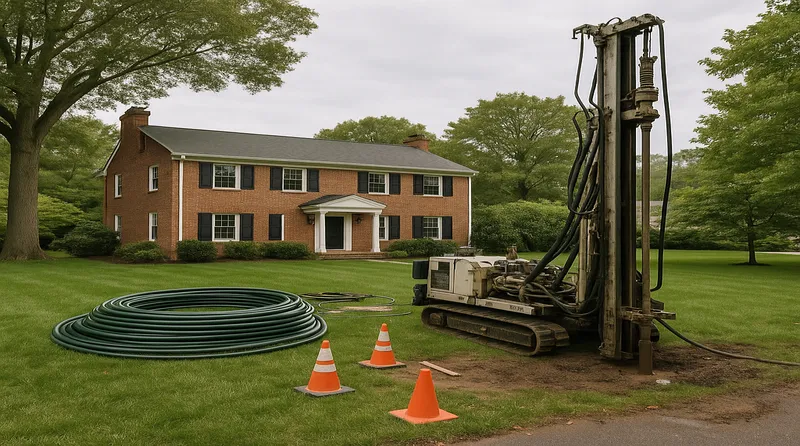
Virginia is a geothermal state in the making. Ground temperatures are favorable across the full stretch of the commonwealth — high-50s to low-60s°F depending on your region — and the state's energy policy is shifting in ways that should improve incentives for efficient heating and cooling over the next several years. Virginia Energy (the Department of Mines, Minerals and Energy, now rebranded) explicitly lists ground-source heat pumps as a "reliable and efficient alternative" for Virginia homeowners.
But the honest picture is more nuanced than most geothermal sales sites will tell you. If you're on natural gas in the Richmond suburbs, the payback math is genuinely difficult. If you're on propane or fuel oil in western Virginia, geothermal could be one of the best home investments you make. And whether you live in Northern Virginia, the Shenandoah Valley, or Hampton Roads, the geology and regulatory environment are different enough to matter.
This guide walks through the real numbers for Virginia homeowners: costs, payback scenarios by fuel type, the current — and frankly limited — state of Virginia utility rebates, and the regional geology that determines what kind of loop system makes sense for your property. We'll also cover an angle most guides miss entirely: why Virginia's explosive data center growth in Loudoun County is likely to push your electricity rates higher over the coming decade, and why that makes geothermal efficiency more valuable than today's numbers alone suggest.
Is a Virginia Geothermal Heat Pump Worth It?
The short answer: it depends on what you're replacing. Virginia's electricity rate as of November 2025 sits at 15.94¢/kWh — slightly above the national average and meaningfully higher than the 14.41¢/kWh average for all of 2024, a sign of the upward pressure that's been building. The average Virginia household uses about 1,032 kWh per month, generating a typical bill around $148.77. Dominion Energy, which serves more than 2.7 million Virginia customers, estimates the average household spends more than $900 per year on heating and cooling alone.
A ground-source heat pump doesn't eliminate that electricity cost — it reduces it dramatically. At a typical coefficient of performance (COP) of 3.5–4.5, you're getting 3.5 to 4.5 units of heat for every unit of electricity you consume. Compare that to an electric resistance heater (COP of 1.0) or even a quality air-source heat pump (COP of 2.5–3.0 in cold weather). The efficiency advantage is real and measurable.
Whether that efficiency advantage translates to a compelling payback depends on your starting point. Here's the honest matrix for Virginia:
- Replacing propane heat: Excellent economics. Virginia's 4.5% propane market is concentrated in rural and western areas where natural gas never reached. Payback of 7–10 years after the 30% federal tax credit is realistic.
- Replacing fuel oil: Similarly strong. Payback of 7–11 years depending on system size and fuel consumption history.
- Replacing electric resistance heat: The best case numerically. Geothermal's 4:1 COP advantage over resistance heating cuts your electricity consumption by 75%. Payback of 5–9 years is achievable.
- Replacing an aging air-source heat pump: Moderate economics. You're comparing two efficient technologies, and the efficiency gap narrows in Virginia's milder climate. Payback of 10–14 years is more typical.
- Replacing natural gas: The hard case. Natural gas is still relatively cheap in Virginia, and the upfront cost of geothermal is substantial. Payback of 15–22 years is the realistic range for most Richmond-area households. This isn't a reason to dismiss geothermal — it's a reason to think carefully about your timeline and motivations.
- New construction: The best overall scenario. When drilling costs are absorbed into construction financing, the effective premium over a conventional system is often $10,000–$20,000, and the payback compresses accordingly.
To understand exactly how geothermal systems work before diving into Virginia specifics, see our primer on how geothermal heat pumps work.
Virginia's Climate and Ground Temperatures
Virginia spans a remarkable range of climate zones, from the semi-coastal warmth of Hampton Roads to the cold mountain winters of the Appalachian highlands near the West Virginia border. That variation affects both the heating load your geothermal system needs to handle and, to a lesser degree, the soil temperatures it's pulling from.
Ground Temperatures: The Constant Underneath
NOAA engineering weather data for Virginia's major cities gives us measured ground temperature benchmarks. At 50-foot depth — the zone where a standard vertical closed-loop borehole operates — Richmond shows approximately 60.5°F year-round, while Roanoke, at higher elevation and with cooler surface temperatures, sits around 58.5°F. Across the full state, the safe planning range is high-50s to low-60s°F for most of Virginia.
This constant temperature is what makes geothermal work. In January, when outdoor air might hit 20°F in Roanoke or the Shenandoah Valley, the ground loop is still exchanging heat with 58°F earth. In August, when Richmond hits 95°F, the ground loop is rejecting heat into that same 60.5°F sink. The stability is the asset.
Heating and Cooling Degree Days
Virginia is genuinely a four-season climate, which helps geothermal economics. Unlike a Minnesota homeowner who primarily cares about heating, a Virginia homeowner gets meaningful return from geothermal in both modes. Richmond averages roughly 3,900 heating degree days (base 65°F) and around 1,400 cooling degree days. Northern Virginia runs slightly higher on heating and significantly higher on cooling due to the urban heat island effect. Roanoke is cooler year-round, with heating days closer to 4,300 and modest cooling demand.
The practical implication: geothermal's summer cooling efficiency is a real financial contributor in Virginia, unlike in heating-dominated northern climates where the cooling value is secondary. That matters when you're running a 25-year payback model.
Virginia Geology and Loop Design by Region
Virginia's geology is as varied as its landscape, and that variation directly shapes the cost and feasibility of different geothermal loop designs. Understanding your region's geology isn't just academic — it affects whether a vertical or horizontal loop makes more sense, what your drilling costs per foot will look like, and whether open-loop options are viable or regulated out.
Northern Virginia and the Piedmont Plateau
The broad Piedmont region running from Northern Virginia through Richmond is underlain by metamorphic and igneous crystalline rock — primarily granite, gneiss, and schist at depth. This geology requires diamond-tipped rotary drilling for vertical boreholes, which costs more per foot than drilling in sedimentary formations, but produces highly stable, long-lasting installations. Thermal conductivity in Piedmont crystalline rock is good to excellent, meaning boreholes can be spaced efficiently and systems sized appropriately without excessive drilling depth.
Loudoun County and the outer NoVA suburbs have seen significant geothermal adoption in higher-end residential construction, partly because the area's affluent homeowner base is more likely to look at long-term economics and partly because high-capacity HVAC systems are common in larger homes.
Shenandoah Valley and the Ridge-and-Valley Province
The Shenandoah Valley sits in the Ridge-and-Valley Appalachian province, underlain primarily by carbonate rocks — limestone and dolomite. This is karst territory. Karst geology has important implications for geothermal planning: the rock can be fractured, dissolution features (sinkholes, caves) can be present, and there may be preferential groundwater flow paths. An experienced driller familiar with karst conditions is essential here.
On the positive side, karst groundwater systems can make open-loop installations attractive where yields are high and water quality is suitable — but these systems require DEQ water withdrawal review (more on that in the Permits section). Closed-loop vertical systems are the safer default for most residential applications in karst areas.
Western Virginia and the Appalachian Plateau
The southwestern corner of Virginia — the coalfields and the high Appalachian plateau — is underlain by sedimentary rock: sandstone, shale, and coal-bearing formations. Drilling is generally easier and less expensive than in crystalline Piedmont rock. The bigger factor in this region is the heating load: winters here are genuinely cold, homes are less likely to be on natural gas (Appalachian Power serves this territory, and many homes heat with propane, fuel oil, or electric resistance), and geothermal's efficiency advantage is at its maximum.
Coastal Plain and Hampton Roads
The coastal plain east of the fall line — including Hampton Roads, the Northern Neck, and the Eastern Shore — sits on deep unconsolidated sediments: sand, gravel, silt, and clay extending hundreds of feet down before hitting bedrock. This geology presents both opportunity and constraint for geothermal.
Horizontal loop systems can work well in the coastal plain's softer soils if you have sufficient land area. Vertical closed-loop drilling is feasible but requires careful engineering in unconsolidated sediments. Open-loop (groundwater) systems might seem attractive given the aquifer access, but this is exactly where Virginia DEQ's groundwater management area rules apply most strictly — withdrawals of 300,000 gallons per month or more in designated groundwater management areas require DEQ permits. For a residential open-loop system that doesn't approach that threshold, you're typically fine, but larger systems require review.
Virginia Geothermal Costs and Payback
Installed geothermal system costs in Virginia follow national patterns, adjusted for regional drilling conditions and labor markets. [NEEDS VERIFICATION: current installed cost benchmarks from Virginia-based contractors, 2025–2026 pricing.] The ranges below reflect national installer data and should be verified with 2–3 local bids before financial planning.
Typical Installed Cost Ranges
For a 2,000–2,500 sq ft Virginia home:
- Vertical closed-loop system: $20,000–$35,000 installed before incentives. Northern Virginia and Richmond suburban markets tend toward the higher end; rural western Virginia can be lower depending on contractor availability and drilling conditions.
- Horizontal closed-loop system: $15,000–$25,000 installed where sufficient land area exists. Less common in established suburban neighborhoods but viable on larger rural lots.
- Open-loop (groundwater) system: $12,000–$20,000 if a suitable well already exists; $15,000–$28,000 with new well installation. Requires groundwater quality testing and DEQ review in some areas.
The 30% federal Residential Clean Energy Credit applies to all of these, with no dollar cap. See our complete guide to the federal geothermal tax credit for how to claim it and what qualifies. For a $25,000 system, the credit is worth $7,500 — reducing your effective cost to $17,500 in the year of installation.
For deeper analysis of what drives installed costs up or down, see our geothermal installation cost guide.
Payback Scenarios by Fuel Type
The following scenarios use Virginia's current electricity rate of 15.94¢/kWh and representative fuel costs. Actual results will vary based on your home size, insulation quality, system design, and local fuel prices.
Scenario 1: Replacing propane (western Virginia / rural areas)
A home using 900 gallons of propane annually at $3.00–$3.50/gallon spends $2,700–$3,150/year on heating fuel alone. A geothermal system covering the same load with a COP of 3.8 would consume roughly 9,000–10,000 kWh, costing $1,435–$1,594 at current rates. Annual savings: $1,100–$1,550+. After the 30% federal credit on a $25,000 system ($17,500 net cost), simple payback is roughly 7–10 years. For a comparison of the full cost picture, see our geothermal vs. propane analysis.
Scenario 2: Replacing fuel oil
Similar math to propane. A home burning 600 gallons of fuel oil at $3.50–$4.00/gallon spends $2,100–$2,400/year. Geothermal savings of $700–$1,000/year post-installation yield paybacks of 7–11 years after the federal credit.
Scenario 3: Replacing electric resistance heat
This is where geothermal's COP advantage is most dramatic. An electric resistance baseboard system operating at COP 1.0 requires four times the electricity of a geothermal system at COP 4.0. A home spending $1,800/year on electric resistance heating could reduce that to $450/year with geothermal — saving $1,350 annually. Payback on a $17,500 net cost system: 5–9 years. This is the strongest economic case in Virginia.
Scenario 4: Replacing natural gas (Richmond suburbs, most of NoVA)
This is the case that requires the most honest treatment. Natural gas remains relatively inexpensive in Virginia, and many suburban homes are efficiently heated at $800–$1,200/year. A geothermal system at $1,400/year in electricity may not produce significant savings — or could even cost more annually in some cases. Payback periods of 15–22 years are realistic. For many Virginia households currently on natural gas, the primary motivations for geothermal are non-financial: reducing carbon footprint, independence from gas supply disruptions, or anticipation of future rate increases. See our detailed geothermal vs. natural gas comparison for the full breakdown.
The rate trajectory argument
Here's an angle that doesn't get enough attention: Virginia's electricity rates are under significant upward pressure from data center load growth. The Virginia Joint Legislative Audit and Review Commission (JLARC) found in 2024 that a typical Dominion residential customer could see generation and transmission charges rise $14–$37/month by 2040 in constant dollars — driven significantly by the data center buildout in Loudoun County (more on this in the Utilities section). If electricity rates do rise toward that range, every efficiency improvement you've locked in becomes more valuable. A geothermal system that's marginal at today's rates could look excellent at 2035 rates. This is speculative and your decision shouldn't depend on it, but it's a real consideration that pure payback calculators miss.
For a broader discussion of how to model payback under different assumptions, see our guide to geothermal payback periods.
Virginia Incentives, Rebates, and Tax Credits
This is where we need to be direct: Virginia's state-level incentive picture for residential geothermal is thin compared to states like Maryland, Massachusetts, or Oregon. Here's what actually exists and what doesn't.
Federal Tax Credit (30% — the main event)
The 30% Residential Clean Energy Credit under the Inflation Reduction Act is the single most important financial incentive for Virginia geothermal. It applies to ground-source heat pump systems and associated installation costs, with no dollar cap. On a $25,000 system, that's a $7,500 tax credit — not a deduction, a credit, reducing your federal tax liability dollar-for-dollar. The credit is available through at least 2032.
One critical point: this is a nonrefundable credit. If you don't owe $7,500 in federal taxes in the year of installation, you won't receive the full benefit unless you can carry forward the unused portion. Consult a tax professional before making financial plans based on the full credit value.
Virginia State Tax Credit
[NEEDS VERIFICATION: As of this writing, no clearly published Virginia-specific state income tax credit for residential geothermal heat pump installations has been identified in DSIRE's database. Readers should check the DSIRE Virginia programs page and consult with a Virginia tax professional before assuming any state credit applies. This section will be updated if a state-level program is confirmed.]
Virginia has historically been less aggressive than neighboring states in offering state-level energy efficiency tax credits. The Virginia Clean Economy Act (VCEA) creates framework and utility obligations, but does not itself establish homeowner tax credits for equipment purchases.
Dominion Energy Rebates
Dominion Energy, serving 2.7 million Virginia customers, offers a limited energy efficiency rebate program. Current published rebates include $50 for smart thermostats and up to $400 for ENERGY STAR certified heat pump water heaters. [NEEDS VERIFICATION: No clearly published direct residential geothermal heat pump rebate from Dominion Energy has been confirmed as of this writing. Readers should contact Dominion Energy directly or check their current rebate portal at dominionenergy.com before finalizing financial projections.] The absence of a Dominion geothermal rebate is notable given that the state's largest utility has the infrastructure to offer one.
Why might this change? The Virginia Clean Economy Act requires utilities to meet energy savings targets of 2.0% annually in Phase I, rising to 5.0% in Phase II, measured against 2019 retail sales. These aren't direct homeowner rebates — they're performance obligations on the utilities. But as those targets tighten, utilities will need to deploy efficiency programs broadly, and high-efficiency heat pumps (including ground-source systems) are among the most cost-effective ways to hit those targets. Virginia may develop more robust utility-funded geothermal incentives within the next 3–5 years as the VCEA obligations intensify.
Appalachian Power Rebates
Appalachian Power (AEP Virginia), which serves western Virginia, runs separate efficiency programs. Rebate availability and amounts differ from Dominion and should be verified directly with the utility. Homeowners in western Virginia — particularly those replacing propane or fuel oil — should contact Appalachian Power about any heat pump incentives before ruling out additional utility incentives.
Federal IRA Upgrade Incentives
In addition to the 30% tax credit, the Inflation Reduction Act created the High-Efficiency Electric Home Rebate Act (HEEHRA) program, which provides point-of-sale rebates for qualifying households based on income. For eligible Virginia households, these rebates can cover a portion of heat pump costs — though availability depends on your state and utility administering the program. Check current HEEHRA availability with Virginia's energy office.
For a full breakdown of financing options and how to stack multiple incentives, see our guide to geothermal financing options.
Utility Territory: Dominion vs Appalachian Power
Which utility serves your home in Virginia matters more than most homeowners realize. The economics of geothermal, the rebate landscape, and the rate trajectory are meaningfully different depending on whether you're in Dominion or Appalachian Power territory.
Dominion Energy Virginia
Dominion serves the vast majority of the state — Northern Virginia, the Richmond region, Hampton Roads, and the Eastern Shore. It is the nation's sixth-largest producer of electricity and is in the midst of a massive capital investment program driven by data center load growth in Northern Virginia.
Loudoun County alone hosts approximately 25 million square feet of operational data center space, with another roughly 4 million square feet in active development. The county's data centers generate $586.8 million in annual tax revenue — but they also consume enormous amounts of power. JLARC's 2024 study on data centers in Virginia found that this concentrated load growth is a primary driver of Dominion's projected rate increases. The projection of $14–$37/month in additional generation and transmission charges by 2040 for the average Dominion residential customer is a direct consequence of building out grid infrastructure for hyperscaler demand.
The takeaway for geothermal: every kilowatt-hour you displace with high-efficiency heating becomes more valuable as rates climb. A geothermal system that looks marginal at 15.94¢/kWh looks considerably better at 20¢ or 22¢/kWh. This doesn't change the math today, but it's a real long-term consideration for Dominion customers.
Appalachian Power (AEP Virginia)
Appalachian Power serves western and southwestern Virginia — the Roanoke region, New River Valley (including Blacksburg), much of the Shenandoah Valley, and the coalfields of southwestern Virginia. The economics of geothermal in Appalachian Power territory are often substantially better than in Dominion's service area, for several reasons:
- Higher heating loads: Mountain climates in western Virginia are significantly colder than Richmond or Northern Virginia. More heating degree days mean more fuel consumed, which means a bigger savings opportunity.
- Less natural gas penetration: Many homes in western Virginia heat with propane, fuel oil, or electric resistance — all of which have more compelling geothermal paybacks than natural gas.
- Different rate trajectory: Appalachian Power's rate pressures differ from Dominion's. The absence of hyperscale data center load in western Virginia means Appalachian Power customers face different future rate dynamics.
If you're an Appalachian Power customer heating with propane in the Roanoke metro or Shenandoah Valley, the combination of a cold climate, expensive fuel, and favorable ground temperatures makes a particularly strong case for geothermal.
Permits and Site Constraints
Virginia requires HVAC and mechanical permits for geothermal heat pump installations — this is standard practice and your installer should handle it. The more Virginia-specific permitting considerations involve drilling and groundwater.
Well Drilling Permits
Vertical closed-loop boreholes in Virginia require a well construction permit from the Virginia Department of Health (VDH) or local health department, depending on your locality. Installers familiar with Virginia regulations will handle this as a standard part of the project. The permit process is not onerous for typical residential vertical loop installations.
Groundwater Management Areas (Open-Loop Systems)
If you're considering an open-loop (groundwater) geothermal system in eastern Virginia, understand the DEQ groundwater management area rules. Virginia has designated groundwater management areas in the Coastal Plain where groundwater withdrawal is regulated due to regional aquifer pressures. Within these areas, withdrawals of 300,000 gallons per month or more require a DEQ groundwater withdrawal permit. A typical residential open-loop geothermal system operates at 5–15 gallons per minute — at 12 hours/day operation, that's roughly 1.8–5.4 million gallons per month, well over the permit threshold.
This means most residential open-loop systems in eastern Virginia's Coastal Plain will require a DEQ groundwater withdrawal permit, adding cost and time to the project. It does not mean open-loop systems are prohibited — they're installed and operating successfully throughout coastal Virginia — but the permitting process is real and should be planned for. Closed-loop vertical systems avoid this regulatory layer entirely, which is why they're the default for most Virginia installations.
Local Setback and HOA Considerations
Horizontal loop trenching requires setbacks from property lines, structures, and septic systems. Vertical borehole drilling typically has a smaller footprint and fewer setback issues, which is one reason vertical systems dominate in established suburban neighborhoods. If you're in a homeowners association, review your CC&Rs — some prohibit or restrict drilling equipment access. This is increasingly rare as geothermal adoption grows, but worth checking before you invest in a site assessment.
Real Virginia Installations
Virginia Tech KnowledgeWorks Building, Blacksburg
The most rigorously documented geothermal installation in Virginia is the KnowledgeWorks building at Virginia Tech in Blacksburg, studied as part of graduate-level research at the university. The building's geothermal system consumed 627,500 kWh annually — compared to 751,200 kWh/year for a modeled Variable Air Volume (VAV) baseline system and 651,200 kWh/year for an air-source heat pump (ASHP) alternative. That represents annual savings of 123,700 kWh versus the VAV system and 23,700 kWh versus the ASHP scenario.
These aren't theoretical projections — they're measured operational data from a real Virginia building in Appalachian Power territory. The savings differential against the ASHP alternative (23,700 kWh/year) is particularly relevant for residential comparisons, since many Virginia homeowners are already on air-source heat pumps and considering whether an upgrade to ground-source makes sense.
At 15.94¢/kWh, 23,700 kWh/year represents approximately $3,779 in annual savings — for a commercial building. Scaled to a typical residential system, the proportional savings in a similar Blacksburg-area climate would be meaningful but smaller in absolute terms. The data point stands as useful validation that geothermal's efficiency advantage over ASHP is real in Virginia conditions.
Northern Virginia Residential (Representative)
Installer reports from the NoVA market consistently describe geothermal performing well in larger suburban homes with high cooling loads. In a climate with both meaningful heating and significant summer cooling, geothermal's year-round efficiency advantage accumulates on both sides of the ledger. Homeowners replacing aging propane systems in older NoVA homes — particularly those not served by natural gas — report paybacks in the 8–12 year range post-incentives.
Who Should Seriously Consider Geothermal in Virginia?
Based on Virginia's energy economics, geology, and incentive landscape, the following homeowner profiles have the strongest case for geothermal:
Strong Candidates
- Propane or fuel oil users in western Virginia or rural areas. This is the most compelling Virginia case. You're already paying premium rates for expensive fuel, your heating loads are real, and the federal credit gets you to a payback inside a decade.
- Homes with electric resistance heat. COP of 4+ versus COP of 1 is an enormous efficiency gap. Even at Virginia's electricity rates, the savings are substantial and payback is fast.
- New construction buyers in any Virginia region. When drilling costs are folded into a construction loan at mortgage rates, the effective cost of geothermal versus conventional HVAC is much smaller than a retrofit calculation suggests. This is the best structural opportunity.
- Larger homes (3,000+ sq ft) with high heating and cooling loads. Higher energy consumption means larger absolute savings, which improves payback timelines regardless of fuel type.
- Long-term homeowners (10+ year horizon). Geothermal makes the most financial sense for people planning to be in their homes long enough to capture the back half of the payback curve and the ongoing years of free savings beyond that.
Marginal or Poor Candidates
- Natural gas users in the Richmond or NoVA suburbs with modest heating loads. The math doesn't work well unless you have a very large home, or unless non-financial factors (carbon footprint, energy independence) are part of your decision.
- Homeowners planning to sell within 5–7 years. You may recover some installation cost in resale value, but you're unlikely to recoup the full investment through energy savings before selling.
- Properties with major site constraints. Small lots, high water tables in coastal plain areas, or active karst geology can significantly increase installation cost or preclude certain loop designs.
How to Find a Virginia Geothermal Installer
Geothermal installation is a specialized trade. Not every HVAC contractor has the drilling relationships, system design experience, or equipment sourcing to do it well. Here's how to find qualified installers in Virginia:
Certification: What to Look For
The primary professional credential for geothermal installers in the United States is the International Ground Source Heat Pump Association (IGSHPA) accreditation. IGSHPA-accredited contractors have completed training in system design, loop installation, and equipment sizing. This isn't a guarantee of quality, but it's a meaningful signal that the contractor takes the work seriously and stays current with industry standards.
Virginia also has Class A and Class B contractor license requirements for HVAC work. Confirm that any contractor you're considering holds a current Virginia contractor's license and carries appropriate liability insurance.
Getting Multiple Bids
This cannot be overstated: get at least three bids for any geothermal installation. Pricing varies significantly between contractors, and the scope of proposals can differ considerably — number of boreholes, loop configuration, heat pump brand and capacity, and whether well completion reports and permits are included in the price. A detailed scope comparison across multiple bids will tell you more than any single estimate.
Questions to Ask Installers
- How many geothermal systems have you installed in Virginia, and can you provide references in my region?
- Are you IGSHPA accredited? Who is the drilling subcontractor, and are they licensed in Virginia?
- Will you conduct a formal load calculation for my home before sizing the system?
- Does your proposal include handling VDH well construction permits and DEQ notifications if applicable?
- What equipment brands do you typically install, and what are the warranty terms for the heat pump and loop field?
- Have you worked with Dominion/Appalachian Power on any rebate applications?
Red Flags
Be cautious of contractors who provide quotes without a site visit or load calculation, promise payback timelines significantly shorter than the scenarios described in this guide, or can't provide local references for completed Virginia installations. The geothermal market has grown enough that legitimate, experienced contractors are available in most Virginia metro areas.
Virginia Geothermal FAQ
- Does Virginia have a state tax credit for geothermal heat pumps?
- As of this writing, no clearly published Virginia-specific state income tax credit for residential geothermal installations has been confirmed. [NEEDS VERIFICATION] The 30% federal Residential Clean Energy Credit is the primary tax incentive available to Virginia homeowners. Check DSIRE's Virginia programs page for the most current state-level incentive information.
- Does Dominion Energy offer rebates for geothermal heat pumps?
- Dominion's current published rebate programs focus on smart thermostats and heat pump water heaters. No clearly published direct residential geothermal heat pump rebate from Dominion has been confirmed as of this writing. [NEEDS VERIFICATION] Contact Dominion Energy directly at their current rebate portal for the most current program information, as utility programs change.
- What ground temperatures can I expect in Virginia?
- Most of Virginia experiences ground temperatures in the high-50s to low-60s°F at typical borehole depths. Richmond is approximately 60.5°F at 50-foot depth; Roanoke is approximately 58.5°F. Higher elevations in the Appalachians run a bit cooler.
- Can I use an open-loop (groundwater) geothermal system in eastern Virginia?
- Open-loop systems are installed in eastern Virginia, but the Coastal Plain's designated groundwater management areas mean that most residential open-loop systems require a DEQ groundwater withdrawal permit. Closed-loop vertical systems are more common in this region partly because they avoid that regulatory layer. Consult with an experienced local installer about your specific site conditions.
- How long do geothermal systems last in Virginia?
- Ground loop fields are typically warranted for 25–50 years and commonly last much longer — the HDPE pipe used in modern installations has an estimated lifespan of 50+ years. The heat pump unit itself typically lasts 20–25 years, similar to a conventional HVAC system. This extended equipment life is part of geothermal's long-term value proposition.
- Is the data center boom in Northern Virginia relevant to my geothermal decision?
- Indirectly, yes. Loudoun County's massive data center concentration — the world's largest — is a primary driver of Dominion's projected rate increases over the coming decade. JLARC projects $14–$37/month in additional generation and transmission charges for typical Dominion customers by 2040. Every unit of efficiency you lock in now becomes more valuable as rates rise. It's not a reason to rush into geothermal, but it's a real factor in long-term financial modeling.
- How does geothermal compare to a high-efficiency air-source heat pump in Virginia?
- In Virginia's climate, the comparison is more nuanced than in cold northern climates where ASHP performance degrades sharply in extreme cold. Modern cold-climate air-source heat pumps perform well down to 0°F and below. The geothermal advantage in Virginia is real but less dramatic than in Minnesota — expect a meaningful COP advantage (3.8–4.5 vs. 2.5–3.0 in winter conditions), lower operating costs, and consistent performance regardless of outdoor temperature. Whether that advantage justifies the higher upfront cost depends on your fuel type, system size, and planning horizon.
- What incentives are available beyond the federal tax credit?
- The Inflation Reduction Act's High-Efficiency Electric Home Rebate Act (HEEHRA) may provide additional point-of-sale rebates for qualifying Virginia households based on income. Check with Virginia Energy's office for current HEEHRA program status. Some local utilities may have programs not covered in this guide — contact Dominion or Appalachian Power directly for current offerings.
Sources
- EIA Monthly Electric Power Review — Average Retail Price of Electricity by State (Table 5.6.A)
- EIA Electricity Sales, Revenue, and Average Retail Price by State (Table 5A)
- EIA State Energy Data System, Virginia — Heating Fuel Mix and Consumption
- Virginia Energy (DMME), Geothermal Resources — Ground-Source Heat Pump Overview
- DSIRE Virginia Programs — Database of State Incentives for Renewables & Efficiency
- Dominion Energy Virginia — Energy Star Products Rebates
- Dominion Energy Virginia — Home Energy Savings Programs
- JLARC, Data Centers in Virginia (2024) — Rate Impact Analysis
- Loudoun County Economic Development — Data Center Alley
- Virginia Code §56-596.2 — Virginia Clean Economy Act Efficiency Standards
- Virginia DEQ — Water Withdrawal Permits and Groundwater Management Areas
- Virginia Tech KnowledgeWorks — Geothermal System Energy Performance Case Study
- NOAA Engineering Weather Data — Richmond, Virginia (Ground Temperature Data)
- NOAA Engineering Weather Data — Roanoke, Virginia (Ground Temperature Data)