
In This Guide
- Maine's Oil Problem — and the Alternative
- Maine by the Numbers
- Geothermal vs. Heating Oil: The Math
- Federal 30% Tax Credit
- Efficiency Maine Rebate & Loans
- Stacking Incentives: What You Can Actually Collect
- Maine's Geology for Geothermal
- What Installation Costs in Maine
- Permitting in Maine
- Finding a Qualified Installer
- Bottom Line: Is Geothermal Right for You?
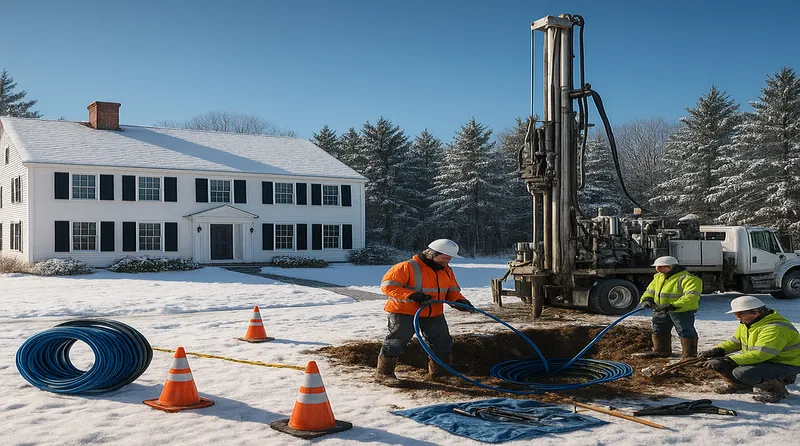
Maine runs on heating oil. Always has. About 73% of Maine homes use fuel oil as their primary heating source — the highest proportion of any state in the country, by a wide margin. That's not a historical curiosity. It's an ongoing financial burden that most Maine homeowners have simply accepted as the cost of living in a cold place.
They shouldn't have to. Ground-source geothermal heat pumps are quietly transforming how northern homes heat themselves, and Maine's combination of brutal winters, expensive oil, and generous incentives makes it one of the strongest geothermal markets anywhere in the US. The math here is unusually favorable. The payback window, when you stack the federal tax credit against Efficiency Maine's rebate and loan programs, is shorter than most people expect.
This guide breaks down exactly what it costs, what you can collect in incentives, and what the process looks like — for a Maine homeowner who's ready to stop filling the oil tank.
Maine's Oil Problem — and the Alternative
The data is stark: according to the U.S. Energy Information Administration, Maine is the most heating-oil-dependent state in the nation. When heating oil prices spiked in 2022, Maine households paying $5+ per gallon didn't have many options. Oil doesn't have a thermostat. You pay whatever the market charges.
That price volatility is the core problem. In the past decade, heating oil in the Northeast has ranged from under $2/gallon to over $5. The average Maine homeowner burning 800–1,000 gallons per heating season has experienced annual swings of $2,000 or more in their heating costs — with zero control over any of it.
Geothermal changes the equation fundamentally. A ground-source heat pump doesn't burn fuel — it moves heat. It pulls thermal energy from the earth, which maintains a roughly constant 45°F year-round in Maine, regardless of what's happening above ground. That stability translates directly to predictable operating costs. Your heating bill becomes a function of how much electricity you use, multiplied by a fixed rate. No commodity exposure, no supply chain surprises, no $500 fill-ups.
The technology isn't new — geothermal heat pumps have been installed in New England homes for 40+ years — but the economics have shifted significantly. Equipment costs have dropped, installer networks have expanded, and the incentive stack available today (more on that below) makes this a realistic option for middle-class homeowners, not just those building high-end custom homes.
Maine by the Numbers
Maine Energy Profile
- Homes heating with fuel oil: ~73% (highest in the US)
- Average residential electricity rate: 26.04¢/kWh (2025, EIA)
- Annual heating degree days (Portland): ~7,500 HDD; statewide avg ~8,427 HDD
- Average ground temperature (4–6 ft depth): ~45°F year-round
- IECC climate zone: 6A (Very Cold, moist)
- Average annual heating oil price (2024–25): ~$3.75–$4.20/gallon
Let's start with the electricity rate. At 26.04¢/kWh, Maine's residential rate is high — among the top five in the country. You might think that makes geothermal a bad deal. It doesn't, and here's why: a geothermal heat pump delivers 3 to 4 units of heat for every 1 unit of electricity it consumes (this ratio is called the Coefficient of Performance, or COP). That multiplier effect more than offsets the high per-kWh rate, especially when you're comparing against heating oil.
The climate numbers matter too. With over 8,400 annual heating degree days on average — and locations in northern Maine pushing 9,000+ — Maine homes work their heating systems hard. That's a lot of hours logged each year. The efficiency advantage of geothermal (vs. burning oil at 85–90% efficiency) compounds over a long heating season in a way it simply doesn't in a milder climate.
Ground temperature at 45°F is solid for geothermal performance. It's not as warm as the mid-Atlantic or deep South, but it's high enough that a well-designed system will maintain good efficiency through even the coldest Maine winters. The ground loop extracts heat from the earth — it doesn't need warm ground, just stable ground.
Geothermal vs. Heating Oil: The Math
Let's run the numbers honestly, because this is where Maine's case for geothermal is strongest.
Heating Oil Costs
Heating oil contains about 138,500 BTU per gallon. At a boiler efficiency of 85%, you're getting roughly 117,700 usable BTUs per gallon. At a delivered price of $4.00/gallon (a conservative middle estimate for current Maine pricing), that works out to:
$34.00 per million BTU of useful heat from oil
If prices spike to $4.50, you're at $38.22/MMBtu. At $5.00, you're at $42.47. This is why heating oil is a gamble every winter.
Geothermal Costs
A geothermal heat pump in Maine's climate typically operates at a seasonal COP of around 3.2–3.6. Let's use 3.4 as our baseline. One kWh of electricity contains 3,412 BTUs. At 26.04¢/kWh, that's 26.04¢ for 3,412 BTU of electricity input, which the heat pump converts into 3.4 × 3,412 = 11,601 BTU of delivered heat.
That translates to: $22.44 per million BTU of useful heat from geothermal
Annual Savings Estimate
A 1,800 sq ft Maine home with average insulation typically needs 75–90 MMBtu of heat per winter. Let's use 80 MMBtu as the midpoint:
Annual Heating Cost Comparison (80 MMBtu/year)
- Heating oil at $4.00/gal: $2,720/year
- Geothermal at 26.04¢/kWh, COP 3.4: $1,795/year
- Annual savings: ~$925/year
- Note: Geothermal also provides cooling — oil heating systems don't. Add the cost of whatever AC you're replacing.
That $925 figure is conservative. It doesn't account for oil price volatility, and it doesn't credit geothermal for replacing central air conditioning. If you're currently running window units or a separate AC system, geothermal handles cooling too — at the same operating efficiency.
At $925/year in savings, an $18,000 geothermal system (after the $3,000 Efficiency Maine rebate and 30% federal tax credit — more on those below) is looking at a net-cost payback of under 12 years. Factor in the cooling credit and the real payback window is closer to 8–10 years on a system with a 25-year lifespan.
Federal 30% Tax Credit
The federal Residential Clean Energy Credit (Section 25D of the tax code) covers 30% of the total installed cost of a qualifying geothermal heat pump system. There's no dollar cap on this credit — if your system costs $25,000 installed, you're claiming $7,500 back on your federal taxes.
A few important details:
- It's a tax credit, not a deduction. A credit reduces your tax liability dollar-for-dollar. If you owe $8,000 in federal taxes, a $7,500 credit leaves you owing $500.
- If the credit exceeds your tax liability in one year, the excess carries forward to future tax years. You don't lose it.
- The system must meet efficiency requirements — Energy Star certified geothermal heat pumps qualify. Your installer can confirm eligibility before you sign anything.
- The credit is available through 2032 at 30%, then steps down: 26% in 2033, 22% in 2034. No reason to rush, but no reason to wait a decade either.
- It applies to the full installed cost — equipment, labor, ground loop drilling or trenching, controls, everything tied to the installation.
For most Maine homeowners, the federal tax credit alone covers $5,500–$9,000 of a typical installation. Combined with the Efficiency Maine rebate below, the incentive stack is substantial.
For full details, see our complete guide to the federal geothermal tax credit and consult a tax professional for your specific situation.
Efficiency Maine Rebate & Loans
Efficiency Maine is Maine's state energy efficiency agency, and it offers one of the more straightforward geothermal rebates in the Northeast.
The $3,000 Rebate
Efficiency Maine pays a rebate of up to $3,000, or 1/3 of the project cost, whichever is less. For most geothermal installations, the 1/3 cap is the limiting factor — a $12,000 system would get $3,000; a $9,000 system would also cap at $3,000. For the vast majority of Maine homeowners, expect to collect the full $3,000.
Requirements:
- ENERGY STAR certified geothermal heat pump
- Installed by a Residential Registered Vendor for Geothermal Systems (Efficiency Maine maintains this list)
- Primary year-round residence — no vacation homes or seasonal camps
- Single-family homes, duplexes, condos, and mixed-use buildings with 1–2 housing units are eligible
- One rebate per housing unit (lifetime limit)
- Submit claim within six months of project completion
The rebate process is straightforward: hire a registered vendor, complete the installation, submit the claim form, wait six weeks for a check. Efficiency Maine processes these routinely.
One thing worth noting: you can stack the Efficiency Maine rebate with the federal 30% tax credit. They're not mutually exclusive. However, when calculating your federal credit, the rebate reduces your basis — technically, you'd calculate 30% on the net cost after the rebate, or on the full installed cost (consult your tax professional on timing and structure).
Home Energy Loans
Efficiency Maine also operates a Green Bank financing program with multiple loan options that make geothermal accessible even when you don't have $20,000 sitting around:
Efficiency Maine Home Energy Loan Options
- 1-Year, 0% APR: Short-term, interest-free. Ideal if you're waiting on the federal tax credit refund.
- 5-Year, 5.99% APR: Monthly payment on a $15,000 net loan: ~$290/month
- 10-Year, 7.99% APR: Monthly payment on a $15,000 net loan: ~$182/month
- Income-Based 10-Year, 5.99% APR: For qualifying low/moderate-income households
A common financing structure: take the 1-year 0% loan, file your taxes and receive the 30% federal credit, apply that credit toward the loan balance, then refinance the remainder on a longer term if needed. Many Maine installers are familiar with this approach and can walk you through it.
Note that projects don't need to receive an Efficiency Maine rebate to be eligible for the loan programs — but most projects will qualify for both.
Stacking Incentives: What You Can Actually Collect
Here's what the incentive stack looks like on a real Maine installation:
Incentive Stack Example: $22,000 Installed System
- Gross installation cost: $22,000
- Efficiency Maine rebate: −$3,000
- Federal 30% tax credit (on net cost): −$5,700
- Net out-of-pocket cost: ~$13,300
- Annual savings vs. oil at $4.00/gal: ~$925
- Simple payback: ~14 years
- Payback with AC credit & oil at $4.50/gal: ~10–11 years
- System lifespan: 25 years (loop) / 15–20 years (heat pump)
On a 25-year horizon, you're looking at cumulative savings that easily exceed the installation cost — plus you've hedged yourself against oil price spikes for the next two-plus decades. That's not a bad trade.
Maine's Geology for Geothermal
Maine's geology is dominated by granite bedrock — some of the oldest and hardest rock in North America. That's relevant because virtually all Maine geothermal systems use vertical closed loops, where a drilling rig bores 200–400 feet straight down and installs U-shaped pipe loops in the borehole.
The geology presents both challenges and advantages:
The challenge: Drilling through Maine's granite and schist costs more than drilling through softer sedimentary formations common in the Midwest. Drilling contractors in Maine typically charge $25–$40 per foot. A typical residential installation requiring 3 boreholes at 250 feet each means 750 linear feet — that's $18,750–$30,000 just for drilling, before equipment. This is one reason Maine geothermal quotes run higher than national averages.
The advantage: Granite conducts heat extremely well and stores thermal energy effectively. Maine bedrock provides excellent loop performance — the ground loop will extract heat efficiently even during the coldest stretches of a Maine winter. You don't lose performance to poor geology here.
In coastal and southern Maine, you'll encounter glacial till, clay, and sand/gravel deposits that can reduce drilling costs somewhat. The Kennebec and Penobscot Valleys also have significant alluvial deposits. An experienced local installer will assess your site before quoting — ask specifically about expected drilling conditions and whether horizontal loops are feasible on your lot (they require more land but can be cheaper than vertical drilling in some soil conditions).
Open-loop systems (which draw groundwater directly through the heat pump and return it to an aquifer or discharge point) are less common in Maine but exist in some locations with high-yield wells. The Maine DEP regulates these under the Water Withdrawal Act; your installer will know whether your site qualifies.
What Installation Costs in Maine
There's no way to give a precise number without a site assessment — installation cost depends on lot size, soil conditions, existing ductwork, and system sizing. But here are realistic ranges for Maine as of 2025–2026:
Maine Geothermal Installation Cost Ranges
- Small home (1,200–1,500 sq ft): $18,000–$24,000 installed
- Medium home (1,500–2,500 sq ft): $22,000–$32,000 installed
- Large home (2,500+ sq ft): $30,000–$45,000+ installed
- Vertical drilling (most Maine sites): $25–$40/linear foot
- With existing ductwork: Lower cost; without ductwork, add $5,000–$12,000
Maine quotes trend higher than the national average of $18,000–$25,000, largely due to the bedrock drilling costs described above. Get at least three quotes — the spread between high and low can be significant, and a lower bid doesn't always mean lower quality. Ask each contractor to itemize drilling, equipment, and labor separately so you can compare apples to apples.
If your home currently has a forced-air system with ductwork, conversion to geothermal is straightforward — the heat pump connects to your existing air handler. If you have a hot-water baseboard system (common in older Maine homes), you'll need either a hydronic heat pump or a duct conversion. The latter adds cost but is commonly done. Some Maine homeowners add a few mini-split fan coil units to zones that lack good ductwork rather than running new ducts throughout the house.
For a detailed breakdown of what drives geothermal installation costs nationally, see our geothermal installation cost guide.
Permitting in Maine
Maine geothermal installations typically require permits at both the state and local level:
State-Level Requirements
- Maine DEP Well Drilling: Any well drilled in Maine — including geothermal boreholes — requires notification under Maine law. Licensed well drillers handle this automatically; confirm your contractor is licensed under the Maine Well Driller's Act.
- Open-loop systems: If using groundwater, you'll likely need a withdrawal permit from the Maine DEP depending on withdrawal volume. Your installer will advise.
- Wetlands/shoreland: Maine has strict Shoreland Zoning laws. If your property is within 250 feet of a water body, additional DEP review may apply. Horizontal loops in shoreland zones require extra attention.
Local Permits
- Building permit: Most Maine municipalities require a building permit for geothermal installation. Cost varies; expect $100–$400.
- Electrical permit: Required for the heat pump unit connection.
- Plumbing permit: Required in many municipalities for the ground loop piping.
A reputable installer will pull all required permits as part of the job. Be skeptical of any contractor who suggests skipping permits to save time or money — it creates problems at resale and may void manufacturer warranties.
Finding a Qualified Installer
Maine has a growing installer network, concentrated in southern and central Maine but with coverage statewide. Here's how to find and vet one:
Efficiency Maine's Registered Vendor List
Start here. Efficiency Maine maintains a list of approved vendors at efficiencymaine.com/at-home/vendor-locator/. Only installers on this list can help you receive the $3,000 Efficiency Maine rebate, so there's no reason to hire anyone who isn't on it. The list also provides some basic accountability — registered vendors have agreed to Efficiency Maine's standards.
IGSHPA Certification
Look for installers certified by the International Ground Source Heat Pump Association (IGSHPA). IGSHPA-certified technicians have completed training specific to ground-source systems and have demonstrated competency in loop design and installation. See our guide to geothermal installer certifications for what these credentials mean.
Questions to Ask Contractors
- How many geothermal systems have you installed in Maine specifically? (Local experience matters for geology and permitting.)
- Do you design the loop in-house or sub it out? (In-house is generally preferable.)
- What drilling equipment do you use, and what happens if you hit unexpected geology?
- Will you handle all permits, and can you provide a list of what's required for my site?
- What's included in the warranty, and who handles service if something goes wrong?
Don't hire on price alone. The ground loop is a 50-year investment — shoddy loop installation is expensive to fix after the fact. The heat pump itself has a 15-year warranty from most major manufacturers, but the loop outlasts that by decades if properly installed.
Bottom Line: Is Geothermal Right for You?
Maine homeowners who get the most out of geothermal tend to share a few characteristics:
You're heating with fuel oil or propane. This is the biggest one. If you're currently burning $3,000–$4,000/year in oil, the operating cost comparison is compelling from day one. Natural gas customers have a harder case to make, but there aren't many of them in rural Maine anyway.
You plan to stay in the house for at least 10 years. Geothermal is a long-term investment. The economics are strong, but the payback period of 8–14 years (depending on your baseline costs and incentive capture) means short-term residents don't get full value. That said, geothermal systems add demonstrable value to home appraisals and are increasingly a selling point in the Maine real estate market.
Your lot can accommodate a ground loop. Vertical loops can fit in relatively small yards — you're drilling down, not out — but very constrained urban lots can be challenging. Most rural and suburban Maine properties have no problem. Ask an installer for a site assessment before assuming it won't work.
You have or want central air. If you're already planning to add AC, geothermal handles both for the cost of one installation. In Maine, summer cooling isn't as critical as in the South, but climate is changing, and a geothermal system that delivers efficient heating AND cooling is a stronger value proposition than a heating-only system.
You're not on the fence about staying in Maine. This probably sounds obvious, but geothermal is a capital-intensive project that rewards commitment to a property. If you're planning to downsize in five years, a heat pump mini-split system might be a better near-term choice.
Maine has quietly become one of the best states in the country for geothermal adoption — not because the incentives are the most generous (they're solid, not spectacular), but because the baseline condition — nearly everyone burning expensive, volatile oil in a very cold climate — creates enormous room for improvement. The 73% who still heat with oil aren't staying there forever. Geothermal is one of the best exits.
Ready to Explore Geothermal for Your Maine Home?
Start with Efficiency Maine's vendor locator to find a registered installer near you. Get at least three quotes, ask each contractor to itemize drilling costs separately, and check IGSHPA certification. The $3,000 rebate claim form is available at efficiencymaine.com once your project is complete.
Find Maine Installers →Related Reading
- How Geothermal Heat Pumps Work — the technology explained without the jargon
- Federal Geothermal Tax Credit Guide (2026) — how to claim your 30%
- Geothermal Installation Cost Guide — what drives costs and how to compare quotes
- Geothermal vs. Propane for Rural Homes — if oil isn't your only alternative
- New Hampshire Geothermal Guide — similar climate, different incentives
- Connecticut Geothermal Guide — highest electricity rates in New England, geothermal still wins