
In This Guide
West Virginia's Heating Reality
West Virginia doesn't fit neatly into the standard geothermal pitch. The state has no geothermal-specific tax credit or rebate program. Its electricity comes overwhelmingly from coal — the most carbon-intensive grid in the United States. And a significant portion of WV homeowners heat with natural gas in the urban areas, where geothermal's financial case is weakest.
But here's what makes WV interesting: a large share of homes — particularly older housing stock and manufactured homes throughout rural Appalachia — heat with electric baseboard or resistance heating. And replacing electric resistance heat with a geothermal heat pump produces the most dramatic efficiency improvement of any fuel conversion. DOE data shows geothermal can reduce electricity consumption for heating by up to 75% compared to electric resistance. At WV's electricity rates, that translates to a 4–6 year payback after the federal tax credit — one of the best cases in the country.
Add the significant rural propane market (especially in southern WV's coalfield counties) and you have a state where geothermal makes clear financial sense for the right homes, even without state-level support.
Does Geothermal Work in West Virginia?
Ground Temperatures
West Virginia's shallow ground temperature (10–15 feet below the surface) holds steady at approximately 54–58°F across most of the state — slightly warmer than Pennsylvania to the north, consistent with Virginia to the east. At these temperatures, a ground-source heat pump runs at a COP of 3.5–4.0 in heating mode, delivering 3.5 to 4 units of heat for every unit of electricity consumed. Compared to electric baseboard heat at 1.0 COP (by definition), the efficiency advantage is enormous.
Climate Across the State
WV's topography creates meaningful climate variation:
- Charleston / Kanawha Valley: ~4,400–4,600 heating degree days — relatively mild for the Mountain State
- Huntington / Ohio Valley: ~4,200–4,400 HDD — the warmest part of WV
- Morgantown / North-Central WV: ~5,200–5,500 HDD — significantly colder
- Bluefield / Southern Highlands: ~5,000–5,200 HDD — cold plateau climate
The colder northern and highland areas actually improve geothermal ROI — more heating hours mean more efficient-operation hours and more annual savings. Morgantown-area homes get more value from geothermal than Charleston-area homes with the same fuel costs, because the heating season is longer.
Geology and System Types
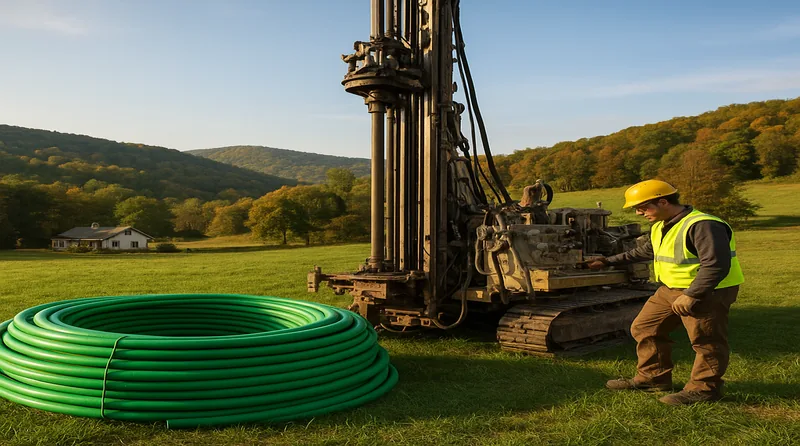
West Virginia sits on the Appalachian Plateau, underlain by limestone, shale, and sandstone. This hard-rock geology means vertical closed-loop systems dominate — most WV sites encounter bedrock within the first 50 feet of drilling. Vertical bores run 150–300 feet per ton; a typical 3-ton system needs 3–4 boreholes totaling 450–900 bore-feet.
Rural WV homeowners with larger parcels (half an acre or more of open land) may be candidates for horizontal loop systems — less expensive per installed foot but requiring more land. Valley-bottom farm areas in particular often have sufficient flat, open land for horizontal trenching.
Open-loop systems — which draw groundwater directly through the heat pump — are possible where well water quality and quantity support it, but water quality in some WV counties has been affected by historic coal mining activity. Always test your well water before considering open-loop. For most WV sites, closed-loop is the simpler, lower-risk choice.
Cost and ROI: Three Scenarios
System Costs
A typical 3-ton vertical closed-loop system in West Virginia runs $16,000–$26,000 installed. Hard-rock Appalachian drilling adds cost compared to soft-soil states, but WV's lower labor costs partially offset this. After the 30% federal tax credit (Section 25D), net cost is roughly $11,200–$18,200.
Scenario 1: Replacing Electric Baseboard or Resistance Heat — Best Case
This is where WV geothermal makes the strongest argument of any fuel comparison. Electric resistance heat is 100% efficient by definition — every unit of electricity becomes one unit of heat. A geothermal heat pump at COP 3.8 produces 3.8 units of heat per unit of electricity. The gap is enormous.
- Annual electric baseboard heating cost (2,000 sq ft WV home): ~$2,000–$3,000/year
- Geothermal equivalent: ~$525–$790/year electricity (COP 3.8, at 11.05¢/kWh)
- Annual heating savings: ~$1,475–$2,210/year
- Cooling savings vs. window AC or no AC: ~$150–$300/year (geothermal adds central cooling most electric-baseboard homes don't have)
- Total annual savings: ~$1,625–$2,510/year
- Payback (net ~$14,700 after credit): ~4–6 years
A 4–6 year payback on a 25-year system with a 50-year ground loop is an exceptional investment. Homes currently heating with electric baseboard are the strongest geothermal candidates in West Virginia — and there are a lot of them.
Scenario 2: Replacing Propane — Strong Case
- Annual propane heating cost: ~700 gallons × $3.00/gal = ~$2,100/year
- Geothermal operating cost: ~$525–$600/year electricity
- Annual heating savings: ~$1,500–$1,575/year + cooling savings ~$150–$250
- Total annual savings: ~$1,650–$1,825/year
- Payback (net ~$14,700): ~7–9 years
Southern WV's coalfield counties — McDowell, Mingo, Logan, Wyoming, Wayne — are heavily propane-dependent, with limited natural gas infrastructure. Propane is expensive, and rural WV propane users face the same supply volatility as rural homeowners across Appalachia. Geothermal converts that vulnerability into a fixed infrastructure cost. The case is solid.
Scenario 3: Replacing Natural Gas — Honest Assessment
- Annual gas heating cost: ~600 therms × $1.20/therm = ~$720/year
- Geothermal operating cost: ~$525–$600/year electricity
- Annual heating savings: ~$120–$195/year + cooling ~$150–$250
- Total annual savings: ~$270–$445/year
- Payback (net ~$14,700): ~25–33 years
Natural gas in urban WV is affordable. The payback for replacing gas with geothermal is long, and we won't pretend otherwise. This scenario makes financial sense only at system replacement time (comparing geo to full HVAC replacement cost, not just operating savings), new construction, or for homeowners with long time horizons and strong preferences for energy independence.
Incentives: Federal Yes, State No
Federal Tax Credit — 30%, Confirmed
The Residential Clean Energy Credit (Section 25D) covers 30% of the full installed cost of a ground-source heat pump system — equipment, labor, drilling, all of it. Runs at 30% through 2032. It's a tax credit, not a deduction. On a $20,000 installation, that's $6,000 directly off your federal tax bill.
One WV-specific note: the credit is nonrefundable, meaning it can only reduce your federal tax liability to zero — it won't generate a refund check. Lower-income WV homeowners who owe less in federal taxes may not be able to use the full credit in a single year. Unused credit does carry forward to subsequent tax years, so it's not lost — it just takes longer to collect. See our federal tax credit guide for carry-forward mechanics and documentation requirements.
West Virginia Has No State Geothermal Incentive
This is one of the more straightforward answers in any state guide: as of 2026, West Virginia has no state income tax credit, rebate program, or specific incentive for residential geothermal heat pump installations. The state has historically been among the least active in the country on clean energy policy.
The federal 30% credit is your primary incentive. Plan around that.
Utility Programs — [NEEDS VERIFICATION]
WV's major electric utilities have some efficiency programs, though ground-source heat pump eligibility requires verification before you count on it:
- Appalachian Power (AEP WV, serving most of southern and eastern WV): Has energy efficiency programs — verify whether GSHP qualifies at appalachianpower.com/savings or call 1-800-956-4237.
- Mon Power (FirstEnergy, serving northern WV including Morgantown): Verify current rebate programs at monpower.com or call 1-800-686-0022.
Do not rely on these programs in your financial planning until you have confirmed current availability and amounts with your utility directly.
Financing Options
WV homeowners have access to standard financing paths: HELOC (if you have home equity), personal loans, and manufacturer financing. USDA Rural Energy for America Program (REAP) loans are available for agricultural properties in rural WV. For a full breakdown, see our geothermal financing guide.
The Coal Grid Reality
This section deserves its own heading because it comes up, and the honest answer matters.
West Virginia's electric grid generates approximately 1,912 pounds of CO₂ per megawatt-hour — ranked first in the United States for grid carbon intensity. Nearly all of WV's electricity comes from coal. This is relevant if you're considering geothermal partly for environmental reasons.
The honest picture:
- If you're replacing propane or heating oil: Geothermal dramatically reduces your carbon footprint even on WV's coal grid. You're replacing direct combustion of fossil fuels with electricity that — despite coal — requires far less total fuel per unit of heat delivered thanks to the heat pump's efficiency multiplier.
- If you're replacing electric resistance heat: You're still on coal, but using 75% less of it. Net carbon per heating season drops substantially.
- If you're replacing natural gas: The carbon math is more nuanced and depends on the specific emissions intensity of your utility and your local gas supply. It's not a clear win on carbon for natural gas homes in WV.
The primary case for geothermal in West Virginia is economic, not environmental. The energy cost savings are real and substantial. The carbon story is mixed depending on your starting fuel. We'd rather be straight about it than oversell.
Marcellus Shale: What You Actually Need to Know
Northern West Virginia — Wetzel, Tyler, Doddridge, Ritchie, Roane counties — sits in active Marcellus Shale gas territory. WV residents in these areas sometimes wonder whether geothermal drilling will interact with gas wells or subsurface infrastructure.
The short answer: no, there is no direct conflict. Marcellus Shale in WV sits at approximately 5,000–8,500 feet of depth. Geothermal ground loops for residential systems go 150–400 feet deep. There is no physical overlap.
The nuance worth knowing: in areas with active gas drilling, your installer should review any available subsurface geology reports for your specific parcel. Some Appalachian areas have encountered natural gas migration at shallower depths (Devonian shale gas at 1,000–2,500 feet) — not a typical concern for GHP depths, but worth asking about if you're in a heavily drilled area. Your IGSHPA-certified installer will be familiar with these considerations.
Geothermal and Manufactured Homes
West Virginia has one of the highest manufactured home rates in the United States — approximately 20% or more of the housing stock. This comes up because manufactured homes are often where electric baseboard heat is most concentrated, and also because homeowners sometimes assume geothermal doesn't work in a manufactured home.
It can work, but it requires some attention:
- Ductwork compatibility: Many manufactured homes have ductwork sized for the high supply-air temperatures of electric furnaces or heat strips. Geothermal systems deliver lower supply-air temperatures. You may need duct modifications or a system designed specifically for lower-temperature delivery.
- Electrical service: A geothermal system typically requires 200-amp electrical service. Older manufactured homes may have 100-amp or even 60-amp panels that need upgrading.
- Duct sealing: Manufactured home ductwork frequently leaks — duct sealing before installing a geothermal system will meaningfully improve performance and is worth doing regardless.
- ROI context: Given that electric-baseboard manufactured homes have the highest heating costs and the best geothermal payback, the investment can still make sense even after factoring in panel and duct upgrades. Get a full assessment from your installer.
Permitting in West Virginia
WV Licensed Well Driller Requirement
Vertical ground loop borehole drilling in West Virginia requires a licensed well driller under WV Code Chapter 22, Article 9. Your geothermal installer either holds this license or works with a licensed driller. Confirm this before signing any contract.
Open-Loop Groundwater Regulations
If you're considering an open-loop system (drawing from a water well), the WV Department of Environmental Protection's Office of Water Resources regulates groundwater use and discharge. Open-loop systems that return water to the aquifer via a return well or discharge to a stream require DEP review. In areas with historic coal mining — which includes much of southern and central WV — water quality concerns may make open-loop impractical. Closed-loop is the lower-risk default for most WV sites.
Local Building Permits
Mechanical and electrical permits are required from your county or municipality. WV's county-level government structure means permit office familiarity varies. Budget $200–$500 for local permits depending on jurisdiction.
Finding a Qualified WV Installer
West Virginia's geothermal contractor market is thinner than neighboring mid-Atlantic states. Start with the IGSHPA certified contractor directory — IGSHPA certification is your baseline qualification check. You may find that certified contractors operate out of Charleston, Morgantown, or even bordering Virginia and Pennsylvania markets and travel into WV.
Key questions for WV-specific situations:
- Do you hold a WV licensed well driller certification, or do you work with a licensed driller?
- Have you done installations in this county's geology before? What rock formations did you encounter?
- For older homes: Can you assess whether my ductwork is compatible with geothermal supply-air temperatures?
- For manufactured homes: Have you installed geo in a manufactured home before?
Get at least two quotes — in thinner markets, price competition is limited, but comparing approaches will tell you a lot about installer knowledge. See our installation cost guide for regional benchmarks.
Bottom Line: Who Should Consider Geothermal in West Virginia
Strong candidates:
- Homes heating with electric baseboard or resistance heat — 4–6 year payback, strongest ROI case in the state
- Propane-heated rural homes (southern WV, coalfield counties) — 7–9 year payback, good long-term investment
- New construction — system designed in from the start, avoids retrofit premium
- Agricultural properties with large lots in rural WV
Think carefully:
- Natural gas homes in Charleston, Morgantown, Huntington — 25-33 year payback; only makes sense at system replacement or new construction
- Manufactured homes — possible but requires ductwork and electrical assessment first
- Properties in coal-mining areas considering open-loop — test water quality first, closed-loop may be safer
West Virginia doesn't have the incentive stack of some neighboring states, but the federal 30% credit is real money, and the electric-baseboard-to-geothermal conversion is one of the strongest ROI cases in residential energy efficiency anywhere in the country. If your WV home is on electric heat, it's worth a site assessment.
For neighboring state comparisons, see our Virginia geothermal guide, Pennsylvania guide, Kentucky guide, and Ohio guide — Ohio's SE Appalachian counties (Athens, Hocking, Vinton, Meigs) share WV's propane-belt economics and vertical-loop geology. For the propane analysis, see our geothermal vs. propane comparison. And for the full federal incentive picture, see our federal tax credit guide.
Sources
- EIA — West Virginia Electricity Profile (11.05¢/kWh annual average, 2024; grid carbon intensity #1 in US)
- DOE EnergySaver — Geothermal Heat Pumps (75% heating electricity reduction vs. resistance heat)
- GeoExchange — Geothermal Basics (system specs, payback ranges)
- IRS — Residential Clean Energy Credit (Section 25D, 30% federal tax credit)
- WV DEP — Office of Water Resources (groundwater / open-loop regulations)
- IGSHPA — Find a Certified Geothermal Contractor
- NOAA — U.S. Climate Normals (WV heating degree days)